Ammon Nelson Law - Facebook Ammon Nelson Law - Twitter Ammon Nelson Law - YouTube Ammon Nelson Law - Instagram
  • About Us
  • Team
  • Contact Us
  • FAQs
  • En Español
Ammon Nelson Law

Ammon Nelson Law

Visit North Carolina Website

Call For A Consultation

801.337.4355
  • Family Law
    • Divorce
    • Child Custody
    • Child Support
    • Spousal Support
    • Special Needs Children
    • Father’s Rights
    • Visitation Rights
    • Grandparents Rights
  • Divorce
    • Annulment
    • How To File
    • No Fault Divorce
    • Uncontested Divorce
    • Contested Divorce
    • Irretrievable Breakdown & Divorce
    • Division of Intellectual Property
    • Divorce By Publication
    • Equitable Distribution
    • High-Asset Marital Estates
  • Child Custody
    • How to Get Full Custody
    • Joint Custody
    • Relocation & Custody
    • Interstate & International Custody and Recovery
  • Child Support
    • How to Obtain Child Support
  • Spousal Support
    • Pre and Post Nuptial Agreements
    • Post Judgement Enforcement Modification
    • Orders of Protection
  • Estate Planning and Probate
    • Social Security Disability
    • Estate Planning
    • Personal Injury
    • Probate
    • Guardianship and Conservatorship
  • Mediation

The Essential Guide to Alimony Law in Utah

Home » Archives for Ammon » Page 5

Why Understanding Alimony Law in Utah Matters for Your Financial Future

Alimony law in Utah provides financial support to spouses who need assistance maintaining their standard of living after divorce. Here’s what you need to know:

Key Points About Utah Alimony:

  • Eligibility – Either spouse can request alimony based on financial need, earning capacity, and ability to pay
  • Duration – Generally cannot exceed the length of the marriage (except in special circumstances)
  • Termination – Automatically ends upon remarriage or death of the recipient; cohabitation also terminates support
  • 2024 Reforms – New laws emphasize fairness, income equalization for long marriages, and consideration of stay-at-home parent contributions
  • Modification – Can be changed due to substantial changes like retirement, job loss, or health issues
  • Types – Includes temporary, rehabilitative, reimbursement, and durational support

Money questions in divorce can be tricky. And hard to change once the court signs a decree. Whether you’re the spouse seeking support or the one who may be ordered to pay, understanding how Utah courts determine alimony is essential for protecting your financial future.

Alimony—also called spousal support—is not automatically granted in every case. Utah courts have broad discretion to decide whether support is necessary and fair based on multiple factors including your standard of living during marriage, each spouse’s financial condition and earning capacity, the length of your marriage, and even marital fault in some situations.

The landscape of alimony in Utah changed significantly in 2024. New reforms introduced more structured criteria and clearer guidelines, particularly for marriages lasting 10 years or more where one spouse reduced their career to care for children. These changes affect both how alimony is initially determined and how it can be modified later.

At Ammon Nelson Law, PLLC, we’ve guided countless families in Northern Utah through complex divorce proceedings involving spousal support, ensuring fair outcomes under alimony law in Utah while protecting my clients’ rights and financial stability. We understand both the legal complexities and the emotional challenges families face during divorce.
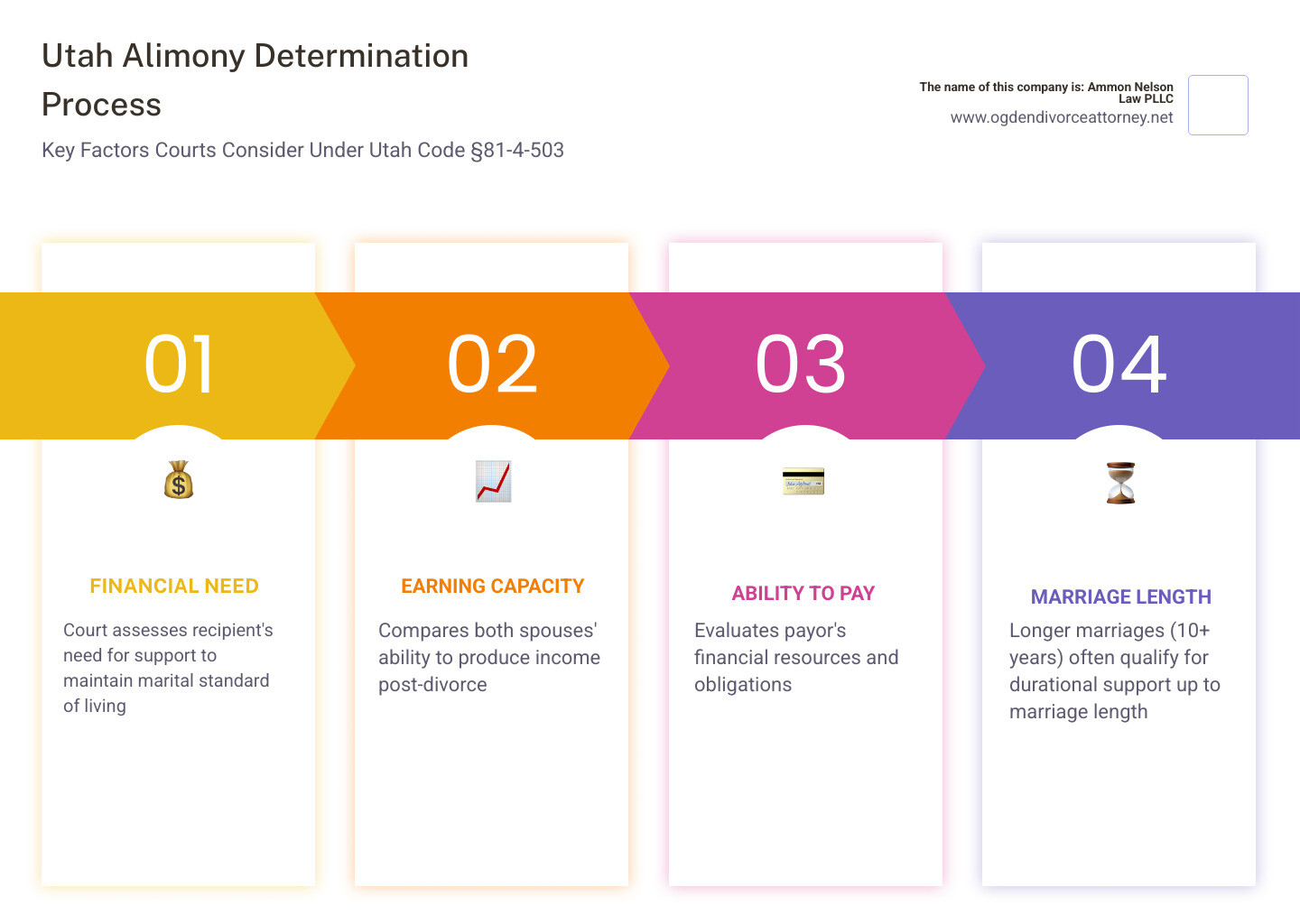
Infographic showing the Utah alimony determination process: eligibility factors, duration limits, types of support, 2024 reform highlights, modification triggers, and automatic termination conditions - alimony law in utah infographic pillar-4-steps

Understanding Alimony Law in Utah: Eligibility and Factors

In our practice at Ammon Nelson Law PLLC, we often see clients who are surprised to learn that alimony isn’t a “one-size-fits-all” calculation. Unlike child support, which follows a fairly rigid formula, alimony is highly discretionary. To understand if you or your spouse qualifies, we must look at the primary statutory factors.

Under Utah Code Title 81, Chapter 4, Part 5, the court evaluates several core elements:

  1. The financial condition and needs of the recipient spouse: Does the spouse asking for money actually need it to meet their reasonable monthly expenses?
  2. The recipient’s earning capacity: This includes their education, work history, and ability to produce income.
  3. The payor spouse’s ability to provide support: You can’t squeeze blood from a turnip; the court won’t order support that the other spouse simply cannot afford after meeting their own needs.
  4. The length of the marriage: This is a heavy hitter in determining both the amount and how long the checks will keep coming.
  5. Custody of minor children: Whether the recipient spouse has physical custody of children who require care that limits employment.

We also look at whether the recipient spouse worked in a business owned by the other spouse or contributed to the other spouse’s education (like working to put a partner through medical school). For a deeper dive into these basics, you can explore our overview of Spousal Support.

Legal documents and a gavel on a wooden desk - alimony law in utah

The Role of Marital Standard of Living

One of the most important concepts in alimony law in Utah is the “marital standard of living.” The court’s goal is generally to keep both parties as close as possible to the lifestyle they enjoyed while married.

Judges look at the lifestyle at the time of separation. If you were living in a luxury home in Salt Lake City and vacationing twice a year, the court will try to ensure the dependent spouse isn’t suddenly forced into a lifestyle that is vastly inferior. However, since two households are more expensive to run than one, “income equalization” often becomes the practical solution when there isn’t enough money to keep both people in the lap of luxury.

Factor Pre-2024 Reform Approach Post-2024 Reform (HB 220)
Standard of Living Broad judicial discretion. Specific factors added to define “standard.”
Look-back Period Vague or inconsistent. Required look-back for financial needs.
Income Equalization Common in long marriages. Mandatory rebuttable presumption for 10+ year marriages with childcare impact.
Income Imputation Often assumed full-time work. Limitations if there is a disability or no recent work history.

For more details on how these factors play out in real cases, check out Alimony in Utah: A Guide to Spousal Support.

How Fault Impacts Alimony Law in Utah

Utah is a “no-fault” divorce state, meaning you don’t have to prove your spouse did something wrong to get a divorce. However—and this is a big “however”—Utah is unique because the court can consider “fault” when deciding alimony.

Under Utah Code 81-4-503, “wrongful conduct” that substantially contributed to the breakup of the marriage can be used to increase, decrease, or even deny alimony. This includes:

  • Adultery: Engaging in sexual relations with someone other than your spouse.
  • Physical Harm: Intentionally causing or attempting to cause physical harm.
  • Fear of Harm: Causing a spouse or child to fear life-threatening harm.
  • Financial Undermining: Substantially undermining the financial stability of the other party.

It’s important to note that this isn’t meant to be a “punishment” in the criminal sense, but rather an equitable consideration. If a spouse’s bad behavior caused the financial rift, the judge has the discretion to let that influence the final number.

Determining the Amount and Duration of Support

When we sit down with clients in our Ogden or Salt Lake City offices, the first question is usually, “How much and for how long?” Because there is no set formula, we have to build a case based on your specific financial records.

The court typically looks at your monthly budget. If your reasonable needs are $4,000 a month and you can only earn $2,500, your “need” is $1,500. If your spouse has a surplus of $1,500 after their own expenses, that’s often where the alimony amount lands. This is part of the broader process of Equitable Distribution that we manage for our clients.

Types of Alimony Available Under Alimony Law in Utah

Not all alimony looks the same. Depending on your situation, the court might order:

  • Temporary Support (Alimony Pendente Lite): This is paid while the divorce is still moving through the courts to keep the bills paid.
  • Rehabilitative Alimony: This is short-term support intended to get a spouse back on their feet—perhaps while they finish a degree or a job training program.
  • Durational Alimony: This is the most common type, providing support for a set number of years.
  • Reimbursement Alimony: This might be awarded if one spouse supported the other through professional school, expecting to share in the future high earnings that are now being lost to divorce.

Understanding which type applies to you is a key part of The Divorce Process in Utah.

Statutory Limits on Duration

One of the firmest rules in alimony law in Utah involves the clock. Per Utah Code § 81-4-502(7), alimony cannot be ordered for a period longer than the length of the marriage.

If you were married for 12 years, the maximum alimony duration is 12 years. There are very rare “extenuating circumstances” that might allow a judge to go beyond this, but they are the exception, not the rule. It is also important to remember that the time you spend paying temporary alimony during the divorce process usually counts toward that total time limit. You can find more official guidance on this at the Alimony – Utah Courts page.

Recent 2024 Reforms and HB 220 Changes

The year 2024 brought significant updates to how we handle these cases. The 2024 HB 220 Divorce Amendments were designed to make alimony more predictable and fairer for modern families.

One of the biggest shifts involves income imputation. In the past, courts often assumed a stay-at-home parent could immediately go out and earn a full-time wage. The new law is more compassionate. It places restrictions on imputing income if a spouse has been out of the workforce for a long time due to childcare or has a diagnosed disability. The court now has to look at “reasonable barriers” to employment rather than just assuming everyone can work a 40-hour week at a certain rate.

Equalization in Long-Term Marriages

For those in long-term marriages (defined as 10 years or more), the 2024 reforms added a powerful tool. If a recipient spouse has “diminished workplace experience” because they stayed home to raise the couple’s children, there is now a rebuttable presumption that the court should equalize the parties’ standards of living.

This means the starting point for the judge is to try and make sure both spouses end up with a similar lifestyle, acknowledging that the stay-at-home parent’s contribution to the family allowed the other spouse to build their career. This is particularly relevant in High Asset Marital Estates where the income gap can be substantial.

Modification and Termination of Spousal Support

Life doesn’t stand still after a divorce decree is signed. Jobs are lost, people retire, and ex-spouses move in with new partners. Alimony law in Utah allows for modifications, but only if there is a “substantial material change in circumstances” that wasn’t anticipated in the original decree.

Common reasons for modification include:

  • Retirement: Utah law now explicitly states that a payor’s retirement is a substantial change that can lead to a reduction or termination of alimony.
  • Job Loss or Disability: If the person paying can no longer earn what they used to, the payment may need to drop.
  • Income Increase: If the person receiving alimony suddenly lands a high-paying executive job, the “need” for support might vanish.

The process involves filing a petition with the court. You can learn more about this in our guide on Post-Judgement Enforcement and Modification.

Terminating Alimony for Cohabitation or Remarriage

Alimony doesn’t always last until the end of the court-ordered duration. It terminates automatically if:

  1. The recipient spouse remarries.
  2. Either spouse dies.

However, the most contentious termination issue is cohabitation. If the person receiving alimony moves in with a new romantic partner, the payor can petition to stop the payments.

Under Utah Code Section 81-4-502, cohabitation means living together on a regular basis in a relationship of a romantic or sexual nature. It’s not just about having a roommate; it’s about a shared life that resembles a marriage. Pro-tip: You must file your motion to terminate within one year of when you knew (or should have known) about the cohabitation. If you wait too long, you might lose your right to stop the payments.

Frequently Asked Questions about Alimony in Utah

Are alimony payments taxable in Utah?

This is a point of major confusion. For any divorce finalized after December 31, 2018, federal tax laws changed significantly.

  • For the Payor: Alimony payments are not tax-deductible.
  • For the Recipient: Alimony received is not considered taxable income.

This was a massive shift from the old rules where the payor got a tax break and the recipient paid the bill. If your divorce was finalized before 2019, you might still be under the old “tax-deductible” rules, so always consult with a tax professional or our team to be sure.

Can spouses agree to waive alimony?

Absolutely. Many couples choose to resolve alimony through Pre and Post Nuptial Agreements or by negotiating a settlement during the divorce. You can agree to a “non-modifiable” waiver, meaning that no matter what happens in the future, neither party can ask for alimony. This provides a level of certainty that many of our Northern Utah clients appreciate.

What happens if alimony is not paid?

Alimony is a court order, not a suggestion. If a spouse stops paying, they can be found in contempt of court. This can lead to:

  • Income Withholding: The money is taken directly from their paycheck.
  • Judgments: A judge can issue a judgment for the total amount of past-due alimony (arrears), plus interest.
  • Legal Fees: The non-paying spouse may be ordered to pay the other spouse’s attorney fees.
  • Jail Time: In extreme cases of willful non-payment, a judge can order jail time.

Conclusion

Navigating alimony law in Utah is one of the most stressful parts of a divorce. Whether you are worried about how you will support yourself or concerned that your hard-earned income will be unfairly distributed, you don’t have to face these questions alone.

At Ammon Nelson Law PLLC, we pride ourselves on providing customized, results-driven representation. We understand the nuances of the 2024 reforms and how to build a compelling case for our clients in Ogden, Salt Lake City, and throughout Northern Utah. Our goal is to ensure that your final divorce decree is fair, sustainable, and protects your future.

If you have questions about your specific situation, we invite you to reach out. For more resources, visit our spousal support services page or contact us today to schedule a consultation. Let us help you find the clarity and stability you deserve.

Filed Under: Divorce Tagged With: alimony

Why Understanding Utah Sole Custody Cases is Critical for Your Family’s Future

Utah sole custody cases are among the most challenging family law matters to win. Here’s what you need to know right away:

Quick Facts About Utah Sole Custody:

  • Sole physical custody means your child lives with you at least 255 nights per year (70% or more of the time)
  • Sole legal custody means you alone make major decisions about your child’s medical care, education, and religious upbringing
  • Joint custody is presumed – Utah courts start with the assumption that joint legal custody serves children best
  • You must prove otherwise – To win sole custody, you need clear evidence that joint custody would harm your child
  • Key evidence includes domestic violence, substance abuse, neglect, parental unfitness, or geographic distance between parents

The end of a relationship is difficult, especially when children are involved. In Utah, you’re fighting against a legal system designed to keep both parents actively involved in a child’s life. The court won’t award sole custody just because you prefer it or because you and your ex don’t get along. You need compelling evidence that sole custody protects your child’s welfare.

This creates real challenges for parents who genuinely need sole custody to protect their children. The burden of proof falls on you to demonstrate why the standard joint custody arrangement won’t work. You’ll need to gather evidence, steer court procedures, attend mediation, and potentially go to trial – all while managing the emotional stress of protecting your child.

At Ammon Nelson Law, PLLC, we’ve guided countless families through Utah sole custody cases across Northern Utah, helping parents build strong cases that prioritize their children’s safety and wellbeing. My firm combines traditional legal expertise with modern technology to provide clear, effective representation when your family’s future is on the line.

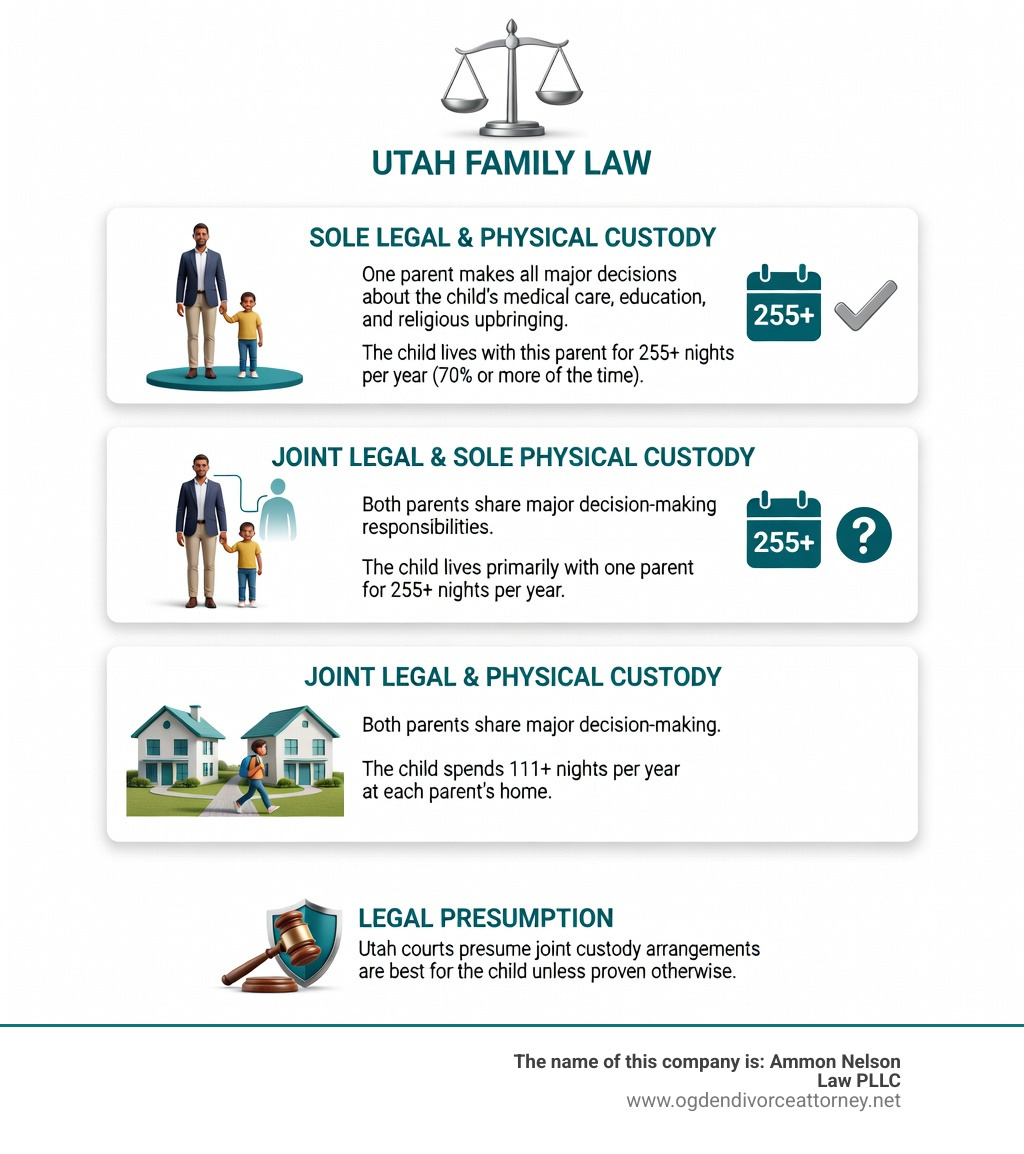
Infographic showing Utah custody types: Sole Legal and Physical Custody (one parent makes all major decisions and child lives with them 255+ nights/year), Joint Legal and Sole Physical Custody (both parents make decisions but child lives primarily with one parent 255+ nights/year), Joint Legal and Physical Custody (both parents make decisions and child lives at each home 111+ nights/year), and the legal presumption favoring joint custody arrangements - utah sole custody cases infographic

Understanding Sole Legal and Physical Custody in Utah

When we talk about Utah sole custody cases, we have to break the concept of “custody” into two distinct buckets: legal and physical. In Utah, these are treated separately, though they often overlap in sole custody awards.

parent and child in a safe home environment - utah sole custody cases

Legal Custody: The Power to Decide

Legal custody refers to the right and responsibility to make major life decisions for your child. This isn’t about what they eat for lunch; it’s about the big stuff. If you are awarded sole legal custody, you have the final say on:

  • Education: Which school they attend or if they are homeschooled.
  • Healthcare: Decisions regarding elective surgeries, vaccinations, and mental health therapy.
  • Religion: Which religious practices the child will be raised with.

Physical Custody: Where the Child Lives

Physical custody refers to the actual residence of the child. When a court awards sole physical custody, the child lives primarily with one parent. However, this doesn’t mean the other parent disappears (more on that later).

According to Utah Code Section 81-1-101, a “custodial parent” is defined based on where the child spends their nights. Understanding the difference between these types is vital, as explored in our guide on Divorce: Two Types of Custody.

Feature Sole Custody Joint Custody
Primary Residence One parent’s home (255+ nights) Both parents’ homes (at least 111 nights each)
Major Decisions One parent decides Parents must agree/consult
Parent-Time Usually scheduled for non-custodial parent Shared more equally
Legal Presumption Must be proven as “best interest” Default starting point for courts

Defining Sole Physical Custody in Utah Sole Custody Cases

In the eyes of Utah law, physical custody is a numbers game. To be considered the sole physical custodian, the child must reside with you for more than 70% of the year. Specifically, this means the child spends 255 nights or more at your home.

If the other parent has the child for 111 nights or more (roughly 30%), the state considers it “joint physical custody.” This distinction is critical because it impacts everything from child support calculations to the daily routine of the child. You can read more about these definitions on our Custody page.

Decision-Making Authority in Utah Sole Custody Cases

One of the most common reasons parents tell us, “I Want Sole Custody,” is because they cannot agree with the other parent on fundamental issues. If you have sole legal custody, you are the “tie-breaker” by default—actually, there is no tie to break because you hold the authority.

In many Utah sole custody cases, a judge might award “Joint Legal Custody” but give one parent “final decision-making authority” over specific areas, like education, if the parents are prone to deadlocking. However, true sole legal custody is usually reserved for cases where one parent is completely unavailable, incapacitated, or deemed unfit to participate in the child’s upbringing.

Why Winning Utah Sole Custody Cases is Challenging

If you walk into a courtroom in Ogden or Salt Lake City and simply say, “I’m the better parent,” you aren’t going to win sole custody. Utah law has a very strong “rebuttable presumption” that joint legal custody is in the best interest of the child.

The Rebuttable Presumption

A “rebuttable presumption” means the judge starts the case assuming that both parents should be involved in decision-making. It is your job to “rebut” or disprove that assumption with cold, hard evidence. The court’s primary concern is never the parent’s feelings; it is always the “best interest of the child.”

Utah Code Section 81-9-204 outlines the factors a judge must look at. These include the past conduct of the parents, their emotional stability, and their ability to put the child’s needs first. For a deeper dive, see our article on Understanding Child Custody Laws in Utah.

Overcoming the Preference for Joint Custody

To overcome this preference, we must show the court that joint custody is actually harmful or impossible. Common reasons a judge might move away from Joint Custody include:

  • Parental Unfitness: Issues like chronic substance abuse or untreated severe mental illness.
  • Geographic Distance: If one parent lives in Northern Utah and the other lives in Florida, joint physical custody (111 nights each) is logistically impossible once the child is school-aged.
  • Domestic Violence: This is a major factor that can immediately shift the court’s perspective on what is “safe” for the child.
  • Special Needs: If a child has profound medical or educational needs that require a level of stability and consistency that a two-home shuffle cannot provide.

Key Factors and Evidence for Awarding Sole Custody

Winning Utah sole custody cases requires a mountain of evidence. You cannot rely on hearsay or “he said, she said” arguments. The court needs documentation.

The “Big Three”: Abuse, Neglect, and Substance Abuse

The most straightforward (though tragic) way to secure sole custody is by proving the other parent is a danger to the child. Under Utah Code 81-9-104, the court must consider evidence of:

  1. Domestic Violence: Whether directed at the child, the other parent, or even another household member.
  2. Neglect: Failure to provide food, clothing, shelter, or medical care.
  3. Abuse: Physical, sexual, or emotional harm.

If these factors are present, the court may not only award sole custody but also order “supervised parent-time” to ensure the child is never left alone with the dangerous parent. We discuss these heavy topics further in our Custody Considerations guide.

Proving the Best Interest of the Child in Utah Sole Custody Cases

Beyond the “Big Three,” the court looks at the “Best Interest Factors.” This is a holistic view of the child’s life.

  • Stability: Who has been the primary caregiver? Who takes the child to doctor appointments and parent-teacher conferences?
  • Moral Conduct: While Utah courts don’t judge parents for having a new partner, they do care if that partner is a convicted felon or if the parent’s lifestyle exposes the child to harmful situations.
  • Child’s Desires: If the child is at least 14 years old, the judge will give their preference “added weight,” though it is not the deciding factor.
  • Financial Stability: While a parent’s wealth isn’t a reason to award custody, the ability to provide a stable, clean home is.

To learn more about building this part of your case, check out How to Get Full Custody. You may also want to review the official factors for custody evaluators used by the state.

The Legal Process of Seeking Sole Custody

Seeking sole custody isn’t just about showing up to court. It’s a structured, often lengthy legal journey.

Step 1: Filing the Petition

The process begins when we file a “Petition for Custody” (or a Petition for Divorce if you are married). This document tells the court exactly what you want and why. Along with the petition, a Domestic Relations Injunction is automatically issued. This order prevents either parent from doing anything drastic, like moving the kids out of state or canceling insurance, while the case is pending.

Step 2: Service of Process

The other parent must be “served”—formally given the papers. They then have 21 days (if they live in Utah) or 30 days (if they live elsewhere) to file an “Answer.” If they don’t respond, you might win by “default,” but that is rare in contested Utah sole custody cases.

Step 3: Mediation

Utah law requires parents to attempt mediation before going to trial. A neutral third party helps you try to reach an agreement. If you can agree on sole custody here, the process is much faster and cheaper. If not, the case moves toward trial.

Step 4: Temporary Orders

Because court cases take time, we often ask for a “Temporary Order.” This sets the rules for custody and child support right now while we wait for the final trial.

You can find many of the necessary Utah Court Forms online, but we highly recommend having an attorney review them to ensure you aren’t accidentally signing away your rights.

The Role of Custody Evaluations and Trials

If mediation fails, the judge needs more information. This is where a Custody Evaluation comes in.

Under Rule 4-903, the court can appoint a professional (usually a psychologist) to investigate your family. They will:

  • Interview both parents.
  • Observe the parents with the child.
  • Talk to “collateral contacts” like teachers and doctors.
  • Review medical and school records.

The evaluator then writes a report recommending who should have custody. While the judge doesn’t have to follow this report, they usually do. For more detail, read the official Information on Utah custody evaluations.

Rights of the Non-Custodial Parent and Order Modifications

Even if you win sole physical custody, the other parent usually retains “parent-time” (the legal term for visitation).

Parent-Time Schedules

In Utah sole custody cases, the non-custodial parent is typically entitled to a minimum schedule outlined in Utah Code Section 81-9-302. For children ages 5-18, this usually includes:

  • One weekday evening.
  • Alternating weekends.
  • Holidays and several weeks in the summer.

If the non-custodial parent is dangerous, we can fight for “supervised parent-time,” where a third party must be present during all visits.

Modifying an Existing Custody Decree

Life changes. A parent who was stable two years ago might struggle with addiction today. Or, a parent who was “unfit” may have completed rehab and turned their life around.

To change a custody order, you must prove:

  1. There has been a substantial and material change in circumstances.
  2. The modification is in the best interest of the child.

Moving to a new house in the same neighborhood isn’t a “substantial change.” Moving 200 miles away or a parent getting arrested is. You can find more on this in the Utah Courts Custody Guide.

Frequently Asked Questions about Utah Sole Custody Cases

Can a history of domestic violence guarantee sole custody?

While it is a massive factor, it is not an automatic “guarantee.” The court will look at how recent the violence was, whether it was directed at the child, and if the parent has sought treatment. However, Utah law takes this very seriously. If you are in immediate danger, please contact the National Domestic Violence Hotline or local Northern Utah law enforcement immediately.

How does a parent’s relocation affect sole custody?

Utah has a “150-mile rule.” If a parent plans to move more than 150 miles away, they must provide 60 days’ notice to the other parent and the court. This often triggers a review of the custody arrangement because the existing schedule will no longer work. The court will use the factors in Utah Code Section 81-9-207 to decide if the child should move with the relocating parent or stay with the other parent.

At what age can a child choose which parent to live with?

In Utah, a child never gets to make the final choice until they are 18. However, once a child turns 14, the judge is legally required to give their desires “added weight.” The judge will still look at why the child wants to live with a certain parent. If the child wants to live with Dad because Dad has no rules and lets them skip school, the judge will likely ignore that preference.

Conclusion: Partnering with Ammon Nelson Law PLLC

Navigating Utah sole custody cases is an emotional marathon. Whether you are in Ogden, Salt Lake City, or anywhere in Northern Utah, you don’t have to run it alone.

At Ammon Nelson Law PLLC, we provide customized, results-driven representation. We understand that every family is different, and we are dedicated to protecting the bonds that matter most. We don’t just fill out paperwork; we build a strategy designed to show the court exactly why your proposed arrangement is what’s best for your child.

If you are ready to take the next step in securing your child’s future, we are here to help. Contact an Ogden Divorce Attorney at our office today to schedule a consultation and begin building your case.

Filed Under: Custody Tagged With: attorney

Why Choosing the Right Path Matters When Your Marriage Ends

Uncontested divorce attorney Utah services help couples who agree on the terms of their separation steer the legal process efficiently and affordably. Here’s what you need to know:

Quick Answer: What Makes an Uncontested Divorce Different?

  • Both spouses agree on all major issues (property, debts, custody, support)
  • No courtroom battles – judge reviews and approves your agreement
  • 30-day minimum timeline after filing (vs. months or years for contested cases)
  • Significantly lower costs – flat fees typically range from $2,000.00 – $3,000.00
  • Attorney guidance ensures your agreement is legally sound and fair

You’ll still need to:

  1. Meet Utah’s residency requirement (3 months in your county)
  2. Complete mandatory classes if you have minor children ($65 per parent)
  3. File proper paperwork with the court ($310-$333 filing fee)
  4. Wait at least 30 days before the judge signs your decree

Once you and your spouse have made the decision to dissolve your marriage, you don’t want to deal with a lengthy and expensive legal process. An uncontested divorce offers a streamlined alternative – but even amicable splits require careful legal navigation to protect your rights and avoid costly mistakes down the road.

At Ammon Nelson Law, PLLC, we are uncontested divorce attorneys in Utah practicing in Northern Utah with experience serving families throughout the state. We’ve helped countless couples achieve fair, comprehensive settlements that hold up over time. Ammon Nelson Law, PLLC combines personalized attention with efficient processes to guide you through this transition with confidence.

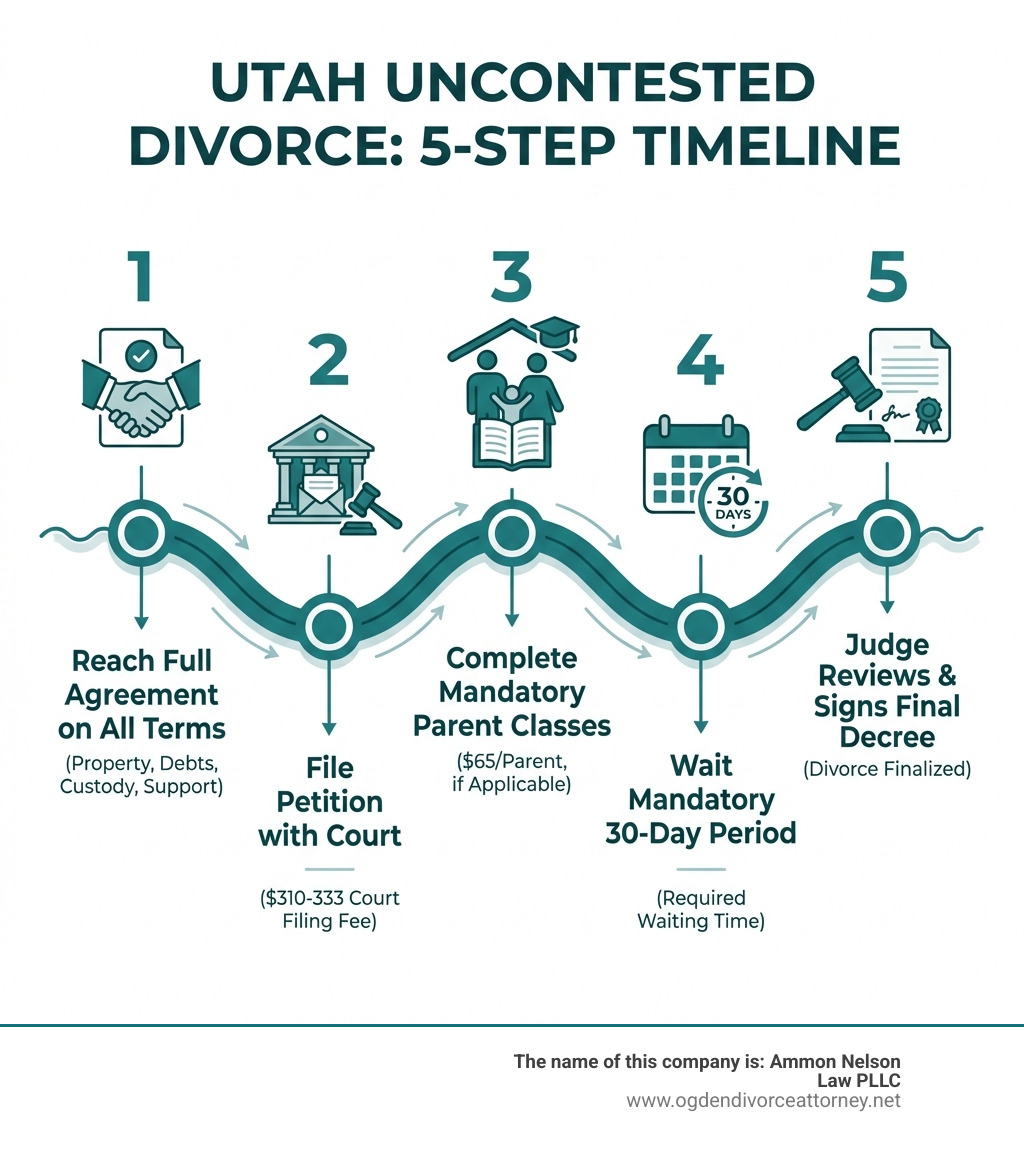
infographic showing 5-step timeline: 1) Reach full agreement on all terms, 2) File petition with court ($310-333 fee), 3) Complete mandatory parent classes if applicable ($65/parent), 4) Wait mandatory 30-day period, 5) Judge reviews and signs final decree - uncontested divorce attorney utah infographic

Understanding Uncontested Divorce and Its Primary Benefits

couple shaking hands after agreement - uncontested divorce attorney utah

When we talk about an uncontested divorce in Utah, we are referring to a situation where both spouses are in total agreement on every single aspect of their separation. This isn’t just about agreeing that it’s time to part ways; it’s about reaching a consensus on the “marriage bucket”—everything from who gets the family dog to how the 401(k) is split.

The primary benefit, and the reason many of our clients in Ogden and Salt Lake City seek out an uncontested divorce attorney Utah, is cost-effectiveness. A contested vs. uncontested divorce comparison reveals a massive gap in spending. While a contested battle can cost tens of thousands of dollars in billable hours, an uncontested filing often involves a predictable flat fee.

Beyond the wallet, there is the matter of emotional health. Litigation is inherently adversarial. It pits spouse against spouse, which can be devastating for families, especially those with children. Choosing an amicable path preserves a level of respect and cooperation that makes post-divorce life much easier. Furthermore, you gain privacy protection. While certain court orders remain public, the intimate details of your negotiations stay between you, your spouse, and your legal counsel. For more general information on the types of divorce available, you can visit the Official Utah Court Divorce Information.

Legal Requirements for an Uncontested Divorce Attorney in Utah

Before we can set sail toward your final decree, we must ensure you meet the legal “gatekeeping” requirements set by the state. Utah law is quite specific about who can file here and on what grounds.

Residency Rules

To file for divorce in a Utah District Court, at least one spouse must have lived in the state and the specific county where you are filing for at least three months immediately prior to filing the petition. If there are minor children involved, most courts prefer a residency of at least six months to establish jurisdiction over custody matters. We frequently assist clients in determining the best jurisdiction between our Ogden and Salt Lake City offices based on these residency milestones.

Grounds for Divorce

While Utah does allow for “fault” grounds (such as adultery or habitual drunkenness), the vast majority of uncontested cases are filed under “irreconcilable differences.” This is a no-fault ground, meaning you aren’t blaming your spouse for the breakdown of the marriage; you are simply stating that the marriage is no longer workable. This keeps the temperature low and helps maintain the “uncontested” status.

Requirement Couples Without Children Couples With Minor Children
Residency (County) 3 Months 3 Months
Residency (State) 3 Months 6 Months (preferred)
Mandatory Waiting Period 30 Days 30 Days
Mandatory Education None Orientation & Education Classes
Typical Filing Fee ~$333 ~$333

For a deeper dive into the logistics of starting your case, check out our guide on how to file.

The Step-by-Step Process to Finalize Your Agreement

The process for an uncontested divorce is designed to be streamlined, but it still follows a specific legal rhythm.

  1. Drafting and Filing the Petition: We prepare a Petition for Divorce that outlines all the terms you and your spouse have agreed upon. This includes property division, debt allocation, and child-related terms.
  2. Service of Process or Waiver: In a truly uncontested case, the “Respondent” (the other spouse) usually signs a “Appearance, Consent and Waiver” document. This tells the court they have seen the petition, agree with it, and don’t need to be formally “served” by a sheriff or process server.
  3. The 30-Day Waiting Period: Utah law imposes a mandatory 30-day waiting period from the date the petition is filed before a judge can sign the final decree. This was recently reduced from 90 days in 2018, making the process much faster than it used to be.
  4. Final Decree: Once the waiting period has passed and all requirements (like parent classes) are met, we submit the final Findings of Fact and Conclusions of Law and the Decree of Divorce to the judge for a signature.

You can learn more about the nuances of this timeline in our article on the divorce process in Utah. If the filing fees are a concern, the Utah Court Filing Fee and Waiver Information page provides details on how to request a fee reduction based on financial hardship.

Navigating the Role of an Uncontested Divorce Attorney in Utah

You might wonder, “If we agree on everything, why do we need an attorney?” It’s a fair question. The reality is that the court requires very specific language to ensure a decree is enforceable. We’ve seen many “DIY” divorces hit a snag because a pension wasn’t divided correctly or a parenting plan was too vague to follow.

Our role as your uncontested divorce attorney Utah is to act as the architect of your agreement. We draft the documents to ensure they comply with Utah law, protect your individual rights, and provide a “fairness review” to make sure you aren’t inadvertently signing away something vital. For more on why professional guidance is a safety net, visit our uncontested divorce service page.

Additional Requirements for Families with Minor Children

If you have kids, the state of Utah takes an extra interest in your case to ensure the children’s best interests are protected. Both parents must complete two specific classes:

  • Divorce Orientation: A one-hour session ($30).
  • Divorce Education: A two-hour session ($35).

These classes help parents understand the impact of divorce on children and how to co-parent effectively. You can find registration details at Mandatory Utah Divorce Education Classes. Additionally, child support must be calculated using the Official Utah Child Support Calculator. Even if you agree on a different amount, the judge needs to see the “guideline” calculation to approve your agreement.

Avoiding Common Pitfalls in Amicable Settlements

Even the most amicable divorces can hit rocky waters if you aren’t careful. One of the biggest mistakes we see is a lack of full financial disclosure. If one spouse finds later that the other hid a retirement account or a debt, the entire “uncontested” agreement can be set aside, leading to expensive litigation.

Another pitfall is “rushing to be done.” We understand the desire to move on, but signing a document you don’t fully understand can haunt you for years. This is especially true regarding asset valuation—knowing what that house or business is actually worth today is vital for a fair split. To understand what happens when things aren’t so simple, read about what you need to know about contested divorces.

Why You Need an Uncontested Divorce Attorney in Utah for Complex Assets

If your marriage involves more than just a rented apartment and a shared bank account, the complexity increases exponentially.

  • Retirement Accounts: Splitting a 401(k) or a pension often requires a Qualified Domestic Relations Order (QDRO). Without this specific legal document, you could face massive tax penalties or lose your right to the funds entirely.
  • Business Ownership: If one of you started a business during the marriage, it is likely marital property. We help determine if a buyout, a trade for other assets, or a structured sale is the best path forward.
  • Debt Allocation: Just because your divorce decree says your spouse pays the credit card doesn’t mean the credit card company cares. We help structure agreements that protect your credit score.

Preparation is key to handling these assets correctly. See our guide on preparing for divorce for more tips.

Frequently Asked Questions about Utah Uncontested Divorce

Can the mandatory 30-day waiting period be waived?

Yes, but it isn’t a “given.” You must file a Motion to Waive the Waiting Period and demonstrate “extraordinary circumstances.” This usually involves showing that waiting 30 days would cause significant emotional or financial hardship. Judges have high discretion here, so having an attorney draft this motion is highly recommended.

Are my divorce records public in Utah?

Since April 1, 2012, divorce records in Utah are classified as private. This means that only the parties involved and their attorneys can view the full case file. However, the final Decree of Divorce and any orders (like an order to waive the waiting period) are still public records. We take great care to ensure sensitive info like Social Security numbers and children’s birth dates are kept in protected, non-public documents.

Can I modify the agreement after the final decree is issued?

Yes, but the bar is high. You must show a “substantial and material change in circumstances” that was not contemplated at the time of the divorce. Common reasons include a significant change in income (up or down 30% or more), a parent needing to relocate out of state, or a change in the child’s needs. This requires filing a new Petition to Modify with the court.

Conclusion

Navigating an uncontested divorce doesn’t have to be a storm of paperwork and stress. By choosing the path of mutual agreement, you are already halfway to a smoother transition. However, ensuring that your agreement is durable, fair, and legally sound requires the steady hand of an experienced professional.

At Ammon Nelson Law PLLC, we provide customized, results-driven representation for clients across Northern Utah. Whether you are in Ogden, South Ogden, or Salt Lake City, our team is dedicated to helping you reach the finish line with your sanity and your assets intact. We treat our clients like family, offering clear answers and intelligent strategy every step of the way.

Ready to move forward? Contact an experienced Ogden Divorce Attorney today for a consultation, and let us help you find the “smooth sailing” resolution you deserve.

Filed Under: Divorce Tagged With: agreement

  • « Previous Page
  • 1
  • …
  • 3
  • 4
  • 5
  • 6
  • 7
  • …
  • 23
  • Next Page »

Ogden Location

1492 East Ridgeline Dr., Suite 3
South Ogden, UT 84405
Phone: 801.337.4355
Fax: 801.337.0737
Email: ammon@ammonnelsonlaw.com

Monday9:00 AM - 6:00 PM
Tuesday9:00 AM - 6:00 PM
Wednesday9:00 AM - 6:00 PM
Thursday9:00 AM - 6:00 PM
Friday9:00 AM - 6:00 PM
SaturdayAvailable for Emergencies
SundayClosed

Directions

Navigation

  • Family Law
  • Divorce
  • Child Custody
  • Child Support
  • Spousal Support

Follow Us

Ammon Nelson Law - Facebook Ammon Nelson Law - Twitter Ammon Nelson Law - YouTube Ammon Nelson Law - Instagram

2022 Ammon Nelson Law | All Rights Reserved | Privacy Policy | Terms | XML Sitemap | Site by PDM