Why Having a Salt Lake City Estate Planning Lawyer Matters for Your Family’s Future
A Salt Lake City estate planning lawyer helps residents protect their assets, name guardians for minor children, avoid lengthy probate, and ensure their wishes are honored after death or incapacity.
Quick Answer: What Can a Salt Lake City Estate Planning Lawyer Do for You?
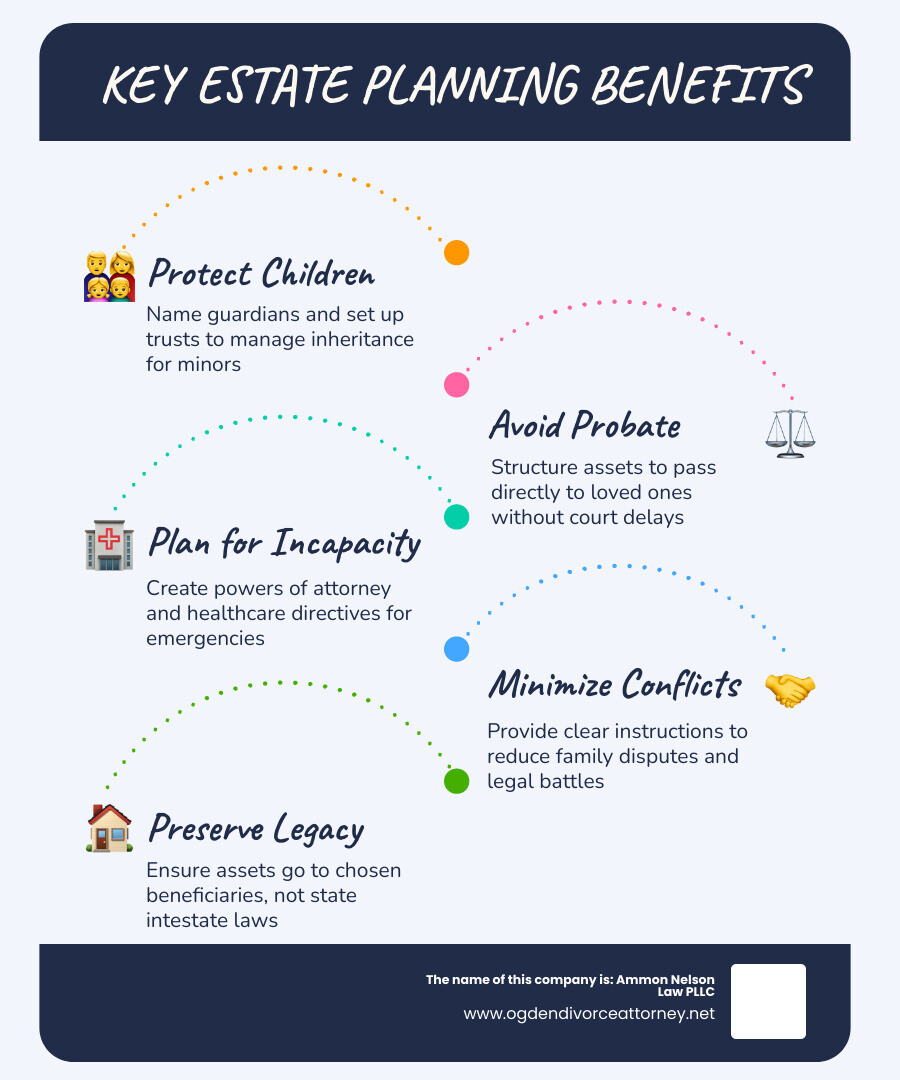
- Protect your children: Name guardians and set up trusts to manage their inheritance
- Avoid probate delays: Structure assets to pass directly to loved ones
- Plan for incapacity: Create powers of attorney and healthcare directives
- Minimize family conflict: Establish clear instructions that reduce disputes
- Preserve your legacy: Ensure assets go where you want, not where Utah law decides
Most people think estate planning is only for the wealthy. The truth is simpler and more urgent: if you have children, own property, or care about who inherits your belongings, you need an estate plan.
More than 60% of Americans don’t have a will. In Utah, dying without one means the state decides who gets your assets under intestate succession laws (Utah Code §75-2-101). Your minor children could end up with court-appointed guardians you’ve never met. Your spouse might have to share your estate with other relatives. Your family could face months of probate proceedings and thousands of dollars in unnecessary legal fees.
Estate planning isn’t about death—it’s about protecting what you value most while you’re still here. It’s about making sure your children are cared for by people you trust. It’s about giving your spouse clear authority to manage finances if you’re hospitalized. It’s about leaving instructions that spare your family from guessing what you would have wanted.
I’m Ammon Nelson, and I’ve helped countless Northern Utah families create estate plans that protect their children and preserve their legacies. As a Salt Lake City estate planning lawyer serving families throughout the region, I understand the unique concerns of parents navigating divorce, custody issues, and family transitions who need to ensure their children’s future is secure no matter what happens.
The Role of a Salt Lake City Estate Planning Lawyer in Protecting Your Legacy
When we talk about a “legacy,” we aren’t just talking about millions of dollars in a bank account. We are talking about your home, your family heirlooms, your business, and most importantly, your values. A Salt Lake City estate planning lawyer acts as the architect of your future, helping you build a framework that protects these assets from unnecessary taxes, creditors, and legal battles.

In Utah, the law provides a “default” plan for those who don’t create their own. This is known as intestate succession under Utah Code §75-2-101. If you pass away without a will, the state uses a rigid formula to distribute your property. While this might seem fine on the surface, it rarely accounts for the nuances of modern families—especially blended families or those with specific needs.
For example, if you are in the middle of a divorce or have recently remarried, the state’s default distribution might leave assets to an ex-spouse or fail to provide for children from a previous relationship. By working with us, you can engage in personalized planning that ensures your assets go exactly where you want them to.
Beyond just distribution, we focus on:
- Asset Protection: Keeping your hard-earned property safe from potential lawsuits or creditors.
- Incapacity Planning: Ensuring that if you are ever unable to make decisions for yourself due to illness or injury, someone you trust has the legal authority to step in.
- Tax Efficiency: Minimizing the “bite” that taxes might take out of your estate, preserving more for your heirs.
More info about estate planning services
Essential Components of a Utah Estate Plan: Wills, Trusts, and Powers of Attorney
A comprehensive estate plan is more than just a single piece of paper; it is a toolkit of legal instruments designed to handle different scenarios.
1. The Last Will and Testament
Think of a will as the foundation of your plan. It allows you to:
- Appoint a personal representative (executor) to manage your affairs.
- Name legal guardians for your minor children—this is perhaps the most critical step for parents in Salt Lake City.
- Specify who receives specific items of personal property.
2. Revocable Living Trusts
While a will is essential, it usually must go through probate court. A Revocable Living Trust is a powerful alternative that allows your assets to pass to your beneficiaries without court intervention. You remain in control of the assets during your lifetime and can change the trust at any time. It is a misconception that these are only for the “one percent.” In reality, trusts are for everyone, not just the wealthy, as they save your family the time and expense of the probate process.
3. Powers of Attorney (Financial and Medical)
What happens if you are alive but cannot speak for yourself?
- Financial Power of Attorney: This document names an agent to manage your bank accounts, pay your mortgage, and handle business affairs if you become incapacitated.
- Advance Health Care Directive: This combines a living will and a medical power of attorney. It tells doctors what kind of life-sustaining treatment you want and names someone to make medical decisions on your behalf.
How a Salt Lake City Estate Planning Lawyer Simplifies Probate
If a loved one has already passed away, you might find yourself facing the Utah Uniform Probate Code. Probate is the court-supervised process of validating a will, paying off debts, and distributing what remains. It can be a “legal weed” patch that is difficult to navigate alone.
A Salt Lake City estate planning lawyer simplifies this by:
- Executor Guidance: We help the person in charge understand their fiduciary duties so they don’t accidentally break the law or incur personal liability.
- Debt Settlement: Ensuring creditors are paid in the correct order of priority.
- Dispute Resolution: If siblings are fighting over a family home or a specific inheritance, we provide the legal mediation or litigation support needed to reach a resolution.
More info about probate services
Specialized Planning: Elder Law, Medicaid, and Special Needs Trusts
As we age, our legal needs shift from “what happens when I’m gone” to “how do I afford the care I need now?” This is where elder law and specialized planning become vital for Salt Lake City residents.
Medicaid Planning
Long-term care in Utah can be incredibly expensive. Many families fear that a few years in a nursing home will wipe out an entire lifetime of savings. We assist with Medicaid planning strategies that help you qualify for assistance while legally preserving assets for your spouse or children.
Special Needs Trusts
If you have a child or family member with a disability, leaving them a direct inheritance could be a disaster. It might disqualify them from essential government benefits like SSI or Medicaid. A Special Needs Trust (or Supplemental Needs Trust) allows you to provide for their quality of life—buying them clothes, electronics, or specialized therapy—without jeopardizing their basic benefits.
Guardianship and Conservatorship
Sometimes, an adult loved one loses the capacity to care for themselves, and they haven’t signed powers of attorney. In these cases, we help families petition the court for Guardianship (to make personal/medical decisions) or Conservatorship (to manage money). This is a complex legal process that requires expert guidance to ensure the protected person’s rights are respected while they receive the care they need.
More info about guardianship and conservatorship
Choosing the Right Salt Lake City Estate Planning Lawyer for Your Family
Choosing a lawyer isn’t just about finding someone who can draft a document; it’s about finding a partner who understands your family dynamics. At Ammon Nelson Law PLLC, we pride ourselves on a customized, results-driven approach.
| Feature | Last Will & Testament | Revocable Living Trust |
|---|---|---|
| Probate Required? | Yes | No |
| Privacy | Public Record | Private |
| Cost | Lower Upfront | Higher Upfront |
| Ease of Use | Simple to Create | Requires Asset Retitling |
| Protection | Basic | Advanced |
When looking for a Salt Lake City estate planning lawyer, consider these factors:
- Experience: Look for a firm with decades of combined experience in Utah law.
- Billing Practices: Many of our clients appreciate flat-fee billing for standard estate plans, so there are no surprises when the bill arrives.
- Communication: You want a lawyer who listens more than they talk. Your plan should reflect your values, not a template.
If you want to compare top rated Utah attorneys, you will see that the best ones are those who prioritize the client relationship over the transaction.
What to Expect When Meeting Your Salt Lake City Estate Planning Lawyer
If you’ve never met with an attorney before, the process can feel intimidating. We try to keep it as warm and simple as possible.
- Initial Consultation: We sit down (or meet virtually) to discuss your family, your assets, and your goals. We’ll ask “what if” questions you might not have considered.
- Document Review: Once we draft your plan, we’ll go through it together to ensure every name is spelled correctly and every wish is accurately captured.
- The Signing Meeting: This is the formal part. We ensure all documents are signed, witnessed, and notarized according to Utah law.
- Asset Retitling: A trust is like a safe; it only works if you put your valuables inside. We help you understand how to move your home or accounts into the trust’s name.
- Periodic Updates: Life changes. We recommend a review every 3 to 5 years.
Frequently Asked Questions about Estate Planning in Utah
Do I need a will if I don’t have a large estate?
Absolutely. Even if you only own a car and a modest bank account, a will ensures those items go to the person of your choosing. More importantly, if you have minor children, a will is the only place you can legally nominate a guardian. Without it, a judge—who doesn’t know your family—will decide who raises your kids.
How often should I update my estate plan?
We generally suggest a “check-up” every few years. However, major life events should trigger an immediate update, including:
- Marriage or divorce (especially important in Utah!)
- The birth or adoption of a child
- Purchasing a new home or starting a business
- A significant change in tax laws
What happens if I die without a will in Salt Lake City?
As mentioned, you fall under Utah’s “intestate” laws. This often leads to family disputes. For example, if you are remarried, your current spouse and your children from a previous marriage might end up in a legal tug-of-war over your house. A Salt Lake City estate planning lawyer prevents this “state-mandated distribution” from causing unnecessary pain for your survivors.
Conclusion
Estate planning is one of the greatest gifts you can give your family. It provides a roadmap during their most difficult moments, ensuring that your love and protection continue even when you aren’t there to provide them personally.
At Ammon Nelson Law PLLC, we are committed to providing customized, results-driven representation for families in Salt Lake City, Ogden, and throughout Northern Utah. Whether you need a simple will, a complex trust, or help navigating the probate of a loved one’s estate, we are here to help.
Don’t leave your family’s future to chance or the “default” settings of the state. Start your estate plan today and gain the peace of mind that comes with knowing your legacy is secure.