Ammon Nelson Law - Facebook Ammon Nelson Law - Twitter Ammon Nelson Law - YouTube Ammon Nelson Law - Instagram
  • About Us
  • Team
  • Contact Us
  • FAQs
  • En Español
Ammon Nelson Law

Ammon Nelson Law

Visit North Carolina Website

Call For A Consultation

801.337.4355
  • Family Law
    • Divorce
    • Child Custody
    • Child Support
    • Spousal Support
    • Special Needs Children
    • Father’s Rights
    • Visitation Rights
    • Grandparents Rights
  • Divorce
    • Annulment
    • How To File
    • No Fault Divorce
    • Uncontested Divorce
    • Contested Divorce
    • Irretrievable Breakdown & Divorce
    • Division of Intellectual Property
    • Divorce By Publication
    • Equitable Distribution
    • High-Asset Marital Estates
  • Child Custody
    • How to Get Full Custody
    • Joint Custody
    • Relocation & Custody
    • Interstate & International Custody and Recovery
  • Child Support
    • How to Obtain Child Support
  • Spousal Support
    • Pre and Post Nuptial Agreements
    • Post Judgement Enforcement Modification
    • Orders of Protection
  • Estate Planning and Probate
    • Social Security Disability
    • Estate Planning
    • Personal Injury
    • Probate
    • Guardianship and Conservatorship
  • Mediation

The Ultimate Utah Child Support Schedule and Calculation Guide

Home » alimony

What the Utah Child Support Worksheet Actually Tells You (And How to Use It)

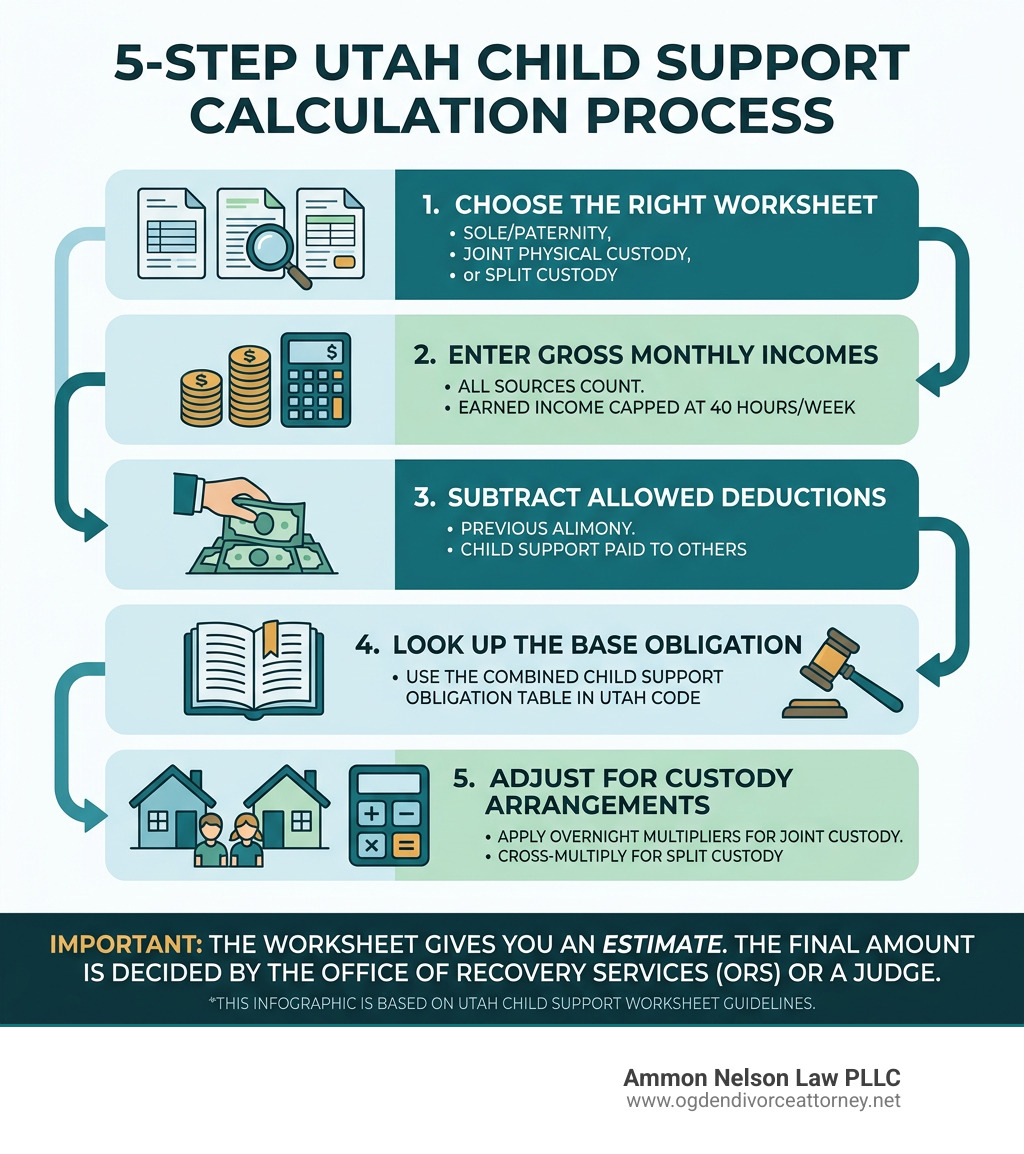
The Utah child support worksheet is the official form Utah courts use to calculate how much one parent pays the other for child support. Here is a quick overview of how it works:

The 5 steps to calculate Utah child support:

  1. Choose the right worksheet – Sole/Paternity, Joint Physical Custody, or Split Custody
  2. Enter each parent’s gross monthly income – all sources count, earned income capped at 40 hours/week
  3. Subtract allowed deductions – previously ordered alimony and child support paid to others
  4. Look up the base obligation – use the Combined Child Support Obligation Table in Utah Code
  5. Adjust for custody – apply overnight multipliers for joint custody or cross-multiply for split custody

Important: The worksheet gives you an estimate. The final amount is decided by the Office of Recovery Services (ORS) or a judge.

Figuring out child support during a divorce or custody dispute is stressful – especially when you are not sure which form to use, how to report your income, or what adjustments apply to your situation. Getting the numbers wrong can cost you thousands of dollars over the life of an order.

I’m Ammon Nelson, a Utah family law attorney with years of experience helping parents across Northern Utah navigate the Utah child support worksheet process and fight for fair outcomes. Let me walk you through exactly how this works.

5-step Utah child support calculation process infographic - utah child support worksheet infographic

Understanding the Different Types of Utah Child Support Worksheets

When we sit down with clients in our Ogden or Salt Lake City offices, the first thing we have to do is identify which Utah child support worksheet fits their family structure. Using the wrong form is like trying to fit a square peg in a round hole—the math simply won’t work for your legal case.

Utah provides three primary worksheets based on physical custody arrangements. If you aren’t sure where to start, you can Calculate Child Support using the state’s online estimator, but you will still need to file the specific paper version with the court. For a deeper dive into the legal nuances, check out our More info about child support page.

Choosing the Correct Utah Child Support Worksheet

  • Sole Physical Custody / Paternity: This is the most common worksheet. We use this when the children live with one parent most of the time, and the other parent has “parent-time” (visitation) for fewer than 111 overnights per year.
  • Joint Physical Custody: To qualify for this worksheet, each parent must have at least 111 overnights with the children annually. The math here is more favorable to the “obligor” (the payer) because it accounts for the costs the second parent incurs while the children are in their home.
  • Split Custody: This is a rarer scenario where, for example, one child lives primarily with the Mother and another child lives primarily with the Father. This requires a complex cross-multiplication of support obligations.

Statutory Tables and Utah Code References

The numbers you plug into a Utah child support worksheet don’t come out of thin air. They are governed by the Utah Child Support Act. One of the biggest points of confusion we see involves which table to use.

As of early 2023, Utah updated its support tables. If you are modifying a final order that was entered for the first time prior to January 1, 2023, you may still be looking at Utah Code 81-6-302. However, for most new cases or recent modifications, we use the updated tables found in Utah Code 81-6-304. These tables set the “Base Combined Child Support Obligation” based on the parents’ combined income and the number of children. You can read the specific language regarding income in Utah Code 81-6-203.

Official Utah court forms for child support - utah child support worksheet

How to Calculate Income for the Utah Child Support Worksheet

The “engine” of any child support calculation is income. In Utah, we use “Gross Monthly Income,” which is your income before taxes are taken out. This can be tricky if you are self-employed or have multiple income streams. If you’re feeling overwhelmed, we have a guide on How to obtain child support that breaks down the initial steps.

Defining Gross Monthly Income

Utah law defines gross income very broadly. It includes prospective income from almost any source:

  • Salaries and wages
  • Commissions, royalties, and bonuses
  • Social Security benefits (non-means-tested)
  • Pensions and annuities
  • Alimony received from a previous marriage
  • Dividends and interest

However, there is a very important “40-hour limit.” Per 45 C.F.R. 302.56 Guidelines, income from earned sources is generally limited to the equivalent of one full-time, 40-hour work week. If you work 60 hours a week to make ends meet, the court usually won’t punish you by including those extra 20 hours in the calculation for an initial order.

Imputing Income for Unemployed or Underemployed Parents

What happens if a parent refuses to work or takes a lower-paying job to avoid support? The court can “impute” income. This means the judge treats that parent as if they are earning what they could be earning based on their work history and qualifications.

If a parent has no recent work history, the default is often the federal minimum wage. In Utah, $7.25 per hour equates to a gross monthly income of $1,260 for a 40-hour week. We also look at incarceration; under Utah law, if a parent is incarcerated for at least six months, it is generally not considered “voluntary unemployment.”

Adjusting the Utah Child Support Worksheet for Custody and Deductions

Once we have the gross income, we don’t just jump to the table. We have to calculate the “Adjusted Gross Income.” This is where we subtract “credits” for other obligations. For a quick refresher, see our post on Three things you must know about child support.

Joint Physical Custody and Overnight Adjustments

In a joint custody Utah child support worksheet, the number of overnights is everything.

  • 111 to 130 overnights: The parent with fewer overnights gets a small reduction. We multiply the number of nights over 110 by .0027, then multiply that by the combined support obligation.
  • 131+ overnights: The reduction gets steeper. We multiply the nights over 130 by .0084.

These multipliers ensure that as a parent spends more time (and money) physically caring for the child, their cash support obligation decreases.

Deductions and Credits for Other Children

You are allowed to subtract certain costs from your gross income:

  1. Previously Ordered Alimony: If you are actually paying alimony from a prior marriage.
  2. Previously Ordered Child Support: If you are paying support for children from a different relationship.
  3. Children in Present Home: This is an optional credit under Utah Code. If you have natural or adopted children living with you who are not part of this specific case, you can sometimes get a credit to ensure you can support them, too.
Custody Type Overnight Requirement Calculation Method
Sole Custody < 111 nights for one parent Standard Table Lookup
Joint Custody 111+ nights for both Multiplier Adjustments (.0027/.0084)
Split Custody Each parent has 1+ child Cross-Multiplication of Obligations

Navigating Deviations and Required Documentation

Sometimes, the standard math on the Utah child support worksheet just doesn’t produce a fair result. In these cases, we ask the court for a “deviation.” If you’re worried about how these orders are actually enforced, read our Ultimate guide to enforcement tools.

Valid Reasons for Guideline Deviations

The court has the discretion to change the amount if the guideline version is “unjust or inappropriate.” Common reasons include:

  • Property Settlements: If one parent took on more marital debt in exchange for lower support.
  • Extraordinary Travel Expenses: If one parent has to fly across the country for parent-time.
  • Special Needs: If a child has medical or educational needs not covered by the standard table.
  • Low Income: If a payer earns between $650 and $1,050, we use a special “Low Income Table” to ensure they can still afford to live.

Documentation Required for Verification

You cannot just “guess” your income. The court requires proof. We always tell our clients to gather:

  • The last 12 months of pay stubs.
  • The most recent year’s tax returns.
  • Employer statements if you just started a job.
  • Copies of previous court orders for alimony or other child support.
  • Verification of health insurance premiums and child care costs (these are shared 50/50 in addition to the base support).

Frequently Asked Questions about the Utah Child Support Worksheet

Are overtime pay and second jobs included in the calculation?

Generally, no. Utah policy (and ORS guidelines) typically focuses on a standard 40-hour work week for first-time orders. If you have always worked two jobs and that income is consistent, it might be included, but we often fight to keep that second job out of the calculation so you aren’t penalized for working extra hard. However, in a modification, if the original order included overtime, the new one likely will too.

What happens if my income is inconsistent or seasonal?

If you are a contractor, a salesperson on commission, or work seasonally (like in construction), we use “income averaging.” We typically look at a multi-year average or a year-to-date average to find a “fair” monthly number. This prevents a parent from paying too much during a slow month or too little during a boom month.

Where can I get help completing the worksheet?

The Office of Recovery Services (ORS) provides an online calculator, but their staff cannot give you legal advice or help you fill out the forms. You can work with a Licensed Paralegal Practitioner for basic forms, but if there are disputes about income or custody, a private attorney is your best bet to ensure the Utah child support worksheet is accurate.

Conclusion

Calculating child support isn’t just about plugging numbers into a box; it’s about ensuring your children are provided for while maintaining your own financial stability. Whether you are in Ogden, Salt Lake City, or anywhere in Northern Utah, the team at Ammon Nelson Law PLLC is here to help. We provide customized, results-driven representation to ensure your Utah child support worksheet reflects the reality of your life.

Don’t leave your financial future to chance or a glitchy online calculator. If you need to Calculate your Utah child support and want to make sure it’s done right the first time, reach out to us today. We’ll help you navigate the math so you can focus on what matters most—your family.

Filed Under: Child Support Tagged With: alimony

Why Alimony Utah Collaborative Law Is the Smarter Way to Handle Spousal Support

Alimony Utah collaborative law gives divorcing spouses a structured, out-of-court path to negotiate spousal support — without the stress, cost, and bitterness of a courtroom battle.

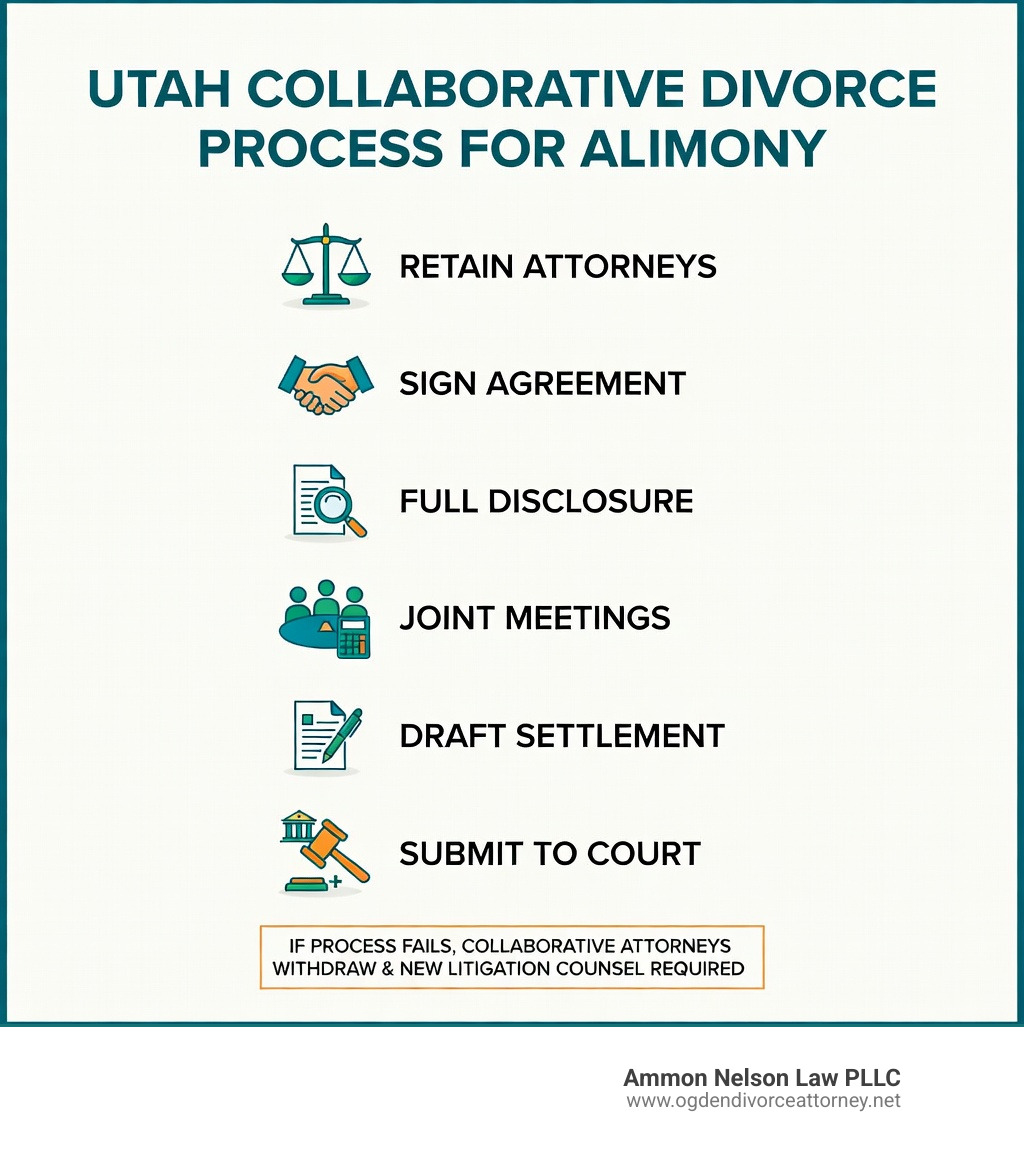
Here is a quick overview of how it works:

  1. Both spouses hire collaboratively trained attorneys who commit to staying out of court.
  2. Everyone signs a participation agreement — the official start of the process under Utah’s Uniform Collaborative Law Act.
  3. Both parties fully disclose finances — income, assets, debts, and needs.
  4. Joint meetings are held to negotiate alimony terms, often with neutral financial experts.
  5. A written settlement is drafted and submitted to the court for approval.
  6. If the process breaks down, collaborative attorneys must withdraw and new counsel is needed for litigation.

This approach is especially valuable when children are involved, when the financial picture is complex, or when you simply want to move forward with dignity.

I’m Ammon Nelson, a Utah family law attorney with years of experience helping families in Northern Utah navigate alimony Utah collaborative law disputes and divorce proceedings. I’ve guided clients through both collaborative and litigated spousal support cases, and I’ve seen how the right process can protect your financial future and your family relationships.

Step-by-step infographic showing the Utah collaborative divorce process for alimony: Step 1 - Both parties retain collaboratively trained attorneys; Step 2 - Sign participation agreement; Step 3 - Full financial disclosure by both parties; Step 4 - Joint negotiation meetings with optional neutral financial expert; Step 5 - Draft written alimony settlement terms; Step 6 - Submit agreement to court for approval; Note at bottom: If process fails, collaborative attorneys withdraw and new litigation counsel is required - Alimony Utah collaborative law infographic

Understanding Alimony Utah Collaborative Law and Spousal Support Basics

Before we dive into the “how-to” of the collaborative process, we need to understand what alimony actually is under Utah law. Alimony, or spousal support, is court-ordered money paid from one former spouse to another. Its primary goal isn’t to punish anyone (though it might feel like it sometimes!); it’s to maintain the standard of living established during the marriage and ensure neither party falls into financial ruin.

In Northern Utah, whether you are in Ogden or Salt Lake City, the courts look at several key factors. Under Utah Code Section 30-3-5(10) and the more recent recodification in Utah Code 81-4-502, the court evaluates:

  • Financial Need: What are the recipient’s actual monthly expenses?
  • Earning Capacity: What is the recipient’s ability to earn income, considering their education and work history?
  • Ability to Pay: Can the other spouse actually afford the support while still meeting their own needs?
  • Marriage Length: Generally, alimony won’t last longer than the marriage itself.
  • Standard of Living: The lifestyle you shared at the time of separation.

One of the unique aspects of Utah law is that “fault” can still play a role. If one spouse committed adultery, caused physical harm, or undermined the family’s financial stability, a judge can take that into account when setting the award. However, in a collaborative setting, we often focus more on future stability than past mistakes. For a deeper dive into these basics, you can check out our Alimony in Utah: A Guide to Spousal Support.

The Collaborative Process: Negotiating Spousal Support

If you’ve ever seen a divorce on TV, it usually involves a lot of shouting in a mahogany-paneled courtroom. Alimony Utah collaborative law is the exact opposite. It’s a voluntary process where both parties agree to resolve their issues outside of court.

The process officially begins when both spouses and their respective attorneys sign a Participation Agreement. This is a binding contract where everyone agrees to play fair, be honest, and—most importantly—stay out of the courtroom. If either party decides to ditch the process and go to trial, both collaborative attorneys must withdraw, and the spouses have to hire entirely new legal teams. This “disqualification requirement” gives everyone a huge incentive to make the collaboration work.

Collaborative Law vs. Litigation: A Quick Comparison

Feature Collaborative Law Litigation
Control You and your spouse decide the outcome A judge decides the outcome
Privacy Negotiations are confidential Court records are mostly public
Cost Often lower (shared experts) Usually higher (battle of experts)
Speed Moves at your own pace Tied to the court’s busy calendar
Relationship Focuses on mutual respect Often adversarial and bitter

In the collaborative model, we use “Interest-Based Negotiation.” Instead of saying, “I want $2,000 a month,” we ask, “What are the financial needs for both households to remain stable?” This often involves Mediation techniques and joint meetings where we look at the big picture. You can learn more about how this fits into the broader timeline in The Divorce Process in Utah.

Negotiating Alimony Utah Collaborative Law Agreements

One of the best parts of the collaborative process is the “Team.” We don’t just have lawyers in the room. We often bring in:

  • Neutral Financial Professionals: To help create realistic budgets.
  • Divorce Coaches: To help manage the emotional “noise” that can derail money talks.
  • Child Specialists: If custody issues are intertwined with financial needs.

Recent legislative changes, specifically 2024 H.B. 220 Legislation, have made these negotiations more structured. For instance, there is now a rebuttable presumption that for marriages of 10 years or more, the court should attempt to equalize the standard of living if the recipient spouse has diminished workplace experience due to caring for children.

In a collaborative setting, we use these laws as a framework, but we have the flexibility to be creative. We might look at a “look-back period” to see what expenses really were, or we might discuss “income imputation”—deciding what a spouse could earn if they returned to the workforce—without the hostility of a cross-examination.

Navigating Cohabitation and Alimony Modification

A common “gotcha” in Utah alimony cases is cohabitation. Under Utah law, alimony typically terminates if the recipient spouse starts living with a new romantic partner. But it’s not as simple as having a boyfriend or girlfriend stay over for the weekend.

Utah courts use a strict definition of cohabitation based on cases like Myers v. Myers and Haddow v. Haddow. To terminate alimony, the payer usually has to prove:

  1. A shared residence.
  2. A romantic or sexual relationship.
  3. A “marriage-like” relationship (sharing chores, keys, and finances).

A recent case, Kinsey v. Kinsey, showed just how high this bar is. Even though the ex-wife spent many nights at her boyfriend’s house, the court didn’t terminate alimony because she didn’t have a key, didn’t leave her car there, and didn’t share expenses.

In Alimony Utah collaborative law, we can address these “what-ifs” ahead of time. We can draft specific language in your settlement about what happens if one spouse moves in with a partner. This prevents future legal battles and the need for private investigators. If things change down the road, you may need to look into Spousal Support / Post-Judgement Enforcement & Modification.

Protecting Your Rights with Alimony Utah Collaborative Law

Whether you are the one paying or the one receiving, the goal is protection.

  • For the Recipient: We ensure your earning capacity is accurately assessed. If you have a disability or have been out of the workforce for 20 years raising kids, we make sure the agreement reflects that “diminished workplace experience.”
  • For the Payer: We look at future milestones like retirement. In Utah, retirement is generally considered a “substantial material change in circumstances” that allows for alimony modification.

By using the collaborative process, you can build these protections directly into your agreement. Instead of a rigid court order, you get a customized roadmap. This is the essence of Spousal Support in a kinder divorce.

Frequently Asked Questions about Utah Alimony

How does cohabitation affect my alimony payments in Utah?

In Utah, alimony is required to terminate if the recipient is proven to be cohabiting with another person in a relationship that resembles marriage. This requires more than just dating; it usually involves sharing a residence and financial responsibilities. Under the law, you have one year from the time you knew (or should have known) about the cohabitation to file a motion to terminate support.

What happens if the collaborative law process fails?

If the parties cannot reach an agreement and the collaborative process “breaks down,” the process terminates. Because of the “withdrawal clause,” both attorneys must resign, and you will have to hire new litigation attorneys to take the case to court. This is designed to ensure everyone negotiates in good faith.

Can alimony be modified after a collaborative agreement is signed?

Yes, but only if there is a “substantial material change in circumstances” that wasn’t contemplated at the time of the original agreement. Examples include a significant involuntary loss of income, a permanent disability, or the payer reaching a reasonable retirement age. Collaborative law can also be used for these modifications to avoid returning to court.

Conclusion

Divorce is never easy, but it doesn’t have to be a war. At Ammon Nelson Law PLLC, we believe that alimony Utah collaborative law offers a path to a more stable and respectful future. By focusing on customization and results-driven representation, we help our clients in Ogden, Salt Lake City, and throughout Northern Utah reach agreements that actually work for their real lives.

If you are looking for a way to handle your spousal support issues with dignity and financial clarity, we are here to help. Whether you need to establish a new order or modify an existing one, our team is dedicated to protecting your rights. For More info about spousal support services, contact us today to schedule a consultation and see if the collaborative path is right for you.

Filed Under: Divorce Tagged With: alimony

Why Understanding Alimony Law in Utah Matters for Your Financial Future

Alimony law in Utah provides financial support to spouses who need assistance maintaining their standard of living after divorce. Here’s what you need to know:

Key Points About Utah Alimony:

  • Eligibility – Either spouse can request alimony based on financial need, earning capacity, and ability to pay
  • Duration – Generally cannot exceed the length of the marriage (except in special circumstances)
  • Termination – Automatically ends upon remarriage or death of the recipient; cohabitation also terminates support
  • 2024 Reforms – New laws emphasize fairness, income equalization for long marriages, and consideration of stay-at-home parent contributions
  • Modification – Can be changed due to substantial changes like retirement, job loss, or health issues
  • Types – Includes temporary, rehabilitative, reimbursement, and durational support

Money questions in divorce can be tricky. And hard to change once the court signs a decree. Whether you’re the spouse seeking support or the one who may be ordered to pay, understanding how Utah courts determine alimony is essential for protecting your financial future.

Alimony—also called spousal support—is not automatically granted in every case. Utah courts have broad discretion to decide whether support is necessary and fair based on multiple factors including your standard of living during marriage, each spouse’s financial condition and earning capacity, the length of your marriage, and even marital fault in some situations.

The landscape of alimony in Utah changed significantly in 2024. New reforms introduced more structured criteria and clearer guidelines, particularly for marriages lasting 10 years or more where one spouse reduced their career to care for children. These changes affect both how alimony is initially determined and how it can be modified later.

At Ammon Nelson Law, PLLC, we’ve guided countless families in Northern Utah through complex divorce proceedings involving spousal support, ensuring fair outcomes under alimony law in Utah while protecting my clients’ rights and financial stability. We understand both the legal complexities and the emotional challenges families face during divorce.

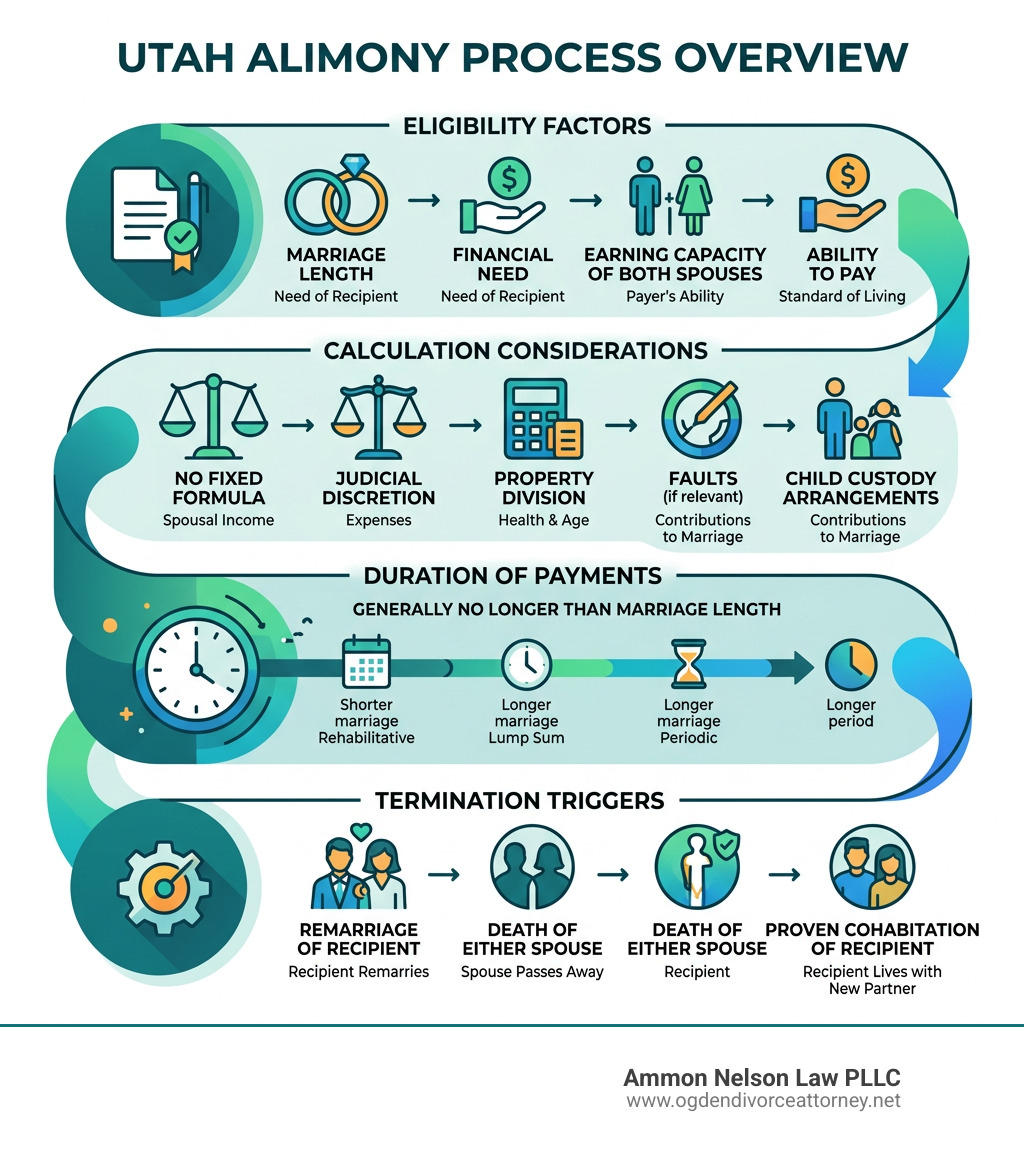
Infographic showing the Utah alimony determination process: eligibility factors, duration limits, types of support, 2024 reform highlights, modification triggers, and automatic termination conditions - alimony law in utah infographic pillar-4-steps

Understanding Alimony Law in Utah: Eligibility and Factors

In our practice at Ammon Nelson Law PLLC, we often see clients who are surprised to learn that alimony isn’t a “one-size-fits-all” calculation. Unlike child support, which follows a fairly rigid formula, alimony is highly discretionary. To understand if you or your spouse qualifies, we must look at the primary statutory factors.

Under Utah Code Title 81, Chapter 4, Part 5, the court evaluates several core elements:

  1. The financial condition and needs of the recipient spouse: Does the spouse asking for money actually need it to meet their reasonable monthly expenses?
  2. The recipient’s earning capacity: This includes their education, work history, and ability to produce income.
  3. The payor spouse’s ability to provide support: You can’t squeeze blood from a turnip; the court won’t order support that the other spouse simply cannot afford after meeting their own needs.
  4. The length of the marriage: This is a heavy hitter in determining both the amount and how long the checks will keep coming.
  5. Custody of minor children: Whether the recipient spouse has physical custody of children who require care that limits employment.

We also look at whether the recipient spouse worked in a business owned by the other spouse or contributed to the other spouse’s education (like working to put a partner through medical school). For a deeper dive into these basics, you can explore our overview of Spousal Support.

Legal documents and a gavel on a wooden desk - alimony law in utah

The Role of Marital Standard of Living

One of the most important concepts in alimony law in Utah is the “marital standard of living.” The court’s goal is generally to keep both parties as close as possible to the lifestyle they enjoyed while married.

Judges look at the lifestyle at the time of separation. If you were living in a luxury home in Salt Lake City and vacationing twice a year, the court will try to ensure the dependent spouse isn’t suddenly forced into a lifestyle that is vastly inferior. However, since two households are more expensive to run than one, “income equalization” often becomes the practical solution when there isn’t enough money to keep both people in the lap of luxury.

Factor Pre-2024 Reform Approach Post-2024 Reform (HB 220)
Standard of Living Broad judicial discretion. Specific factors added to define “standard.”
Look-back Period Vague or inconsistent. Required look-back for financial needs.
Income Equalization Common in long marriages. Mandatory rebuttable presumption for 10+ year marriages with childcare impact.
Income Imputation Often assumed full-time work. Limitations if there is a disability or no recent work history.

For more details on how these factors play out in real cases, check out Alimony in Utah: A Guide to Spousal Support.

How Fault Impacts Alimony Law in Utah

Utah is a “no-fault” divorce state, meaning you don’t have to prove your spouse did something wrong to get a divorce. However—and this is a big “however”—Utah is unique because the court can consider “fault” when deciding alimony.

Under Utah Code 81-4-503, “wrongful conduct” that substantially contributed to the breakup of the marriage can be used to increase, decrease, or even deny alimony. This includes:

  • Adultery: Engaging in sexual relations with someone other than your spouse.
  • Physical Harm: Intentionally causing or attempting to cause physical harm.
  • Fear of Harm: Causing a spouse or child to fear life-threatening harm.
  • Financial Undermining: Substantially undermining the financial stability of the other party.

It’s important to note that this isn’t meant to be a “punishment” in the criminal sense, but rather an equitable consideration. If a spouse’s bad behavior caused the financial rift, the judge has the discretion to let that influence the final number.

Determining the Amount and Duration of Support

When we sit down with clients in our Ogden or Salt Lake City offices, the first question is usually, “How much and for how long?” Because there is no set formula, we have to build a case based on your specific financial records.

The court typically looks at your monthly budget. If your reasonable needs are $4,000 a month and you can only earn $2,500, your “need” is $1,500. If your spouse has a surplus of $1,500 after their own expenses, that’s often where the alimony amount lands. This is part of the broader process of Equitable Distribution that we manage for our clients.

Types of Alimony Available Under Alimony Law in Utah

Not all alimony looks the same. Depending on your situation, the court might order:

  • Temporary Support (Alimony Pendente Lite): This is paid while the divorce is still moving through the courts to keep the bills paid.
  • Rehabilitative Alimony: This is short-term support intended to get a spouse back on their feet—perhaps while they finish a degree or a job training program.
  • Durational Alimony: This is the most common type, providing support for a set number of years.
  • Reimbursement Alimony: This might be awarded if one spouse supported the other through professional school, expecting to share in the future high earnings that are now being lost to divorce.

Understanding which type applies to you is a key part of The Divorce Process in Utah.

Statutory Limits on Duration

One of the firmest rules in alimony law in Utah involves the clock. Per Utah Code § 81-4-502(7), alimony cannot be ordered for a period longer than the length of the marriage.

If you were married for 12 years, the maximum alimony duration is 12 years. There are very rare “extenuating circumstances” that might allow a judge to go beyond this, but they are the exception, not the rule. It is also important to remember that the time you spend paying temporary alimony during the divorce process usually counts toward that total time limit. You can find more official guidance on this at the Alimony – Utah Courts page.

Recent 2024 Reforms and HB 220 Changes

The year 2024 brought significant updates to how we handle these cases. The 2024 HB 220 Divorce Amendments were designed to make alimony more predictable and fairer for modern families.

One of the biggest shifts involves income imputation. In the past, courts often assumed a stay-at-home parent could immediately go out and earn a full-time wage. The new law is more compassionate. It places restrictions on imputing income if a spouse has been out of the workforce for a long time due to childcare or has a diagnosed disability. The court now has to look at “reasonable barriers” to employment rather than just assuming everyone can work a 40-hour week at a certain rate.

Equalization in Long-Term Marriages

For those in long-term marriages (defined as 10 years or more), the 2024 reforms added a powerful tool. If a recipient spouse has “diminished workplace experience” because they stayed home to raise the couple’s children, there is now a rebuttable presumption that the court should equalize the parties’ standards of living.

This means the starting point for the judge is to try and make sure both spouses end up with a similar lifestyle, acknowledging that the stay-at-home parent’s contribution to the family allowed the other spouse to build their career. This is particularly relevant in High Asset Marital Estates where the income gap can be substantial.

Modification and Termination of Spousal Support

Life doesn’t stand still after a divorce decree is signed. Jobs are lost, people retire, and ex-spouses move in with new partners. Alimony law in Utah allows for modifications, but only if there is a “substantial material change in circumstances” that wasn’t anticipated in the original decree.

Common reasons for modification include:

  • Retirement: Utah law now explicitly states that a payor’s retirement is a substantial change that can lead to a reduction or termination of alimony.
  • Job Loss or Disability: If the person paying can no longer earn what they used to, the payment may need to drop.
  • Income Increase: If the person receiving alimony suddenly lands a high-paying executive job, the “need” for support might vanish.

The process involves filing a petition with the court. You can learn more about this in our guide on Post-Judgement Enforcement and Modification.

Terminating Alimony for Cohabitation or Remarriage

Alimony doesn’t always last until the end of the court-ordered duration. It terminates automatically if:

  1. The recipient spouse remarries.
  2. Either spouse dies.

However, the most contentious termination issue is cohabitation. If the person receiving alimony moves in with a new romantic partner, the payor can petition to stop the payments.

Under Utah Code Section 81-4-502, cohabitation means living together on a regular basis in a relationship of a romantic or sexual nature. It’s not just about having a roommate; it’s about a shared life that resembles a marriage. Pro-tip: You must file your motion to terminate within one year of when you knew (or should have known) about the cohabitation. If you wait too long, you might lose your right to stop the payments.

Frequently Asked Questions about Alimony in Utah

Are alimony payments taxable in Utah?

This is a point of major confusion. For any divorce finalized after December 31, 2018, federal tax laws changed significantly.

  • For the Payor: Alimony payments are not tax-deductible.
  • For the Recipient: Alimony received is not considered taxable income.

This was a massive shift from the old rules where the payor got a tax break and the recipient paid the bill. If your divorce was finalized before 2019, you might still be under the old “tax-deductible” rules, so always consult with a tax professional or our team to be sure.

Can spouses agree to waive alimony?

Absolutely. Many couples choose to resolve alimony through Pre and Post Nuptial Agreements or by negotiating a settlement during the divorce. You can agree to a “non-modifiable” waiver, meaning that no matter what happens in the future, neither party can ask for alimony. This provides a level of certainty that many of our Northern Utah clients appreciate.

What happens if alimony is not paid?

Alimony is a court order, not a suggestion. If a spouse stops paying, they can be found in contempt of court. This can lead to:

  • Income Withholding: The money is taken directly from their paycheck.
  • Judgments: A judge can issue a judgment for the total amount of past-due alimony (arrears), plus interest.
  • Legal Fees: The non-paying spouse may be ordered to pay the other spouse’s attorney fees.
  • Jail Time: In extreme cases of willful non-payment, a judge can order jail time.

Conclusion

Navigating alimony law in Utah is one of the most stressful parts of a divorce. Whether you are worried about how you will support yourself or concerned that your hard-earned income will be unfairly distributed, you don’t have to face these questions alone.

At Ammon Nelson Law PLLC, we pride ourselves on providing customized, results-driven representation. We understand the nuances of the 2024 reforms and how to build a compelling case for our clients in Ogden, Salt Lake City, and throughout Northern Utah. Our goal is to ensure that your final divorce decree is fair, sustainable, and protects your future.

If you have questions about your specific situation, we invite you to reach out. For more resources, visit our spousal support services page or contact us today to schedule a consultation. Let us help you find the clarity and stability you deserve.

Filed Under: Divorce Tagged With: alimony

  • 1
  • 2
  • 3
  • Next Page »

Ogden Location

1492 East Ridgeline Dr., Suite 3
South Ogden, UT 84405
Phone: 801.337.4355
Fax: 801.337.0737
Email: ammon@ammonnelsonlaw.com

Monday9:00 AM - 6:00 PM
Tuesday9:00 AM - 6:00 PM
Wednesday9:00 AM - 6:00 PM
Thursday9:00 AM - 6:00 PM
Friday9:00 AM - 6:00 PM
SaturdayAvailable for Emergencies
SundayClosed

Directions

Navigation

  • Family Law
  • Divorce
  • Child Custody
  • Child Support
  • Spousal Support

Follow Us

Ammon Nelson Law - Facebook Ammon Nelson Law - Twitter Ammon Nelson Law - YouTube Ammon Nelson Law - Instagram

2022 Ammon Nelson Law | All Rights Reserved | Privacy Policy | Terms | XML Sitemap | Site by PDM