Ammon Nelson Law - Facebook Ammon Nelson Law - Twitter Ammon Nelson Law - YouTube Ammon Nelson Law - Instagram
  • About Us
  • Team
  • Contact Us
  • FAQs
  • En Español
Ammon Nelson Law

Ammon Nelson Law

Visit North Carolina Website

Call For A Consultation

801.337.4355
  • Family Law
    • Divorce
    • Child Custody
    • Child Support
    • Spousal Support
    • Special Needs Children
    • Father’s Rights
    • Visitation Rights
    • Grandparents Rights
  • Divorce
    • Annulment
    • How To File
    • No Fault Divorce
    • Uncontested Divorce
    • Contested Divorce
    • Irretrievable Breakdown & Divorce
    • Division of Intellectual Property
    • Divorce By Publication
    • Equitable Distribution
    • High-Asset Marital Estates
  • Child Custody
    • How to Get Full Custody
    • Joint Custody
    • Relocation & Custody
    • Interstate & International Custody and Recovery
  • Child Support
    • How to Obtain Child Support
  • Spousal Support
    • Pre and Post Nuptial Agreements
    • Post Judgement Enforcement Modification
    • Orders of Protection
  • Estate Planning and Probate
    • Social Security Disability
    • Estate Planning
    • Personal Injury
    • Probate
    • Guardianship and Conservatorship
  • Mediation

Who is the Boss? Understanding Adult Guardianship Laws

Home » Archives for Ammon » Page 7

Why Legal Guardianship of an Adult Matters for Your Family

Legal guardianship of an adult is a court-supervised relationship where a judge appoints someone to make decisions for another adult who cannot manage their own personal care, finances, or both. Here’s what you need to know:

Quick Answer: Adult Guardianship Basics

  • What it is: A legal process where a court grants someone authority to make decisions for an incapacitated adult
  • When it’s needed: When an adult cannot manage personal care, finances, or health decisions due to dementia, disability, illness, or injury
  • Types: Limited (specific decisions only), plenary/full (most decisions), temporary, or emergency
  • Who decides: A judge evaluates medical evidence and appoints a guardian based on the adult’s best interests
  • Alternatives exist: Power of Attorney, Advance Directives, Supported Decision-Making, and trusts may avoid guardianship
  • Court oversight: Guardians must report regularly to the court and act in the ward’s best interests

Sometimes, because of aging, disease, or injury, people need help managing some or all of their daily affairs. This creates real challenges for families—especially when a loved one can no longer pay bills, make medical decisions, or protect themselves from exploitation. Guardianship removes fundamental rights like choosing where to live, managing money, or making healthcare choices. That’s why courts treat it seriously and why you should explore every alternative first.

The decision to seek guardianship is never easy. You’re balancing your loved one’s safety with their autonomy and independence. You might be watching a parent struggle with dementia, or supporting an adult child with disabilities who’s turning 18. Maybe you’re dealing with a sibling whose mental illness or substance use puts them at risk. Whatever your situation, understanding the legal framework helps you make informed decisions that truly protect your family member while preserving their dignity.

I’m Ammon Nelson, and over my years practicing family law in Utah, I’ve guided many families through the complex process of legal guardianship of an adult, helping them steer the emotional and legal challenges while exploring every option to preserve their loved one’s independence. My goal is always to find the least restrictive solution that keeps your family member safe.

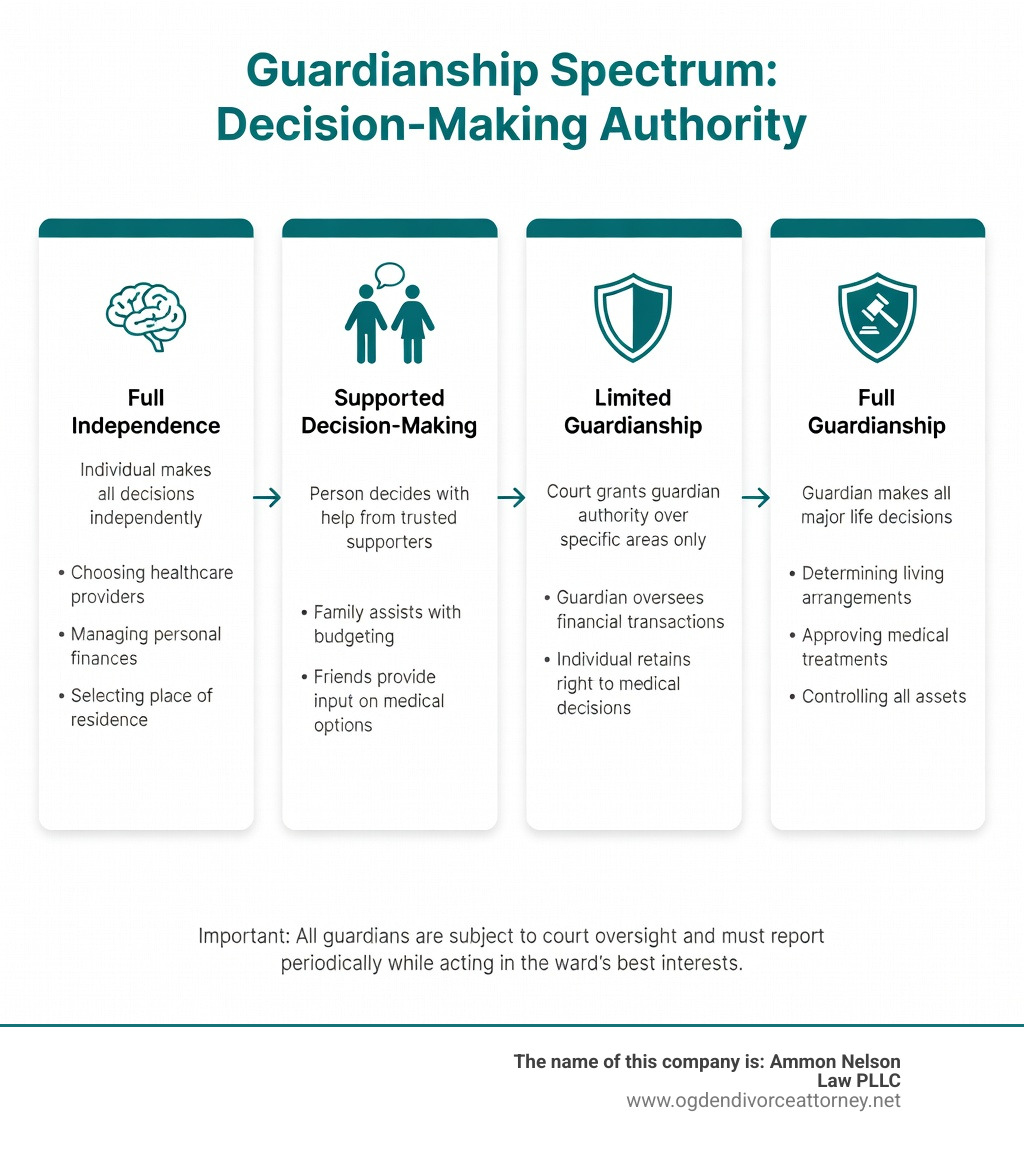
infographic showing the guardianship spectrum from full independence through supported decision-making, limited guardianship, and full guardianship, with examples of decision-making authority at each level - legal guardianship of an adult infographic

Defining Adult Guardianship and the Role of the Court

When we talk about legal guardianship of an adult, we are entering a territory where the law must step in to protect those who can no longer protect themselves. In Utah, the court system views this as a protective measure of last resort.

A “guardian” is a person or entity appointed by a judge to take over decision-making for an “incapacitated person,” often referred to in legal documents as the “ward” or the “protected person.” However, it is vital to remember that the court itself is considered the “superior guardian.” This means the person we appoint as guardian is essentially an agent of the court, acting under its watchful eye and authority.

The court’s role isn’t just to sign a piece of paper and walk away. Judges in Ogden and Salt Lake City take an active role in ensuring that the proposed guardianship is actually necessary. They look for clear and convincing evidence that the individual lacks the capacity to make safe or practical decisions. You can find a deeper dive into these Guardianship key concepts and resources to see how the national legal community defines these roles.

gavel and legal books on a desk - legal guardianship of an adult

When is Legal Guardianship of an Adult Necessary?

We often see families come to us when a crisis has already occurred. Perhaps a parent with advanced dementia has wandered off, or an adult child with a significant intellectual disability is nearing their 18th birthday and needs continued support.

Under Utah law, a guardian may be appointed if an adult is determined to be “incapacitated.” This doesn’t just mean they make bad choices (we all do that sometimes!). It means they lack the ability to adequately evaluate information, make decisions, or provide for their own basic life necessities. Common scenarios include:

  • Cognitive Decline and Dementia: When Alzheimer’s or other forms of dementia impair memory and judgment to the point where the person can no longer manage their own safety.
  • Intellectual or Developmental Disabilities: For young adults who, upon turning 18, still require help with daily living and healthcare decisions.
  • Mental Illness: When severe conditions prevent a person from understanding the consequences of their actions.
  • Substance Abuse: In extreme cases where drug or alcohol dependency has rendered the person unable to care for their physical health or safety.
  • Physical Health Issues: When a sudden injury, like a traumatic brain injury, leaves someone unable to communicate their wishes.

Types of Adult Guardianship and Protective Arrangements

Not every situation requires a “plenary” or full guardianship. In fact, Utah courts strongly prefer “limited guardianship.” We believe in using a “scalpel rather than a sledgehammer”—taking away only the rights that the individual is truly unable to exercise.

  • Plenary (Full) Authority: This gives the guardian rights and responsibilities similar to those a parent has for a minor child. It covers almost all aspects of life, from where the person lives to what medical care they receive.
  • Limited Guardianship: This is custom to the person’s specific needs. For example, the ward might still be allowed to choose their own social activities or vote, but the guardian makes decisions regarding surgery or large financial transactions.
  • Temporary Orders: Sometimes a situation is urgent but might be resolved soon. A temporary guardianship can bridge the gap while a more permanent solution is sought.
  • Emergency Guardianship: If there is an immediate risk of “substantial harm” to the person’s health or safety, the court can fast-track an appointment.

To help you visualize the differences, we’ve broken down the two primary roles often involved in these cases:

Feature Guardianship of the Person Guardianship of the Estate (Conservatorship)
Primary Focus Personal care, health, and safety Financial management and assets
Decisions Made Medical treatment, housing, clothing, food Paying bills, managing investments, selling real estate
Key Responsibility Monitoring caregivers and daily well-being Protecting and growing the ward’s property
Reporting Annual reports on the ward’s condition Annual financial accountings and audits

For more details on how these services are applied in Northern Utah, you can visit our page on Guardianship and Conservatorship services.

Guardianship vs. Conservatorship in Utah

In Utah, we distinguish between the “person” and the “estate.” While “guardian” is the term for the person looking after the individual’s physical well-being, a “conservator” is the person looking after the money.

Often, the same person serves in both roles, but not always. A conservator is especially advised when the ward has significant assets, ongoing business affairs, or complex investments. The conservator’s job is to ensure the ward’s bills are paid and their property is protected from exploitation. They have a fiduciary duty—the highest legal standard of care—to manage that money solely for the benefit of the protected person.

The Step-by-Step Process to Obtain Legal Guardianship of an Adult

Obtaining legal guardianship of an adult is a rigorous process designed to protect the rights of the person being “guarded.” You can’t just walk into a courthouse in Ogden and walk out with a guardianship order.

Here is the general path we follow:

  1. The Petition: We file a formal request with the district court in the county where the adult lives (such as Weber, Salt Lake, or Davis County). This petition outlines why the guardianship is necessary and who is being proposed as the guardian.
  2. The Physician’s Report: A crucial piece of evidence is the Certificate of Medical Examination (CME). A doctor must examine the adult and provide a professional opinion on their capacity to make decisions.
  3. Notice Requirements: Due process is vital. We must provide formal notice to the “interested parties.” This typically includes the adult’s spouse, adult children, parents, and siblings. They have the right to support or object to the petition.
  4. Court Visitor or Guardian ad Litem (GAL): The court often appoints a “Visitor” or a “Guardian ad Litem.” The GAL is an attorney whose job is to represent the best interests of the alleged incapacitated person. They will interview the adult and the proposed guardian and report back to the judge.

The Role of Medical Evaluations and Court Hearings

The heart of the case is the capacity assessment. During the court hearing, the judge will examine the medical evidence and listen to testimony. The adult for whom guardianship is sought has the right to be present, the right to their own attorney, and the right to present their own evidence or cross-examine witnesses.

The judge isn’t just looking for a diagnosis; they are looking for functional impairment. Can the person manage their medications? Do they understand their financial situation? Are they vulnerable to “sweetheart scams” or elder abuse?

If the judge decides a guardian is necessary, they will also determine if the proposed guardian is fit. This involves background checks and, in cases of conservatorship, the requirement of a “bond”—essentially an insurance policy that protects the ward’s estate if the conservator mishandles the money.

Exploring Less Restrictive Alternatives

Because legal guardianship of an adult is so restrictive, Utah law requires that we explore “less restrictive alternatives” first. We always ask: “Can we achieve safety without taking away their rights?”

  • Supported Decision-Making (SDM): This is a popular and empowering alternative. Instead of a guardian making the choice, the adult chooses a “supporter” (like a family member or friend) to help them understand information and communicate their decisions. It’s like having a co-pilot instead of someone taking over the steering wheel.
  • Durable Power of Attorney (POA): If the adult still has the capacity to sign legal documents, they can appoint an agent to handle financial or healthcare matters. This avoids court intervention entirely.
  • Advance Directives and Living Wills: These documents allow a person to state their medical preferences in advance, ensuring their wishes are followed even if they become unable to speak for themselves later.
  • Representative Payee: For individuals whose only income is Social Security or VA benefits, these agencies can appoint a “payee” to manage those specific funds without a full court guardianship.

For more information on these options, the Department of Justice provides a great resource on Less restrictive alternatives to guardianship. You can also learn how these fit into a broader strategy on our page about estate planning and guardianship.

Formal vs. Informal Support Systems

Sometimes, a combination of informal supports is enough to keep someone safe. This might include:

  • Trusts: Setting up a living trust where a trustee manages assets for the beneficiary.
  • HIPAA Releases: Allowing family members to talk to doctors without having full legal authority over the person.
  • Community Resources: Utilizing “Meals on Wheels,” senior centers, or home health aides to provide oversight.

Responsibilities, Rights, and Restoration

Once appointed, a guardian has a massive responsibility. You are a fiduciary, meaning you must act with the utmost good faith. You are not “the boss” in the sense that you can do whatever you want; you are the protector of the ward’s “best interests.”

Key responsibilities include:

  • Annual Reports: You must file a report with the court every year detailing the ward’s physical and mental condition.
  • Financial Accountings: If you are a conservator, you must provide a detailed list of every penny spent from the ward’s estate.
  • Encouraging Independence: Even under guardianship, you should involve the ward in decisions as much as possible. If they can choose what to wear or what to eat, let them!

The Uniform Law Commission-Guardianship and Protective Arrangements Act provides national standards that many states, including Utah, look to for best practices in monitoring and oversight.

Contesting or Terminating Legal Guardianship of an Adult

Guardianship doesn’t have to be permanent. If a person’s condition improves—perhaps they recover from a stroke or stabilize on new medication—they can petition the court for a “restoration of rights.”

Similarly, if a guardian is not doing their job, is being abusive, or is exploiting the ward, interested parties can petition for the guardian’s removal. A guardian can also resign, though they remain responsible until the court appoints a successor.

Due process is the shield that protects the ward. Whether it’s the initial petition or a later request to end the guardianship, the court ensures that everyone’s voice is heard and that the ward’s civil liberties are only restricted as much as absolutely necessary.

Frequently Asked Questions about Adult Guardianship

Who is eligible to serve as a guardian?

In Utah, a guardian must generally be at least 18 years old, of sound mind, and not have a criminal history that would make them unfit (especially felonies involving harm to children or the elderly). While the court prefers family members, they will appoint professional fiduciaries or public guardians if no suitable family member is available.

How much does it cost to establish guardianship?

The cost varies depending on the complexity of the case. You have court filing fees, attorney fees, and the cost of the medical evaluation. If the case is contested (meaning someone objects), the costs can rise. However, in many cases, the attorney’s fees can be reimbursed from the ward’s estate once the guardianship is established.

Does a guardian become financially responsible for the ward’s debts?

No! This is a common fear. As a guardian or conservator, you are not personally liable for the ward’s debts. You use their money to pay their bills. You only become responsible if you co-sign on a loan or if you breach your fiduciary duty and cause a loss to the estate.

Conclusion

Navigating legal guardianship of an adult is an emotional journey. It marks a significant shift in family dynamics, often moving from being a child to being a protector for a parent, or from a parent to a lifelong advocate for an adult child.

At Ammon Nelson Law PLLC, we understand the nuances of Utah law and the specific needs of families in Ogden, Salt Lake City, and throughout Northern Utah. We don’t believe in a “one-size-fits-all” approach. Whether you need to establish a limited guardianship, fight an unnecessary petition, or explore estate planning tools to avoid court altogether, we provide customized, results-driven representation.

Our goal is to ensure that your loved ones are safe, their assets are protected, and their dignity remains intact. If you’re feeling overwhelmed by the “Who is the Boss?” question in your family, let us help you find the right legal balance.

Contact a Utah guardianship and conservatorship attorney today to schedule a consultation and take the first step toward peace of mind for your family.

Filed Under: Guardianship Tagged With: attorney

Why Finding the Right Divorce Lawyer in Salt Lake City Utah Matters

A divorce lawyer Salt Lake City Utah serves as your legal advocate, guiding you through one of life’s most challenging transitions. When you’re facing the end of a marriage, you need more than just legal expertise—you need someone who listens, understands your unique situation, and fights for your interests.

Quick Answer: What to Look for in a Salt Lake City Divorce Lawyer

  1. Experience in Utah family law – Over 14-25 years handling local cases
  2. Clear communication – Returns calls, explains options in plain language
  3. Personalized approach – Treats your case as unique, not just another file
  4. Trial skills – Can negotiate settlements and litigate when needed
  5. Transparent pricing – Retainers typically $3,750-$5,000 with payment plans available
  6. Local knowledge – Familiar with Salt Lake County courts and judges
  7. Full-service support – Handles custody, support, property division, and modifications

The research shows that many clients switch lawyers mid-case because their first attorney was unresponsive or seemed distracted. As one attorney put it: “Nothing disturbs me more than having conversations with people who seem like they’re mentally floating in some galaxy far, far away instead of paying attention to matters at hand.”

What makes Salt Lake City divorces unique? Utah is a no-fault divorce state requiring a 30-day waiting period. Before relocating more than 150 miles with children, you must obtain court approval. Property division follows equitable distribution laws, and custody decisions prioritize the child’s best interests with no automatic rules favoring either parent.

I’m Ammon Nelson, and as a divorce lawyer Salt Lake City Utah families trust, I’ve spent years helping clients steer complex custody battles, high-asset divorces, and sensitive family transitions throughout Northern Utah. My approach combines aggressive advocacy with genuine empathy for what you’re experiencing.

Understanding the Role of a Divorce Lawyer in Salt Lake City Utah

When you hire a divorce lawyer Salt Lake City Utah, you aren’t just hiring someone to fill out paperwork. You are hiring a strategist, a negotiator, and, when necessary, a fierce litigator. Our role at Ammon Nelson Law PLLC is to provide comprehensive legal guidance that covers every facet of your life that the divorce will touch.

An attorney-client consultation - divorce lawyer salt lake city utah

One of the Top Benefits of a Divorce Attorney is having a professional who can look at your situation objectively. When emotions are high, it’s easy to make decisions based on temporary anger or sadness. We help you focus on long-term stability. Our services include:

  • Asset Protection: Ensuring that marital property is divided fairly and that your separate property remains yours.
  • Debt Division: Determining who is responsible for credit cards, mortgages, and loans acquired during the marriage.
  • Spousal Support (Alimony): Evaluating whether one spouse needs financial assistance and whether the other has the ability to pay.
  • Protective Orders: In cases involving domestic violence or threats, we act quickly to secure your safety. If you are in immediate danger, please use Domestic Violence Resources to find safety and support.
  • Case Strategy: Every family is different. We don’t use a “cookie-cutter” approach; we customize our strategy based on whether your case is likely to settle or head to a courtroom.

Navigating the Utah Divorce Process: From Filing to Final Decree

The path to finalizing a divorce in Utah follows a specific legal track. Understanding this timeline can help lower your stress levels because you’ll know exactly what to expect next.

  1. The Petition for Divorce: The process officially begins when one spouse (the petitioner) files a complaint in the county court.
  2. Service and Response: The other spouse (the respondent) must be served with the papers. They typically have 21 days to respond if they are in Utah, or 30 days if they are out of state.
  3. The 30-Day Waiting Period: Utah law mandates a 30-day waiting period between the date the petition is filed and the date the decree is signed. While The Divorce Process in Utah requires this time, it can sometimes be waived for extraordinary circumstances.
  4. Discovery Phase: This is the “information gathering” stage. Both sides exchange documents regarding finances, property, and any other relevant evidence.
  5. Mediation: Most Salt Lake City courts require parties to attempt mediation before going to trial. This is a chance to reach a settlement agreement on your own terms.
  6. Final Decree: Once all issues are resolved—either through a settlement or a judge’s ruling—the court issues the final Divorce Decree, officially ending the marriage.

Comparison: Contested vs. Uncontested Divorce

Feature Uncontested Divorce Contested Divorce
Agreement Spouses agree on ALL issues. Spouses disagree on one or more terms.
Speed Can be finalized shortly after 30 days. Can take a year or more.
Cost Generally lower legal fees. Higher due to litigation and discovery.
Court Appearances Often none or very minimal. Multiple hearings and a potential trial.

Whether your case is Contested vs Uncontested Divorces, having a divorce lawyer Salt Lake City Utah ensures your rights are protected during the negotiation of settlement agreements.

Choosing a Divorce Lawyer in Salt Lake City Utah for Contested Cases

If your spouse is unwilling to compromise, you are in a contested divorce. This is where What You Need to Know About Contested Divorces becomes vital: you need a lawyer with exceptional litigation skills.

Contested cases often involve:

  • High Net Worth Assets: Dividing businesses, retirement accounts, and multiple real estate holdings.
  • Hidden Asset Discovery: Using forensic techniques to find money or property a spouse might be trying to conceal.
  • Expert Witnesses: Bringing in child psychologists or financial evaluators to testify.
  • Trial Preparation: Building a case that can withstand the scrutiny of a judge.

Key Legal Considerations: Custody, Support, and Property Division

The most emotional part of any divorce involves the children and the home. Utah courts use the “best interests of the child” standard when determining Custody. This means the judge looks at who has been the primary caregiver, the emotional bond between the parent and child, and the stability of the home environment.

When it comes to Child Support, Utah uses a specific formula based on both parents’ gross incomes and the number of overnights the child spends with each parent. You can get an estimate of these figures using the Child Support Calculator.

Property and Alimony

Utah is an equitable distribution state. This doesn’t necessarily mean a 50/50 split. Instead, it means the court divides marital property in a way that is fair based on the length of the marriage and each person’s financial situation.

Regarding Alimony in Utah: A Guide to Spousal Support, there is no set formula. The court looks at:

  1. The financial need of the recipient.
  2. The recipient’s earning capacity.
  3. The ability of the payor spouse to provide support.

Understanding the nuances of Spousal Support is critical, as these orders can last for a duration equal to the length of the marriage.

Parental Relocation and Mediation with a Divorce Lawyer in Salt Lake City Utah

Utah has strict rules regarding moving with children after a divorce. If a parent intends to move more than 150 miles away from the other parent, they must provide 60 days’ notice and often obtain judge approval. This 150-mile rule is designed to protect the child’s relationship with both parents.

For more details, you can review Essential Custody Legal Info. If a move is contested, a judge will decide if the relocation is in the child’s best interest. If the move is denied, the parent can still move, but custody may be transferred to the parent staying in Utah.

Mediation is often the best way to handle these disputes. The benefits of mediation include:

  • Control: You and your spouse decide the outcome, not a judge.
  • Privacy: Mediation happens behind closed doors, not in a public record.
  • Cost: It is almost always cheaper than a trial.

If you are struggling to steer these rules, the Courts Self Help Center provides resources, but they cannot give the strategic legal advice that a divorce lawyer Salt Lake City Utah can provide.

Evaluating Costs, Communication, and Attorney Approach

Hiring a lawyer is an investment in your future. At Ammon Nelson Law PLLC, we believe in transparency. Typical retainers for a divorce lawyer Salt Lake City Utah range from $3,750 to $5,000, depending on the complexity of the case.

When Hiring an Attorney, ask about their fee structure:

  • Retainers: An upfront payment held in a trust account.
  • Payment Plans: Options to spread out the cost of your representation.
  • Unbundled Services: Hiring a lawyer for specific tasks (like drafting a document) rather than full representation.

Communication is just as important as cost. You should choose a firm that prioritizes your peace of mind. As a boutique firm, we offer personalized attention that larger “law factories” can’t match. We integrate financial planning and emotional support resources into our practice because we know that a divorce affects your whole life, not just your legal status.

Frequently Asked Questions about Salt Lake City Divorces

How long is the mandatory waiting period for a divorce in Utah?

Utah law requires a 30-day waiting period from the date the petition is filed before the judge can sign the final decree. This “cooling off” period can occasionally be waived if there is a compelling reason, such as safety concerns or military deployment.

What happens if my spouse refuses to sign the divorce papers?

You can still get a divorce. If your spouse is served and fails to respond within the 21-30 day window, you can ask the court for a “default judgment.” This typically means the judge grants the divorce based on the terms you requested in your petition.

How does the court determine “equitable distribution” of assets?

“Equitable” means fair, not necessarily equal. The court considers the length of the marriage, the age and health of the parties, their occupations, and the source of the property. Generally, property you owned before the marriage or received as a specific inheritance remains yours, while assets earned during the marriage are subject to division.

Conclusion

Choosing a divorce lawyer Salt Lake City Utah is one of the most significant decisions you will make. You deserve results-driven advocacy from a team that understands the local landscape of Salt Lake County and Northern Utah.

At Ammon Nelson Law PLLC, we pride ourselves on providing customized representation that actually listens to your goals. Don’t just take our word for it—read our SLC Testimonials to see how we’ve helped your neighbors through their toughest times.

Whether you need a Salt Lake City advocate or an Ogden Divorce Attorney, we are here to restore peace to your family. Contact us today to schedule your consultation and take the first step toward your new beginning.

Filed Under: Divorce Tagged With: attorney

Understanding the Intersection of Domestic Violence and Alimony in Utah

Utah alimony domestic violence cases present unique legal challenges where survivors of abuse must navigate complex financial obligations during divorce. Here’s what you need to know:

Key Facts About Utah Alimony and Domestic Violence:

  • Utah considers fault: Courts may consider domestic violence when determining alimony awards under Utah Code § 81-4-502
  • Fault includes physical harm: Knowingly causing or attempting to cause physical harm, creating fear of life-threatening harm, or substantially undermining financial stability qualifies as “fault”
  • Not automatic disqualification: Unlike California, Utah does not automatically bar abusers from receiving alimony—judges have discretion
  • Survivors can be ordered to pay: Without explicit statutory protection, domestic violence survivors may still be required to pay alimony to their abusers
  • Duration typically limited: Alimony generally cannot exceed the length of the marriage unless extenuating circumstances exist
  • Protective orders help: Obtaining a protective order creates legal documentation of abuse that can influence alimony decisions

What This Means for You:

If you’re a domestic violence survivor facing alimony obligations, Utah law provides some protection through the “fault” consideration, but it’s not automatic. You’ll need to prove the abuse substantially contributed to the marriage’s breakdown. Courts can close proceedings and seal records when fault is at issue, protecting your privacy while presenting evidence.

Conversely, if you suffered abuse during your marriage, proving fault can increase the amount and duration of alimony you receive, or potentially deny your abuser any spousal support.

Ammon Nelson Law, family law attorneys serving Northern Utah with experience in complex divorce and domestic violence cases, We’ve helped numerous clients steer the challenging intersection of Utah alimony domestic violence law to protect their financial futures while escaping abusive situations. Understanding how Utah courts weigh domestic violence in alimony determinations is critical for achieving fair outcomes in these emotionally charged cases.

Infographic showing how domestic violence impacts alimony in Utah: fault consideration factors, protective order benefits, evidence requirements, and potential outcomes for both survivors and abusers - Utah alimony domestic violence infographic 3_facts_emoji_grey

Utah’s Legal Framework: How Domestic Violence Impacts Alimony

Navigating the waters of divorce in Utah often means dealing with the concept of alimony—money one party pays the other for support. While many think of divorce as a strictly “no-fault” process, Utah law maintains a significant exception when it comes to spousal support.

Under the Utah Code Title 81, Chapter 4, Part 5 Introduction, alimony is designed to help the lower-earning spouse maintain a standard of living similar to what they enjoyed during the marriage. However, when domestic violence enters the picture, the court’s focus shifts from simple math to equity. Utah is unique because, while you don’t need to prove a “reason” to get divorced, the court has the judicial discretion to consider “fault” when deciding how much alimony should be paid and for how long.

Economic abuse is a frequently overlooked factor in these cases. If one spouse controlled all the finances or intentionally sabotaged the other’s ability to work, Utah courts can view this as a form of marital fault that justifies a higher alimony award for the survivor.

Legal documents and a gavel representing Utah family law statutes - Utah alimony domestic violence

Defining Fault Under Utah Alimony Domestic Violence Statutes

Recent legislative updates, specifically HB 220, have brought much-needed clarity to what “fault” actually means in our state. According to Utah Code 81-4-502, “fault” isn’t just a vague term for being a “bad spouse.” It specifically includes:

  1. Physical Harm: Knowingly and intentionally causing or attempting to cause physical harm to the other party or a minor child.
  2. Life-Threatening Fear: Knowingly and intentionally causing the other party or a minor child to reasonably fear life-threatening harm.
  3. Financial Undermining: Conduct that substantially undermines the financial stability of the other party.

The law requires that this conduct be “knowing and intentional.” This means accidental harm (like a car accident) generally won’t count as fault. For the court to reduce or deny alimony based on these factors, the abuse must have “substantially contributed” to the breakup of the marriage.

The Role of Protective Orders in Financial Awards

If you are in immediate danger, Orders of Protection are your first line of defense. In Utah, a court can issue an ex parte protective order (an order granted without the other side present) that includes temporary spousal support.

According to Utah Code 78B-7-603, these orders can provide:

  • No-contact provisions: Keeping the abuser away from your home and work.
  • Temporary Maintenance: Financial support to ensure the survivor can pay bills while the divorce is pending.
  • Safety Retrieval: Law enforcement accompaniment to safely retrieve personal belongings.

To secure financial relief through a protective order, you must provide income verification, such as pay stubs or tax returns, at the subsequent hearing. These orders serve as powerful evidence when we later argue for a permanent alimony determination.

Can a Survivor Be Forced to Pay Alimony to an Abuser?

This is perhaps the most painful question a survivor can ask. Unfortunately, because Utah does not have a “bright-line” rule that automatically bars abusers from receiving support, it is statistically possible for a higher-earning survivor to be ordered to pay their abuser. This often happens when the survivor has been the primary breadwinner, and the abuser claims a “need” based on their standard of living during the marriage.

Abusers often use the tag/abusive-spouse dynamic to maintain control even after the separation. They may argue that because they didn’t work during the marriage, the survivor “owes” them support. This creates a situation of gross inequality, where the survivor’s hard-earned income is used to fund the lifestyle of the person who harmed them.

Factor Utah Approach
Fault Consideration Discretionary; judge may consider it.
Statutory Bar No automatic bar for convicted abusers.
Definition of Abuse Includes physical, fear, and financial.
Privacy Proceedings can be closed/records sealed.

Utah Alimony Domestic Violence: The Unconscionability Defense

When the law seems to fail, we turn to deeper legal doctrines like unconscionability. Originally a concept from contract law, we can apply this to tag/abuse cases by arguing that a divorce settlement requiring a survivor to pay an abuser is fundamentally unfair.

  • Procedural Unfairness: This occurs when there was a lack of meaningful choice. If a survivor signed a lopsided agreement because they were under duress or suffering from the psychological effects of abuse, the agreement may be procedurally unconscionable.
  • Substantive Unfairness: This refers to the terms themselves. We argue that forcing a victim to subsidize their tormentor violates public policy and is “shocking to the conscience.”

Comparing Utah Law to Other State Approaches

Utah’s approach is often described as a “middle ground.” While we aren’t a “pure” no-fault state like some, we also don’t have the strict disqualification laws found in California (Family Code § 4325), which presumes that any spouse convicted of domestic violence within five years of the divorce filing should receive zero alimony.

The Utah Courts generally prioritize the “financial need vs. ability to pay” analysis. However, the 2024 legislative updates show a clear move toward giving survivors more leverage to challenge these awards based on the “fault” of the abuser.

Legal Strategies: Challenging Alimony Awards to Abusers

Winning a Utah alimony domestic violence dispute requires more than just telling your story; it requires a mountain of evidence. We work with our clients to gather:

  • Police Reports and 911 transcripts: These provide a timeline of incidents.
  • Medical Records: Documentation of injuries or psychological treatment for PTSD.
  • Financial Records: Proof of “financial undermining,” such as secret accounts or destroyed credit.
  • Testimony: Statements from witnesses who observed the abuse or its aftermath.

If you are getting a restraining order, that document becomes a cornerstone of our financial strategy. It serves as a court-recognized “finding of fact” that abuse occurred.

Proving Fault to Terminate or Deny Support

To successfully deny an abuser alimony, we must show the court that the violence was a primary cause of the divorce. If we can prove “chronic violence,” Utah judges are much more likely to exercise their discretion to deny support entirely. We often use tag/protective-order violations to show the court that the abuser remains a threat, further justifying a total cutoff of financial ties.

Utah Alimony Domestic Violence and Imputed Income

One common tactic abusers use is “voluntary unemployment.” They may refuse to work to maximize the alimony they receive from the survivor. Under Utah Code 81-4-503, we can ask the court to “impute” income to them. This means the court treats them as if they are earning what they could earn based on their work history and education.

Conversely, for survivors whose earning capacity was diminished due to abuse or disability, the law now provides protections. Courts must consider the “impact of diminished workplace experience” and cannot simply force a survivor back into the workforce if they have been out for years caring for children or recovering from trauma.

The Psychological and Financial Toll on Survivors

The trauma of domestic violence doesn’t end when the physical danger stops. Research shows that 63.8% of female survivors of intimate partner violence suffer from PTSD. This often manifests as a “fight-flight-freeze” response during legal proceedings.

At Ammon Nelson Law PLLC, we help our clients stay safe by recognizing these triggers. Financial abuse—where an abuser controls access to money—is present in nearly 99% of domestic violence cases. This leaves survivors with no “war chest” to fight a legal battle. We often point clients toward Local Resources | Utah Domestic Violence to find support groups and emergency financial aid.

Impact of Trauma on Divorce Negotiations

Trauma can literally impair a survivor’s ability to negotiate. The pressure to “just get it over with” leads many survivors to agree to unfair alimony terms just to escape the abuser’s presence. Abusers use this “settlement pressure” as a final act of coercive control.

If you are facing a divorce involving an abuser, it is vital to have an advocate who understands these power dynamics. We ensure that negotiations happen in a safe environment, often through counsel, so the survivor isn’t re-traumatized by face-to-face contact with their ex-spouse.

Legislative Reform and the Future of Utah Alimony Laws

The landscape of Utah alimony domestic violence law is shifting. The 2024 General Session saw the passage of HB 220, which represents a major step forward for survivor rights.

Key updates include:

  • Look-back Periods: Courts now require a more thorough review of financial records to prevent spouses from hiding assets right before a divorce.
  • Income Equalization: For marriages over 10 years where one spouse stayed home (often a dynamic in abusive relationships), there is now a rebuttable presumption that the court should equalize standards of living.
  • Fault Definition: As mentioned earlier, the explicit inclusion of “fear of life-threatening harm” as fault allows us to argue cases where physical bruises may not be present, but psychological terror was constant.

These reforms are heavily influenced by the #MeToo movement and advocacy from organizations like the Office of Recovery Services (ORS), which helps manage the financial fallout of dissolved marriages.

Frequently Asked Questions about Utah Alimony Domestic Violence

Does domestic violence automatically disqualify a spouse from receiving alimony in Utah?

No. Utah is not an “automatic disqualification” state. However, the court “may” consider fault. If the domestic violence was the primary cause of the divorce and substantially contributed to the breakup, a judge has the authority to deny alimony to the abuser or significantly reduce it.

How does a protective order affect my alimony case?

A protective order is vital evidence. It provides a legal record of the abuse that can be used to prove “fault” under Utah Code § 81-4-502. Furthermore, it can provide immediate, temporary financial support (temporary maintenance) before the divorce is even finalized.

Can I modify my alimony if my ex-spouse becomes abusive after the divorce?

Generally, alimony is based on conduct during the marriage. However, if the abuse constitutes a “material change in circumstances”—for example, if the abuse results in your inability to work or requires significant medical expenses—you may be able to petition the court for a modification. Additionally, if the abuser is the recipient of alimony and begins cohabiting with a new partner, alimony can often be terminated.

Conclusion

At Ammon Nelson Law PLLC, we understand that a divorce involving Utah alimony domestic violence is about more than just numbers on a spreadsheet—it’s about your safety, your dignity, and your future. Whether you are in Ogden, Salt Lake City, or anywhere in Northern Utah, we provide customized, results-driven representation designed to break the cycle of abuse and secure your financial independence.

We specialize in Spousal Support cases where the stakes are high and the emotions are higher. Our team is committed to ensuring that the legal system works for survivors, not against them. If you are ready to take the next step toward a life free from abuse and financial burden, we are here to fight for the results you deserve.

Contact our Ogden or Salt Lake City offices today to schedule a consultation and begin building a safer, more secure future.

Filed Under: Divorce Tagged With: alimony

  • « Previous Page
  • 1
  • …
  • 5
  • 6
  • 7
  • 8
  • 9
  • …
  • 23
  • Next Page »

Ogden Location

1492 East Ridgeline Dr., Suite 3
South Ogden, UT 84405
Phone: 801.337.4355
Fax: 801.337.0737
Email: ammon@ammonnelsonlaw.com

Monday9:00 AM - 6:00 PM
Tuesday9:00 AM - 6:00 PM
Wednesday9:00 AM - 6:00 PM
Thursday9:00 AM - 6:00 PM
Friday9:00 AM - 6:00 PM
SaturdayAvailable for Emergencies
SundayClosed

Directions

Navigation

  • Family Law
  • Divorce
  • Child Custody
  • Child Support
  • Spousal Support

Follow Us

Ammon Nelson Law - Facebook Ammon Nelson Law - Twitter Ammon Nelson Law - YouTube Ammon Nelson Law - Instagram

2022 Ammon Nelson Law | All Rights Reserved | Privacy Policy | Terms | XML Sitemap | Site by PDM