Legal Custody vs Physical Custody: The Two Parts of a Custody Order
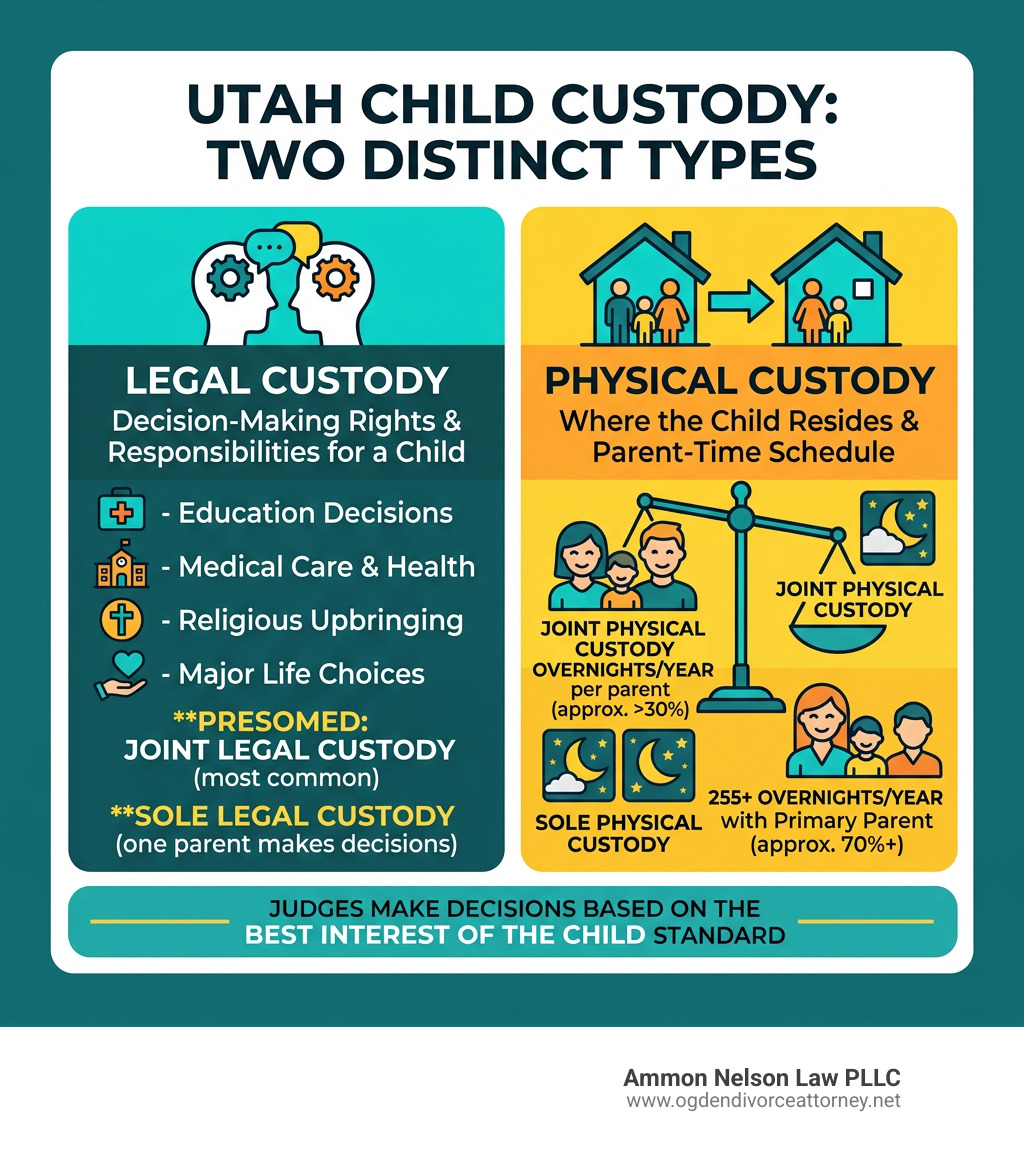
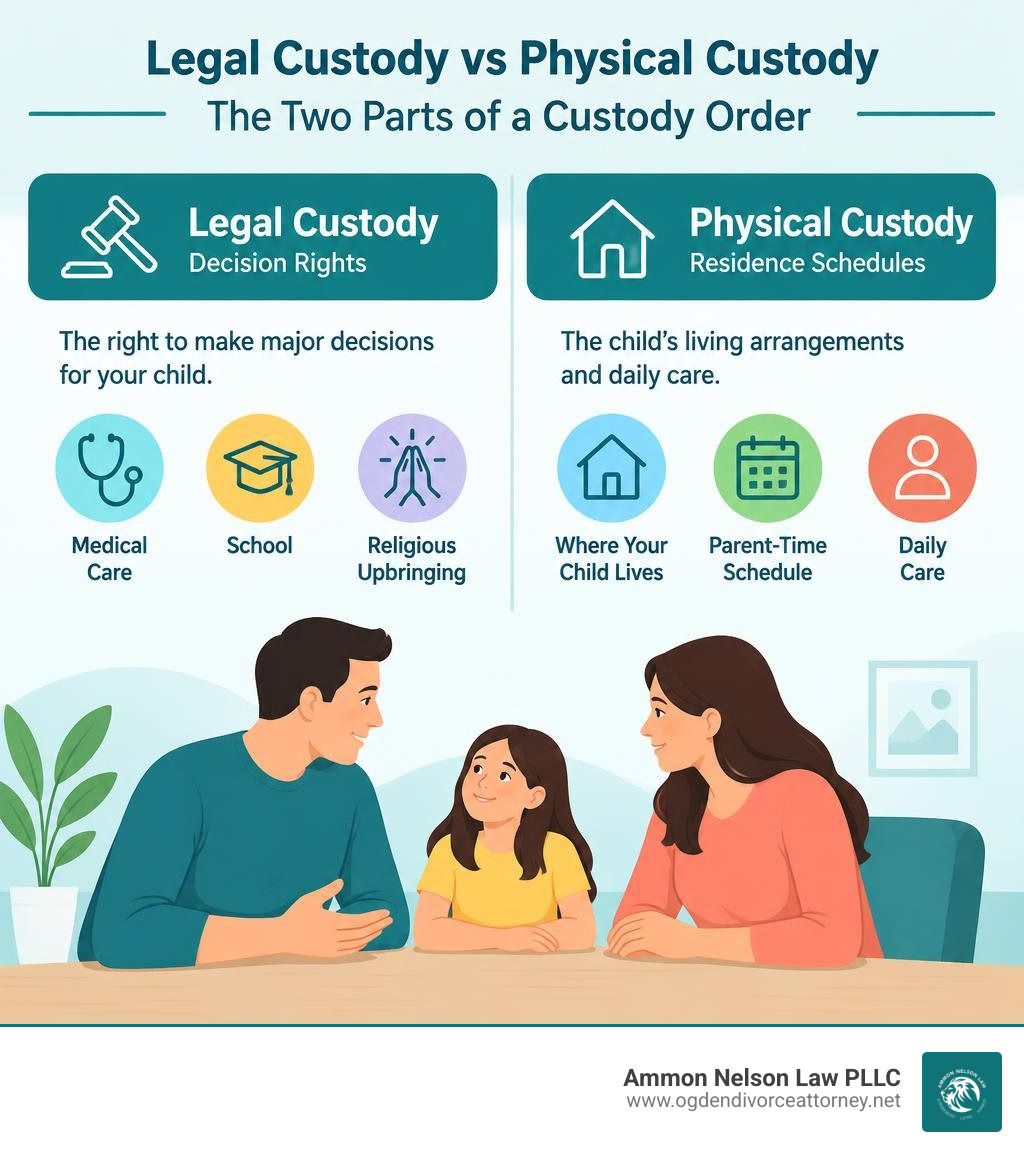
Legal custody is the right to make major decisions for your child, such as decisions about medical care, school, and religious upbringing. Physical custody addresses where your child lives and who handles daily care.
In a legal custody vs physical custody case, these rights can be divided in different ways. For example, parents may share legal custody even when the child has one primary home and follows a regular parent-time schedule with the other parent.
A custody order should clearly cover both issues. It can set out who makes major decisions, where the child stays on school nights, how holidays are divided, and how parents will handle disagreements. Utah courts focus on the child’s best interests, with special attention to safety, stability, and each parent’s ability to meet the child’s needs.
I am Ammon Nelson, a Northern Utah family law attorney who helps parents work through legal custody vs physical custody questions, parenting plans, support concerns, and custody disputes. As a father of eight and an attorney serving Utah families, I understand that a clear plan can protect both your parental role and your child’s routine.
Understanding Legal Custody vs Physical Custody
When walking through a family restructuring, many parents assume that “custody” is a single, all-or-nothing package deal. In reality, modern family law splits the concept down the middle. To build an effective parenting foundation, it helps to review the distinction between legal authority and residential schedules. When filing for divorce, two types of custody will form the backbone of your court decree: legal custody and physical custody.
Understanding these concepts within our local statutes is vital. The state legislature sets out clear rules under Utah Code Section 81-9-205, establishing statutory definitions for how decision-making and physical care are granted by family court judges.
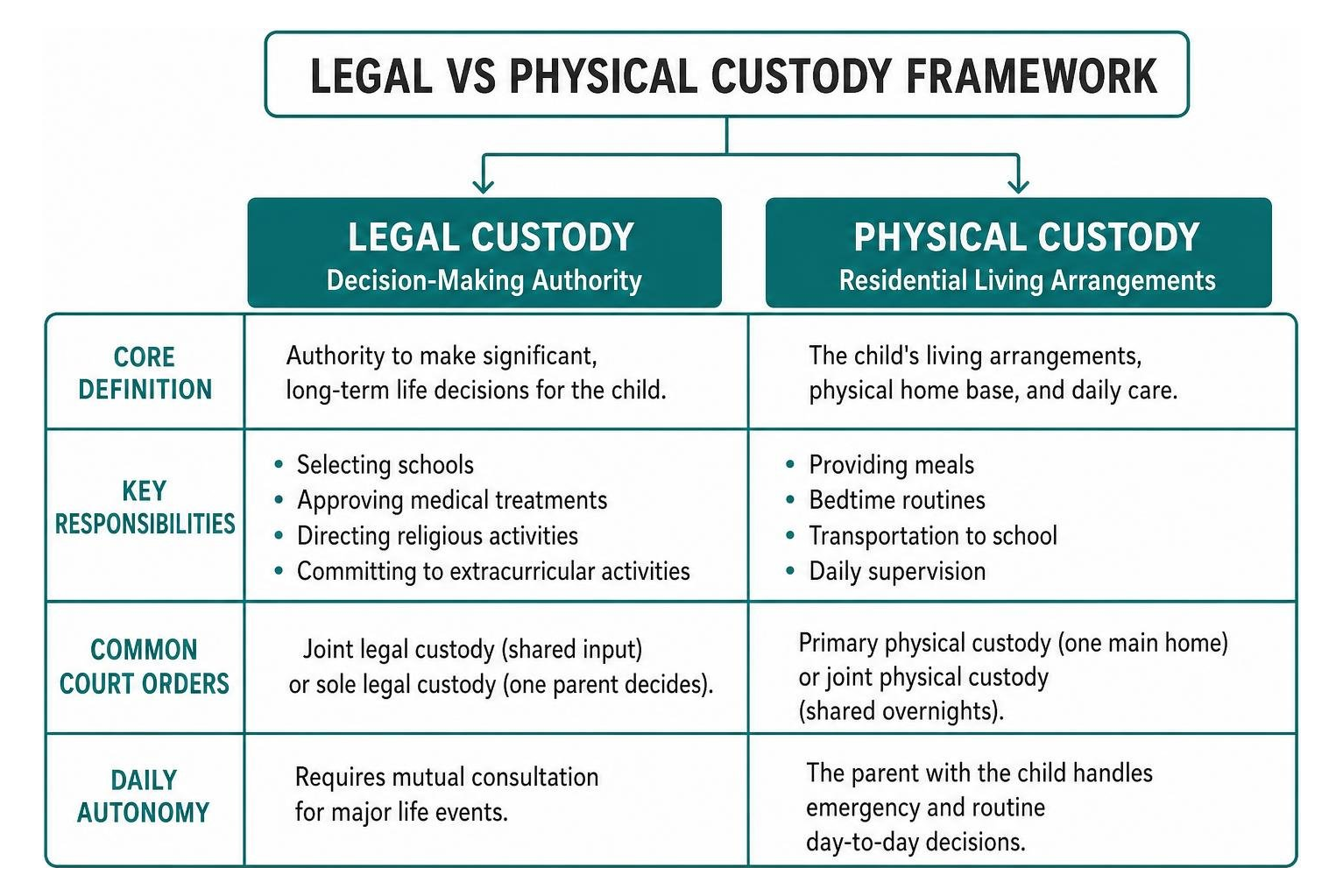
| Feature | Legal Custody | Physical Custody |
|---|---|---|
| Core Definition | Authority to make significant, long-term life decisions for the child. | The child’s living arrangements, physical home base, and daily care. |
| Key Responsibilities | Selecting schools, approving medical treatments, directing religious activities. | Providing meals, bedtime routines, transportation to school, daily supervision. |
| Common Court Orders | Joint legal custody (shared input) or sole legal custody (one parent decides). | Primary physical custody (one main home) or joint physical custody (shared overnights). |
| Daily Autonomy | Requires mutual consultation for major life events. | The parent with the child handles emergency and routine day-to-day decisions. |
Defining Legal Custody: Decision-Making Authority
Legal custody is essentially the governing power over your child’s developmental roadmap. It covers significant choices that will affect the child’s long-term well-being and life trajectory, rather than what time they brush their teeth on a Tuesday evening.
Major decision categories governed by legal custody include:
- Education: Enrolling in public, private, or charter schools, selecting specialized tutoring, and managing individualized education programs (IEPs).
- Healthcare & Mental Health: Choosing pediatricians, approving elective surgeries, managing orthodontic care, and selecting therapists or counselors.
- Religious Upbringing: Determining formal religious affiliations, attendance at services, and participation in milestone religious rituals.
- Extracurricular Activities: Committing the child to high-demand sports programs, music lessons, or travel clubs that require substantial financial or scheduling commitments from both households.
When parents share joint legal custody, neither parent has the legal right to unilaterally make these major decisions without consulting the other. If a deadlock occurs, parenting plans can outline dispute resolution processes, such as mediation, or assign specific tie-breaking authority to one parent for certain domains (like medical or academic choices).
Defining Physical Custody: Residential Living Arrangements

While legal custody controls high-level decision-making, physical custody dictates the physical reality of where the child sleeps, eats, and spends their days. This establishes the child’s primary home base and determines the schedule of physical care.
Physical custody outlines how parents manage their routines and exercise their visitation rights. The parent with whom the child resides most of the time is often referred to as the custodial or primary residential parent, while the other parent exercises scheduled parent-time. During their designated parent-time, each parent holds the authority to make routine, day-to-day decisions—such as bedtime rules, homework supervision, and dietary choices.
Exploring Sole vs Joint Custody Configurations
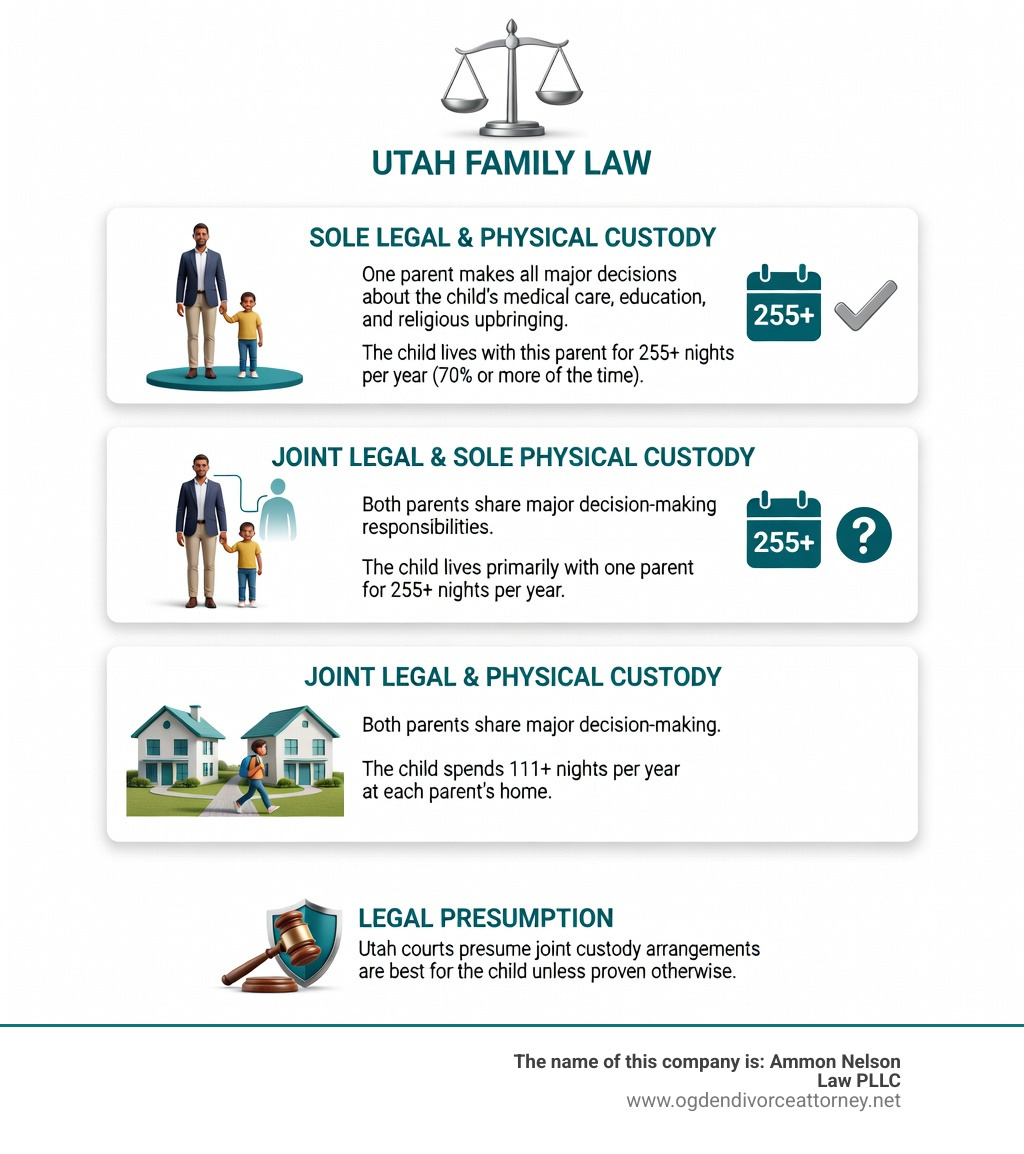
Navigating custody means understanding how legal and physical responsibilities can be paired. You can have joint legal custody while one parent has primary physical custody, or you can have joint custody in both categories. When understanding child custody laws in Utah, it helps to see that judges seek arrangements that provide stability while fostering strong relationships with both parents whenever safe and practical.
Evaluating Legal Custody vs Physical Custody in Joint Arrangements
In our family courts, there is a general presumption that joint legal custody is beneficial for children, provided both parents can communicate effectively and keep conflict away from the kids. Entering into joint custody structures does not necessarily mean a strict 50/50 clock split.
Under official state standards and court guidance on child custody and parent-time, joint physical custody in Utah generally means that the child stays overnight with each parent for at least 111 nights during the year (roughly 30% of the time). Common joint physical configurations include:
- Equal 50/50 Schedules: Alternating weeks or rotating “2-2-3” schedules where children spend substantial, balanced time in both homes.
- Shared Overnights (e.g., 60/40 or 70/30): The child maintains a primary school-week base with one parent but spends extended weekends, mid-week dinners, and substantial vacation blocks with the other.
This division allows both parents to remain deeply involved in educational progress, sports, and daily milestones without disrupting the child’s academic stability.
When Courts Award Sole Legal Custody vs Physical Custody to One Parent
While joint arrangements are common, there are circumstances where shared decision-making or unsupervised residential time is unsafe or impractical for a child. When a parent is exploring how to get full custody or seeking sole custody, judges require clear evidence showing why joint custody is not in the child’s best interests.
Courts examine various types of child custody and may order sole custody under conditions such as:
- Domestic Violence or Child Abuse: Documented physical, emotional, or sexual abuse within the household.
- Untreated Substance Abuse: Chronic drug or alcohol dependency that compromises parental judgment and child safety.
- Severe Parental Unfitness or Neglect: An inability or unwillingness to provide adequate housing, supervision, nutrition, or medical attention.
- Severe High-Conflict Alienation: Persistent, bad-faith refusal to cooperate or communicate, paralyzing the ability to make basic decisions for the child.
In these situations, the court may award sole legal and physical custody to one parent. The other parent may be granted specific, scheduled visitation—often supervised if safety risks remain—ensuring the child maintains a safe connection without compromising their welfare.
How Courts Determine Custody and Best Interests Standards

When parents cannot reach an agreement on their own or through mediation, a judge must step in to make the final determination. In every custody case across Weber County, Salt Lake County, and Northern Utah, the guiding benchmark is always the best interests of the child.
Judges do not make these decisions arbitrarily. They systematically weigh statutory custody considerations to evaluate which environment will best support the child’s safety, emotional growth, and long-term stability.
Best Interests Criteria and Parental Fitness Factors
To evaluate what serves a child’s best interests, courts examine several interrelated factors:
- Past Parenting and Primary Caregiver History: Which parent has historically managed daily doctor appointments, school meetings, bedtime routines, and meal preparation?
- Parental Fitness and Moral Character: Each parent’s physical, mental, and emotional health, stability, and absence of criminal or abusive behavior.
- Willingness to Encourage the Other Parent-Child Relationship: A parent’s ability to support an ongoing, positive bond between the child and the co-parent, rather than alienating them.
- Child’s Developmental and Special Needs: How well each parent can meet specific medical, academic, or behavioral needs.
- Stability of the Home Environment: Proximity to schools, community ties, extended family networks, and maintaining continuity in the child’s life.
- Child’s Expressed Preference: If the child is of sufficient age and maturity (frequently 14 or older in Utah), the court may consider their input, though the judge retains final discretion.
Designing Parenting Plans and Physical Custody Schedules
A successful custody resolution requires a thorough, written agreement. Adhering to structured parenting plan guidelines prevents ambiguity and reduces conflict over holidays, transportation, and schedule adjustments.
Common physical custody schedules include:
- The 2-2-3 Schedule: The child spends 2 days with Parent A, 2 days with Parent B, and then 3 days (the weekend) with Parent A. The following week, the order alternates. This works well for younger children who benefit from seeing both parents frequently.
- Alternating Weeks (7-on / 7-off): The child rotates between homes every seven days (often switching on Friday afternoons). This schedule works well for school-aged children and teenagers because it minimizes frequent transitions.
- 2-2-5-5 Rotation: The child regularly spends Mondays and Tuesdays with Parent A, Wednesdays and Thursdays with Parent B, and alternates 3-day weekends. This provides predictable weekdays for both homes.
- Primary Residence with Standard Parent-Time: The child resides with the primary custodian during the school week, spending alternating weekends, one mid-week evening, and alternating major holidays with the non-custodial parent.
A solid parenting plan also includes clear provisions for holiday rotations, summer vacation travel itineraries, school breaks, and designated exchange locations.
Practical Interactions: Child Support, Modifications, and Enforcement
Legal and physical custody arrangements directly influence other core elements of family law, including monthly financial support and future decree adjustments.
Custody and Child Support Calculations
Child support is calculated using state statutory guidelines that consider both parents’ gross monthly incomes and the number of overnights the child spends in each household.
- In sole physical custody arrangements (where one parent has fewer than 111 overnights), child support is calculated using standard base tables where the non-custodial parent pays a set percentage based on relative income.
- In joint physical custody arrangements (where each parent has 111 or more overnights), child support adjustments take into account the shared time, reducing support obligations proportionally as overnight care is balanced between homes.
Modifying Custody Orders
Custody decrees are not permanently locked in stone. If life circumstances change substantially after an order is entered, either parent can file a Petition to Modify. To succeed, the moving parent must demonstrate:
- A substantial and material change in circumstances that was not anticipated when the original decree was entered (such as parental relocation beyond 150 miles, significant career shifts, or evolving medical/educational needs).
- That the proposed modification is in the best interests of the child.
If one parent routinely ignores court-ordered parent-time, withholds visitation, or makes unilateral major medical or schooling decisions without legal authority, the aggrieved parent can file a Motion to Enforce Order (Order to Show Cause) to ask the court to step in, make up lost parent-time, issue fines, or adjust custody.
Frequently Asked Questions About Child Custody
What is the most common child custody arrangement?
Statistically, the most common arrangement across family courts is joint legal custody paired with primary physical custody to one parent (alongside a standard, robust parent-time schedule for the other parent). This setup gives both parents equal authority in major life decisions while giving the child a consistent home base for school weeks. However, true 50/50 joint physical custody plans are increasingly common when parents live close to each other.
How does physical custody time impact child support calculations?
Physical custody directly influences child support through overnight counts. When a parent crosses the statutory joint physical custody threshold (at least 111 overnights per year in Utah), the court uses a shared-custody child support formula. This formula factors in the financial contribution of housing and caring for the child during those overnights, which often reduces the net child support transfer payment compared to a sole physical custody calculation.
Can custody orders be modified after the divorce is finalized?
Yes. Custody orders can be formally modified if a parent proves that a substantial and material change in circumstances has occurred since the decree was signed. Common triggers include out-of-state relocations, changes in a child’s health or educational needs, or evidence that the current environment is no longer serving the child’s best interests.
Conclusion
Working through child custody disputes is one of the most significant legal and emotional steps a parent can take. Distinguishing between who makes major decisions (legal custody) and where your child sleeps at night (physical custody) is essential to protecting your parental rights and setting up your child for long-term stability.
At Ammon Nelson Law PLLC, we provide customized, results-driven representation for parents across Ogden, Salt Lake City, South Ogden, and throughout Northern Utah. Whether you are drafting an initial parenting plan, mediating a shared-time schedule, or seeking a post-decree modification, our team is here to help you protect your family.
For experienced, compassionate guidance on your custody or divorce matter, explore our family law services and schedule a consultation with our team today.