Ammon Nelson Law - Facebook Ammon Nelson Law - Twitter Ammon Nelson Law - YouTube Ammon Nelson Law - Instagram
  • About Us
  • Team
  • Contact Us
  • FAQs
  • En Español
Ammon Nelson Law

Ammon Nelson Law

Visit North Carolina Website

Call For A Consultation

801.337.4355
  • Family Law
    • Divorce
    • Child Custody
    • Child Support
    • Spousal Support
    • Special Needs Children
    • Father’s Rights
    • Visitation Rights
    • Grandparents Rights
  • Divorce
    • Annulment
    • How To File
    • No Fault Divorce
    • Uncontested Divorce
    • Contested Divorce
    • Irretrievable Breakdown & Divorce
    • Division of Intellectual Property
    • Divorce By Publication
    • Equitable Distribution
    • High-Asset Marital Estates
  • Child Custody
    • How to Get Full Custody
    • Joint Custody
    • Relocation & Custody
    • Interstate & International Custody and Recovery
  • Child Support
    • How to Obtain Child Support
  • Spousal Support
    • Pre and Post Nuptial Agreements
    • Post Judgement Enforcement Modification
    • Orders of Protection
  • Estate Planning and Probate
    • Social Security Disability
    • Estate Planning
    • Personal Injury
    • Probate
    • Guardianship and Conservatorship
  • Mediation

The Essential Guide to Post Nuptial Agreements

Home » agreement

What Post Nuptial Agreements Actually Do (And Why They Matter)

Post nuptial agreements are legal contracts signed by married couples after their wedding that define how assets, debts, and financial responsibilities will be divided if the marriage ends.

Here is a quick overview of what you need to know:

Question Quick Answer
What is it? A written contract signed by spouses after marriage
When can you get one? At any point during your marriage
What does it cover? Property, debts, spousal support, inheritance
What can’t it cover? Child custody or child support
Is it legally binding? Yes, if properly drafted and executed
Do you need a lawyer? Strongly recommended for both spouses

Maybe you skipped a prenup because the wedding was coming fast. Maybe your finances have changed significantly since you said “I do.” Or maybe you and your spouse just want clarity and peace of mind going forward. Whatever brought you here, a postnup can be a practical tool for protecting your family’s future.

Research consistently shows that couples with clear financial agreements report higher marriage satisfaction. That is not a coincidence. When money expectations are spelled out, there is less room for conflict and resentment to grow.

I’m Ammon Nelson, a Utah family law attorney with extensive experience helping couples navigate post nuptial agreements and other complex marital legal matters. My firm, Ammon Nelson Law PLLC, serves families across Northern Utah from our South Ogden location, and I have seen how the right legal agreement can protect a family before a crisis hits.

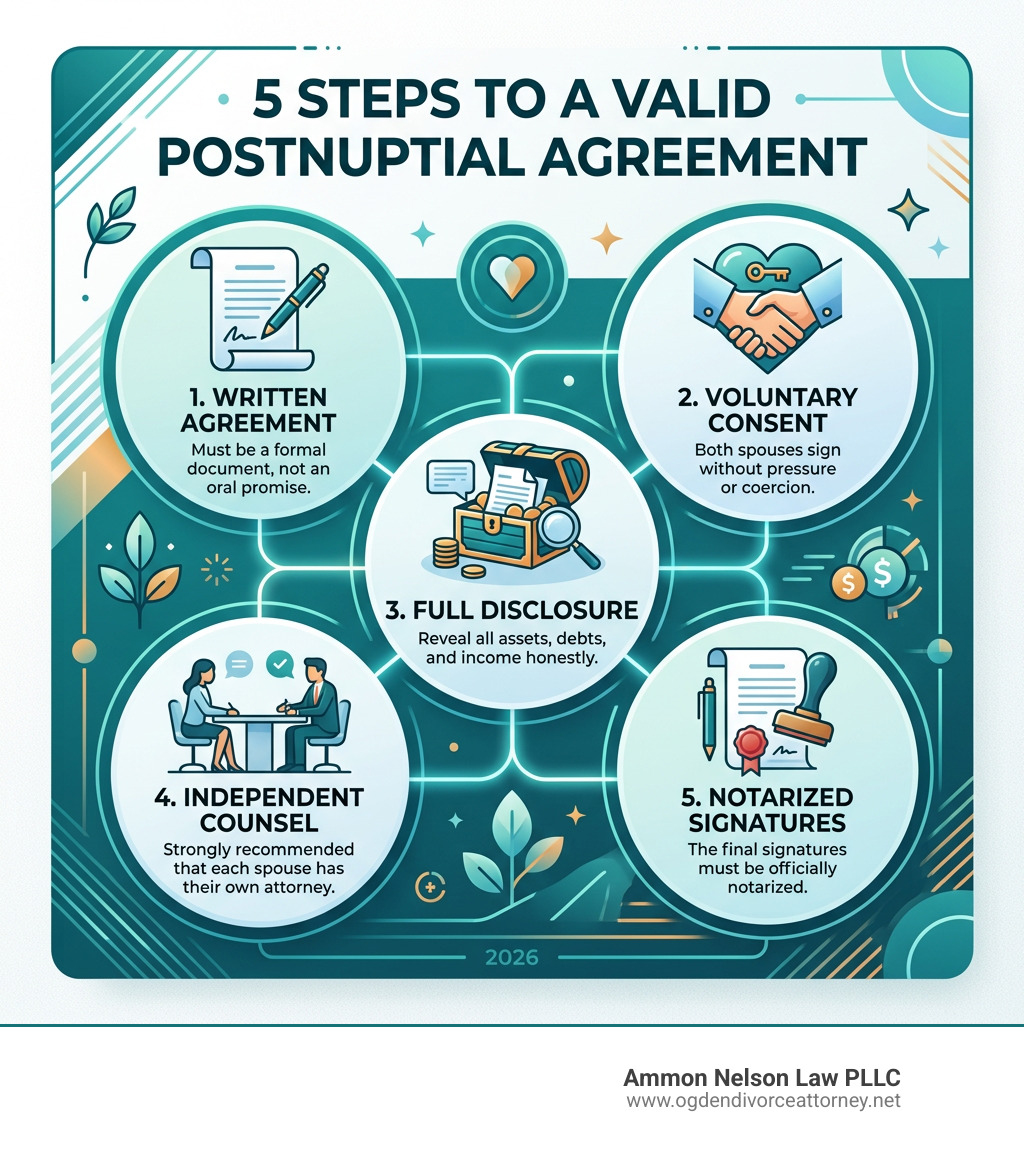
5 steps to a valid postnup: written, voluntary, full disclosure, independent counsel, notarized - post nuptial agreements

Understanding Post Nuptial Agreements

signed legal contract for postnup - post nuptial agreements

At its simplest, a post nuptial agreement is a written contract entered into by spouses after they have already tied the knot. While most people are familiar with prenuptial agreements—those contracts signed in the frantic weeks leading up to a wedding—postnups serve a similar purpose but are executed during the marriage itself.

Historically, these agreements were not always easy to come by. Under the old legal concept known as the “marital unity doctrine,” a husband and wife were seen as a single legal entity. Because you cannot technically contract with yourself, agreements between spouses were often considered invalid. You can read more about the evolution of this concept in The Legal Unity of Husband and Wife. However, as laws evolved in the 1970s alongside the rise of no-fault divorce, courts began to recognize that married couples should have the right to manage their financial destinies.

In Utah and across the U.S., the prevalence of these agreements is growing. While only about 3% of couples signed prenups in 2010, that number jumped to 15% by 2022. Many couples who missed the window for a prenup are now turning to post nuptial agreements to find that same level of security.

The Fiduciary Difference

One of the most critical things we explain to our clients in Ogden and Salt Lake City is that a postnup is held to a higher legal standard than a prenup. Why? Because once you are married, you have a fiduciary relationship with your spouse. This is a relationship of “highest good faith and fair dealing.” You cannot take unfair advantage of one another, and you must provide complete transparency. Because of this bond, judges scrutinize postnups very closely to ensure no one was pressured into signing away their rights. For those concerned about how this affects alimony or future payments, you can find More info about spousal support services to see how these legal obligations intersect.

Feature Prenuptial Agreement Postnuptial Agreement
Timing Signed before the wedding Signed after the wedding
Legal Standard Contractual arms-length Fiduciary (higher standard)
Primary Goal Protect pre-marital assets Address changes during marriage
Ease of Enforcement Generally high Subject to stricter court review

Why Couples Choose a Postnup

Life changes fast. The financial reality you had on your wedding day might look nothing like your life five or ten years later. We often see couples seek out post nuptial agreements when a significant “life event” occurs.

One common reason is inheritance protection. If you receive a large inheritance from a parent, Utah law generally views that as separate property. However, if you deposit that money into a joint bank account or use it to pay off the family mortgage, it can become “commingled,” meaning it might be split 50/50 in a divorce. A postnup keeps those family assets protected.

Another frequent driver is infidelity recovery. It might sound counterintuitive, but a postnup can actually help save a marriage. Prevalence rates for infidelity in American marriages range from 20% to 40%. For some couples, a postnup serves as a “reconciliation agreement.” It provides the aggrieved spouse with financial security and clear terms for the future, allowing the couple to focus on rebuilding trust rather than worrying about “what if.”

We also work with many stay-at-home parents. If one spouse leaves a high-paying career to raise children in Northern Utah, they are often at a financial disadvantage if the marriage ends years later. A postnup can guarantee them a specific share of assets or alimony to recognize their contribution to the home. If you’re wondering if it’s too late for you, check out our guide on is-it-ever-too-late-for-a-postnuptial-agreement-after-marriage.

Protecting Assets with Post Nuptial Agreements

For the entrepreneurs in Salt Lake City and Ogden, protecting a business is often the top priority. If you started a business during the marriage, it is likely considered marital property. A post nuptial agreement allows you to:

  • Designate the business as separate property.
  • Avoid the massive expense of a professional business valuation during a divorce.
  • Protect family heirlooms or physical gifts from being sold to settle debts.
  • Outline how future earnings or “side hustles” will be handled.
  • Override standard community property-style overrides to ensure a fair, customized split.

Legal Requirements for Enforceability

A postnup isn’t worth the paper it’s written on if it isn’t enforceable. Because Utah courts want to ensure fairness, there are strict rules you must follow. You can’t just scribble an agreement on a napkin and expect it to hold up.

First and foremost, there must be full financial disclosure. This means both spouses must lay all their cards on the table—bank accounts, debts, retirement funds, and property values. If you hide an offshore account or a secret debt, the entire agreement could be tossed out by a judge later.

Secondly, the execution must be voluntary. If there is any evidence of “duress” or “coercion”—basically, if one spouse felt forced into signing—the contract is void. This is why timing is everything. Signing a postnup during a heated argument is a recipe for a legal challenge.

According to Prenuptial and Postnuptial Contract Law in the USA, the agreement must also not be “unconscionable.” This is a fancy legal word for “grossly unfair.” If the agreement leaves one spouse wealthy and the other on public assistance, a judge is unlikely to enforce it.

The “Must-Haves” for a Utah Postnup:

  1. Written Format: Oral promises are never enforceable in this area of law.
  2. Signatures and Notarization: Both parties must sign, and having a notary public witness the signatures is a standard requirement for validity.
  3. Independent Legal Counsel: While not always strictly required by every statute, having separate lawyers is the best way to prove the agreement was fair.
  4. Meeting the Statute of Frauds: This ensures the contract is formal and documented.

What Can and Cannot Be Included

Couples are often surprised by how much—and how little—they can control with a postnup. Most financial matters are fair game. You can decide who gets the house, how the 401(k) is split, and who is responsible for that pesky credit card debt. You can even include provisions for what happens if a spouse passes away during the marriage.

However, there are “no-go” zones. You cannot use a postnup to regulate “routine marital duties.” You can’t, for example, include a clause that fines a spouse for not doing the dishes or failing to walk the dog. Courts view these as “lifestyle clauses” that violate public policy.

Limitations of Post Nuptial Agreements

The most important limitation involves children. Post nuptial agreements cannot legally determine child custody or child support.

  • Child Custody: Judges always retain the final say based on the children’s best interests. You cannot “contract away” a child’s right to see a parent or decide where they will live five years before a separation happens.
  • Child Support: Similarly, child support belongs to the child, not the parents. You cannot agree to waive child support in a postnup, as this would deprive the child of necessary resources.
  • Illegal Acts: Any clause requiring a spouse to do something illegal is automatically void.

Frequently Asked Questions about Postnups

How much does a postnuptial agreement cost?

The cost of a postnup varies based on complexity. If you have a simple financial life—one house and a few bank accounts—the process is relatively straightforward. However, if you own multiple businesses, have international assets, or are dealing with complex tax structures, the attorney fees will reflect that.

In terms of timing, a simple postnup can often be drafted and signed within 2-3 weeks. More complex cases involving extensive negotiations between separate lawyers can take 3-4 months. Think of it as an investment; the cost of a postnup is a fraction of the cost of a litigated divorce.

Can a postnuptial agreement be challenged in court?

Yes, they can be challenged, which is why professional drafting is so important. Common reasons for a challenge include:

  • Duress: “I only signed it because they threatened to leave me.”
  • Hidden Assets: “I didn’t know about the $200,000 retirement account.”
  • Lack of Counsel: “I didn’t have a lawyer to explain what I was giving up.”
  • Unfairness: The terms are so one-sided they “shock the conscience” of the court.

Do both spouses need separate lawyers?

While some couples try to save money by using one lawyer, this is a major risk. In fact, a judge is much more likely to throw out an agreement if both spouses didn’t have independent representation.

Because of the fiduciary duty and the requirement for highest good faith, each spouse needs an advocate who is looking out only for their interests. Using the same lawyer creates a conflict of interest that can jeopardize the entire agreement.

Conclusion

At Ammon Nelson Law PLLC, we believe that post nuptial agreements aren’t about planning for a divorce—they are about planning for a successful marriage. By removing financial ambiguity and protecting your individual interests, you create a foundation of transparency and trust.

Whether you are a business owner in Salt Lake City or a family in South Ogden looking to protect an inheritance, we provide customized, results-driven representation. We understand the unique landscape of Northern Utah law and are here to ensure your agreement is fair, legal, and built to last.

Don’t wait for a crisis to define your financial future. Schedule a consultation for post nuptial agreements with our team today and get the peace of mind you deserve.

Filed Under: Family Law Tagged With: agreement

Why Understanding Child Support Utah Matters for Your Family

Child support Utah is a legal obligation that ensures both parents financially contribute to their children’s needs after separation or divorce. Here’s what you need to know right away:

Quick Facts About Child Support in Utah:

  • Who Pays: The non-custodial parent typically pays support to the custodial parent
  • How Much: Based on both parents’ incomes, custody arrangement, and number of children
  • Duration: Until the child turns 18 or graduates high school, whichever is later
  • Cannot Be Waived: Utah law requires child support in every case involving minor children
  • Enforcement Agency: The Office of Recovery Services (ORS) handles collection and enforcement
  • Modification: Possible with a 30% income change or after 3 years with a 10% difference

Understanding child support in Utah doesn’t have to be overwhelming. The state uses specific guidelines and formulas to calculate support amounts, considering factors like your gross income, custody arrangement (sole, joint, or split), and additional expenses like medical care and childcare. Whether you’re establishing a new order, seeking modification, or dealing with enforcement issues, knowing how the system works protects both your rights and your children’s well-being.

I’m Ammon Nelson, and I’ve helped countless Northern Utah families navigate the complexities of child support Utah cases with clarity and confidence. With offices in South Ogden and a client-focused approach, my firm combines legal expertise with technology to make the child support process as straightforward as possible.

infographic showing the Utah child support calculation process from income determination through custody arrangement to final payment amount - child support utah infographic

How Child Support Utah is Calculated

When we sit down with clients in our Ogden or Salt Lake City offices, the first question is almost always: “How much is this going to cost?” or “How much will I receive?” In Utah, child support isn’t just a number pulled out of thin air by a judge who happens to be having a good day. It is governed by a very specific set of rules known as the Utah Code 81-6-203.

calculator and legal documents - child support utah

The process begins with the “Income Shares Model.” This model is based on the idea that a child should receive the same proportion of parental income that they would have received if the parents were still living together. To get to the final number, we use child support worksheets to determine the base combined child support obligation.

Here is the simplified three-step dance the court performs:

  1. Combine Adjusted Gross Incomes (AGI): We take the monthly income of Parent A and Parent B.
  2. Consult the Table: We look at the Utah Child Support Guidelines table to find the “base obligation” for that combined income level and the number of children involved.
  3. Split the Bill: Each parent is responsible for a proportional share of that base obligation. If Parent A earns 60% of the combined income, they are responsible for 60% of the support amount.

Understanding Gross Income for Child Support Utah

To get the math right, we have to start with the right numbers. “Gross income” in Utah is a broad net. According to the Utah Child Support Guidelines, it includes prospective income from almost any source.

Common inclusions are:

  • Salaries and wages
  • Bonuses, commissions, and severance pay
  • Pensions and Social Security benefits
  • Rental income and dividends
  • Gifts and prizes (yes, even that lottery win counts!)
  • Alimony from a previous marriage

However, not everything is fair game. The law excludes “means-tested” welfare benefits like SNAP (food stamps), housing subsidies, or Supplemental Security Income (SSI).

Once we have the gross income, we calculate the Adjusted Gross Income (AGI). We do this by subtracting alimony or child support that is already being paid for children from a previous relationship. This ensures that a parent’s total support obligations don’t exceed their actual ability to pay.

Imputed Income and Underemployment

“But what if my ex-spouse suddenly decides to quit their high-paying corporate job to become a full-time professional kite flier just to avoid paying support?”

We hear versions of this concern often. Utah courts are ahead of you on this one. If a parent is “voluntarily unemployed or underemployed,” the court can impute income. This means the court treats the parent as if they are earning what they should be earning based on their work history, education, and the current job market.

Typically, if a parent’s work history is unknown, the court will impute income at the federal minimum wage for a 40-hour work week. However, there are imputed income exceptions where the court will not assign phantom income, such as:

  • The parent is physically or mentally unable to work.
  • The parent is engaged in career training to establish basic job skills.
  • The cost of childcare would be nearly equal to what the parent would earn.
  • A child has unusual emotional or physical needs that require the parent to stay home.

Custody Arrangements and Their Financial Impact

The number of nights your children spend at your house doesn’t just affect your grocery bill; it’s a massive factor in child support Utah calculations. Utah recognizes three primary types of physical custody, each with its own worksheet and math.

  1. Sole Physical Custody: This applies when the child spends more than 255 nights a year with one parent. In this scenario, the non-custodial parent pays the full proportional share of the base obligation to the custodial parent.
  2. Joint Physical Custody: To qualify for a joint custody calculation, the child must spend at least 111 nights a year in each parent’s home. Because both parents are providing housing and food for a significant portion of the year, the support amount is typically lower than in sole custody cases.
  3. Split Custody: This is less common but happens when there are multiple children and at least one child lives with each parent.

The Equal parent-time schedule (often called 50/50 custody) has become increasingly common in Northern Utah since 2021. While it looks “fair” on paper, it requires a high level of cooperation between parents to work effectively.

Medical and Child Care Expenses in Child Support Utah

The “base support” amount you find on the table only covers the basics like food and shelter. Utah law requires that every child support order also addresses two other major categories:

  • Medical Expenses: Both parents are usually ordered to share the cost of health insurance premiums for the child. Furthermore, any “uninsured” costs (co-pays, dental work, glasses) are typically split 50/50.
  • Child Care Expenses: If childcare is necessary for a parent to work or attend career training, the cost is shared equally between the parents.

You can use the ORS Calculator to get an estimate of how these extras will impact the final monthly payment. You must provide verification of these costs (like a receipt or insurance premium breakdown) to the other parent within 30 days of payment to be reimbursed.

Modifying and Enforcing Your Support Order

Life changes. Jobs are lost, promotions are earned, and children grow up. Because of this, a child support order isn’t necessarily “forever.”

Modifying Your Order

In Utah, you can seek a modifying child support action under two main conditions:

  1. Substantial Change in Circumstances: If there has been a significant shift—like a 30% change in a parent’s income—you can petition for a change at any time.
  2. The Three-Year Rule: If it has been at least three years since the last order was entered, you can ask for a review if the new calculated amount would be at least 10% different from the current order.

It is vital to understand the difference between a Petition and a Motion. A Petition is essentially starting a new mini-lawsuit to change the permanent order, while a Motion is often used for temporary or procedural adjustments within an ongoing case.

Enforcement Tools and the Office of Recovery Services (ORS)

A court order is just a piece of paper unless it’s followed. If a parent falls behind, the ORS Services become the primary tool for enforcement. The ORS has a “toolbox” that would make most debt collectors jealous, including:

  • Income Withholding: Taking the support directly from a paycheck.
  • Tax Intercepts: Seizing federal or state tax refunds.
  • License Suspension: Taking away driver’s, professional, or even hunting/fishing licenses.
  • Liens: Placing a legal claim against the parent’s property or seizing bank accounts.
  • Contempt of Court: In extreme cases, a judge can order jail time for a parent who refuses to pay despite having the ability to do so.

Frequently Asked Questions about Utah Child Support

When does the child support obligation end?

In the Beehive State, your duty to pay generally ends when the child turns 18 or graduates with their high school class, whichever happens later. However, if a child is “emancipated” (gets married or joins the military), the obligation ends early. On the flip side, if a child has a disability that makes them a “disabled dependent,” support may be ordered to continue indefinitely.

Can child support be waived or changed by remarriage?

Let’s be clear: You cannot “waive” child support in Utah. Even if both parents agree to $0, a judge must approve it and ensure it’s in the child’s best interests. As for remarriage, the act of getting remarried doesn’t automatically change support. However, if the remarriage results in new children to support or a massive shift in the household’s financial resources, it might be grounds for a modification under Utah child support laws.

How does paternity affect support cases?

You cannot have a child support order without a legal father. For unmarried parents, paternity must be established first. This can be done through a Voluntary Declaration of Paternity at the hospital, through ORS, or via genetic testing ordered by the court. Once paternity is established, the legal father has both the duty to support and the right to seek custody or parent-time.

Conclusion

Navigating child support Utah can feel like trying to solve a Rubik’s Cube while blindfolded. Between gross income calculations, night-count thresholds, and ORS enforcement rules, there is a lot of room for error. But you don’t have to do this alone.

At Ammon Nelson Law PLLC, we provide customized, results-driven representation for clients throughout Northern Utah. Whether you are in Ogden, Salt Lake City, or South Ogden, our goal is to ensure your children are provided for while protecting your financial future. We believe in a straightforward approach that takes the “mind-losing” stress out of family law.

Ready to get your child support questions answered by a professional? Schedule a consultation for child support Utah today and let us help you find a path forward.

Filed Under: Child Support Tagged With: agreement

Understanding Your Rights: Why Legal Enforceability Matters

Are post nuptial agreements binding? Yes, postnuptial agreements are generally legally binding in most jurisdictions, including Utah, but only when they meet specific legal requirements. Courts will enforce these agreements if they are fair, entered into voluntarily, include full financial disclosure, and comply with state law.

Quick Answer: When Postnups Are Binding

  • Written and signed by both spouses (notarization recommended)
  • Full financial disclosure of all assets and debts
  • Voluntary agreement without pressure, threats, or coercion
  • Fair terms that are not unconscionable to either party
  • Independent legal counsel for both spouses (required in some states)
  • Proper consideration exchanged between parties (varies by state)
  • Cannot include child custody or child support provisions

Courts scrutinize postnuptial agreements more closely than prenuptial agreements because spouses owe each other a fiduciary duty after marriage. This means you must deal with each other in the highest good faith and transparency.

When a couple gets married, breaking up and postnuptial agreements are often the furthest thoughts from their minds. However, a postnuptial agreement is an effective legal tool that can offer both parties significant financial protection. These contracts become especially important when life circumstances change—like receiving an inheritance, starting a business, or reconciling after marital difficulties.

The key difference from prenuptial agreements lies in timing. Prenups are signed before marriage when the relationship is still independent. Postnups are signed after marriage, when a fiduciary relationship already exists between spouses. This higher standard means courts will examine these agreements carefully to ensure neither spouse took advantage of the other.

Why Enforceability Matters for Utah Families

If you’re facing divorce or separation in Northern Utah, understanding whether your postnuptial agreement will hold up in court directly affects your financial future and your children’s well-being. An unenforceable agreement provides no protection. The research shows that Utah courts are particularly hesitant to enforce postnuptials regarding wealth accumulated during marriage, making proper drafting essential.

I’m Ammon Nelson, and I’ve helped numerous Utah families steer complex family law issues, including ensuring that postnuptial agreements are binding and enforceable. My experience shows that when couples understand the legal requirements around are post nuptial agreements binding, they make better decisions to protect their assets and their families.

infographic showing the essential requirements for a binding postnuptial agreement in Utah: written document with signatures, full financial disclosure from both parties, voluntary execution without coercion, fair and reasonable terms, independent legal counsel for each spouse, proper consideration exchanged, and compliance with Utah family law statutes - are post nuptial agreements binding infographic

What is a Postnuptial Agreement and How Does it Differ from a Prenup?

calendar highlighting "After Marriage" - are post nuptial agreements binding

At its core, a postnuptial agreement is a contract entered into by spouses after they have already said “I do.” While it shares many similarities with a prenuptial agreement, the primary distinction is the timing of the execution. Married Couples: What is a Post-Nuptial Agreement? explains that these documents are intended to show exactly what a couple intends to happen to their money and property if the marriage ends.

In our practice serving Ogden and Salt Lake City, we often see couples turn to postnups when their financial landscape shifts. Perhaps one spouse receives a significant inheritance, or a family business suddenly takes off. Unlike a prenup, which deals with “what ifs” before the marriage begins, a postnup deals with the reality of a marriage already in progress.

Feature Prenuptial Agreement Postnuptial Agreement
Timing Signed before the wedding Signed after the wedding
Assets Covered Mostly pre-marital assets Both pre-marital and marital assets
Legal Standard Contract law Higher fiduciary standard
Common Use Protecting existing wealth Managing new wealth or reconciliation

For more details on how these differ, you can explore More info about Pre and Post Nuptial Agreements. A postnup is a powerful tool for asset protection, debt management, and clarifying inheritance rights, especially for blended families where children from previous relationships need to be protected.

Are Post Nuptial Agreements Binding in Utah and Other Jurisdictions?

When clients ask, “are post nuptial agreements binding?” the answer in Utah is a cautious “yes.” Utah law recognizes these agreements, but our courts approach them with a healthy dose of skepticism. Unlike prenups, which are governed by the Uniform Premarital Agreement Act, postnups are viewed through the lens of general contract law and equity.

Historically, the legal world was divided on this. However, landmark cases like Radmacher v Granatino have shifted the global perspective, suggesting that courts should give effect to a nuptial agreement that is freely entered into by each party with a full appreciation of its implications, unless it would be unfair to do so.

In Utah, courts are particularly hesitant to enforce agreements that attempt to divide wealth accumulated during the marriage in a way that seems fundamentally unfair. If you are navigating a Divorce, the court will look at the agreement to see if it simplifies the process or creates an “unconscionable” result. Can Postnuptial Agreements Simplify Separation Decisions? highlights that while they can streamline decisions, they must be drafted with precision to survive judicial scrutiny.

Understanding why some post nuptial agreements are binding while others fail

The reason postnups face tougher scrutiny is the fiduciary relationship that exists between spouses. In a marriage, you aren’t just two strangers making a deal; you are partners who owe each other a duty of “highest good faith and fair dealing.”

This concept is codified in places like California Family Code § 721, and while Utah has its own statutes, the principle remains: you cannot take unfair advantage of your spouse. If the agreement was born out of transparency and mutual consent, it stands a much better chance. If it was born out of a power imbalance or hidden bank accounts, it will likely fail.

Essential Legal Requirements for Validity and Enforceability

To ensure your agreement is more than just a piece of paper, it must meet several strict legal criteria.

  1. In Writing and Signed: Oral agreements about property division are virtually never enforceable in Utah. The document must be written and signed by both parties.
  2. Full Financial Disclosure: This is the “make or break” step. You must provide a complete and truthful list of all assets and debts. An agreement isn’t enforceable unless both spouses understand the value and extent of the property involved.
  3. Voluntary Execution: If one spouse was forced or pressured into signing, the agreement is void.
  4. Consideration: In contract law, “consideration” means something of value must be exchanged. This could be a mutual waiver of rights or even an agreement to work on the marriage. Utah courts generally look for a fair exchange.

Hiring an Attorney to oversee this process is the best way to ensure these boxes are checked.

How independent legal advice ensures post nuptial agreements are binding

We cannot stress this enough: both spouses should have their own lawyer. A postnup is only enforceable if each spouse had a meaningful opportunity to consult with independent counsel.

Even in Utah, where it might not be a strict statutory requirement for every single clause, a judge is much more likely to uphold an Agreement if both parties had professional review. It proves that the consent was “informed” and that neither party was bullied into a bad deal.

Factors That Lead to a Postnup Being Challenged or Invalidated

Even a well-drafted postnup can be challenged. Common grounds for invalidation include:

  • Duress or Coercion: Signing “with a pen to your head” (metaphorically) makes the contract invalid.
  • Unconscionability: If the agreement is so one-sided that it leaves one spouse destitute while the other remains wealthy, a judge may toss it out.
  • Fraud or Misrepresentation: Hiding a secret offshore account or undervalued business interest is a fast track to having your agreement invalidated.
  • Failure to Disclose: This is the most common pitfall. Transparency is non-negotiable.

Why timing matters for whether post nuptial agreements are binding

Timing isn’t just about the two-year rule. It’s about the context of the relationship. If a postnup is signed during a reconciliation period, it can be seen as a tool for stability. However, if it’s signed while one spouse is already moving into an apartment, it looks more like a separation agreement, which has different legal standards.

What Assets and Provisions Can a Postnup Cover?

A postnuptial agreement can be incredibly bespoke. Most couples use them to define:

  • Marital vs. Separate Property: Clarifying that the inheritance you received stays yours.
  • Business Interests: Ensuring that a business you started remains under your control and isn’t dismantled in a divorce.
  • Debts: Protecting one spouse from the other’s gambling debts, student loans, or business liabilities.
  • Spousal Support: You can pre-determine Spousal Support amounts or waive them entirely (though Utah courts will review this for fairness at the time of divorce).
  • Retirement Accounts: Deciding how 401(k)s or pensions will be divided.

According to What is a post-nuptial agreement, and is it binding?, these documents can even cover the family home and personal belongings, providing much-needed clarity.

Provisions that are typically NOT enforceable

While you can cover a lot, you cannot cover everything. Courts will ignore provisions regarding:

  1. Child Custody: Decisions about children are always based on the children’s best interests at the time of the split. You cannot “contract away” your child’s right to see a parent or a parent’s duty to care for them.
  2. Child Support: Similar to custody, you cannot waive or set child support in a postnup. The court retains the power to ensure children are financially supported.
  3. Marital Duties: Provisions requiring a spouse to perform certain chores or maintain a certain weight are generally considered against public policy and are unenforceable.
  4. Illegal Acts: Any clause requiring or encouraging illegal activity is void.

Frequently Asked Questions about Postnuptial Enforceability

Can I create a postnup without a lawyer?

Technically, yes, but it is extremely risky. Without professional guidance, you are likely to miss a disclosure requirement or include an unenforceable clause that could cause the whole agreement to be thrown out. Given that are post nuptial agreements binding depends heavily on following strict legal procedures, having an attorney is your best insurance policy.

Does a postnup protect my inheritance?

Yes, this is one of the most common reasons for a postnup. If you receive an inheritance during the marriage and want to ensure it remains separate property (and perhaps eventually goes to your children from a previous marriage), a postnup can clearly define it as non-marital.

How often should we update our postnuptial agreement?

We recommend reviewing it every 3 to 5 years or after any major life event, such as the birth of a child, a significant change in income, or the purchase of a new home. An outdated agreement may no longer reflect the “fairness” the court looks for.

Conclusion

Navigating the complexities of marital contracts requires a steady hand and local expertise. At Ammon Nelson Law PLLC, we provide customized, results-driven representation for clients throughout Northern Utah. Whether you are in Ogden or Salt Lake City, we understand the nuances of Utah family law and can help you determine if a postnup is right for your situation.

Don’t leave your financial future to chance or a cookie-cutter template. Protect your future with a Pre and Post Nuptial Agreement that is drafted to be binding, fair, and enforceable. Contact us today to schedule a consultation at our Ogden or Salt Lake City offices.

Filed Under: Divorce Tagged With: agreement

  • 1
  • 2
  • Next Page »

Ogden Location

1492 East Ridgeline Dr., Suite 3
South Ogden, UT 84405
Phone: 801.337.4355
Fax: 801.337.0737
Email: ammon@ammonnelsonlaw.com

Monday9:00 AM - 6:00 PM
Tuesday9:00 AM - 6:00 PM
Wednesday9:00 AM - 6:00 PM
Thursday9:00 AM - 6:00 PM
Friday9:00 AM - 6:00 PM
SaturdayAvailable for Emergencies
SundayClosed

Directions

Navigation

  • Family Law
  • Divorce
  • Child Custody
  • Child Support
  • Spousal Support

Follow Us

Ammon Nelson Law - Facebook Ammon Nelson Law - Twitter Ammon Nelson Law - YouTube Ammon Nelson Law - Instagram

2022 Ammon Nelson Law | All Rights Reserved | Privacy Policy | Terms | XML Sitemap | Site by PDM