Ammon Nelson Law - Facebook Ammon Nelson Law - Twitter Ammon Nelson Law - YouTube Ammon Nelson Law - Instagram
  • About Us
  • Team
  • Contact Us
  • FAQs
  • En Español
Ammon Nelson Law

Ammon Nelson Law

Visit North Carolina Website

Call For A Consultation

801.337.4355
  • Family Law
    • Divorce
    • Child Custody
    • Child Support
    • Spousal Support
    • Special Needs Children
    • Father’s Rights
    • Visitation Rights
    • Grandparents Rights
  • Divorce
    • Annulment
    • How To File
    • No Fault Divorce
    • Uncontested Divorce
    • Contested Divorce
    • Irretrievable Breakdown & Divorce
    • Division of Intellectual Property
    • Divorce By Publication
    • Equitable Distribution
    • High-Asset Marital Estates
  • Child Custody
    • How to Get Full Custody
    • Joint Custody
    • Relocation & Custody
    • Interstate & International Custody and Recovery
  • Child Support
    • How to Obtain Child Support
  • Spousal Support
    • Pre and Post Nuptial Agreements
    • Post Judgement Enforcement Modification
    • Orders of Protection
  • Estate Planning and Probate
    • Social Security Disability
    • Estate Planning
    • Personal Injury
    • Probate
    • Guardianship and Conservatorship
  • Mediation

Everything You Need to Know About Child Custody Laws in Utah

Home » Custody

What You Need to Know About Child Custody Laws in Utah (Quick Overview)

Child custody laws in Utah govern how parents share rights and responsibilities for their children after a separation or divorce. Here is a quick breakdown of the key rules:

  • Two types of custody: Legal custody (who makes major decisions) and physical custody (where the child lives)
  • Joint legal custody is presumed to be in the child’s best interest unless there is evidence of domestic violence, abuse, or other rebutting factors
  • Joint physical custody requires each parent to have the child for at least 111 overnights per year (more than 30% of the year)
  • Sole physical custody means one parent has the child for 255 or more nights per year (70%+)
  • Three statutory parent-time schedule options: Standard minimum, 60/40, or 50/50 equal parent-time (added in May 2021)
  • Relocation rule: A parent moving 150 miles or more must give 60 days’ written notice
  • Best interest of the child is the standard every Utah judge uses to make custody decisions
  • Children 14 and older have their custody preferences given added weight by the court

If you are going through a custody dispute in Utah, the stakes are high — and the rules are detailed. Whether you are trying to protect your parenting rights, negotiate a fair schedule, or understand what a judge will look at, knowing the law is your first step.

I’m Ammon Nelson, a Utah family law attorney with years of experience helping parents navigate child custody laws in Utah through some of the most difficult moments of their lives. I’ve seen how the right information — and the right representation — can make all the difference for families across Northern Utah.
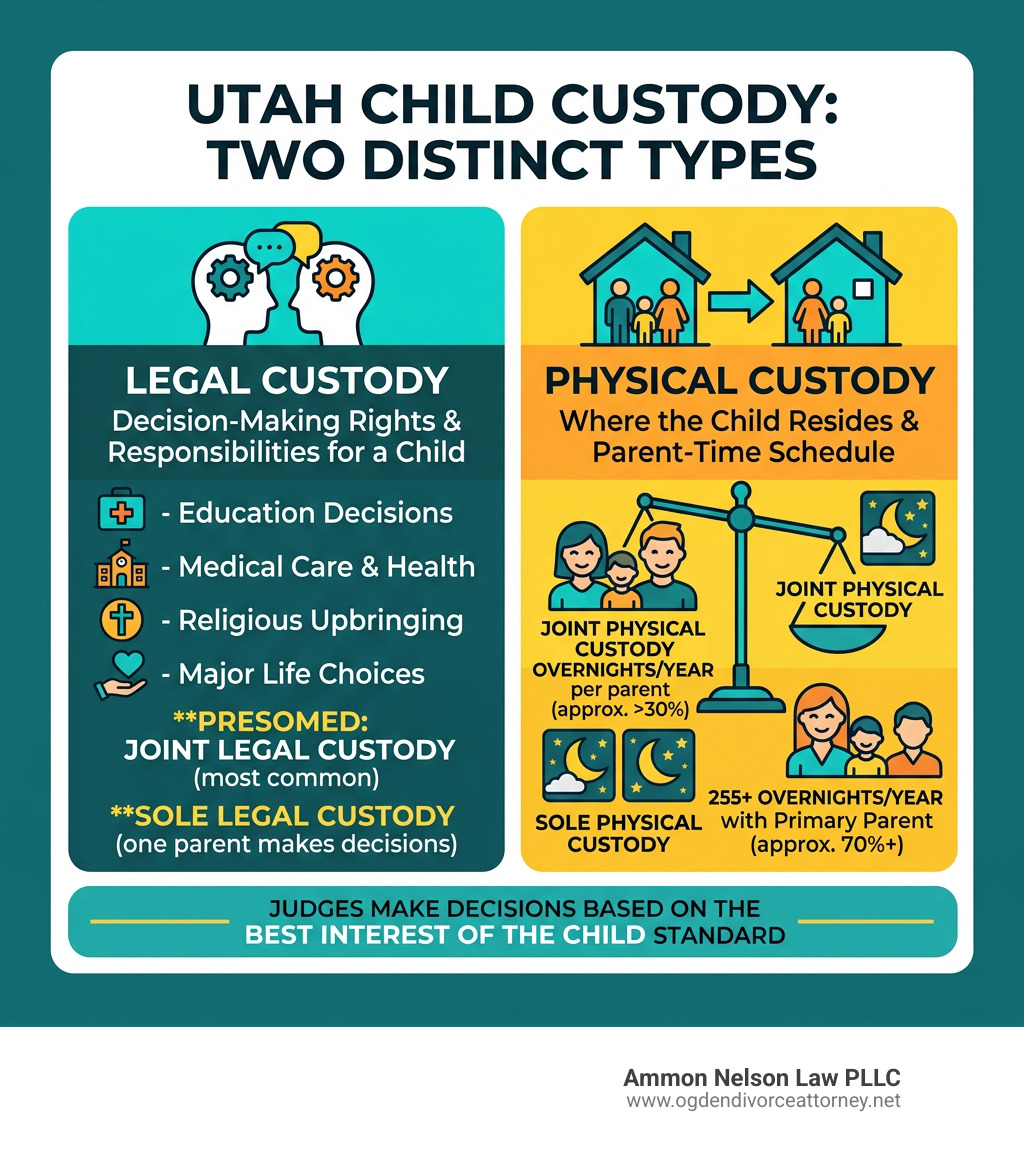
Infographic explaining the difference between legal and physical custody in Utah, with overnight thresholds - child custody

Understanding the Framework of Child Custody Laws in Utah

Gavel and law books representing Utah child custody statutes - child custody laws in utah

When we sit down with clients in our Ogden or Salt Lake City offices, the first thing we clarify is that “custody” isn’t just one thing. In Utah, the law splits custody into two distinct categories: legal and physical. Understanding this framework is essential because you could have joint legal custody but sole physical custody, or vice versa (though the latter is rare).

The state recently overhauled its statutes, renumbering many sections under Title 81. This update aims to streamline how we approach Understanding Child Custody Laws in Utah. Whether you are going through a Divorce Two Types of Custody situation or a parentage case, these definitions remain the same.

Custody Type Overnight Threshold Percentage of Year
Sole Physical One parent has 255+ nights 70% or more
Joint Physical Each parent has 111+ nights More than 30%
Split Custody Siblings are divided between parents Varies per child

Legal vs. Physical Child Custody Laws in Utah

Legal custody is all about decision-making. It involves the right to have a say in the “big three” areas of a child’s life: education (which school they attend), healthcare (major medical treatments or surgeries), and religious upbringing. In most cases, Utah judges prefer joint legal custody, meaning parents must consult each other and reach a shared decision.

Physical custody refers to where the child actually lives. This is determined by the number of overnight stays. The court looks at information on the best interest factors to decide if a child should have a primary residence with one parent or move between two homes frequently.

Sole vs. Joint Custody Thresholds

The “magic number” in Utah is 111. To have Joint Custody in a physical sense, each parent must have the child for at least 111 overnights per year. If one parent has 110 nights or fewer, the other parent is considered to have sole physical custody.

Why does this matter? Beyond just the time spent with your child, these thresholds significantly impact child support calculations. If you are seeking The Ultimate Guide to Winning Sole Custody in Utah, you are generally looking at a situation where the child stays with you for 255 nights or more (70% of the year).

How Utah Courts Determine the Best Interest of the Child

In Utah, there is no “default” parent. The law is gender-neutral; neither mothers nor fathers have an automatic advantage. Instead, every decision is guided by the “best interest of the child” standard.

Under Utah Code Section 81-9-204, a judge will evaluate dozens of factors. These aren’t just checked off a list; they are weighed based on the specific needs of your family. We often help clients navigate these Custody Considerations to ensure their strongest arguments are presented. When Children and Divorce intersect, the court’s primary goal is stability and safety.

Key factors a judge considers include:

  • The past conduct and moral character of each parent.
  • The parent’s ability to provide food, clothing, and medical care.
  • The “primary caretaker” history (who was doing the heavy lifting before the split).
  • The child’s bond with each parent and their siblings.
  • The parents’ ability to cooperate and put the child’s needs first.

The Impact of Domestic Violence on Child Custody Laws in Utah

Safety is the court’s highest priority. While Utah law presumes joint legal custody is best, this presumption is completely rebutted if there is evidence of domestic violence, neglect, or abuse. If a parent has a history of violence, we work diligently to implement safety planning.

If you are in immediate danger, please reach out to the National Domestic Violence Hotline. In court, evidence of abuse can lead to supervised visitation or, in extreme cases, a complete denial of parent-time. Understanding How to Get Full Custody often starts with documenting these safety concerns to protect the children.

Navigating Parent-Time and the 50/50 Custody Statute

In Utah, the term parent-time is used instead of “visitation” in most custody cases. That wording matters because it reflects the idea that both parents are actively involved in raising the child. Utah law now addresses parent-time under the updated custody statutes, including Utah Code Section 81-9-302, which outlines minimum parent-time schedules.

Utah law also allows for a 50/50 split if it’s in the child’s best interest and both parents have been actively involved. This change has shifted the landscape of Visitation Rights and significantly impacts Child Support calculations, as equal time often results in lower support transfers between households.

Standard Minimum Parent-Time Schedules

If parents can’t agree on a schedule, Utah law provides several “fall-back” options. These are found in Utah Code Section 81-9-302 and subsequent sections:

  1. Children Under 5: These schedules are more gradual, recognizing that younger children may struggle with long periods away from a primary caregiver.
  2. Children 5 to 18 (Standard): This typically includes one weekday evening and alternating weekends.
  3. The 145-Night Schedule: An “expanded” schedule that offers more time than the minimum but less than a full 50/50 split.

These schedules also include detailed holiday rotations (alternating odd and even years) and extended summer breaks. For families with Special Needs Children, we often customize these schedules to ensure the child’s routine remains as consistent as possible.

Requirements for a Utah Parenting Plan

Whenever joint custody is requested, Utah law requires a formal written parenting plan. This isn’t just a calendar; it’s a roadmap for how you will raise your child while living apart.

A valid parenting plan must include:

  • A residential schedule (where the child is every day).
  • A plan for major holidays and school breaks.
  • Provisions for decision-making authority.
  • A dispute resolution process (like mediation) to handle future disagreements.
  • Relocation provisions.

You can find links to court forms to help start this process, but we recommend having an attorney review your plan. A well-drafted plan is one of the best ways of Helping Your Child Cope with Divorce because it reduces parental conflict.

Relocation, Modifications, and Enforcing Custody Orders

Life changes. People get new jobs, remarry, or simply need a fresh start. However, when children are involved, you can’t just pack up and go. Utah has a specific “150-mile rule.” If a parent intends to move 150 miles or more away from the other parent, they must provide 60 days’ advance written notice to the court and the other parent.

This often triggers a hearing on Relocation Custody. If the move isn’t in the child’s best interest, the court might even change who has primary physical custody. For cases involving moves out of state, we handle Interstate International Custody and Recovery to ensure Utah’s orders are respected across borders.

Modifying an Existing Custody Order

To change a final custody order, you must prove two things:

  1. There has been a material and substantial change in circumstances since the last order was signed.
  2. The change is in the best interest of the child.

A “substantial changes” might include a parent’s remarriage, a change in a parent’s work schedule, or a child’s maturing needs. If you believe your current arrangement no longer works, we can help you file a petition for Custody modification.

Enforcement and Violations

What happens if the other parent refuses to follow the schedule? In Utah, you cannot “self-help” by withholding child support if you aren’t getting your parent-time. Instead, you must file a Motion to Enforce.

The court has several tools to handle violations:

  • Make-up parent-time: Giving you back the days you lost.
  • Contempt of court: Fines or even jail time for the offending parent.
  • Attorney fees: Ordering the other parent to pay your legal costs.

You can find more information about custody and parentage through various legal aid resources, but prompt action is usually necessary to stop a pattern of interference.

Frequently Asked Questions about Utah Custody

What are the steps involved in filing for custody in Utah?

The process begins with filing a Petition for Custody (or a Petition for Divorce if you are married) in the district court where the child lives. The other parent must be served with a summons. Both parents are required to attend a mandatory parenting course. From there, the case usually moves to mediation. If you can’t agree, the case goes to trial where a judge makes the final call. During this time, we also help clients figure out How to Obtain Child Support to ensure the child’s financial needs are met.

Can a parent with a history of domestic violence get parent-time?

Yes, but it is often restricted. The court believes that, generally, children benefit from a relationship with both parents, but safety is paramount. A judge will look at the best interest factors and may order supervised visitation. This might take place at a professional facility or with a designated supervisor. Evidence of rehabilitation, such as completing domestic violence transition programs or therapy, is often required before a parent can move toward unsupervised time. Resources like NNEDV.org provide additional context on how survivors can navigate these legal waters.

Are there special rules for children conceived from sexual assault?

Utah law is very strict here. Under Utah Code 81-9-104, a person convicted of sexual assault that resulted in the conception of the child is generally barred from having custody or parent-time rights. This is designed to ensure the safety of the survivor and the child. In many of these cases, the court may move to terminate parental rights entirely to protect the family unit.

Conclusion

Navigating child custody laws in Utah is a journey no parent should take alone. The rules are complex, the emotions are high, and the outcome will shape your child’s future for years to come. At Ammon Nelson Law PLLC, we are dedicated to providing customized, results-driven representation for families throughout Northern Utah.

Whether you are in Ogden or Salt Lake City, our goal is to protect your rights and your children’s well-being. Don’t leave your family’s future to chance. Contact an experienced Utah custody attorney today to schedule your consultation and start building a stable future for your children.

Filed Under: Custody Tagged With: agreement

Why Understanding Utah Sole Custody Cases is Critical for Your Family’s Future

Utah sole custody cases are among the most challenging family law matters to win. Here’s what you need to know right away:

Quick Facts About Utah Sole Custody:

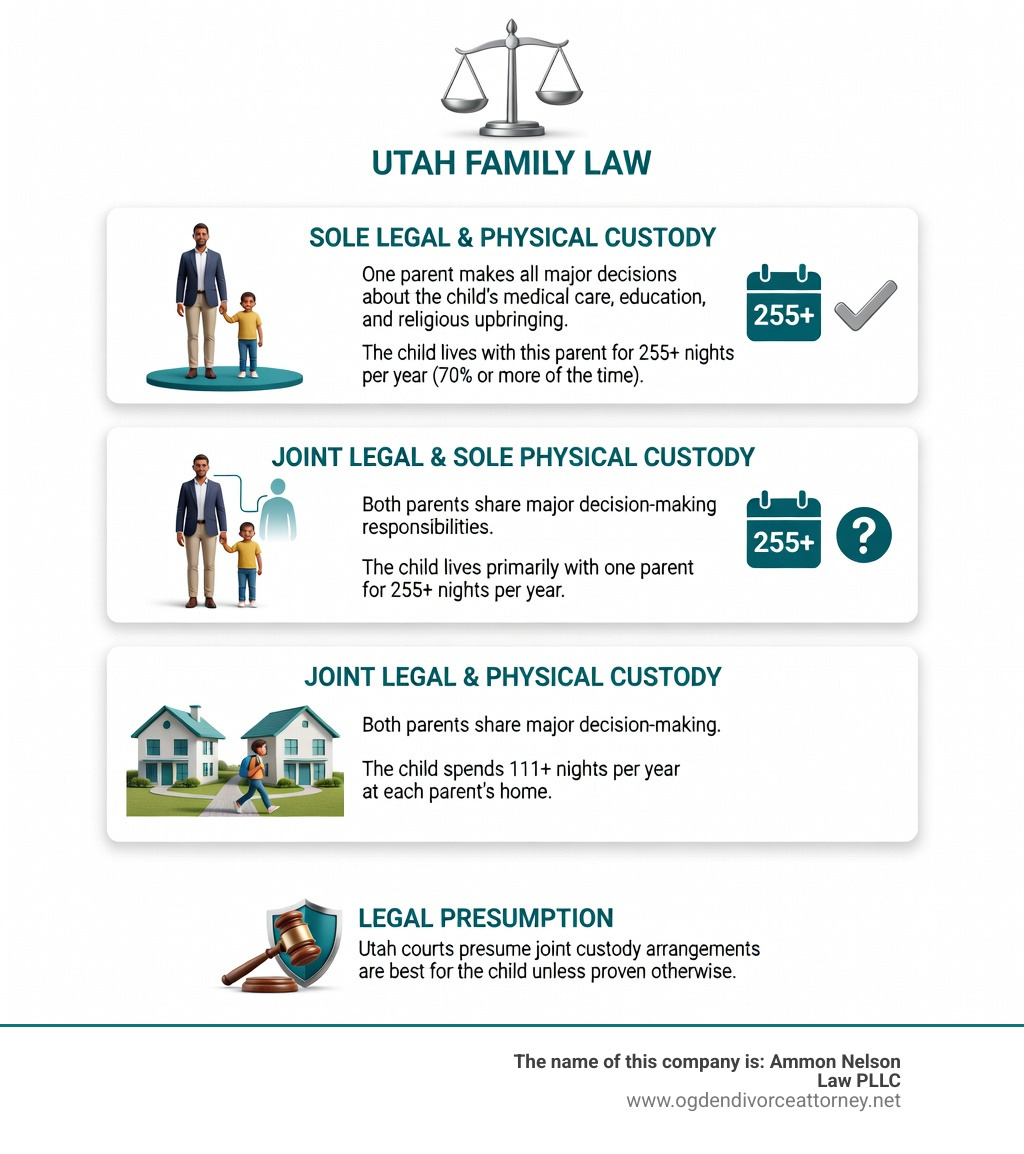
  • Sole physical custody means your child lives with you at least 255 nights per year (70% or more of the time)
  • Sole legal custody means you alone make major decisions about your child’s medical care, education, and religious upbringing
  • Joint custody is presumed – Utah courts start with the assumption that joint legal custody serves children best
  • You must prove otherwise – To win sole custody, you need clear evidence that joint custody would harm your child
  • Key evidence includes domestic violence, substance abuse, neglect, parental unfitness, or geographic distance between parents

The end of a relationship is difficult, especially when children are involved. In Utah, you’re fighting against a legal system designed to keep both parents actively involved in a child’s life. The court won’t award sole custody just because you prefer it or because you and your ex don’t get along. You need compelling evidence that sole custody protects your child’s welfare.

This creates real challenges for parents who genuinely need sole custody to protect their children. The burden of proof falls on you to demonstrate why the standard joint custody arrangement won’t work. You’ll need to gather evidence, steer court procedures, attend mediation, and potentially go to trial – all while managing the emotional stress of protecting your child.

At Ammon Nelson Law, PLLC, we’ve guided countless families through Utah sole custody cases across Northern Utah, helping parents build strong cases that prioritize their children’s safety and wellbeing. My firm combines traditional legal expertise with modern technology to provide clear, effective representation when your family’s future is on the line.

Infographic showing Utah custody types: Sole Legal and Physical Custody (one parent makes all major decisions and child lives with them 255+ nights/year), Joint Legal and Sole Physical Custody (both parents make decisions but child lives primarily with one parent 255+ nights/year), Joint Legal and Physical Custody (both parents make decisions and child lives at each home 111+ nights/year), and the legal presumption favoring joint custody arrangements - utah sole custody cases infographic

Understanding Sole Legal and Physical Custody in Utah

When we talk about Utah sole custody cases, we have to break the concept of “custody” into two distinct buckets: legal and physical. In Utah, these are treated separately, though they often overlap in sole custody awards.

parent and child in a safe home environment - utah sole custody cases

Legal Custody: The Power to Decide

Legal custody refers to the right and responsibility to make major life decisions for your child. This isn’t about what they eat for lunch; it’s about the big stuff. If you are awarded sole legal custody, you have the final say on:

  • Education: Which school they attend or if they are homeschooled.
  • Healthcare: Decisions regarding elective surgeries, vaccinations, and mental health therapy.
  • Religion: Which religious practices the child will be raised with.

Physical Custody: Where the Child Lives

Physical custody refers to the actual residence of the child. When a court awards sole physical custody, the child lives primarily with one parent. However, this doesn’t mean the other parent disappears (more on that later).

According to Utah Code Section 81-1-101, a “custodial parent” is defined based on where the child spends their nights. Understanding the difference between these types is vital, as explored in our guide on Divorce: Two Types of Custody.

Feature Sole Custody Joint Custody
Primary Residence One parent’s home (255+ nights) Both parents’ homes (at least 111 nights each)
Major Decisions One parent decides Parents must agree/consult
Parent-Time Usually scheduled for non-custodial parent Shared more equally
Legal Presumption Must be proven as “best interest” Default starting point for courts

Defining Sole Physical Custody in Utah Sole Custody Cases

In the eyes of Utah law, physical custody is a numbers game. To be considered the sole physical custodian, the child must reside with you for more than 70% of the year. Specifically, this means the child spends 255 nights or more at your home.

If the other parent has the child for 111 nights or more (roughly 30%), the state considers it “joint physical custody.” This distinction is critical because it impacts everything from child support calculations to the daily routine of the child. You can read more about these definitions on our Custody page.

Decision-Making Authority in Utah Sole Custody Cases

One of the most common reasons parents tell us, “I Want Sole Custody,” is because they cannot agree with the other parent on fundamental issues. If you have sole legal custody, you are the “tie-breaker” by default—actually, there is no tie to break because you hold the authority.

In many Utah sole custody cases, a judge might award “Joint Legal Custody” but give one parent “final decision-making authority” over specific areas, like education, if the parents are prone to deadlocking. However, true sole legal custody is usually reserved for cases where one parent is completely unavailable, incapacitated, or deemed unfit to participate in the child’s upbringing.

Why Winning Utah Sole Custody Cases is Challenging

If you walk into a courtroom in Ogden or Salt Lake City and simply say, “I’m the better parent,” you aren’t going to win sole custody. Utah law has a very strong “rebuttable presumption” that joint legal custody is in the best interest of the child.

The Rebuttable Presumption

A “rebuttable presumption” means the judge starts the case assuming that both parents should be involved in decision-making. It is your job to “rebut” or disprove that assumption with cold, hard evidence. The court’s primary concern is never the parent’s feelings; it is always the “best interest of the child.”

Utah Code Section 81-9-204 outlines the factors a judge must look at. These include the past conduct of the parents, their emotional stability, and their ability to put the child’s needs first. For a deeper dive, see our article on Understanding Child Custody Laws in Utah.

Overcoming the Preference for Joint Custody

To overcome this preference, we must show the court that joint custody is actually harmful or impossible. Common reasons a judge might move away from Joint Custody include:

  • Parental Unfitness: Issues like chronic substance abuse or untreated severe mental illness.
  • Geographic Distance: If one parent lives in Northern Utah and the other lives in Florida, joint physical custody (111 nights each) is logistically impossible once the child is school-aged.
  • Domestic Violence: This is a major factor that can immediately shift the court’s perspective on what is “safe” for the child.
  • Special Needs: If a child has profound medical or educational needs that require a level of stability and consistency that a two-home shuffle cannot provide.

Key Factors and Evidence for Awarding Sole Custody

Winning Utah sole custody cases requires a mountain of evidence. You cannot rely on hearsay or “he said, she said” arguments. The court needs documentation.

The “Big Three”: Abuse, Neglect, and Substance Abuse

The most straightforward (though tragic) way to secure sole custody is by proving the other parent is a danger to the child. Under Utah Code 81-9-104, the court must consider evidence of:

  1. Domestic Violence: Whether directed at the child, the other parent, or even another household member.
  2. Neglect: Failure to provide food, clothing, shelter, or medical care.
  3. Abuse: Physical, sexual, or emotional harm.

If these factors are present, the court may not only award sole custody but also order “supervised parent-time” to ensure the child is never left alone with the dangerous parent. We discuss these heavy topics further in our Custody Considerations guide.

Proving the Best Interest of the Child in Utah Sole Custody Cases

Beyond the “Big Three,” the court looks at the “Best Interest Factors.” This is a holistic view of the child’s life.

  • Stability: Who has been the primary caregiver? Who takes the child to doctor appointments and parent-teacher conferences?
  • Moral Conduct: While Utah courts don’t judge parents for having a new partner, they do care if that partner is a convicted felon or if the parent’s lifestyle exposes the child to harmful situations.
  • Child’s Desires: If the child is at least 14 years old, the judge will give their preference “added weight,” though it is not the deciding factor.
  • Financial Stability: While a parent’s wealth isn’t a reason to award custody, the ability to provide a stable, clean home is.

To learn more about building this part of your case, check out How to Get Full Custody. You may also want to review the official factors for custody evaluators used by the state.

The Legal Process of Seeking Sole Custody

Seeking sole custody isn’t just about showing up to court. It’s a structured, often lengthy legal journey.

Step 1: Filing the Petition

The process begins when we file a “Petition for Custody” (or a Petition for Divorce if you are married). This document tells the court exactly what you want and why. Along with the petition, a Domestic Relations Injunction is automatically issued. This order prevents either parent from doing anything drastic, like moving the kids out of state or canceling insurance, while the case is pending.

Step 2: Service of Process

The other parent must be “served”—formally given the papers. They then have 21 days (if they live in Utah) or 30 days (if they live elsewhere) to file an “Answer.” If they don’t respond, you might win by “default,” but that is rare in contested Utah sole custody cases.

Step 3: Mediation

Utah law requires parents to attempt mediation before going to trial. A neutral third party helps you try to reach an agreement. If you can agree on sole custody here, the process is much faster and cheaper. If not, the case moves toward trial.

Step 4: Temporary Orders

Because court cases take time, we often ask for a “Temporary Order.” This sets the rules for custody and child support right now while we wait for the final trial.

You can find many of the necessary Utah Court Forms online, but we highly recommend having an attorney review them to ensure you aren’t accidentally signing away your rights.

The Role of Custody Evaluations and Trials

If mediation fails, the judge needs more information. This is where a Custody Evaluation comes in.

Under Rule 4-903, the court can appoint a professional (usually a psychologist) to investigate your family. They will:

  • Interview both parents.
  • Observe the parents with the child.
  • Talk to “collateral contacts” like teachers and doctors.
  • Review medical and school records.

The evaluator then writes a report recommending who should have custody. While the judge doesn’t have to follow this report, they usually do. For more detail, read the official Information on Utah custody evaluations.

Rights of the Non-Custodial Parent and Order Modifications

Even if you win sole physical custody, the other parent usually retains “parent-time” (the legal term for visitation).

Parent-Time Schedules

In Utah sole custody cases, the non-custodial parent is typically entitled to a minimum schedule outlined in Utah Code Section 81-9-302. For children ages 5-18, this usually includes:

  • One weekday evening.
  • Alternating weekends.
  • Holidays and several weeks in the summer.

If the non-custodial parent is dangerous, we can fight for “supervised parent-time,” where a third party must be present during all visits.

Modifying an Existing Custody Decree

Life changes. A parent who was stable two years ago might struggle with addiction today. Or, a parent who was “unfit” may have completed rehab and turned their life around.

To change a custody order, you must prove:

  1. There has been a substantial and material change in circumstances.
  2. The modification is in the best interest of the child.

Moving to a new house in the same neighborhood isn’t a “substantial change.” Moving 200 miles away or a parent getting arrested is. You can find more on this in the Utah Courts Custody Guide.

Frequently Asked Questions about Utah Sole Custody Cases

Can a history of domestic violence guarantee sole custody?

While it is a massive factor, it is not an automatic “guarantee.” The court will look at how recent the violence was, whether it was directed at the child, and if the parent has sought treatment. However, Utah law takes this very seriously. If you are in immediate danger, please contact the National Domestic Violence Hotline or local Northern Utah law enforcement immediately.

How does a parent’s relocation affect sole custody?

Utah has a “150-mile rule.” If a parent plans to move more than 150 miles away, they must provide 60 days’ notice to the other parent and the court. This often triggers a review of the custody arrangement because the existing schedule will no longer work. The court will use the factors in Utah Code Section 81-9-207 to decide if the child should move with the relocating parent or stay with the other parent.

At what age can a child choose which parent to live with?

In Utah, a child never gets to make the final choice until they are 18. However, once a child turns 14, the judge is legally required to give their desires “added weight.” The judge will still look at why the child wants to live with a certain parent. If the child wants to live with Dad because Dad has no rules and lets them skip school, the judge will likely ignore that preference.

Conclusion: Partnering with Ammon Nelson Law PLLC

Navigating Utah sole custody cases is an emotional marathon. Whether you are in Ogden, Salt Lake City, or anywhere in Northern Utah, you don’t have to run it alone.

At Ammon Nelson Law PLLC, we provide customized, results-driven representation. We understand that every family is different, and we are dedicated to protecting the bonds that matter most. We don’t just fill out paperwork; we build a strategy designed to show the court exactly why your proposed arrangement is what’s best for your child.

If you are ready to take the next step in securing your child’s future, we are here to help. Contact an Ogden Divorce Attorney at our office today to schedule a consultation and begin building your case.

Filed Under: Custody Tagged With: attorney

Divorce is a challenging chapter in life, and understanding the legal process is essential for a smoother transition. If you’re considering or facing a divorce in Utah, this guide will walk you through the key steps and considerations involved in the divorce process in the Beehive State.

Divorce process in Utah. How to navigate divorce so your separation has little negative effect on the children.
The Divorce Process in Utah

Understanding Grounds for Divorce in Utah:

Utah recognizes both fault and no-fault grounds for divorce. No-fault grounds generally involve irreconcilable differences, while fault-based grounds may include issues like adultery, abandonment, or cruelty. Understanding the grounds relevant to your situation is crucial as it can influence various aspects of the divorce proceedings.

Filing for Divorce:

The divorce process begins with filing a petition in the district court where either spouse resides. Utah has residency requirements, and one of the spouses must have been a resident of the state for at least three months before filing. Detailing the grounds, as well as the desired outcomes in terms of child custody, alimony, and property division, is a critical step in the filing process.

Temporary Orders:

Upon filing, spouses may request temporary orders to address immediate concerns such as child custody, support, and property use during the divorce proceedings. Temporary orders provide stability and set the tone for the ongoing legal process.

Mediation and Alternative Dispute Resolution:

Utah encourages mediation as a means of resolving disputes outside of the courtroom. Mediation can be a more amicable and cost-effective way to reach agreements on issues like child custody, visitation, and division of assets. Mediation has become a mandatory part of every divorce case, and it is often beneficial in facilitating communication and compromise.

Discovery Process:

Discovery involves the exchange of information between spouses, including financial records, property valuations, and any other relevant documents. This phase ensures that both parties have a comprehensive understanding of the marital estate, aiding in fair and equitable distribution. Discovery starts immediately upon the filing of an answer with the Rule 26.1 Initial Disclosure rules. These disclosures are crucial to a case, and failing to complete them can damage your claim.

Division of Marital Assets:

Utah follows the principle of equitable distribution, meaning that marital assets are divided fairly, though not necessarily equally. Factors such as the duration of the marriage, each party’s financial contributions, and the presence of minor children are considered in determining a fair distribution.

Child Custody and Support:

Utah prioritizes the best interests of the child when determining custody arrangements.  A decision about legal custody and physical custody will be made regarding the children. Factors such as the child’s relationship with each parent, the parents’ ability to provide a stable environment, and the child’s wishes (depending on age) are considered. Child support is calculated based on the income of both parents and the amount of time each parent is granted with the children.

Alimony Considerations:

Spousal support, or alimony, may be awarded based on factors such as the length of the marriage, the financial needs of the recipient spouse, and the paying spouse’s ability to contribute. Understanding the criteria for alimony can help spouses anticipate potential outcomes. Consulting a qualified attorney can also help understand the complex area of alimony.

Finalizing the Divorce:

Once all issues are resolved, either through negotiation, mediation, or trial, the court will issue a final divorce decree. This legal document outlines the terms of the divorce, including child custody arrangements, support obligations, and the division of assets. The divorce decree will be binding on both parties.

Navigating the divorce process in Utah requires careful consideration of legal requirements, effective communication, and a commitment to finding fair and amicable resolutions. While divorce is undoubtedly challenging, being informed about the process can empower you to make sound decisions that pave the way for a more positive post-divorce future. If you have specific questions or concerns, consulting with an experienced family law attorney can provide valuable guidance tailored to your unique situation. At Ammon Nelson Law, PLLC all we do is family law. Our attorneys have years of experience, and they can provide quality advice and representation during your divorce matter.

Filed Under: Child Support, Custody, Divorce, Family Law Tagged With: alimony, attorney, Child support, children, custody, divorce, divorce decree, Divorce lawyer, divorce process, legal custody, visitation

  • 1
  • 2
  • Next Page »

Ogden Location

1492 East Ridgeline Dr., Suite 3
South Ogden, UT 84405
Phone: 801.337.4355
Fax: 801.337.0737
Email: ammon@ammonnelsonlaw.com

Monday9:00 AM - 6:00 PM
Tuesday9:00 AM - 6:00 PM
Wednesday9:00 AM - 6:00 PM
Thursday9:00 AM - 6:00 PM
Friday9:00 AM - 6:00 PM
SaturdayAvailable for Emergencies
SundayClosed

Directions

Navigation

  • Family Law
  • Divorce
  • Child Custody
  • Child Support
  • Spousal Support

Follow Us

Ammon Nelson Law - Facebook Ammon Nelson Law - Twitter Ammon Nelson Law - YouTube Ammon Nelson Law - Instagram

2022 Ammon Nelson Law | All Rights Reserved | Privacy Policy | Terms | XML Sitemap | Site by PDM