
What You Need to Know About Alimony in Utah
Alimony in Utah is a court-ordered payment from a higher-earning spouse to a lower-earning spouse — either during the divorce process or after it is finalized — to help prevent financial hardship.
Here is a quick overview of how it works:
| Topic | Key Facts |
|---|---|
| Who can receive it | Either spouse — alimony is gender-neutral in Utah |
| How the amount is set | No formula; judges weigh financial need, earning capacity, marriage length, and more |
| How long it lasts | Generally no longer than the length of the marriage |
| When it ends | Remarriage, death, or proven cohabitation of the recipient |
| Can it be changed | Yes, if there is a substantial and material change in circumstances |
| Tax rules | For divorces after December 31, 2018, alimony is not tax-deductible for the payer |
Divorce is already one of the most stressful events a family can go through. Add an income gap between spouses, and the financial pressure can feel overwhelming — especially if you are a parent trying to keep stability for your kids.
The reality is that alimony is not automatic, it is not only for women, and it is rarely permanent. As one way to think about it: Utah courts are trying to cover “two beds with one blanket.” The goal is to keep both spouses as financially stable as possible after a split — even if that means both make sacrifices early on.
I’m Ammon Nelson, a Utah family law attorney and founder of Ammon Nelson Law PLLC, and I have helped countless clients across Northern Utah navigate the complexities of alimony in Utah — whether they are seeking support or facing a claim against them. In this guide, I will walk you through everything you need to know, from how courts calculate awards to how to enforce or modify an order.
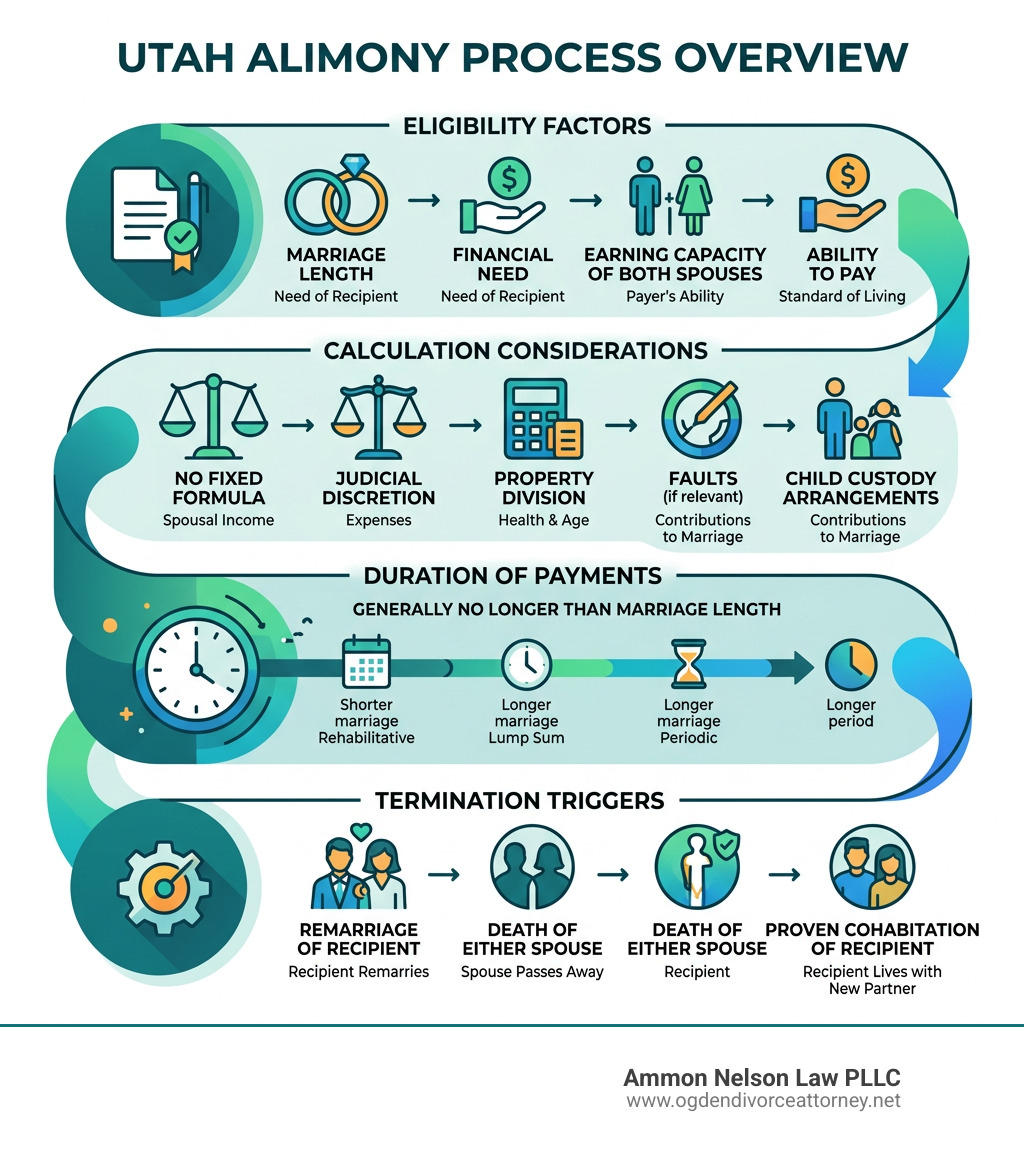
Basic alimony in Utah glossary:
Understanding Alimony in Utah: Purpose and Eligibility
In the legal world, we often refer to alimony as “spousal support.” Its primary purpose is to ensure that the end of a marriage doesn’t leave one person in total financial ruin while the other continues to thrive. Think of it as a bridge designed to help the lower-earning spouse transition into a self-sufficient life.
Historically, alimony was almost exclusively awarded to women, but those days are gone. Under Utah Code Title 81, Chapter 4, Part 5, the law is strictly gender-neutral. Whether you are a husband or a wife, you have the right to request support if the financial circumstances justify it. This shift reflects the modern reality where 40% of U.S. households now have female breadwinners.
The core philosophy behind alimony in Utah is fairness. If one spouse spent decades supporting the other’s career or raising children, the court recognizes that they contributed to the “marital unit” and shouldn’t be penalized for that sacrifice. For a deeper dive into these principles, you can check out The Essential Guide to Alimony Law in Utah.
Who Qualifies for Support?
Eligibility isn’t just about who made more money; it’s about economic dependency. According to Alimony – Utah Courts, the judge looks at several specific factors to see if someone qualifies:
- Financial Condition and Needs: Does the requesting spouse have enough income to cover their basic monthly expenses?
- Earning Capacity: What is the person’s ability to work? This includes their education, past work history, and whether they have been out of the workforce for a long time.
- Ability to Pay: Can the other spouse actually afford to help? You can’t get “blood out of a turnip,” as the saying goes. If the higher earner is also struggling to make ends meet, the award may be small or non-existent.
- Custodial Status: If you are the primary caregiver for minor children, the court considers how that affects your ability to work full-time.
Common Myths About Alimony in Utah
There are plenty of “water cooler” myths about divorce that can lead to a lot of unnecessary anxiety. Let’s clear a few up:
- “Everyone gets alimony.” In reality, alimony is awarded in only about 10% of U.S. divorces today. It is far less common than it was in the 1960s when fewer women worked outside the home.
- “Alimony is for life.” Permanent alimony is extremely rare in Utah. Most awards are designed to be temporary.
- “If I get child support, I can’t get alimony.” This is false. They are two separate calculations. While child support is for the kids, alimony is for the spouse.
- “It’s all up to the judge.” Actually, over 90% of divorces in Utah are settled through mediation or negotiation without ever going to trial. You and your spouse have a lot of power to decide these terms yourselves.
For more myth-busting, see our article Alimony in Utah: A Guide to Spousal Support.
How Courts Determine and Calculate Awards
Unlike child support, which uses a very strict mathematical formula, alimony in Utah is much more subjective. Judges have a lot of discretion. To make a decision, they rely heavily on “Financial Declarations”—documents where both parties list every penny of income and every expense, from mortgage payments to the cost of a haircut.
Under Utah Code 81-4-503, the court must enter specific findings regarding the needs of the recipient and the ability of the payer. If a judge decides to “impute” income (meaning they assume you could be making more than you currently are), they have to explain exactly why.
| Factor | What the Court Looks For |
|---|---|
| Standard of Living | The lifestyle you enjoyed at the time of separation. |
| Itemized Expenses | Your actual monthly costs (rent, utilities, food, insurance). |
| Income from All Sources | Not just your paycheck, but also dividends, rent, or side hustles. |
| Debts | You cannot intentionally rack up debt just to avoid paying alimony. |
For a more detailed breakdown, visit our page on Spousal Support.
The Role of Fault and Misconduct
Utah is technically a “no-fault” divorce state, meaning you don’t have to prove your spouse did something wrong to get a divorce. However, alimony in Utah is one of the few areas where “fault” still matters.
Under current Utah law, the court may consider fault when deciding alimony under Utah Code 81-4-503. Fault can include:
- Adultery: Infidelity that substantially contributed to the breakup of the marriage.
- Physical Harm: Domestic violence or abuse directed at a spouse or children.
- Financial Undermining: Hiding assets, depleting marital funds, or otherwise damaging the other spouse’s financial position.
While fault can increase or decrease an award, it isn’t meant to be “punitive.” The court isn’t there to fine someone for being a bad partner; they are there to address the financial damage caused by that behavior. Learn more at Utah Alimony and Domestic Violence: The Legal Connection Explained.
Standard of Living and Income Equalization
The goal of the court is to keep both spouses as close as possible to the “marital standard of living.” If you lived in a million-dollar home in Ogden and vacationed in Europe every summer, the court will try to ensure the lower-earning spouse doesn’t end up in a tiny apartment while the other keeps the mansion.
In marriages lasting 10 years or more, there is often a presumption that the court should try to equalize the standards of living. This is especially true if one spouse has “diminished workplace experience” because they stayed home to care for the couple’s children. The law recognizes that “two beds with one blanket” is hard, and if there isn’t enough money to go around, both parties should share the financial burden equally.
Duration and Different Types of Support

Not all alimony looks the same. Depending on your situation, the court might order one of several types:
- Temporary Alimony (Alimony Pendente Lite): This is paid while the divorce is still moving through the courts. It ensures the lower-earning spouse can pay their bills until a final decree is signed.
- Rehabilitative Support: This is the most common type. It’s intended to last just long enough for the recipient to get back on their feet—perhaps by finishing a degree or completing job training.
- Alimony in Solido (Lump-Sum): Instead of monthly payments, the payer gives one large sum or a specific piece of property. This is great for “clean breaks” where the parties never want to deal with each other again.
If you have a Pre and Post-Nuptial Agreement, these documents can often override the court’s standard rules, provided they were signed voluntarily and aren’t completely unfair.
Duration Limits for Alimony in Utah
One of the most important rules in Alimony – Utah State Courts is that alimony generally cannot last longer than the length of the marriage.
If you were married for 12 years, your alimony will typically cap at 12 years. There are “extenuating circumstances” that might allow a judge to extend this, such as a permanent disability or a very long-term marriage (30+ years) where the recipient is elderly and cannot work.
Transitional and Lump-Sum Alimony
In shorter marriages (typically under 5-8 years), the court is less likely to award long-term support. Instead, they might focus on “transitional” help. For example, if one spouse moved to Salt Lake City and quit their job to support the other’s career, the court might order a few months of alimony to cover moving costs or “re-entry” into the workforce.
Lump-sum payments are also common if the paying spouse is self-employed or has an irregular income, making monthly payments difficult to track.
Modifying and Terminating Alimony Orders
Life changes, and your divorce decree can change with it. In Utah, alimony orders are not set in stone unless the decree specifically says they are “non-modifiable.”
To change an order, you must prove a substantial and material change in circumstances. This isn’t just a small raise at work; it needs to be something significant that wasn’t expected when the divorce happened.
Common triggers for modification or termination include:
- Retirement: Under Utah Code 81-4-503, reaching full retirement age is generally considered a valid reason to review and likely reduce or end alimony payments.
- Involuntary Job Loss: If the payer loses their job through no fault of their own, they can petition the court for a reduction.
- Increased Need: If the recipient becomes disabled and can no longer work, they might ask for an increase.
For help with these changes, see Spousal Support / Post Judgement Enforcement & Modification.
Remarriage and Death
Under Utah Code 81-4-504(3), alimony automatically terminates if the recipient spouse remarries. You don’t even need to go back to court to stop the checks—the obligation ends the day they say “I do.” However, the payer is still responsible for any “arrears” (past-due money) owed before the wedding date. Alimony also ends automatically if either the payer or the recipient dies.
Cohabitation and the One-Year Rule
This is where things get tricky. If the recipient starts living with a new romantic partner, alimony can be terminated. However, this is not automatic. The paying spouse must file a motion and prove that cohabitation is occurring.
In Utah, “cohabitation” means living together in a relationship that looks like a marriage (sharing expenses, sleeping in the same bed, staying there regularly). You have one year from the date you discovered (or should have known) about the cohabitation to file a motion to terminate. If you wait longer than a year, you may lose your right to end support on those grounds.
Enforcement and Tax Implications
If your ex-spouse stops paying, you shouldn’t just sit back and hope they start again. You have legal tools to collect what you are owed.
Enforcing Alimony in Utah Orders
The primary tool for enforcement is a Motion for an Order to Show Cause. This essentially asks the judge to hold the non-paying spouse in “contempt of court.” If the judge finds they have the money but are simply refusing to pay, the consequences can be severe:
- Judgments: The court can issue a money judgment that accrues interest.
- Wage Garnishment: Money can be taken directly out of their paycheck.
- Bank Levies: The court can freeze and seize funds from their bank accounts.
- Jail Time: In extreme cases of willful refusal, a person can be sent to jail.
We always recommend keeping a clear, unemotional paper trail of all payments and missed dates. Professionalism goes a long way in court.
Handling Out-of-State Orders
If your divorce happened in another state but your ex now lives in Ogden or Salt Lake City, you can still enforce the order here. Under the Uniform Interstate Family Support Act (UIFSA), you must first “register” the foreign order in a Utah court. Once registered, Utah authorities can use all the enforcement tools mentioned above to ensure you get paid.
Tax Implications (The 2019 Shift)
One of the biggest changes to alimony in Utah happened at the federal level.
- For divorces finalized BEFORE January 1, 2019: The person paying alimony could deduct it from their taxes, and the person receiving it had to report it as taxable income.
- For divorces finalized AFTER January 1, 2019: Alimony is no longer tax-deductible for the payer, and it is “tax-free” for the recipient.
This is a massive shift that has changed how we negotiate settlements. Because the payer is now using “after-tax” dollars, they often push for lower monthly amounts.
Frequently Asked Questions about Alimony in Utah
Does adultery automatically disqualify a spouse from receiving alimony?
No. Adultery does not automatically bar a spouse from receiving alimony in Utah. Under Utah Code 81-4-503, the court may consider fault, including adultery, when deciding whether to award support and in what amount. But fault is only one factor. Judges still weigh need, ability to pay, and other circumstances, so a spouse who committed adultery may still receive alimony in some cases.
How does the court handle a spouse who is intentionally unemployed?
If a spouse quits their job or takes a lower-paying position just to avoid paying (or to try to get more) alimony, the court can “impute” income. This means the judge looks at their skills and job market and says, “I am going to pretend you are making $60,000 a year because you could be,” and calculates alimony based on that number.
Can alimony be changed if the paying spouse retires?
Yes. Retirement is specifically mentioned in Utah law as a “substantial material change.” If the payer reaches a reasonable retirement age (usually 65-67) and their income drops significantly, the court will almost always review the alimony order. Unless the original divorce decree specifically forbade changes upon retirement, the payments will likely be reduced or ended.
Conclusion
Navigating alimony in Utah is rarely a straightforward process. Whether you are trying to ensure your financial future after a long marriage or you are concerned about the impact of support payments on your own ability to move forward, having the right legal guidance is essential.
At Ammon Nelson Law PLLC, we provide customized, results-driven representation for clients throughout Northern Utah. From our offices in Ogden and Salt Lake City, we help you understand the nuances of Spousal Support and fight for a fair outcome that protects your interests.
If you are facing a divorce or need to modify an existing order, don’t leave your financial future to chance. Contact us today to discuss your case and learn how we can help you find stability in the next chapter of your life.