
What You Need to Know About Child Custody Laws in Utah (Quick Overview)
Child custody laws in Utah govern how parents share rights and responsibilities for their children after a separation or divorce. Here is a quick breakdown of the key rules:
- Two types of custody: Legal custody (who makes major decisions) and physical custody (where the child lives)
- Joint legal custody is presumed to be in the child’s best interest unless there is evidence of domestic violence, abuse, or other rebutting factors
- Joint physical custody requires each parent to have the child for at least 111 overnights per year (more than 30% of the year)
- Sole physical custody means one parent has the child for 255 or more nights per year (70%+)
- Three statutory parent-time schedule options: Standard minimum, 60/40, or 50/50 equal parent-time (added in May 2021)
- Relocation rule: A parent moving 150 miles or more must give 60 days’ written notice
- Best interest of the child is the standard every Utah judge uses to make custody decisions
- Children 14 and older have their custody preferences given added weight by the court
If you are going through a custody dispute in Utah, the stakes are high — and the rules are detailed. Whether you are trying to protect your parenting rights, negotiate a fair schedule, or understand what a judge will look at, knowing the law is your first step.
I’m Ammon Nelson, a Utah family law attorney with years of experience helping parents navigate child custody laws in Utah through some of the most difficult moments of their lives. I’ve seen how the right information — and the right representation — can make all the difference for families across Northern Utah.
Understanding the Framework of Child Custody Laws in Utah

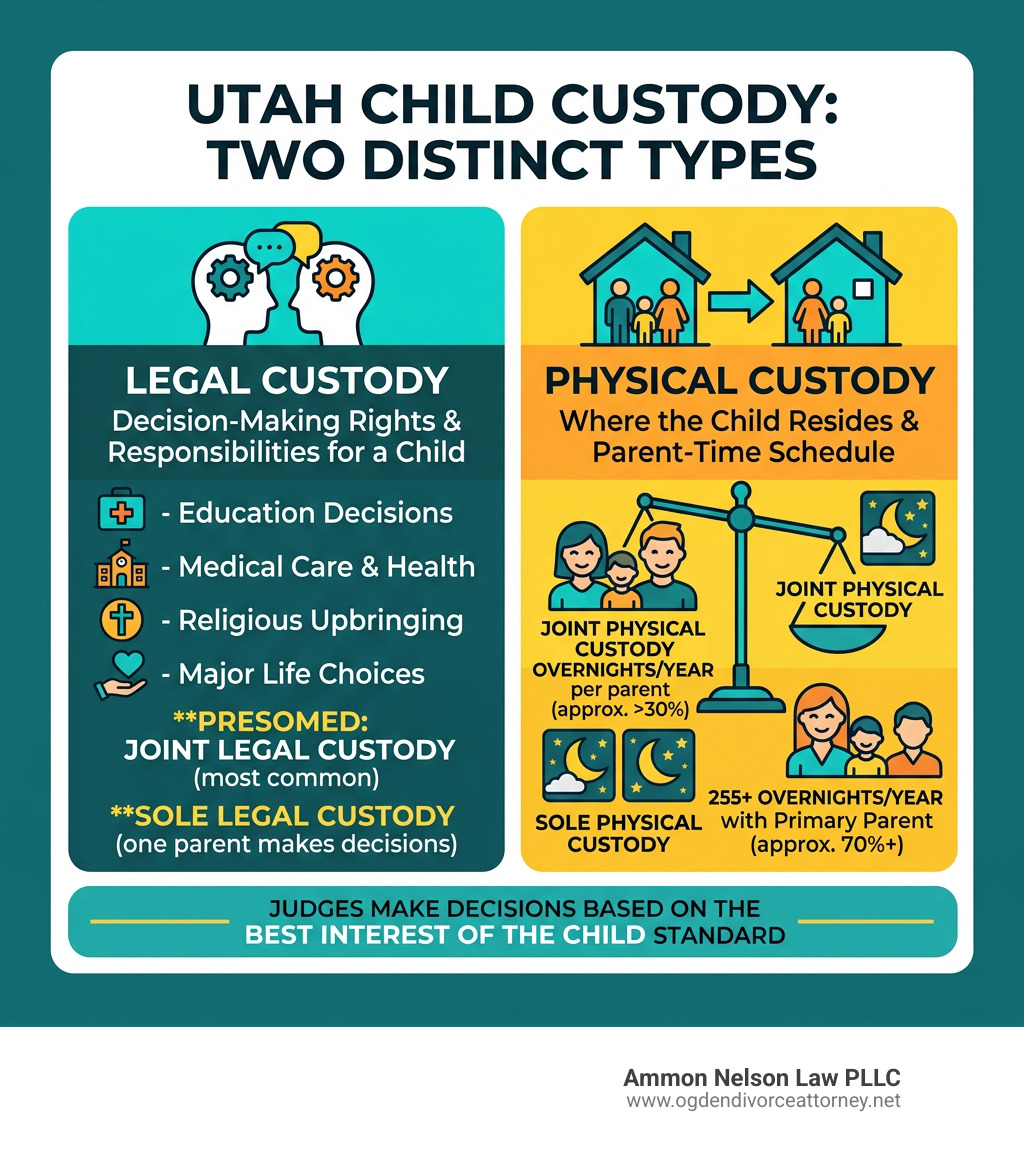
When we sit down with clients in our Ogden or Salt Lake City offices, the first thing we clarify is that “custody” isn’t just one thing. In Utah, the law splits custody into two distinct categories: legal and physical. Understanding this framework is essential because you could have joint legal custody but sole physical custody, or vice versa (though the latter is rare).
The state recently overhauled its statutes, renumbering many sections under Title 81. This update aims to streamline how we approach Understanding Child Custody Laws in Utah. Whether you are going through a Divorce Two Types of Custody situation or a parentage case, these definitions remain the same.
| Custody Type | Overnight Threshold | Percentage of Year |
|---|---|---|
| Sole Physical | One parent has 255+ nights | 70% or more |
| Joint Physical | Each parent has 111+ nights | More than 30% |
| Split Custody | Siblings are divided between parents | Varies per child |
Legal vs. Physical Child Custody Laws in Utah
Legal custody is all about decision-making. It involves the right to have a say in the “big three” areas of a child’s life: education (which school they attend), healthcare (major medical treatments or surgeries), and religious upbringing. In most cases, Utah judges prefer joint legal custody, meaning parents must consult each other and reach a shared decision.
Physical custody refers to where the child actually lives. This is determined by the number of overnight stays. The court looks at information on the best interest factors to decide if a child should have a primary residence with one parent or move between two homes frequently.
Sole vs. Joint Custody Thresholds
The “magic number” in Utah is 111. To have Joint Custody in a physical sense, each parent must have the child for at least 111 overnights per year. If one parent has 110 nights or fewer, the other parent is considered to have sole physical custody.
Why does this matter? Beyond just the time spent with your child, these thresholds significantly impact child support calculations. If you are seeking The Ultimate Guide to Winning Sole Custody in Utah, you are generally looking at a situation where the child stays with you for 255 nights or more (70% of the year).
How Utah Courts Determine the Best Interest of the Child
In Utah, there is no “default” parent. The law is gender-neutral; neither mothers nor fathers have an automatic advantage. Instead, every decision is guided by the “best interest of the child” standard.
Under Utah Code Section 81-9-204, a judge will evaluate dozens of factors. These aren’t just checked off a list; they are weighed based on the specific needs of your family. We often help clients navigate these Custody Considerations to ensure their strongest arguments are presented. When Children and Divorce intersect, the court’s primary goal is stability and safety.
Key factors a judge considers include:
- The past conduct and moral character of each parent.
- The parent’s ability to provide food, clothing, and medical care.
- The “primary caretaker” history (who was doing the heavy lifting before the split).
- The child’s bond with each parent and their siblings.
- The parents’ ability to cooperate and put the child’s needs first.
The Impact of Domestic Violence on Child Custody Laws in Utah
Safety is the court’s highest priority. While Utah law presumes joint legal custody is best, this presumption is completely rebutted if there is evidence of domestic violence, neglect, or abuse. If a parent has a history of violence, we work diligently to implement safety planning.
If you are in immediate danger, please reach out to the National Domestic Violence Hotline. In court, evidence of abuse can lead to supervised visitation or, in extreme cases, a complete denial of parent-time. Understanding How to Get Full Custody often starts with documenting these safety concerns to protect the children.
Navigating Parent-Time and the 50/50 Custody Statute
In Utah, the term parent-time is used instead of “visitation” in most custody cases. That wording matters because it reflects the idea that both parents are actively involved in raising the child. Utah law now addresses parent-time under the updated custody statutes, including Utah Code Section 81-9-302, which outlines minimum parent-time schedules.
Utah law also allows for a 50/50 split if it’s in the child’s best interest and both parents have been actively involved. This change has shifted the landscape of Visitation Rights and significantly impacts Child Support calculations, as equal time often results in lower support transfers between households.
Standard Minimum Parent-Time Schedules
If parents can’t agree on a schedule, Utah law provides several “fall-back” options. These are found in Utah Code Section 81-9-302 and subsequent sections:
- Children Under 5: These schedules are more gradual, recognizing that younger children may struggle with long periods away from a primary caregiver.
- Children 5 to 18 (Standard): This typically includes one weekday evening and alternating weekends.
- The 145-Night Schedule: An “expanded” schedule that offers more time than the minimum but less than a full 50/50 split.
These schedules also include detailed holiday rotations (alternating odd and even years) and extended summer breaks. For families with Special Needs Children, we often customize these schedules to ensure the child’s routine remains as consistent as possible.
Requirements for a Utah Parenting Plan
Whenever joint custody is requested, Utah law requires a formal written parenting plan. This isn’t just a calendar; it’s a roadmap for how you will raise your child while living apart.
A valid parenting plan must include:
- A residential schedule (where the child is every day).
- A plan for major holidays and school breaks.
- Provisions for decision-making authority.
- A dispute resolution process (like mediation) to handle future disagreements.
- Relocation provisions.
You can find links to court forms to help start this process, but we recommend having an attorney review your plan. A well-drafted plan is one of the best ways of Helping Your Child Cope with Divorce because it reduces parental conflict.
Relocation, Modifications, and Enforcing Custody Orders
Life changes. People get new jobs, remarry, or simply need a fresh start. However, when children are involved, you can’t just pack up and go. Utah has a specific “150-mile rule.” If a parent intends to move 150 miles or more away from the other parent, they must provide 60 days’ advance written notice to the court and the other parent.
This often triggers a hearing on Relocation Custody. If the move isn’t in the child’s best interest, the court might even change who has primary physical custody. For cases involving moves out of state, we handle Interstate International Custody and Recovery to ensure Utah’s orders are respected across borders.
Modifying an Existing Custody Order
To change a final custody order, you must prove two things:
- There has been a material and substantial change in circumstances since the last order was signed.
- The change is in the best interest of the child.
A “substantial changes” might include a parent’s remarriage, a change in a parent’s work schedule, or a child’s maturing needs. If you believe your current arrangement no longer works, we can help you file a petition for Custody modification.
Enforcement and Violations
What happens if the other parent refuses to follow the schedule? In Utah, you cannot “self-help” by withholding child support if you aren’t getting your parent-time. Instead, you must file a Motion to Enforce.
The court has several tools to handle violations:
- Make-up parent-time: Giving you back the days you lost.
- Contempt of court: Fines or even jail time for the offending parent.
- Attorney fees: Ordering the other parent to pay your legal costs.
You can find more information about custody and parentage through various legal aid resources, but prompt action is usually necessary to stop a pattern of interference.
Frequently Asked Questions about Utah Custody
What are the steps involved in filing for custody in Utah?
The process begins with filing a Petition for Custody (or a Petition for Divorce if you are married) in the district court where the child lives. The other parent must be served with a summons. Both parents are required to attend a mandatory parenting course. From there, the case usually moves to mediation. If you can’t agree, the case goes to trial where a judge makes the final call. During this time, we also help clients figure out How to Obtain Child Support to ensure the child’s financial needs are met.
Can a parent with a history of domestic violence get parent-time?
Yes, but it is often restricted. The court believes that, generally, children benefit from a relationship with both parents, but safety is paramount. A judge will look at the best interest factors and may order supervised visitation. This might take place at a professional facility or with a designated supervisor. Evidence of rehabilitation, such as completing domestic violence transition programs or therapy, is often required before a parent can move toward unsupervised time. Resources like NNEDV.org provide additional context on how survivors can navigate these legal waters.
Are there special rules for children conceived from sexual assault?
Utah law is very strict here. Under Utah Code 81-9-104, a person convicted of sexual assault that resulted in the conception of the child is generally barred from having custody or parent-time rights. This is designed to ensure the safety of the survivor and the child. In many of these cases, the court may move to terminate parental rights entirely to protect the family unit.
Conclusion
Navigating child custody laws in Utah is a journey no parent should take alone. The rules are complex, the emotions are high, and the outcome will shape your child’s future for years to come. At Ammon Nelson Law PLLC, we are dedicated to providing customized, results-driven representation for families throughout Northern Utah.
Whether you are in Ogden or Salt Lake City, our goal is to protect your rights and your children’s well-being. Don’t leave your family’s future to chance. Contact an experienced Utah custody attorney today to schedule your consultation and start building a stable future for your children.