When You Need a Guardianship Attorney in Salt Lake City
A guardianship attorney Salt Lake residents rely on can help you get legal authority to protect a loved one who can no longer care for themselves — whether that’s a child, an elderly parent, or an adult with a disability.
Here’s what you need to know fast:
- Guardianship gives you legal authority over a person’s daily care, medical decisions, and living arrangements
- Conservatorship gives you authority over a person’s finances and property
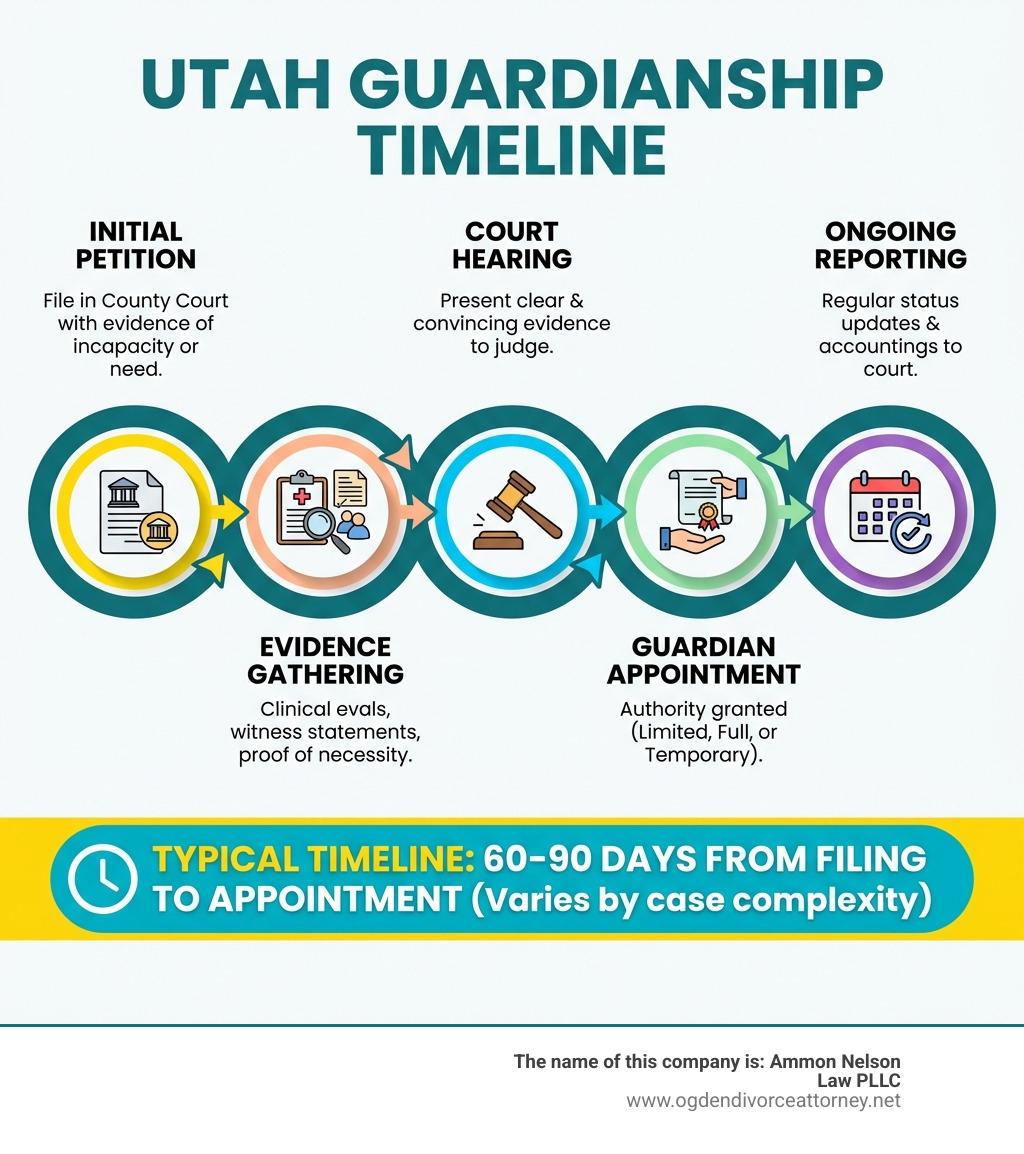
- You file a petition in Utah’s probate court to start the process
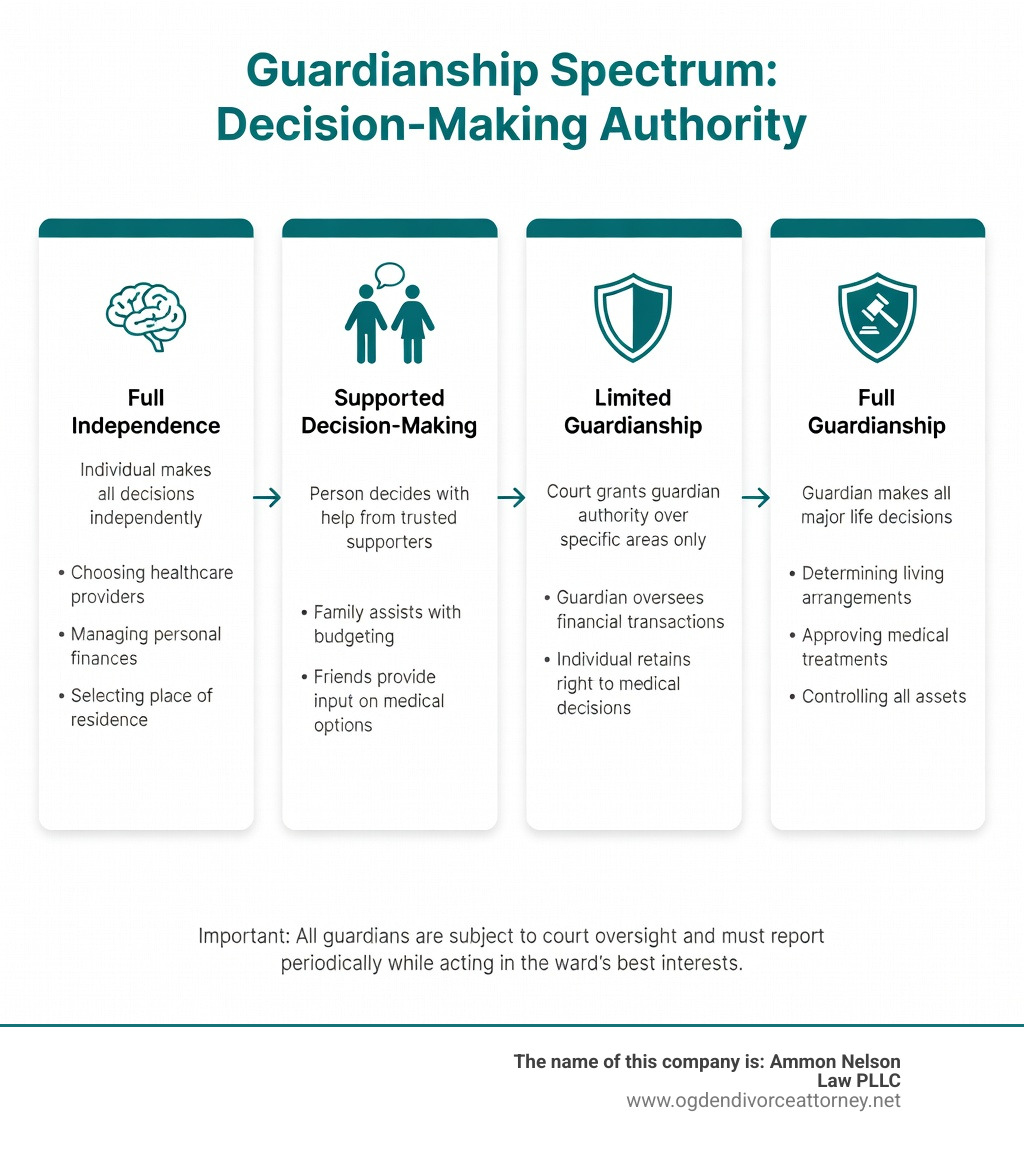
- Utah prefers limited guardianships over full guardianships — courts only grant full authority when truly necessary
- A court hearing is always required — you cannot establish guardianship voluntarily like a power of attorney
- Salt Lake District Court cases may require mandatory mediation before a hearing
Guardianship cases can be emotionally exhausting. You’re trying to protect someone you love while navigating a court system that has strict rules, deadlines, and documentation requirements. One wrong step can delay the process — or worse, put your loved one at risk.
I’m Ammon Nelson, and my firm has helped Utah families navigate complex guardianship and family law matters for years, including cases right here in Salt Lake. As a guardianship attorney practicing in Salt Lake families have turned to, I understand how much is at stake when you’re trying to protect the people you love.
Understanding Guardianship vs. Conservatorship in Utah
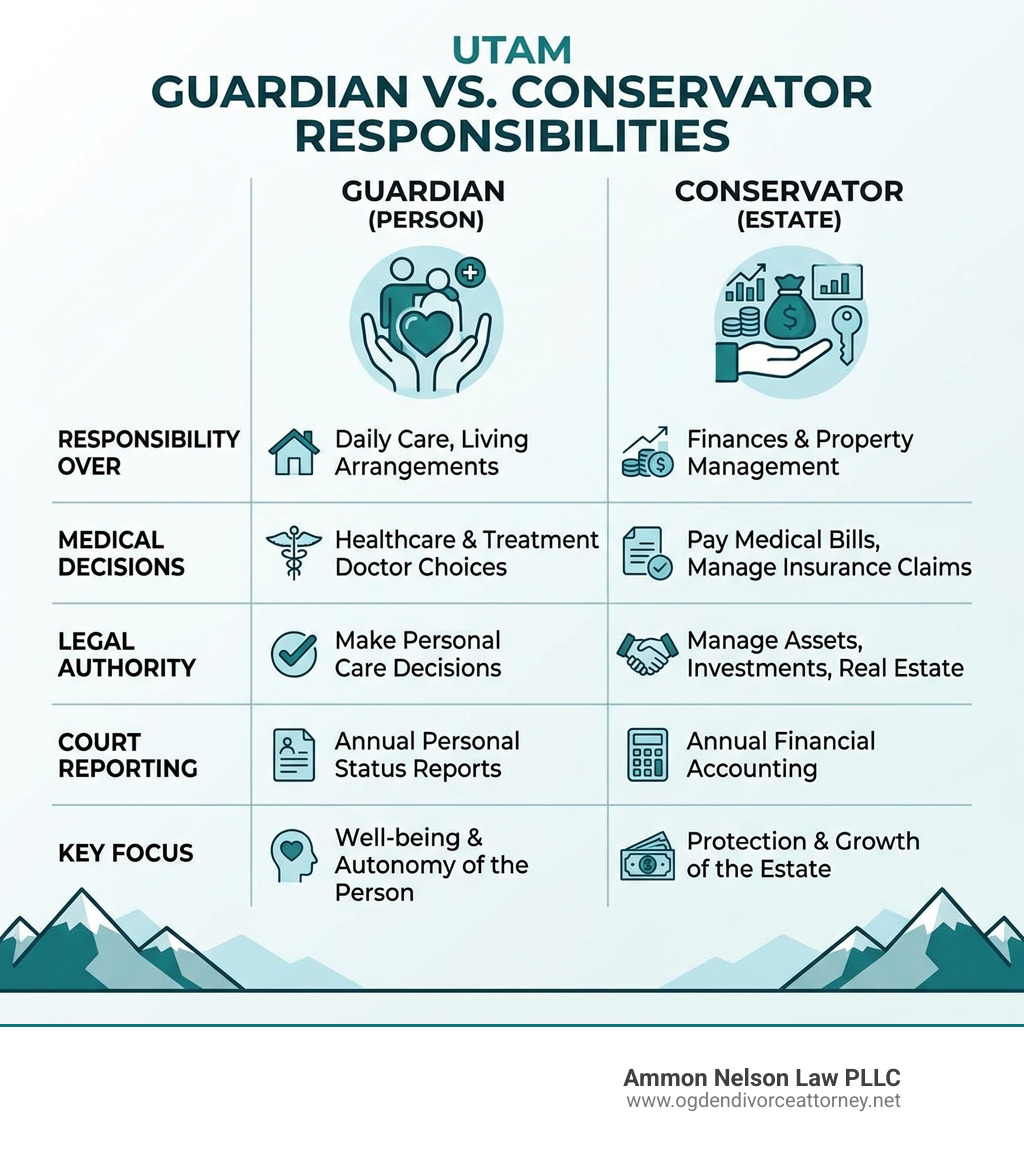
In Utah, the law makes a very clear distinction between caring for a person and caring for their checkbook. While these roles often overlap and are frequently held by the same person, they are legally distinct appointments.
A Guardian is responsible for the “person.” This means making decisions about where they live, what they eat, their medical care, and their general education or daily activities. A Conservator, on the other hand, is the person appointed to manage the “estate.” This involves protecting assets, paying bills, managing investments, and handling property.
When we talk about the person being cared for, the law uses specific terms. A ward is generally a minor under guardianship, while a protected person is typically an adult who has been determined to lack the capacity to manage their own affairs.
One unique nuance in Utah law involves minors. If a minor is set to receive an inheritance or insurance settlement, a conservator is usually required if the estate exceeds $10,000. If the amount is below this threshold, the guardian often assumes these duties automatically. However, for larger sums, the court wants the added layer of financial oversight that a conservatorship provides.
It is also important to note that Utah law strongly favors limited guardianships. The court’s goal is to leave the protected person with as much autonomy as possible. A guardianship attorney Salt Lake will tell you that the court must make a specific finding to grant a “full” guardianship, essentially proving that the person is incapable of making any safe decisions for themselves.
Distinguishing Guardianship from Adoption
We often see families confuse guardianship with adoption, especially when it comes to grandchildren or nieces and nephews. While both provide a stable home for a child, they are legally worlds apart.
In an adoption, parental rights are permanently terminated, and the adoptive parents become the legal parents in every sense. In a guardianship, the biological parents may retain their parental rights, including the right to visit the child and the ongoing financial responsibility to provide support. Guardianship is often seen as a more flexible, sometimes temporary solution when a parent is incarcerated, ill, or otherwise unable to provide daily care.
When a Guardianship Attorney Salt Lake is Necessary
You might find yourself needing a guardianship attorney Salt Lake in several common scenarios:
- Aging Parents: When a parent develops dementia or Alzheimer’s and did not sign a Power of Attorney while they were still competent.
- Special Needs Adults: When a child with developmental disabilities turns 18, their parents lose the legal right to make medical or financial decisions for them unless a guardianship is established.
- Parental Incapacity: If a parent is struggling with substance abuse or severe mental health issues and can no longer provide a safe environment for their children.
- Emergency Situations: If a loved one is suddenly incapacitated by an accident and immediate medical or financial decisions must be made.
Choosing the right advocate is vital. You want someone who understands the local Salt Lake City court culture. How to Choose the Best Utah Estate Planning Attorney for Your Family often comes down to finding a firm that balances technical legal skill with genuine compassion for the family dynamic.
The Legal Process: How a Guardianship Attorney Salt Lake Navigates the Courts
Navigating the Utah court system isn’t as simple as filling out a one-page form. It is a formal judicial proceeding that requires strict adherence to American Bar Association Standards and Utah statutory requirements.
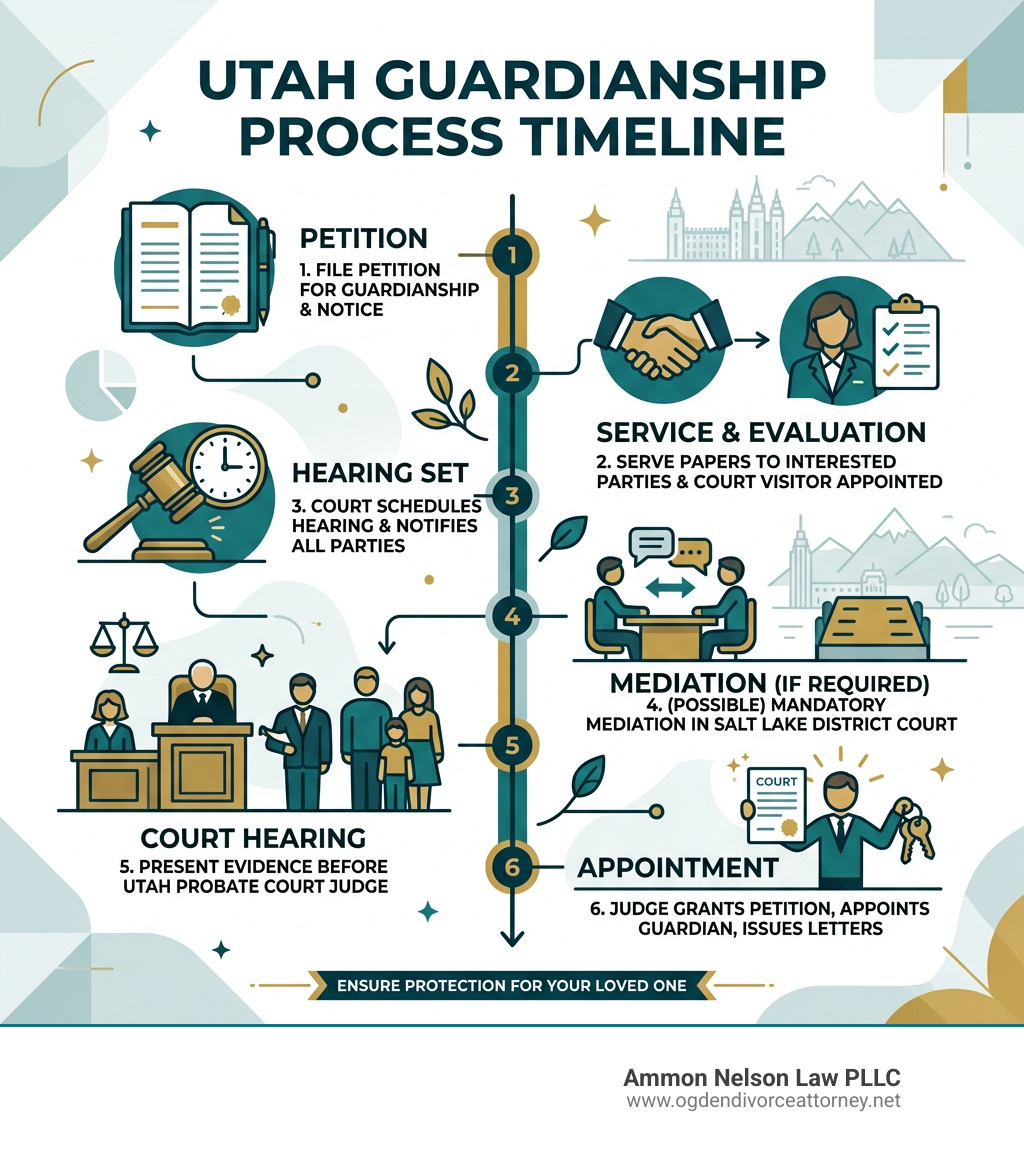
The process begins with filing a formal petition in the district court where the proposed protected person lives. Once filed, you must provide “notice” to all interested parties. This isn’t just a courtesy; it’s a legal requirement to ensure that family members have a chance to object if they feel the guardianship isn’t in the person’s best interest.
Utah law also establishes a “priority of appointment.” The court doesn’t just pick a name out of a hat. Priority generally follows this order:
- A person designated in the ward’s Advance Health Care Directive.
- The spouse.
- An adult child.
- A parent.
- A relative the person has lived with for more than six months.
If you are trying to jump the line—for example, if you are a sibling trying to become a guardian instead of a spouse—you will need a very strong legal argument and evidence as to why the person with higher priority is not fit to serve.
Determining Incapacity and the Petitioner Test
To appoint a guardian for an adult, the court must find that the person is “incapacitated.” This requires clear evidence, usually in the form of a letter or report from a doctor or psychologist. The court may also appoint a “court visitor”—a neutral third party who interviews the protected person and reports back to the judge about whether a guardianship is actually needed.
But the scrutiny isn’t just on the protected person; it’s on you, too. In Utah, any person petitioning to be a guardian must pass a “petitioner competency test.” This is a basic exam to ensure you understand your legal duties, the reporting requirements, and the weight of the responsibility you are taking on. We maintain high standards of Inns of Court Professionalism to ensure our clients are fully prepared for this evaluation.
Mandatory Mediation and Court Hearings
If you are filing in the Salt Lake District Court, be prepared for mandatory mediation. The courts here prefer that families try to work out disputes—such as who should be the guardian or what the visitation schedule looks like—outside of a courtroom.
If mediation fails, the case goes to a formal hearing. The protected person has significant due process rights. They are entitled to be present, to be represented by their own attorney (which the court will appoint if they don’t have one), and to cross-examine witnesses. This is where having an experienced guardianship attorney Salt Lake becomes indispensable. We advocate for your position while ensuring all legal “i’s” are dotted and “t’s” are crossed.
Responsibilities and Ongoing Duties of a Utah Guardian
Once the judge signs the order, your work is just beginning. Being a guardian is a fiduciary role, meaning you are held to the highest standard of trust and care under the law.
As a guardian, your primary duty is to provide for the ward’s care, comfort, and maintenance. This includes:
- Deciding where they live (aiming for the least restrictive environment).
- Consenting to medical treatment.
- Ensuring their daily needs for food, clothing, and social interaction are met.
- Making end-of-life decisions if no Advance Directive exists.
One of the most critical Guardianship and Conservatorship Services we provide is helping our clients stay compliant with the court. You are required to file an Annual Status Report. This report tells the court where the ward is living, how their health is, and why the guardianship should continue. If you miss these filings, the court can remove you or even hold you in contempt.
Managing Financial Affairs as a Conservator
If you are also appointed as a conservator, your record-keeping must be impeccable. You are essentially the CFO of the protected person’s life. You must:
- File an initial inventory of all assets within 90 days.
- Keep the protected person’s money separate from your own (no commingling!).
- Obtain court approval before selling major assets, like a home.
- Provide a regular accounting of every penny that comes in and goes out.
Managing these finances is about more than just paying bills; it’s about asset protection. You must act in their best interest, avoiding any hint of a conflict of interest or self-dealing.
Handling Contested Cases and Terminating Guardianship
Not every guardianship goes smoothly. Sometimes, family members disagree on who should be in charge, or the protected person themselves might object to the guardianship. These “contested” cases can quickly turn into expensive and emotionally draining litigation.
In these situations, we focus on evidence-based advocacy. We look at medical records, financial statements, and witness testimony to build a case for what is truly in the best interest of the ward.
It’s also important to remember that guardianship doesn’t have to be forever. A guardianship can be modified or terminated if:
- The protected person regains capacity (for example, recovering from a temporary illness or injury).
- The minor turns 18.
- The guardian is no longer able to serve due to their own health or relocation.
- A “less restrictive alternative,” like a Power of Attorney, becomes a viable option.
Common mistakes that lead to delays include failing to give notice to the right people, submitting incomplete medical evidence, or failing the petitioner’s test. Working with a specialized attorney helps you avoid these pitfalls from day one.
Frequently Asked Questions about Guardianship in Salt Lake City
What is the difference between a full and limited guardianship in Utah?
A full guardianship gives the guardian authority over all aspects of the ward’s life. A limited guardianship only grants authority over specific areas where the person needs help—such as medical decisions or housing—while allowing them to keep rights like voting or choosing their own friends. Utah law requires the court to prefer the limited version whenever possible.
How long does the guardianship process typically take in Salt Lake County?
For a standard, uncontested guardianship, the process usually takes between 6 to 10 weeks. However, if the case is contested or if there is an emergency, the timeline can change significantly. Emergency “temporary” guardianships can sometimes be granted in a matter of days in extreme circumstances.
Can a guardianship be established without a court hearing?
No. Because guardianship involves stripping a person of their fundamental legal rights, the Utah Constitution and state statutes require a formal court hearing. You cannot simply sign a contract to become someone’s guardian; a judge must sign an order after reviewing the evidence.
Conclusion
At Ammon Nelson Law PLLC, we know that when you are looking for a guardianship attorney Salt Lake, you aren’t just looking for someone to file paperwork. You are looking for a partner to help you protect your family’s future.
Whether you are in Ogden, Salt Lake City, or anywhere in Northern Utah, we provide customized, results-driven representation. We take the time to understand the unique dynamics of your family and the specific needs of your loved one. Don’t leave your family’s safety to chance or complex legal jargon. Secure Your Family’s Future with Expert Estate Planning and guardianship advocacy that puts your loved ones first.
Contact us today at our Salt Lake or Ogden offices to schedule a consultation and take the first step toward peace of mind.