Ammon Nelson Law - Facebook Ammon Nelson Law - Twitter Ammon Nelson Law - YouTube Ammon Nelson Law - Instagram
  • About Us
  • Team
  • Contact Us
  • FAQs
  • En Español
Ammon Nelson Law

Ammon Nelson Law

Visit North Carolina Website

Call For A Consultation

801.337.4355
  • Family Law
    • Divorce
    • Child Custody
    • Child Support
    • Spousal Support
    • Special Needs Children
    • Father’s Rights
    • Visitation Rights
    • Grandparents Rights
  • Divorce
    • Annulment
    • How To File
    • No Fault Divorce
    • Uncontested Divorce
    • Contested Divorce
    • Irretrievable Breakdown & Divorce
    • Division of Intellectual Property
    • Divorce By Publication
    • Equitable Distribution
    • High-Asset Marital Estates
  • Child Custody
    • How to Get Full Custody
    • Joint Custody
    • Relocation & Custody
    • Interstate & International Custody and Recovery
  • Child Support
    • How to Obtain Child Support
  • Spousal Support
    • Pre and Post Nuptial Agreements
    • Post Judgement Enforcement Modification
    • Orders of Protection
  • Estate Planning and Probate
    • Social Security Disability
    • Estate Planning
    • Personal Injury
    • Probate
    • Guardianship and Conservatorship
  • Mediation

How to Choose the Best Utah Estate Planning Attorney for Your Family

Home » Archives for Ammon » Page 4

Why Choosing the Right Utah Estate Planning Attorney Matters for Your Family’s Future

A Utah estate planning attorney helps Utah families protect assets, avoid probate, minimize taxes, and ensure their wishes are honored through legal documents like wills, trusts, powers of attorney, and healthcare directives. The right attorney will guide you through Utah-specific laws, create customized plans for your unique family situation, and provide ongoing support as your life changes.

Key factors when choosing a Utah estate planning attorney:

  1. Experience and credentials – Look for attorneys with 20+ years of practice and specialized certifications like CELA (Certified Elder Law Attorney)
  2. Specialized focus – Choose attorneys who focus 100% on estate planning rather than general practice
  3. Client reviews – Seek firms with 5-star ratings and testimonials about personalized service
  4. Clear pricing – Expect free consultations and transparent flat-fee structures
  5. Utah law expertise – Ensure familiarity with Utah’s probate process, homestead exemptions, and trust laws

Estate planning is about more than legal documents. It’s about protecting the people you love and ensuring your family avoids painful probate processes, costly legal disputes, and unnecessary taxes. One CPA firm described a well-crafted living trust as “the best they had ever seen” – that’s the level of quality you deserve.

Without proper estate planning, Utah’s intestacy laws decide who gets your assets. Your family could face months of probate court, public disclosure of your private affairs, and frozen assets when they need financial support most. If you become incapacitated without healthcare directives, courts may appoint strangers to make medical decisions for you.

Many Utah families put off estate planning because the process feels overwhelming or they assume it’s only for the wealthy. The truth is that everyone with loved ones needs a plan – whether you own a home, have minor children, run a business, or simply want to ensure your wishes are followed.

As Ammon Nelson, I’ve helped countless Northern Utah families steer estate planning with personalized legal solutions that protect what matters most. My firm focuses on making complex legal processes simple and accessible, ensuring you understand every decision in your Utah estate planning attorney journey.
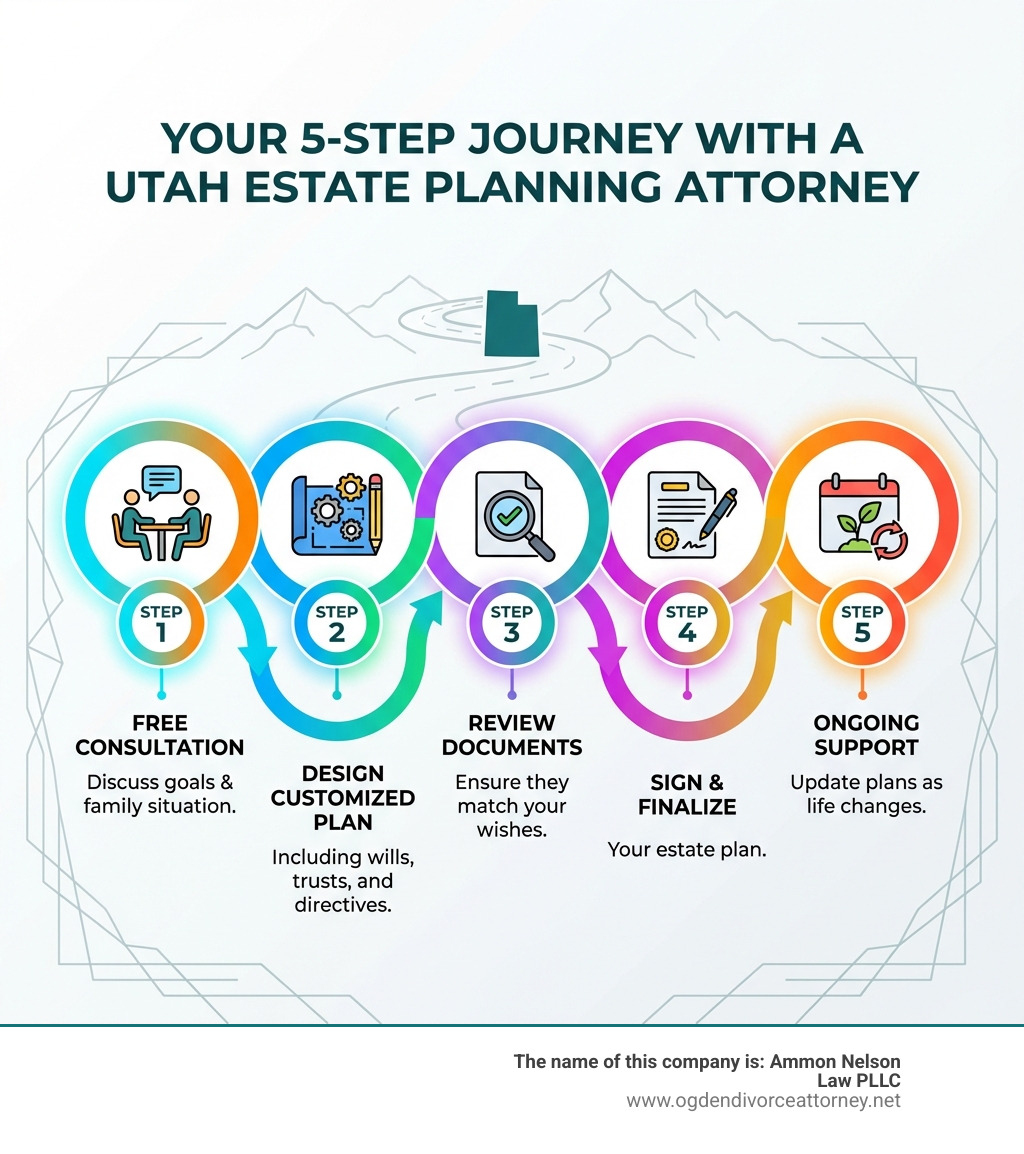
Infographic showing the 5 steps of working with a Utah estate planning attorney: 1) Free consultation to discuss goals and family situation, 2) Design customized plan including wills, trusts, and directives, 3) Review documents to ensure they match your wishes, 4) Sign and finalize your estate plan, 5) Ongoing support to update plans as life changes - utah estate planning attorney infographic

Why Estate Planning Is Essential for Utah Residents

Beautiful Utah landscape representing the legacy we leave behind - utah estate planning attorney

Living in Northern Utah, from the busy streets of Salt Lake City to the scenic foothills of Ogden, we understand the value of hard work and the importance of community. But hard work isn’t just about what you earn today; it’s about what you preserve for tomorrow. For residents in our corner of the Beehive State, estate planning isn’t just a “rich person’s problem”—it’s a vital tool for every family.

At its core, estate planning is the process of arranging the management and disposal of your estate during your life and after you pass away. We often tell our clients that it is a “gift” to their families. Why? Because without a plan, your grieving loved ones are left to steer the complex Utah legal system alone while trying to guess what you would have wanted.

A comprehensive plan addresses several critical areas:

  • Asset Distribution: Ensuring your home, savings, and personal belongings go to the specific people you choose.
  • Family Legacy: Preserving your values and providing for future generations.
  • Guardianship: If you have minor children, this is perhaps the most important part. You—not a judge—decide who will raise them if you are gone.
  • Incapacity Planning: Deciding who handles your finances and medical decisions if you become temporarily or permanently unable to do so yourself.

By working with a Utah estate planning attorney, you move from uncertainty to total control. You can find more info about estate planning services to see how these tools fit your specific Northern Utah lifestyle.

Benefits for Asset Protection and Tax Minimization

One of the biggest misconceptions we hear in our Ogden and Salt Lake City offices is that “the government will take everything.” While that’s an exaggeration, without a plan, taxes and creditors certainly can take a significant bite out of your legacy.

Asset Protection:
We live in a litigious world. Prudent decisions made today can protect your personal and professional properties from loss due to lawsuits, creditors, or bankruptcies. A multidisciplinary approach—combining estate law with asset protection strategies—shields your hard-earned wealth from “unscrupulous creditors” and even potential divorcing spouses of your heirs.

Tax Minimization:
While Utah does not have a state inheritance tax, federal estate tax laws still apply. History shows how quickly these things change. For example, in 2011, the federal estate tax exemption was $5,000,000 with a 35% tax rate on amounts exceeding it. Today’s exemptions are higher, but they are scheduled to “sunset” or decrease in the coming years.

Effective tax planning might involve:

  • Setting up specific irrevocable trusts.
  • Making charitable donations that provide tax breaks.
  • Re-titling assets to maximize the “basis step-up” (a tax concept that can save your heirs thousands in capital gains taxes).

To get started on organizing your thoughts, you can Download Your Free Workbook Below.

Key Components of a Comprehensive Utah Estate Plan

A “plan” isn’t just a single piece of paper. It’s a toolkit. Think of it like a Swiss Army knife for your future; each tool has a specific purpose.

Feature Last Will and Testament Revocable Living Trust
Probate Required? Yes No
Privacy Public Record Private
Asset Control Only after death During life and after death
Cost Lower upfront Higher upfront, lower later
Out-of-State Property Requires multiple probates Avoids out-of-state probate

1. Last Will and Testament: This is your basic roadmap. It outlines who gets what and names guardians for your kids. However, in Utah, a will must go through probate to be validated.

2. Financial Power of Attorney: This allows you to designate a “trusted agent” to handle your bills, banking, and business affairs if you can’t. Without this, your family might have to go to court to get a “conservatorship,” which is expensive and stressful.

3. Advance Healthcare Directive: In Utah, this combines what used to be called a “Living Will” and “Medical Power of Attorney.” It tells doctors your wishes for end-of-life care and names someone to speak for you.

4. Beneficiary Designations: Don’t forget your 401(k) or life insurance! These often pass outside of your will or trust, so they must be kept up to date.

For those dealing with aging parents or children with disabilities, you can find more info about guardianship and conservatorship to ensure they are protected.

Understanding Utah-Specific Laws

Utah has its own set of rules that a general online form won’t account for. For instance, the Utah Uniform Probate Code governs how estates are settled.

  • Homestead Exemptions: Utah law provides certain protections for your primary residence from creditors, which can be integrated into your estate plan.
  • Dynasty Trusts: Utah is a “trust-friendly” state. We can create trusts that last for generations, protecting wealth from taxes and creditors for your grandkids and beyond.
  • Family LLCs: For our clients in Salt Lake City and Ogden who own rental properties or businesses, a Family Limited Liability Company (LLC) can be a powerful tool to consolidate assets and provide another layer of protection.

Differences Between Wills and Trusts Under Utah Law

We often get asked, “Do I really need a trust?” While a will is a great start, a Revocable Living Trust is often the gold standard for Utah families.

A trust allows you to maintain complete control while you are alive. You can add property, take it out, or even cancel the trust entirely. But the magic happens when you pass away. Because the trust “owns” the assets, there is no need for a judge to get involved. This keeps your affairs out of the public record. In contrast, a will becomes a public document once it enters probate—meaning anyone can see what you owned and who you left it to.

If you choose a trust, we often include a “Pour-over Will.” This acts as a safety net, catching any assets you forgot to put in the trust and “pouring” them in after you pass. You can read more about living trust quality and legal documents to understand why quality drafting matters.

Navigating the Utah Probate Process and Why to Avoid It

Probate is the court-supervised process of authenticating a last will and testament if the deceased made one, or distributing assets according to state law if they didn’t. In Utah, while we have “informal probate” which is simpler than in some other states, it can still be a headache.

Why do most people want to avoid it?

  1. It’s Slow: Even a simple probate in Northern Utah can take 6 months to a year.
  2. It’s Public: Your nosy neighbor (or a predator looking for “new money” targets) can look up exactly what your heirs received.
  3. It’s Costly: Attorney fees, court costs, and personal representative fees add up quickly.
  4. Asset Freezes: Sometimes, accounts are frozen during the initial stages of probate, leaving families without cash for immediate needs.

Our goal as a utah estate planning attorney is often to help you bypass this system entirely. You can find more info about probate services if you are currently facing this process with a loved one’s estate.

How a Utah Estate Planning Attorney Uses Trusts to Avoid Probate

By “funding” a revocable living trust—which means re-titling your house, bank accounts, and investments into the name of the trust—you ensure that these assets pass directly to your beneficiaries.

This is especially critical if you own real estate outside of Utah (like a cabin in Idaho or a condo in Arizona). Without a trust, your family might have to go through probate in every single state where you owned land. A trust consolidates everything under one “umbrella,” saving your family thousands in multi-state legal fees.

The Role of a Utah Estate Planning Attorney in Trust Administration

Setting up the trust is only half the battle. When the time comes, someone has to “administer” it. This involves:

  • Fiduciary Duties: Ensuring the trustee follows the law and the trust’s instructions.
  • Record Keeping: Tracking all income and distributions.
  • Tax Compliance: Filing the necessary tax returns for the estate.
  • Avoiding Conflict: Acting as a neutral third party to explain the “why” behind your decisions to beneficiaries.

We provide legal guidance to trustees to ensure they fulfill these duties without making mistakes that could lead to personal liability or family feuds.

Specialized Planning: Business Succession, Special Needs, and Elder Law

Estate planning isn’t just about the “end.” It’s about the “now” and the “what if.”

Business Succession:
Did you know that family businesses generate an estimated one-half of the U.S. Gross National Product and pay half of all wages? If you own a business in Ogden or Salt Lake City, your business is your legacy. We help you create clear succession plans so your life’s work doesn’t crumble the moment you step away. This includes inter-generational transfers and tax-efficient strategies for selling or gifting the business.

You can read more about estate planning and contracts law to see how business and estate law overlap.

Special Needs and Elder Law Issues in Utah

For families with loved ones who have disabilities, traditional estate planning can actually be dangerous. If you leave money directly to a person receiving government benefits (like SSI or Medicaid), they could be disqualified from those benefits.

Supplemental Needs Trusts (SNTs): These allow you to provide for a loved one’s quality of life without jeopardizing their essential government support. We also look at ABLE accounts, which are tax-advantaged savings accounts for individuals with disabilities.

Elder Law: As we age, the cost of long-term care becomes a major concern. We assist with:

  • Medicaid Planning: Helping you qualify for help with nursing home costs while legally protecting assets for your spouse.
  • Long-Term Care Options: Navigating the complex world of assisted living and home care.

There’s more info about trusts for everyone because these tools are designed to protect people at every stage of life.

How to Choose a Utah Estate Planning Attorney

Choosing an attorney is a big decision. You aren’t just buying a document; you are choosing a partner for your family’s future.

What to Look for in a Utah Estate Planning Attorney

  1. Experience Levels: Look for a firm with deep roots. For example, some top Utah attorneys have over 30 or 40 years of experience. You want someone who has seen how these documents actually play out in court ten or twenty years later.
  2. Specialized Focus: Some lawyers do “a little bit of everything.” For estate planning, you want someone who lives and breathes this area of law.
  3. Client Reviews: 5-star ratings on Google tell a story. Look for words like “patient,” “knowledgeable,” and “made it simple.”
  4. Credentials: While not always necessary, look for specialized certifications like a CELA (Certified Elder Law Attorney). There are very few in Utah, and they represent the gold standard in elder law.

To help you prepare for a meeting, Download Your Estate Planning Packet Below.

Cost of Hiring a Utah Estate Planning Attorney

“How much is this going to cost?” It’s the elephant in the room. In Utah, pricing typically depends on complexity.

  • Flat Fees: Many firms offer flat-fee packages for standard estate plans (Will, Trust, Power of Attorney, etc.). This gives you peace of mind knowing the price upfront.
  • Hourly Rates: Usually reserved for complex business litigation or ongoing probate administration.
  • Free Consultations: Most reputable Utah estate planning attorney firms offer a free initial consultation. This is your chance to “interview” the lawyer and see if they are a good fit for your family.

The Risk of DIY: While “online kits” are cheap, they often fail to comply with Utah-specific laws or aren’t “funded” correctly. Saving $1,000 now could cost your family $10,000 in probate fees later. As one attorney put it, professional planning offers the “convenience of DIY but with the counsel only a human expert can provide.”

Common Mistakes and When to Update Your Plan

The biggest mistake? Doing nothing. But even if you have a plan, it can become a “zombie” document—dead, but still walking around.

Common Pitfalls:

  • Failing to Fund the Trust: A trust is like a suitcase; it only works if you put your stuff inside it. If your house isn’t deeded to the trust, it’s going to probate.
  • Choosing the Wrong Executor: Just because someone is your oldest child doesn’t mean they are good with paperwork or neutral in family disputes.
  • Ignoring Beneficiary Designations: If your ex-spouse is still the beneficiary on your life insurance, they get the money—regardless of what your new will says!

When to Review Your Utah Estate Plan

We recommend a check-up every 3 to 5 years. However, certain “Life Events” should trigger an immediate review:

  1. Marriage or Divorce: Your legal status changes everything.
  2. Birth or Adoption: You need to ensure the new addition is provided for and has a guardian named.
  3. Moving: If you moved to Utah from another state, your old documents might not take advantage of Utah’s specific laws (like our homestead exemptions).
  4. Financial Changes: If you start a business or receive a large inheritance.

You can explore more info about Utah estate planning categories to stay updated on what’s relevant to you.

Frequently Asked Questions about Utah Estate Planning Attorneys

How do revocable living trusts help avoid probate in Utah?

A trust avoids probate because the trust itself is the legal owner of the assets. When you pass away, the trust doesn’t “die”—it just gets a new manager (your Successor Trustee). Since the owner (the trust) is still “alive,” the court doesn’t need to get involved to transfer the property.

What qualifications should I look for in a Utah estate planning attorney?

Look for an attorney who focuses heavily on estate law and probate. Check for years in practice (20+ is ideal), local experience in Northern Utah courts, and high peer and client ratings. Professional affiliations like the Utah State Bar’s Estate Planning Section are also a good sign.

How much does estate planning cost in Utah?

A basic “young family” plan (will, guardian naming, power of attorney) might be relatively inexpensive. A full “Living Trust” package for a homeowner with a family usually costs more but saves significantly on future probate fees. Most firms provide a quote after a free consultation.

Conclusion

At Ammon Nelson Law PLLC, we believe that estate planning is about more than just numbers and legal jargon—it’s about people. Whether you are in Ogden, Salt Lake City, or anywhere in Northern Utah, your family deserves a plan that reflects your values and protects your hard-earned legacy.

We pride ourselves on providing customized, results-driven representation. We don’t do “cookie-cutter” law. We listen to your goals, explain your options in plain English, and build a fortress around your family’s future.

Don’t leave your family’s peace of mind to chance. Schedule a consultation for Utah estate planning with us today, and let’s start building your legacy together. We are here to make the complex simple and the future secure.

Filed Under: Estate Planning Tagged With: attorney

Understanding Arrears and Collecting Back Child Support in Utah

When we talk about collecting back child support in Utah, we are dealing with “arrears.” In simple terms, arrears are the accumulated unpaid child support installments that a parent was ordered to pay but didn’t. In Utah, child support isn’t just a suggestion; it is a legal debt.

One of the most important things to understand about Child Support in Utah is that each monthly installment becomes a “judgment by operation of law” the moment it is due and unpaid. This means you don’t necessarily have to go back to court every single month to prove they owe you money; the law already recognizes the debt.

Feature Administrative Enforcement (ORS) Judicial Enforcement (Court)
Cost Low (Nominal annual fee) Higher (Attorney fees/filing fees)
Speed Can be slow due to high caseloads Often faster for specific assets
Tools Tax intercepts, license suspension Contempt of court, jail time, bank levies
Legal Advice None provided Provided by your private attorney
Complexity Standardized forms Customized motions and hearings

How Back Child Support in Utah Accrues

Back child support accrues automatically. If the court orders $500 a month and the parent pays $0, they owe $500. If they pay $300, they owe $200 in arrears. This balance continues to grow until it is paid in full.

In Utah, interest may also be added to these arrears. While it doesn’t always happen automatically in every administrative case, a judge can certainly include interest when we go to court to finalize a “sum certain” judgment. This makes child support debt function much like a high-stakes loan that the non-custodial parent never asked for but is obligated to repay.

Legal Consequences of Non-Payment

The consequences of failing to pay are intentionally designed to be “uncomfortable.” Beyond just owing money, the delinquent parent faces serious credit reporting issues. ORS regularly reports significant arrears to credit bureaus, which can tank a person’s credit score, making it impossible to buy a car or get a mortgage.

There are also Three Things You Must Know About Child Support: it is non-dischargeable in bankruptcy, it survives the child turning 18 (if arrears exist), and the federal government will intervene if missed payments extend beyond two years or exceed $5,000, potentially turning a civil matter into a federal crime.

The Role of the Utah Office of Recovery Services (ORS)

Utah State Capitol - collecting back child support in utah

The Office of Recovery Services (ORS) is the state agency responsible for the Title IV-D program in Utah. Their primary mission is to promote parental responsibility. For many parents, ORS is the first stop for How to Obtain Child Support.

ORS acts as a middleman. They process, record, and distribute payments. If you have an ORS case, the non-custodial parent pays ORS, and ORS pays you. This creates a clear “paper trail” that prevents the “he-said, she-said” arguments about whether a payment was actually made.

Administrative Tools for Collecting Back Child Support in Utah

ORS has a “toolbox” of administrative powers that don’t require a judge’s signature for every action. These Enforcement Tools are highly effective if the non-custodial parent has a steady job or receives government checks.

  • Wage Garnishment: This is the “gold standard” of collection. ORS sends an income withholding order to the parent’s employer, and the support is taken out before the parent even sees their paycheck.
  • Tax Refund Interception: If the parent is due a federal or state tax refund, ORS can snatch it to pay off arrears.
  • Workers’ Comp and Unemployment: Even if the parent is out of work, ORS can often garnish a portion of these benefits.
  • Lottery Winnings: If they hit the jackpot, the state gets its cut for the kids first.

License Suspension and Passport Denial

If the “money tools” don’t work, ORS moves to “lifestyle tools.” Under the ENFORCEMENT OF SUPPORT OBLIGATION guidelines, ORS can initiate the suspension of various licenses. This includes:

  • Driver’s Licenses: Making it difficult to commute.
  • Professional Licenses: Affecting contractors, nurses, or barbers.
  • Recreational Licenses: Suspending hunting and fishing permits is a surprisingly effective motivator in Utah!
  • Passport Denial: If the parent owes more than $2,500, the U.S. State Department can refuse to issue or renew a passport, effectively grounding them from international travel.

Judicial Enforcement: Contempt of Court and Sum Certain Judgments

courtroom interior - collecting back child support in utah

While ORS is great for routine collection, sometimes you need the “heavy lifting” that only a judge can provide. This is where Post-Judgment Enforcement & Modification comes into play.

If a parent is willfully refusing to pay despite having the ability to do so, we can file a Motion to Enforce and an Order to Show Cause. This forces the parent to come to court and explain to a judge why they shouldn’t be held in civil contempt. Contempt can lead to fines and, in extreme cases, jail time. As we often tell our clients, jail is the last resort because a parent in jail isn’t earning money to pay support, but the threat of jail is a powerful tool.

Statute of Limitations and Duration of Judgments

A common myth is that child support debt vanishes when the child turns 18. In Utah, that couldn’t be further from the truth. According to 710P – State of Utah Office of Recovery Services, there is a specific timeframe for enforcement:

  1. The Four-Year Rule: You can enforce child support arrears for up to four years after the youngest child reaches the age of majority (usually 18 or high school graduation).
  2. The Eight-Year Rule: If you obtain a “Sum Certain Judgment” (a specific court order stating exactly how many dollars are owed), that judgment is valid for eight years and can be renewed indefinitely.

This means if you are proactive, you can continue collecting back child support in Utah well into the child’s adulthood.

Strategies for Collecting Back Child Support in Utah

Sometimes ORS hits a wall. They might not be able to find a parent who is “working under the table” or hiding assets. This is when private attorneys like us step in. We can pursue more aggressive avenues:

  • Bank Levies: Freezing and seizing funds directly from a bank account.
  • Writ of Execution: Having a sheriff seize and sell non-exempt property (like a second car or a boat).
  • Property Liens: Placing a legal claim against their real estate so they can’t sell or refinance without paying you first.

Common Challenges: Incarceration, Emancipation, and Modifications

Life happens, and sometimes the “system” gets complicated. For instance, child support does not automatically stop the day a child turns 18. In Utah, you often need to file an Affidavit for Termination to stop the current support, though any arrears stay on the books. Understanding The Divorce Process in Utah helps you anticipate these transitions.

Addressing Incarceration and Unemployment

If a parent goes to jail, their obligation doesn’t necessarily stop, but their ability to pay certainly does. Prison wages are notoriously low, but they can be garnished. We often work with the Domestic Relations Office (DRO) to ensure that even small amounts are collected.

However, if a parent loses their job through no fault of their own, they should immediately file a petition for modification.

Avoiding Common Enforcement Mistakes

We see the same mistakes over and over. To protect your rights, avoid these:

  • Verbal Agreements: “He said he’d pay me double next month if I let him skip this month.” Unless it’s in a court order, it didn’t happen in the eyes of the law.
  • Withholding Parent-Time: You cannot stop the other parent from seeing the child just because they are behind on support. These are two separate legal issues, and withholding visitation could put you in contempt of your Divorce Decree.
  • Waiting Too Long: The longer you wait, the harder it is to find the money. Start enforcement the moment the pattern of non-payment begins.

Frequently Asked Questions about Utah Child Support Arrears

Can back child support be forgiven or reduced in Utah?

It is extremely rare. Courts generally believe that the money belongs to the child, not the parent, so the custodial parent doesn’t always have the right to “waive” it. Forgiveness usually only happens in very specific cases of “equitable indemnity” or if there was a massive factual error in the original calculation.

What happens if the non-custodial parent moves out of state?

We use the Uniform Interstate Family Support Act (UIFSA). Utah ORS coordinates with the other state’s agency to enforce the order. The “long-arm jurisdiction” of the Utah courts allows us to reach across state lines to garnish wages or seize assets, regardless of where the parent hides.

How long does it take to start receiving payments through ORS?

If an order is already in place and we know where the parent works, it usually takes about 30 to 60 days for employer processing to kick in. If we have to “establish” a new order first, it can take 6 months or longer depending on how much the other parent resists. Consistent Child Support tracking is key.

Conclusion

At Ammon Nelson Law PLLC, we know that collecting back child support in Utah isn’t just about the money—it’s about the dance lessons, the braces, the school clothes, and the peace of mind that comes from knowing your child’s needs are met. Whether you need help navigating the ORS system or you need an aggressive Ogden Divorce Attorney to take the matter to court, we provide customized, results-driven representation.

Don’t let arrears continue to pile up while your child goes without. Hiring an Attorney who understands the Northern Utah legal landscape can move your case from “pending” to “paid.”

Secure your child’s future by contacting our child support experts at Ammon Nelson Law PLLC today.

Filed Under: Child Support Tagged With: alimony

Understanding Your Options: When Can You Create a Postnuptial Agreement?

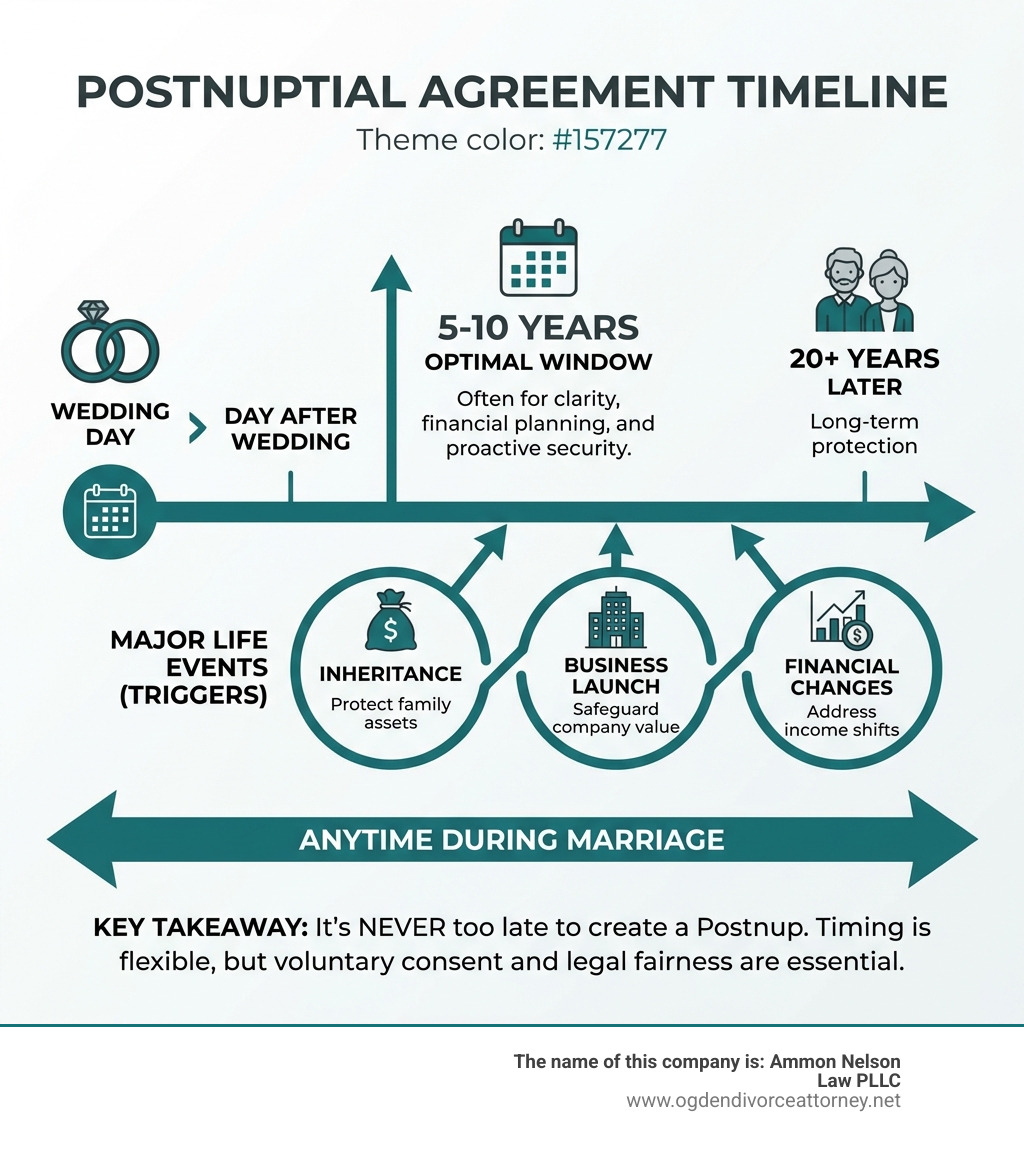
How long after marriage can you get a postnuptial agreement? There is no time limit. You can sign a postnuptial agreement at any point during your marriage—whether that’s the day after your wedding or 50 years later. Here’s what you need to know:

Quick Answer:

  • No deadline exists – You can create a postnup at any time while married
  • From day one to decades later – Couples sign postnups after 2 weeks or 30+ years of marriage
  • Both spouses must agree – The agreement requires voluntary consent from both parties
  • Must meet legal requirements – Written form, full disclosure, and fairness are essential

When you fall in love and marry your partner, protecting your assets in case things don’t work out probably isn’t your top concern. But life changes. Maybe you’ve inherited money, started a business, or your financial situation has shifted dramatically since you said “I do.” Many couples in Northern Utah wonder if it’s too late to establish financial boundaries and protections after years of marriage.

The good news? It’s never too late to create a postnuptial agreement. Whether you’ve been married two months or twenty years, you and your spouse can establish clear terms for property division, debt responsibility, and financial obligations. However, timing does matter when it comes to how courts will view your agreement’s enforceability.

At Ammon Nelson Law, we’ve helped numerous Utah couples steer the complexities of how long after marriage can you get a postnuptial agreement, working with families from South Ogden to Salt Lake City to create enforceable marital contracts that protect their interests. With experience handling high-asset divorces and complex family law matters, I understand how these agreements can provide peace of mind at any stage of marriage.

infographic showing postnuptial agreement timeline from wedding day through decades of marriage, highlighting key milestones like day after wedding, 5-10 years optimal window, 20+ years later, and major life events like inheritance, business launch, or financial changes that trigger postnup creation - how long after marriage can you get a postnuptial agreement infographic

How Long After Marriage Can You Get a Postnuptial Agreement?

One of the most common myths we hear at our Ogden and Salt Lake City offices is that if you didn’t sign a prenuptial agreement before the wedding, you’ve missed your chance to protect your separate property. This couldn’t be further from the truth.

A postnuptial agreement is a legal contract created after the wedding ceremony has taken place. Because there is no strict expiration date on when spouses can contract with one another, the answer to how long after marriage can you get a postnuptial agreement is effectively “anytime before a divorce is finalized.” You could sign one the day after you return from your honeymoon, or you could sign one to celebrate your golden 50th wedding anniversary.

This flexibility is one of the greatest benefits of a postnuptial agreement. It allows couples to address financial realities that didn’t exist when they first got married. For more details on the differences, you can explore More info about pre and post nuptial agreements.

calendar showing a wedding date and future years marked for a postnup - how long after marriage can you get a postnuptial agreement

Determining how long after marriage can you get a postnuptial agreement in Utah

In Utah, the law recognizes the right of spouses to enter into contracts with each other. When we look at the marital estate, Utah follows the principle of equitable distribution. This means that in the event of a divorce, a judge will divide property in a way that is fair, though not necessarily a perfect 50/50 split.

By creating a postnup, you are essentially taking the “equitable” guesswork out of the hands of a judge and deciding for yourselves how assets should be handled. This is particularly important for Equitable Distribution in Ogden Divorce cases where one spouse might have brought significant separate property into the marriage that has since become commingled with marital funds.

Why timing matters: how long after marriage can you get a postnuptial agreement before courts increase scrutiny?

While you can sign a postnup at any time, the context of when you sign it can affect how a court reviews it. Judges generally hold postnuptial agreements to a higher standard of fairness than prenuptials. This is because, once married, spouses owe each other a fiduciary relationship—a legal duty to act in the other’s best interest with the highest good faith and fair dealing.

Common Triggers for Signing a Postnup Years Later

Life doesn’t stand still after the wedding. Many of our clients find that the “best” time to get a postnup is actually 5 to 10 years into the marriage, once their financial lives have become more established.

Common reasons we see for drafting an agreement years later include:

  • Significant Inheritance: Under the law, receiving an inheritance is usually considered separate property. However, if you use that inheritance to pay off the marital mortgage or put it into a joint savings account, it can become a “marital asset.” A postnup can keep those funds protected.
  • Business Ownership: If you started a company after getting married, that business is likely a marital asset. For those dealing with High Asset Marital Estates, a postnup can ensure that the business stays with the founding spouse while providing the other spouse with a fair buyout or other assets in exchange.
  • Career Changes and Stay-at-Home Parenting: If one spouse leaves a lucrative career to raise children in South Ogden, they are sacrificing their future earning potential. A postnup can provide them with financial security (like guaranteed alimony) to acknowledge that sacrifice.
  • Addressing Financial Red Flags: Sometimes, a spouse develops a gambling addiction or reckless spending habits. A postnup can shield the “innocent” spouse from being held liable for those specific debts if the marriage ends.
  • Blended Families: If you have children from a previous relationship, a postnup is an excellent tool for ensuring that specific family heirlooms or properties are preserved for your children rather than being divided in a divorce.

Legal Requirements and Enforceability Standards

To ensure your agreement isn’t just a piece of paper that gets thrown out by a judge, it must meet several strict legal standards.

  1. Written Form: Handshake deals or “he said, she said” promises don’t count. The agreement must be in writing.
  2. Voluntary Agreement: Neither spouse can be forced, threatened, or coerced into signing. If you tell your spouse “sign this or I’m filing for divorce tomorrow,” the agreement may be invalidated due to duress.
  3. Full Financial Disclosure: You must both show your cards. This means a complete list of all assets, debts, bank accounts, and retirement funds. Hiding a secret Bitcoin stash is a surefire way to have your postnup thrown out.
  4. Independent Legal Counsel: While not always strictly required by every state’s law, having your own lawyer is the gold standard for enforceability. We always recommend Hiring an Attorney for each spouse to ensure there is no conflict of interest.
  5. Notarization: The document should be signed in front of a notary public to verify the identities of the signers.
Requirement Prenuptial Agreement Postnuptial Agreement
Timing Before Marriage After Marriage
Standard of Review High Very High (Fiduciary Duty)
Full Disclosure Required Required
Independent Counsel Highly Recommended Essential for Enforceability
Voluntary Must be free of duress Must be free of duress

What Can and Cannot Be Included in a Postnuptial Agreement?

A postnup is a powerful tool, but it isn’t a “catch-all” for every marital whim. There are legal boundaries to what we can include in these documents.

What Can Be Included:

  • Asset Division: Who gets the house in Ogden? Who keeps the 401(k)?
  • Debt Allocation: Who is responsible for the student loans or the credit card debt?
  • Alimony/Spousal Support: You can pre-determine the amount and duration of Alimony in Utah.
  • Inheritance Rights: Ensuring that family money stays within your bloodline.

What Cannot Be Included:

  • Child Custody: Courts will always decide custody based on the children’s best interests at the time of the split. You cannot “contract away” your children.
  • Child Support: You cannot agree to an amount that is lower than the state-mandated guidelines, as child support belongs to the child, not the parent.
  • Illegal Clauses: You cannot include anything that encourages divorce or involves illegal acts.
  • Infidelity Penalties: While some states allow “lifestyle clauses,” Utah courts are generally hesitant to enforce financial penalties for things like cheating, as they can be seen as against public policy.

For a deeper dive into property complexities, see Never Settle Your Divorce Without Considering These Three Property Issues.

Frequently Asked Questions about Postnuptial Timing

Can you get a postnuptial agreement 20 years after marriage?

Absolutely. In fact, many long-term marriages benefit from a postnup as the couple approaches retirement. You may want to protect your estate for your grandchildren or clarify how a recently sold business’s proceeds should be divided. As long as you both agree, there is no strict timeline.

Do both spouses need their own lawyer for a postnup?

We strongly advise it. If one lawyer drafts the agreement for both of you, it creates a massive conflict of interest. If the marriage does end, the spouse who didn’t have a lawyer can easily claim they didn’t understand what they were signing, which threatens the Spousal Support protection you were trying to establish in the first place.

How much does a postnuptial agreement typically cost?

The cost varies based on the complexity of your assets and how much negotiation is required. If you and your spouse are mostly in agreement, the process is much more affordable. In some cases, Mediation Can Save You Money by helping you hammer out the terms before the lawyers start drafting the formal document.

Conclusion

At Ammon Nelson Law PLLC, we believe that a postnuptial agreement isn’t a sign that you expect your marriage to fail; it’s a sign that you respect your partner enough to be honest about finances. Whether you are in Ogden, Salt Lake City, or anywhere in Northern Utah, our customized, results-driven representation ensures your future is secure.

Don’t let the “should have, could have” of a prenuptial agreement stop you from protecting yourself today. It is truly never too late to find clarity and peace of mind. Protect your future with a Postnuptial Agreement by scheduling a consultation with us today. We are here to provide the expert guidance you need to steer your marital finances with confidence.

Filed Under: Family Law Tagged With: agreement

  • « Previous Page
  • 1
  • 2
  • 3
  • 4
  • 5
  • 6
  • …
  • 21
  • Next Page »

Ogden Location

1492 East Ridgeline Dr., Suite 3
South Ogden, UT 84405
Phone: 801.337.4355
Fax: 801.337.0737
Email: ammon@ammonnelsonlaw.com

Monday9:00 AM - 6:00 PM
Tuesday9:00 AM - 6:00 PM
Wednesday9:00 AM - 6:00 PM
Thursday9:00 AM - 6:00 PM
Friday9:00 AM - 6:00 PM
SaturdayAvailable for Emergencies
SundayClosed

Directions

Navigation

  • Family Law
  • Divorce
  • Child Custody
  • Child Support
  • Spousal Support

Follow Us

Ammon Nelson Law - Facebook Ammon Nelson Law - Twitter Ammon Nelson Law - YouTube Ammon Nelson Law - Instagram

2022 Ammon Nelson Law | All Rights Reserved | Privacy Policy | Terms | XML Sitemap | Site by PDM