Ammon Nelson Law - Facebook Ammon Nelson Law - Twitter Ammon Nelson Law - YouTube Ammon Nelson Law - Instagram
  • About Us
  • Team
  • Contact Us
  • FAQs
  • En Español
Ammon Nelson Law

Ammon Nelson Law

Visit North Carolina Website

Call For A Consultation

801.337.4355
  • Family Law
    • Divorce
    • Child Custody
    • Child Support
    • Spousal Support
    • Special Needs Children
    • Father’s Rights
    • Visitation Rights
    • Grandparents Rights
  • Divorce
    • Annulment
    • How To File
    • No Fault Divorce
    • Uncontested Divorce
    • Contested Divorce
    • Irretrievable Breakdown & Divorce
    • Division of Intellectual Property
    • Divorce By Publication
    • Equitable Distribution
    • High-Asset Marital Estates
  • Child Custody
    • How to Get Full Custody
    • Joint Custody
    • Relocation & Custody
    • Interstate & International Custody and Recovery
  • Child Support
    • How to Obtain Child Support
  • Spousal Support
    • Pre and Post Nuptial Agreements
    • Post Judgement Enforcement Modification
    • Orders of Protection
  • Estate Planning and Probate
    • Social Security Disability
    • Estate Planning
    • Personal Injury
    • Probate
    • Guardianship and Conservatorship
  • Mediation

The Legal Reality of Postnuptial Agreement Validity

Home » agreement » Page 2

Understanding Your Rights: Why Legal Enforceability Matters

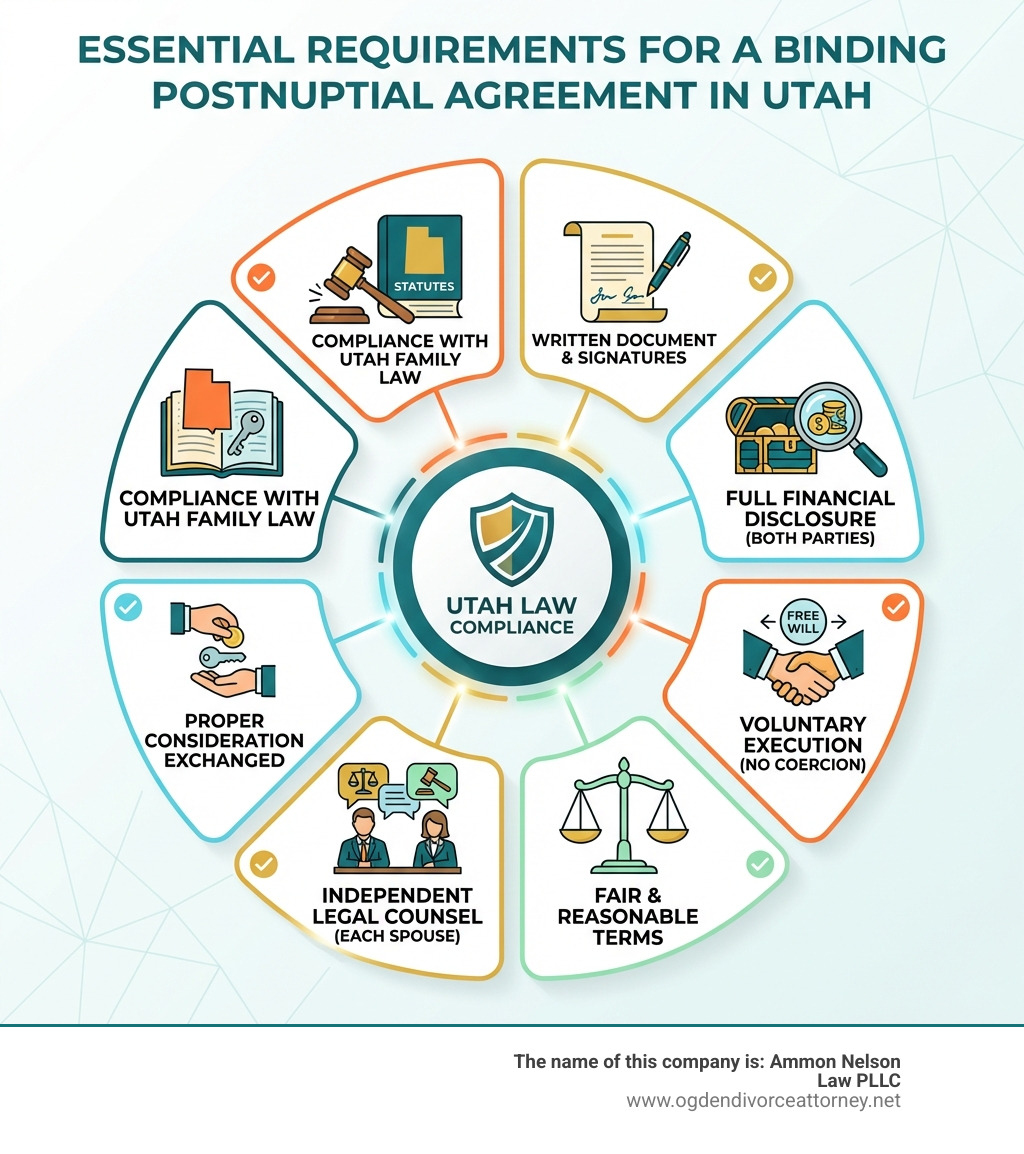
Are post nuptial agreements binding? Yes, postnuptial agreements are generally legally binding in most jurisdictions, including Utah, but only when they meet specific legal requirements. Courts will enforce these agreements if they are fair, entered into voluntarily, include full financial disclosure, and comply with state law.

Quick Answer: When Postnups Are Binding

  • Written and signed by both spouses (notarization recommended)
  • Full financial disclosure of all assets and debts
  • Voluntary agreement without pressure, threats, or coercion
  • Fair terms that are not unconscionable to either party
  • Independent legal counsel for both spouses (required in some states)
  • Proper consideration exchanged between parties (varies by state)
  • Cannot include child custody or child support provisions

Courts scrutinize postnuptial agreements more closely than prenuptial agreements because spouses owe each other a fiduciary duty after marriage. This means you must deal with each other in the highest good faith and transparency.

When a couple gets married, breaking up and postnuptial agreements are often the furthest thoughts from their minds. However, a postnuptial agreement is an effective legal tool that can offer both parties significant financial protection. These contracts become especially important when life circumstances change—like receiving an inheritance, starting a business, or reconciling after marital difficulties.

The key difference from prenuptial agreements lies in timing. Prenups are signed before marriage when the relationship is still independent. Postnups are signed after marriage, when a fiduciary relationship already exists between spouses. This higher standard means courts will examine these agreements carefully to ensure neither spouse took advantage of the other.

Why Enforceability Matters for Utah Families

If you’re facing divorce or separation in Northern Utah, understanding whether your postnuptial agreement will hold up in court directly affects your financial future and your children’s well-being. An unenforceable agreement provides no protection. The research shows that Utah courts are particularly hesitant to enforce postnuptials regarding wealth accumulated during marriage, making proper drafting essential.

I’m Ammon Nelson, and I’ve helped numerous Utah families steer complex family law issues, including ensuring that postnuptial agreements are binding and enforceable. My experience shows that when couples understand the legal requirements around are post nuptial agreements binding, they make better decisions to protect their assets and their families.

infographic showing the essential requirements for a binding postnuptial agreement in Utah: written document with signatures, full financial disclosure from both parties, voluntary execution without coercion, fair and reasonable terms, independent legal counsel for each spouse, proper consideration exchanged, and compliance with Utah family law statutes - are post nuptial agreements binding infographic

What is a Postnuptial Agreement and How Does it Differ from a Prenup?

calendar highlighting "After Marriage" - are post nuptial agreements binding

At its core, a postnuptial agreement is a contract entered into by spouses after they have already said “I do.” While it shares many similarities with a prenuptial agreement, the primary distinction is the timing of the execution. Married Couples: What is a Post-Nuptial Agreement? explains that these documents are intended to show exactly what a couple intends to happen to their money and property if the marriage ends.

In our practice serving Ogden and Salt Lake City, we often see couples turn to postnups when their financial landscape shifts. Perhaps one spouse receives a significant inheritance, or a family business suddenly takes off. Unlike a prenup, which deals with “what ifs” before the marriage begins, a postnup deals with the reality of a marriage already in progress.

Feature Prenuptial Agreement Postnuptial Agreement
Timing Signed before the wedding Signed after the wedding
Assets Covered Mostly pre-marital assets Both pre-marital and marital assets
Legal Standard Contract law Higher fiduciary standard
Common Use Protecting existing wealth Managing new wealth or reconciliation

For more details on how these differ, you can explore More info about Pre and Post Nuptial Agreements. A postnup is a powerful tool for asset protection, debt management, and clarifying inheritance rights, especially for blended families where children from previous relationships need to be protected.

Are Post Nuptial Agreements Binding in Utah and Other Jurisdictions?

When clients ask, “are post nuptial agreements binding?” the answer in Utah is a cautious “yes.” Utah law recognizes these agreements, but our courts approach them with a healthy dose of skepticism. Unlike prenups, which are governed by the Uniform Premarital Agreement Act, postnups are viewed through the lens of general contract law and equity.

Historically, the legal world was divided on this. However, landmark cases like Radmacher v Granatino have shifted the global perspective, suggesting that courts should give effect to a nuptial agreement that is freely entered into by each party with a full appreciation of its implications, unless it would be unfair to do so.

In Utah, courts are particularly hesitant to enforce agreements that attempt to divide wealth accumulated during the marriage in a way that seems fundamentally unfair. If you are navigating a Divorce, the court will look at the agreement to see if it simplifies the process or creates an “unconscionable” result. Can Postnuptial Agreements Simplify Separation Decisions? highlights that while they can streamline decisions, they must be drafted with precision to survive judicial scrutiny.

Understanding why some post nuptial agreements are binding while others fail

The reason postnups face tougher scrutiny is the fiduciary relationship that exists between spouses. In a marriage, you aren’t just two strangers making a deal; you are partners who owe each other a duty of “highest good faith and fair dealing.”

This concept is codified in places like California Family Code § 721, and while Utah has its own statutes, the principle remains: you cannot take unfair advantage of your spouse. If the agreement was born out of transparency and mutual consent, it stands a much better chance. If it was born out of a power imbalance or hidden bank accounts, it will likely fail.

Essential Legal Requirements for Validity and Enforceability

To ensure your agreement is more than just a piece of paper, it must meet several strict legal criteria.

  1. In Writing and Signed: Oral agreements about property division are virtually never enforceable in Utah. The document must be written and signed by both parties.
  2. Full Financial Disclosure: This is the “make or break” step. You must provide a complete and truthful list of all assets and debts. An agreement isn’t enforceable unless both spouses understand the value and extent of the property involved.
  3. Voluntary Execution: If one spouse was forced or pressured into signing, the agreement is void.
  4. Consideration: In contract law, “consideration” means something of value must be exchanged. This could be a mutual waiver of rights or even an agreement to work on the marriage. Utah courts generally look for a fair exchange.

Hiring an Attorney to oversee this process is the best way to ensure these boxes are checked.

How independent legal advice ensures post nuptial agreements are binding

We cannot stress this enough: both spouses should have their own lawyer. A postnup is only enforceable if each spouse had a meaningful opportunity to consult with independent counsel.

Even in Utah, where it might not be a strict statutory requirement for every single clause, a judge is much more likely to uphold an Agreement if both parties had professional review. It proves that the consent was “informed” and that neither party was bullied into a bad deal.

Factors That Lead to a Postnup Being Challenged or Invalidated

Even a well-drafted postnup can be challenged. Common grounds for invalidation include:

  • Duress or Coercion: Signing “with a pen to your head” (metaphorically) makes the contract invalid.
  • Unconscionability: If the agreement is so one-sided that it leaves one spouse destitute while the other remains wealthy, a judge may toss it out.
  • Fraud or Misrepresentation: Hiding a secret offshore account or undervalued business interest is a fast track to having your agreement invalidated.
  • Failure to Disclose: This is the most common pitfall. Transparency is non-negotiable.

Why timing matters for whether post nuptial agreements are binding

Timing isn’t just about the two-year rule. It’s about the context of the relationship. If a postnup is signed during a reconciliation period, it can be seen as a tool for stability. However, if it’s signed while one spouse is already moving into an apartment, it looks more like a separation agreement, which has different legal standards.

What Assets and Provisions Can a Postnup Cover?

A postnuptial agreement can be incredibly bespoke. Most couples use them to define:

  • Marital vs. Separate Property: Clarifying that the inheritance you received stays yours.
  • Business Interests: Ensuring that a business you started remains under your control and isn’t dismantled in a divorce.
  • Debts: Protecting one spouse from the other’s gambling debts, student loans, or business liabilities.
  • Spousal Support: You can pre-determine Spousal Support amounts or waive them entirely (though Utah courts will review this for fairness at the time of divorce).
  • Retirement Accounts: Deciding how 401(k)s or pensions will be divided.

According to What is a post-nuptial agreement, and is it binding?, these documents can even cover the family home and personal belongings, providing much-needed clarity.

Provisions that are typically NOT enforceable

While you can cover a lot, you cannot cover everything. Courts will ignore provisions regarding:

  1. Child Custody: Decisions about children are always based on the children’s best interests at the time of the split. You cannot “contract away” your child’s right to see a parent or a parent’s duty to care for them.
  2. Child Support: Similar to custody, you cannot waive or set child support in a postnup. The court retains the power to ensure children are financially supported.
  3. Marital Duties: Provisions requiring a spouse to perform certain chores or maintain a certain weight are generally considered against public policy and are unenforceable.
  4. Illegal Acts: Any clause requiring or encouraging illegal activity is void.

Frequently Asked Questions about Postnuptial Enforceability

Can I create a postnup without a lawyer?

Technically, yes, but it is extremely risky. Without professional guidance, you are likely to miss a disclosure requirement or include an unenforceable clause that could cause the whole agreement to be thrown out. Given that are post nuptial agreements binding depends heavily on following strict legal procedures, having an attorney is your best insurance policy.

Does a postnup protect my inheritance?

Yes, this is one of the most common reasons for a postnup. If you receive an inheritance during the marriage and want to ensure it remains separate property (and perhaps eventually goes to your children from a previous marriage), a postnup can clearly define it as non-marital.

How often should we update our postnuptial agreement?

We recommend reviewing it every 3 to 5 years or after any major life event, such as the birth of a child, a significant change in income, or the purchase of a new home. An outdated agreement may no longer reflect the “fairness” the court looks for.

Conclusion

Navigating the complexities of marital contracts requires a steady hand and local expertise. At Ammon Nelson Law PLLC, we provide customized, results-driven representation for clients throughout Northern Utah. Whether you are in Ogden or Salt Lake City, we understand the nuances of Utah family law and can help you determine if a postnup is right for your situation.

Don’t leave your financial future to chance or a cookie-cutter template. Protect your future with a Pre and Post Nuptial Agreement that is drafted to be binding, fair, and enforceable. Contact us today to schedule a consultation at our Ogden or Salt Lake City offices.

Filed Under: Divorce Tagged With: agreement

Why Choosing the Right Path Matters When Your Marriage Ends

Uncontested divorce attorney Utah services help couples who agree on the terms of their separation steer the legal process efficiently and affordably. Here’s what you need to know:

Quick Answer: What Makes an Uncontested Divorce Different?

  • Both spouses agree on all major issues (property, debts, custody, support)
  • No courtroom battles – judge reviews and approves your agreement
  • 30-day minimum timeline after filing (vs. months or years for contested cases)
  • Significantly lower costs – flat fees typically range from $2,000.00 – $3,000.00
  • Attorney guidance ensures your agreement is legally sound and fair

You’ll still need to:

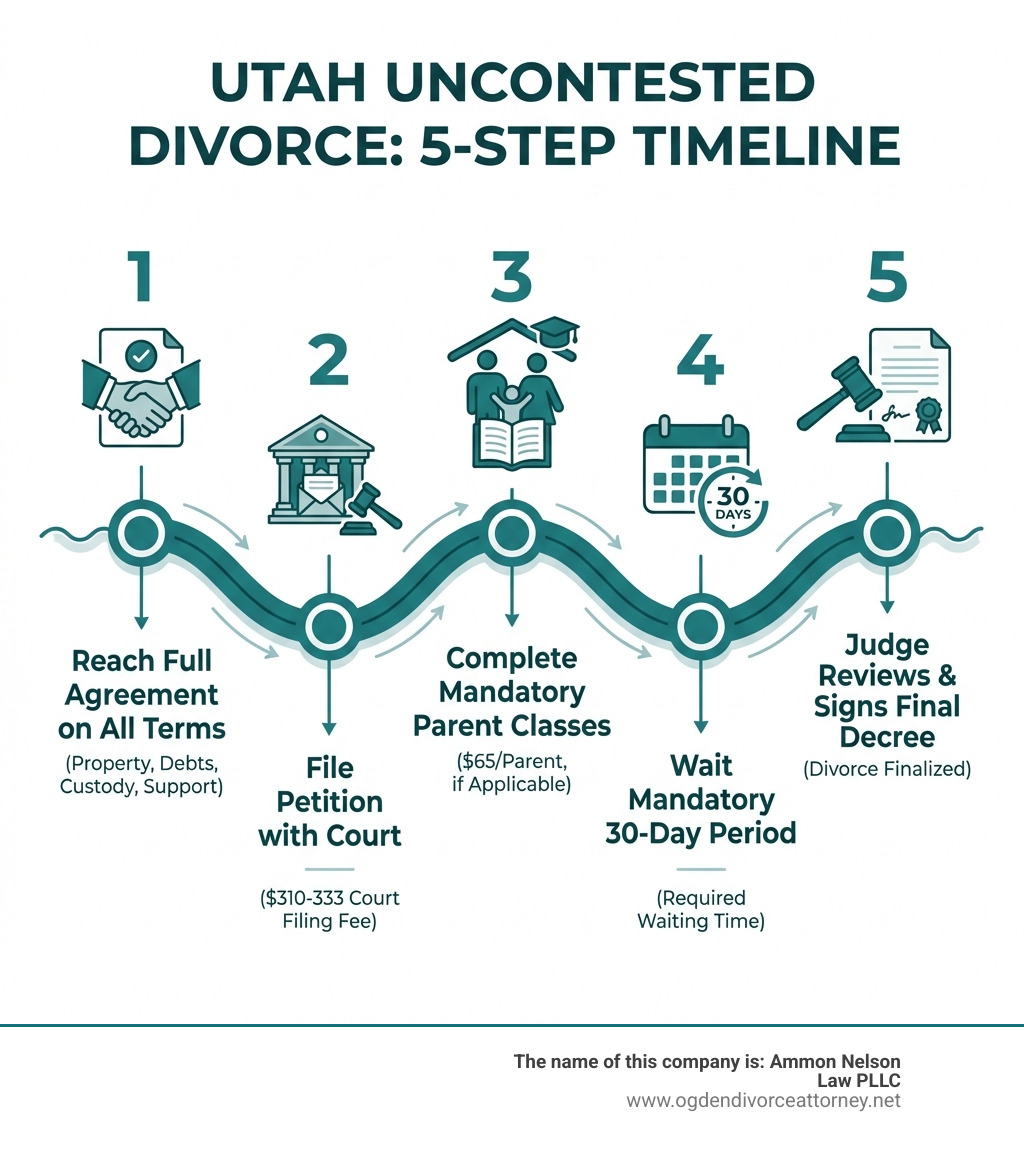
  1. Meet Utah’s residency requirement (3 months in your county)
  2. Complete mandatory classes if you have minor children ($65 per parent)
  3. File proper paperwork with the court ($310-$333 filing fee)
  4. Wait at least 30 days before the judge signs your decree

Once you and your spouse have made the decision to dissolve your marriage, you don’t want to deal with a lengthy and expensive legal process. An uncontested divorce offers a streamlined alternative – but even amicable splits require careful legal navigation to protect your rights and avoid costly mistakes down the road.

At Ammon Nelson Law, PLLC, we are uncontested divorce attorneys in Utah practicing in Northern Utah with experience serving families throughout the state. We’ve helped countless couples achieve fair, comprehensive settlements that hold up over time. Ammon Nelson Law, PLLC combines personalized attention with efficient processes to guide you through this transition with confidence.

infographic showing 5-step timeline: 1) Reach full agreement on all terms, 2) File petition with court ($310-333 fee), 3) Complete mandatory parent classes if applicable ($65/parent), 4) Wait mandatory 30-day period, 5) Judge reviews and signs final decree - uncontested divorce attorney utah infographic

Understanding Uncontested Divorce and Its Primary Benefits

couple shaking hands after agreement - uncontested divorce attorney utah

When we talk about an uncontested divorce in Utah, we are referring to a situation where both spouses are in total agreement on every single aspect of their separation. This isn’t just about agreeing that it’s time to part ways; it’s about reaching a consensus on the “marriage bucket”—everything from who gets the family dog to how the 401(k) is split.

The primary benefit, and the reason many of our clients in Ogden and Salt Lake City seek out an uncontested divorce attorney Utah, is cost-effectiveness. A contested vs. uncontested divorce comparison reveals a massive gap in spending. While a contested battle can cost tens of thousands of dollars in billable hours, an uncontested filing often involves a predictable flat fee.

Beyond the wallet, there is the matter of emotional health. Litigation is inherently adversarial. It pits spouse against spouse, which can be devastating for families, especially those with children. Choosing an amicable path preserves a level of respect and cooperation that makes post-divorce life much easier. Furthermore, you gain privacy protection. While certain court orders remain public, the intimate details of your negotiations stay between you, your spouse, and your legal counsel. For more general information on the types of divorce available, you can visit the Official Utah Court Divorce Information.

Legal Requirements for an Uncontested Divorce Attorney in Utah

Before we can set sail toward your final decree, we must ensure you meet the legal “gatekeeping” requirements set by the state. Utah law is quite specific about who can file here and on what grounds.

Residency Rules

To file for divorce in a Utah District Court, at least one spouse must have lived in the state and the specific county where you are filing for at least three months immediately prior to filing the petition. If there are minor children involved, most courts prefer a residency of at least six months to establish jurisdiction over custody matters. We frequently assist clients in determining the best jurisdiction between our Ogden and Salt Lake City offices based on these residency milestones.

Grounds for Divorce

While Utah does allow for “fault” grounds (such as adultery or habitual drunkenness), the vast majority of uncontested cases are filed under “irreconcilable differences.” This is a no-fault ground, meaning you aren’t blaming your spouse for the breakdown of the marriage; you are simply stating that the marriage is no longer workable. This keeps the temperature low and helps maintain the “uncontested” status.

Requirement Couples Without Children Couples With Minor Children
Residency (County) 3 Months 3 Months
Residency (State) 3 Months 6 Months (preferred)
Mandatory Waiting Period 30 Days 30 Days
Mandatory Education None Orientation & Education Classes
Typical Filing Fee ~$333 ~$333

For a deeper dive into the logistics of starting your case, check out our guide on how to file.

The Step-by-Step Process to Finalize Your Agreement

The process for an uncontested divorce is designed to be streamlined, but it still follows a specific legal rhythm.

  1. Drafting and Filing the Petition: We prepare a Petition for Divorce that outlines all the terms you and your spouse have agreed upon. This includes property division, debt allocation, and child-related terms.
  2. Service of Process or Waiver: In a truly uncontested case, the “Respondent” (the other spouse) usually signs a “Appearance, Consent and Waiver” document. This tells the court they have seen the petition, agree with it, and don’t need to be formally “served” by a sheriff or process server.
  3. The 30-Day Waiting Period: Utah law imposes a mandatory 30-day waiting period from the date the petition is filed before a judge can sign the final decree. This was recently reduced from 90 days in 2018, making the process much faster than it used to be.
  4. Final Decree: Once the waiting period has passed and all requirements (like parent classes) are met, we submit the final Findings of Fact and Conclusions of Law and the Decree of Divorce to the judge for a signature.

You can learn more about the nuances of this timeline in our article on the divorce process in Utah. If the filing fees are a concern, the Utah Court Filing Fee and Waiver Information page provides details on how to request a fee reduction based on financial hardship.

Navigating the Role of an Uncontested Divorce Attorney in Utah

You might wonder, “If we agree on everything, why do we need an attorney?” It’s a fair question. The reality is that the court requires very specific language to ensure a decree is enforceable. We’ve seen many “DIY” divorces hit a snag because a pension wasn’t divided correctly or a parenting plan was too vague to follow.

Our role as your uncontested divorce attorney Utah is to act as the architect of your agreement. We draft the documents to ensure they comply with Utah law, protect your individual rights, and provide a “fairness review” to make sure you aren’t inadvertently signing away something vital. For more on why professional guidance is a safety net, visit our uncontested divorce service page.

Additional Requirements for Families with Minor Children

If you have kids, the state of Utah takes an extra interest in your case to ensure the children’s best interests are protected. Both parents must complete two specific classes:

  • Divorce Orientation: A one-hour session ($30).
  • Divorce Education: A two-hour session ($35).

These classes help parents understand the impact of divorce on children and how to co-parent effectively. You can find registration details at Mandatory Utah Divorce Education Classes. Additionally, child support must be calculated using the Official Utah Child Support Calculator. Even if you agree on a different amount, the judge needs to see the “guideline” calculation to approve your agreement.

Avoiding Common Pitfalls in Amicable Settlements

Even the most amicable divorces can hit rocky waters if you aren’t careful. One of the biggest mistakes we see is a lack of full financial disclosure. If one spouse finds later that the other hid a retirement account or a debt, the entire “uncontested” agreement can be set aside, leading to expensive litigation.

Another pitfall is “rushing to be done.” We understand the desire to move on, but signing a document you don’t fully understand can haunt you for years. This is especially true regarding asset valuation—knowing what that house or business is actually worth today is vital for a fair split. To understand what happens when things aren’t so simple, read about what you need to know about contested divorces.

Why You Need an Uncontested Divorce Attorney in Utah for Complex Assets

If your marriage involves more than just a rented apartment and a shared bank account, the complexity increases exponentially.

  • Retirement Accounts: Splitting a 401(k) or a pension often requires a Qualified Domestic Relations Order (QDRO). Without this specific legal document, you could face massive tax penalties or lose your right to the funds entirely.
  • Business Ownership: If one of you started a business during the marriage, it is likely marital property. We help determine if a buyout, a trade for other assets, or a structured sale is the best path forward.
  • Debt Allocation: Just because your divorce decree says your spouse pays the credit card doesn’t mean the credit card company cares. We help structure agreements that protect your credit score.

Preparation is key to handling these assets correctly. See our guide on preparing for divorce for more tips.

Frequently Asked Questions about Utah Uncontested Divorce

Can the mandatory 30-day waiting period be waived?

Yes, but it isn’t a “given.” You must file a Motion to Waive the Waiting Period and demonstrate “extraordinary circumstances.” This usually involves showing that waiting 30 days would cause significant emotional or financial hardship. Judges have high discretion here, so having an attorney draft this motion is highly recommended.

Are my divorce records public in Utah?

Since April 1, 2012, divorce records in Utah are classified as private. This means that only the parties involved and their attorneys can view the full case file. However, the final Decree of Divorce and any orders (like an order to waive the waiting period) are still public records. We take great care to ensure sensitive info like Social Security numbers and children’s birth dates are kept in protected, non-public documents.

Can I modify the agreement after the final decree is issued?

Yes, but the bar is high. You must show a “substantial and material change in circumstances” that was not contemplated at the time of the divorce. Common reasons include a significant change in income (up or down 30% or more), a parent needing to relocate out of state, or a change in the child’s needs. This requires filing a new Petition to Modify with the court.

Conclusion

Navigating an uncontested divorce doesn’t have to be a storm of paperwork and stress. By choosing the path of mutual agreement, you are already halfway to a smoother transition. However, ensuring that your agreement is durable, fair, and legally sound requires the steady hand of an experienced professional.

At Ammon Nelson Law PLLC, we provide customized, results-driven representation for clients across Northern Utah. Whether you are in Ogden, South Ogden, or Salt Lake City, our team is dedicated to helping you reach the finish line with your sanity and your assets intact. We treat our clients like family, offering clear answers and intelligent strategy every step of the way.

Ready to move forward? Contact an experienced Ogden Divorce Attorney today for a consultation, and let us help you find the “smooth sailing” resolution you deserve.

Filed Under: Divorce Tagged With: agreement

Understanding Your Options: When Can You Create a Postnuptial Agreement?

How long after marriage can you get a postnuptial agreement? There is no time limit. You can sign a postnuptial agreement at any point during your marriage—whether that’s the day after your wedding or 50 years later. Here’s what you need to know:

Quick Answer:

  • No deadline exists – You can create a postnup at any time while married
  • From day one to decades later – Couples sign postnups after 2 weeks or 30+ years of marriage
  • Both spouses must agree – The agreement requires voluntary consent from both parties
  • Must meet legal requirements – Written form, full disclosure, and fairness are essential

When you fall in love and marry your partner, protecting your assets in case things don’t work out probably isn’t your top concern. But life changes. Maybe you’ve inherited money, started a business, or your financial situation has shifted dramatically since you said “I do.” Many couples in Northern Utah wonder if it’s too late to establish financial boundaries and protections after years of marriage.

The good news? It’s never too late to create a postnuptial agreement. Whether you’ve been married two months or twenty years, you and your spouse can establish clear terms for property division, debt responsibility, and financial obligations. However, timing does matter when it comes to how courts will view your agreement’s enforceability.

At Ammon Nelson Law, we’ve helped numerous Utah couples steer the complexities of how long after marriage can you get a postnuptial agreement, working with families from South Ogden to Salt Lake City to create enforceable marital contracts that protect their interests. With experience handling high-asset divorces and complex family law matters, I understand how these agreements can provide peace of mind at any stage of marriage.

infographic showing postnuptial agreement timeline from wedding day through decades of marriage, highlighting key milestones like day after wedding, 5-10 years optimal window, 20+ years later, and major life events like inheritance, business launch, or financial changes that trigger postnup creation - how long after marriage can you get a postnuptial agreement infographic

How Long After Marriage Can You Get a Postnuptial Agreement?

One of the most common myths we hear at our Ogden and Salt Lake City offices is that if you didn’t sign a prenuptial agreement before the wedding, you’ve missed your chance to protect your separate property. This couldn’t be further from the truth.

A postnuptial agreement is a legal contract created after the wedding ceremony has taken place. Because there is no strict expiration date on when spouses can contract with one another, the answer to how long after marriage can you get a postnuptial agreement is effectively “anytime before a divorce is finalized.” You could sign one the day after you return from your honeymoon, or you could sign one to celebrate your golden 50th wedding anniversary.

This flexibility is one of the greatest benefits of a postnuptial agreement. It allows couples to address financial realities that didn’t exist when they first got married. For more details on the differences, you can explore More info about pre and post nuptial agreements.

calendar showing a wedding date and future years marked for a postnup - how long after marriage can you get a postnuptial agreement

Determining how long after marriage can you get a postnuptial agreement in Utah

In Utah, the law recognizes the right of spouses to enter into contracts with each other. When we look at the marital estate, Utah follows the principle of equitable distribution. This means that in the event of a divorce, a judge will divide property in a way that is fair, though not necessarily a perfect 50/50 split.

By creating a postnup, you are essentially taking the “equitable” guesswork out of the hands of a judge and deciding for yourselves how assets should be handled. This is particularly important for Equitable Distribution in Ogden Divorce cases where one spouse might have brought significant separate property into the marriage that has since become commingled with marital funds.

Why timing matters: how long after marriage can you get a postnuptial agreement before courts increase scrutiny?

While you can sign a postnup at any time, the context of when you sign it can affect how a court reviews it. Judges generally hold postnuptial agreements to a higher standard of fairness than prenuptials. This is because, once married, spouses owe each other a fiduciary relationship—a legal duty to act in the other’s best interest with the highest good faith and fair dealing.

Common Triggers for Signing a Postnup Years Later

Life doesn’t stand still after the wedding. Many of our clients find that the “best” time to get a postnup is actually 5 to 10 years into the marriage, once their financial lives have become more established.

Common reasons we see for drafting an agreement years later include:

  • Significant Inheritance: Under the law, receiving an inheritance is usually considered separate property. However, if you use that inheritance to pay off the marital mortgage or put it into a joint savings account, it can become a “marital asset.” A postnup can keep those funds protected.
  • Business Ownership: If you started a company after getting married, that business is likely a marital asset. For those dealing with High Asset Marital Estates, a postnup can ensure that the business stays with the founding spouse while providing the other spouse with a fair buyout or other assets in exchange.
  • Career Changes and Stay-at-Home Parenting: If one spouse leaves a lucrative career to raise children in South Ogden, they are sacrificing their future earning potential. A postnup can provide them with financial security (like guaranteed alimony) to acknowledge that sacrifice.
  • Addressing Financial Red Flags: Sometimes, a spouse develops a gambling addiction or reckless spending habits. A postnup can shield the “innocent” spouse from being held liable for those specific debts if the marriage ends.
  • Blended Families: If you have children from a previous relationship, a postnup is an excellent tool for ensuring that specific family heirlooms or properties are preserved for your children rather than being divided in a divorce.

Legal Requirements and Enforceability Standards

To ensure your agreement isn’t just a piece of paper that gets thrown out by a judge, it must meet several strict legal standards.

  1. Written Form: Handshake deals or “he said, she said” promises don’t count. The agreement must be in writing.
  2. Voluntary Agreement: Neither spouse can be forced, threatened, or coerced into signing. If you tell your spouse “sign this or I’m filing for divorce tomorrow,” the agreement may be invalidated due to duress.
  3. Full Financial Disclosure: You must both show your cards. This means a complete list of all assets, debts, bank accounts, and retirement funds. Hiding a secret Bitcoin stash is a surefire way to have your postnup thrown out.
  4. Independent Legal Counsel: While not always strictly required by every state’s law, having your own lawyer is the gold standard for enforceability. We always recommend Hiring an Attorney for each spouse to ensure there is no conflict of interest.
  5. Notarization: The document should be signed in front of a notary public to verify the identities of the signers.
Requirement Prenuptial Agreement Postnuptial Agreement
Timing Before Marriage After Marriage
Standard of Review High Very High (Fiduciary Duty)
Full Disclosure Required Required
Independent Counsel Highly Recommended Essential for Enforceability
Voluntary Must be free of duress Must be free of duress

What Can and Cannot Be Included in a Postnuptial Agreement?

A postnup is a powerful tool, but it isn’t a “catch-all” for every marital whim. There are legal boundaries to what we can include in these documents.

What Can Be Included:

  • Asset Division: Who gets the house in Ogden? Who keeps the 401(k)?
  • Debt Allocation: Who is responsible for the student loans or the credit card debt?
  • Alimony/Spousal Support: You can pre-determine the amount and duration of Alimony in Utah.
  • Inheritance Rights: Ensuring that family money stays within your bloodline.

What Cannot Be Included:

  • Child Custody: Courts will always decide custody based on the children’s best interests at the time of the split. You cannot “contract away” your children.
  • Child Support: You cannot agree to an amount that is lower than the state-mandated guidelines, as child support belongs to the child, not the parent.
  • Illegal Clauses: You cannot include anything that encourages divorce or involves illegal acts.
  • Infidelity Penalties: While some states allow “lifestyle clauses,” Utah courts are generally hesitant to enforce financial penalties for things like cheating, as they can be seen as against public policy.

For a deeper dive into property complexities, see Never Settle Your Divorce Without Considering These Three Property Issues.

Frequently Asked Questions about Postnuptial Timing

Can you get a postnuptial agreement 20 years after marriage?

Absolutely. In fact, many long-term marriages benefit from a postnup as the couple approaches retirement. You may want to protect your estate for your grandchildren or clarify how a recently sold business’s proceeds should be divided. As long as you both agree, there is no strict timeline.

Do both spouses need their own lawyer for a postnup?

We strongly advise it. If one lawyer drafts the agreement for both of you, it creates a massive conflict of interest. If the marriage does end, the spouse who didn’t have a lawyer can easily claim they didn’t understand what they were signing, which threatens the Spousal Support protection you were trying to establish in the first place.

How much does a postnuptial agreement typically cost?

The cost varies based on the complexity of your assets and how much negotiation is required. If you and your spouse are mostly in agreement, the process is much more affordable. In some cases, Mediation Can Save You Money by helping you hammer out the terms before the lawyers start drafting the formal document.

Conclusion

At Ammon Nelson Law PLLC, we believe that a postnuptial agreement isn’t a sign that you expect your marriage to fail; it’s a sign that you respect your partner enough to be honest about finances. Whether you are in Ogden, Salt Lake City, or anywhere in Northern Utah, our customized, results-driven representation ensures your future is secure.

Don’t let the “should have, could have” of a prenuptial agreement stop you from protecting yourself today. It is truly never too late to find clarity and peace of mind. Protect your future with a Postnuptial Agreement by scheduling a consultation with us today. We are here to provide the expert guidance you need to steer your marital finances with confidence.

Filed Under: Family Law Tagged With: agreement

  • « Previous Page
  • 1
  • 2
  • 3
  • Next Page »

Ogden Location

1492 East Ridgeline Dr., Suite 3
South Ogden, UT 84405
Phone: 801.337.4355
Fax: 801.337.0737
Email: ammon@ammonnelsonlaw.com

Monday9:00 AM - 6:00 PM
Tuesday9:00 AM - 6:00 PM
Wednesday9:00 AM - 6:00 PM
Thursday9:00 AM - 6:00 PM
Friday9:00 AM - 6:00 PM
SaturdayAvailable for Emergencies
SundayClosed

Directions

Navigation

  • Family Law
  • Divorce
  • Child Custody
  • Child Support
  • Spousal Support

Follow Us

Ammon Nelson Law - Facebook Ammon Nelson Law - Twitter Ammon Nelson Law - YouTube Ammon Nelson Law - Instagram

2022 Ammon Nelson Law | All Rights Reserved | Privacy Policy | Terms | XML Sitemap | Site by PDM