
Understanding the Intersection of Domestic Violence and Alimony in Utah
Utah alimony domestic violence cases present unique legal challenges where survivors of abuse must navigate complex financial obligations during divorce. Here’s what you need to know:
Key Facts About Utah Alimony and Domestic Violence:
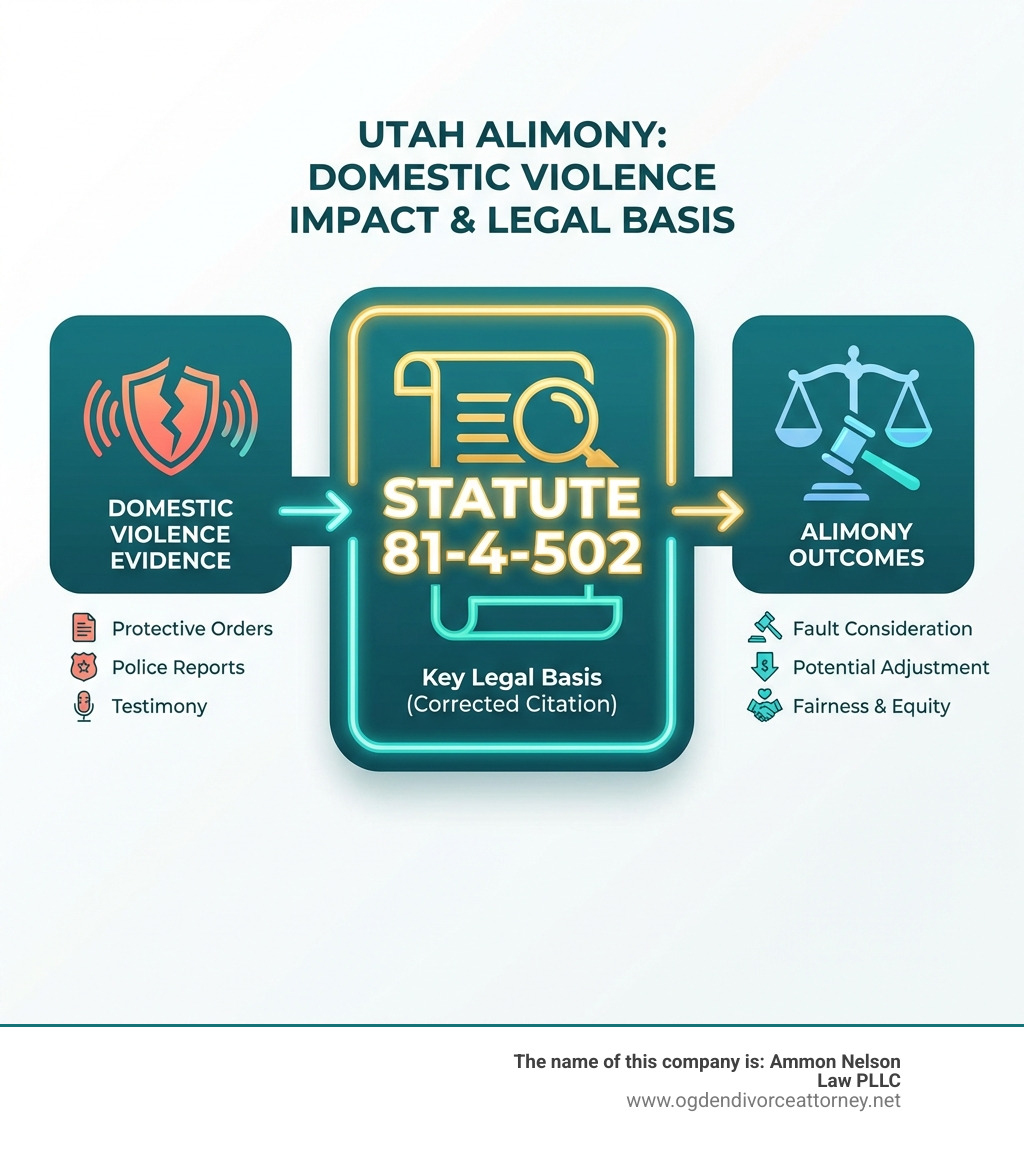
- Utah considers fault: Courts may consider domestic violence when determining alimony awards under Utah Code § 81-4-502
- Fault includes physical harm: Knowingly causing or attempting to cause physical harm, creating fear of life-threatening harm, or substantially undermining financial stability qualifies as “fault”
- Not automatic disqualification: Unlike California, Utah does not automatically bar abusers from receiving alimony—judges have discretion
- Survivors can be ordered to pay: Without explicit statutory protection, domestic violence survivors may still be required to pay alimony to their abusers
- Duration typically limited: Alimony generally cannot exceed the length of the marriage unless extenuating circumstances exist
- Protective orders help: Obtaining a protective order creates legal documentation of abuse that can influence alimony decisions
What This Means for You:
If you’re a domestic violence survivor facing alimony obligations, Utah law provides some protection through the “fault” consideration, but it’s not automatic. You’ll need to prove the abuse substantially contributed to the marriage’s breakdown. Courts can close proceedings and seal records when fault is at issue, protecting your privacy while presenting evidence.
Conversely, if you suffered abuse during your marriage, proving fault can increase the amount and duration of alimony you receive, or potentially deny your abuser any spousal support.
Ammon Nelson Law, family law attorneys serving Northern Utah with experience in complex divorce and domestic violence cases, We’ve helped numerous clients steer the challenging intersection of Utah alimony domestic violence law to protect their financial futures while escaping abusive situations. Understanding how Utah courts weigh domestic violence in alimony determinations is critical for achieving fair outcomes in these emotionally charged cases.
Utah’s Legal Framework: How Domestic Violence Impacts Alimony
Navigating the waters of divorce in Utah often means dealing with the concept of alimony—money one party pays the other for support. While many think of divorce as a strictly “no-fault” process, Utah law maintains a significant exception when it comes to spousal support.
Under the Utah Code Title 81, Chapter 4, Part 5 Introduction, alimony is designed to help the lower-earning spouse maintain a standard of living similar to what they enjoyed during the marriage. However, when domestic violence enters the picture, the court’s focus shifts from simple math to equity. Utah is unique because, while you don’t need to prove a “reason” to get divorced, the court has the judicial discretion to consider “fault” when deciding how much alimony should be paid and for how long.
Economic abuse is a frequently overlooked factor in these cases. If one spouse controlled all the finances or intentionally sabotaged the other’s ability to work, Utah courts can view this as a form of marital fault that justifies a higher alimony award for the survivor.
Defining Fault Under Utah Alimony Domestic Violence Statutes
Recent legislative updates, specifically HB 220, have brought much-needed clarity to what “fault” actually means in our state. According to Utah Code 81-4-502, “fault” isn’t just a vague term for being a “bad spouse.” It specifically includes:
- Physical Harm: Knowingly and intentionally causing or attempting to cause physical harm to the other party or a minor child.
- Life-Threatening Fear: Knowingly and intentionally causing the other party or a minor child to reasonably fear life-threatening harm.
- Financial Undermining: Conduct that substantially undermines the financial stability of the other party.
The law requires that this conduct be “knowing and intentional.” This means accidental harm (like a car accident) generally won’t count as fault. For the court to reduce or deny alimony based on these factors, the abuse must have “substantially contributed” to the breakup of the marriage.
The Role of Protective Orders in Financial Awards
If you are in immediate danger, Orders of Protection are your first line of defense. In Utah, a court can issue an ex parte protective order (an order granted without the other side present) that includes temporary spousal support.
According to Utah Code 78B-7-603, these orders can provide:
- No-contact provisions: Keeping the abuser away from your home and work.
- Temporary Maintenance: Financial support to ensure the survivor can pay bills while the divorce is pending.
- Safety Retrieval: Law enforcement accompaniment to safely retrieve personal belongings.
To secure financial relief through a protective order, you must provide income verification, such as pay stubs or tax returns, at the subsequent hearing. These orders serve as powerful evidence when we later argue for a permanent alimony determination.
Can a Survivor Be Forced to Pay Alimony to an Abuser?
This is perhaps the most painful question a survivor can ask. Unfortunately, because Utah does not have a “bright-line” rule that automatically bars abusers from receiving support, it is statistically possible for a higher-earning survivor to be ordered to pay their abuser. This often happens when the survivor has been the primary breadwinner, and the abuser claims a “need” based on their standard of living during the marriage.
Abusers often use the tag/abusive-spouse dynamic to maintain control even after the separation. They may argue that because they didn’t work during the marriage, the survivor “owes” them support. This creates a situation of gross inequality, where the survivor’s hard-earned income is used to fund the lifestyle of the person who harmed them.
| Factor | Utah Approach |
|---|---|
| Fault Consideration | Discretionary; judge may consider it. |
| Statutory Bar | No automatic bar for convicted abusers. |
| Definition of Abuse | Includes physical, fear, and financial. |
| Privacy | Proceedings can be closed/records sealed. |
Utah Alimony Domestic Violence: The Unconscionability Defense
When the law seems to fail, we turn to deeper legal doctrines like unconscionability. Originally a concept from contract law, we can apply this to tag/abuse cases by arguing that a divorce settlement requiring a survivor to pay an abuser is fundamentally unfair.
- Procedural Unfairness: This occurs when there was a lack of meaningful choice. If a survivor signed a lopsided agreement because they were under duress or suffering from the psychological effects of abuse, the agreement may be procedurally unconscionable.
- Substantive Unfairness: This refers to the terms themselves. We argue that forcing a victim to subsidize their tormentor violates public policy and is “shocking to the conscience.”
Comparing Utah Law to Other State Approaches
Utah’s approach is often described as a “middle ground.” While we aren’t a “pure” no-fault state like some, we also don’t have the strict disqualification laws found in California (Family Code § 4325), which presumes that any spouse convicted of domestic violence within five years of the divorce filing should receive zero alimony.
The Utah Courts generally prioritize the “financial need vs. ability to pay” analysis. However, the 2024 legislative updates show a clear move toward giving survivors more leverage to challenge these awards based on the “fault” of the abuser.
Legal Strategies: Challenging Alimony Awards to Abusers
Winning a Utah alimony domestic violence dispute requires more than just telling your story; it requires a mountain of evidence. We work with our clients to gather:
- Police Reports and 911 transcripts: These provide a timeline of incidents.
- Medical Records: Documentation of injuries or psychological treatment for PTSD.
- Financial Records: Proof of “financial undermining,” such as secret accounts or destroyed credit.
- Testimony: Statements from witnesses who observed the abuse or its aftermath.
If you are getting a restraining order, that document becomes a cornerstone of our financial strategy. It serves as a court-recognized “finding of fact” that abuse occurred.
Proving Fault to Terminate or Deny Support
To successfully deny an abuser alimony, we must show the court that the violence was a primary cause of the divorce. If we can prove “chronic violence,” Utah judges are much more likely to exercise their discretion to deny support entirely. We often use tag/protective-order violations to show the court that the abuser remains a threat, further justifying a total cutoff of financial ties.
Utah Alimony Domestic Violence and Imputed Income
One common tactic abusers use is “voluntary unemployment.” They may refuse to work to maximize the alimony they receive from the survivor. Under Utah Code 81-4-503, we can ask the court to “impute” income to them. This means the court treats them as if they are earning what they could earn based on their work history and education.
Conversely, for survivors whose earning capacity was diminished due to abuse or disability, the law now provides protections. Courts must consider the “impact of diminished workplace experience” and cannot simply force a survivor back into the workforce if they have been out for years caring for children or recovering from trauma.
The Psychological and Financial Toll on Survivors
The trauma of domestic violence doesn’t end when the physical danger stops. Research shows that 63.8% of female survivors of intimate partner violence suffer from PTSD. This often manifests as a “fight-flight-freeze” response during legal proceedings.
At Ammon Nelson Law PLLC, we help our clients stay safe by recognizing these triggers. Financial abuse—where an abuser controls access to money—is present in nearly 99% of domestic violence cases. This leaves survivors with no “war chest” to fight a legal battle. We often point clients toward Local Resources | Utah Domestic Violence to find support groups and emergency financial aid.
Impact of Trauma on Divorce Negotiations
Trauma can literally impair a survivor’s ability to negotiate. The pressure to “just get it over with” leads many survivors to agree to unfair alimony terms just to escape the abuser’s presence. Abusers use this “settlement pressure” as a final act of coercive control.
If you are facing a divorce involving an abuser, it is vital to have an advocate who understands these power dynamics. We ensure that negotiations happen in a safe environment, often through counsel, so the survivor isn’t re-traumatized by face-to-face contact with their ex-spouse.
Legislative Reform and the Future of Utah Alimony Laws
The landscape of Utah alimony domestic violence law is shifting. The 2024 General Session saw the passage of HB 220, which represents a major step forward for survivor rights.
Key updates include:
- Look-back Periods: Courts now require a more thorough review of financial records to prevent spouses from hiding assets right before a divorce.
- Income Equalization: For marriages over 10 years where one spouse stayed home (often a dynamic in abusive relationships), there is now a rebuttable presumption that the court should equalize standards of living.
- Fault Definition: As mentioned earlier, the explicit inclusion of “fear of life-threatening harm” as fault allows us to argue cases where physical bruises may not be present, but psychological terror was constant.
These reforms are heavily influenced by the #MeToo movement and advocacy from organizations like the Office of Recovery Services (ORS), which helps manage the financial fallout of dissolved marriages.
Frequently Asked Questions about Utah Alimony Domestic Violence
Does domestic violence automatically disqualify a spouse from receiving alimony in Utah?
No. Utah is not an “automatic disqualification” state. However, the court “may” consider fault. If the domestic violence was the primary cause of the divorce and substantially contributed to the breakup, a judge has the authority to deny alimony to the abuser or significantly reduce it.
How does a protective order affect my alimony case?
A protective order is vital evidence. It provides a legal record of the abuse that can be used to prove “fault” under Utah Code § 81-4-502. Furthermore, it can provide immediate, temporary financial support (temporary maintenance) before the divorce is even finalized.
Can I modify my alimony if my ex-spouse becomes abusive after the divorce?
Generally, alimony is based on conduct during the marriage. However, if the abuse constitutes a “material change in circumstances”—for example, if the abuse results in your inability to work or requires significant medical expenses—you may be able to petition the court for a modification. Additionally, if the abuser is the recipient of alimony and begins cohabiting with a new partner, alimony can often be terminated.
Conclusion
At Ammon Nelson Law PLLC, we understand that a divorce involving Utah alimony domestic violence is about more than just numbers on a spreadsheet—it’s about your safety, your dignity, and your future. Whether you are in Ogden, Salt Lake City, or anywhere in Northern Utah, we provide customized, results-driven representation designed to break the cycle of abuse and secure your financial independence.
We specialize in Spousal Support cases where the stakes are high and the emotions are higher. Our team is committed to ensuring that the legal system works for survivors, not against them. If you are ready to take the next step toward a life free from abuse and financial burden, we are here to fight for the results you deserve.
Contact our Ogden or Salt Lake City offices today to schedule a consultation and begin building a safer, more secure future.