Ammon Nelson Law - Facebook Ammon Nelson Law - Twitter Ammon Nelson Law - YouTube Ammon Nelson Law - Instagram
  • About Us
  • Team
  • Contact Us
  • FAQs
  • En Español
Ammon Nelson Law

Ammon Nelson Law

Visit North Carolina Website

Call For A Consultation

801.337.4355
  • Family Law
    • Divorce
    • Child Custody
    • Child Support
    • Spousal Support
    • Special Needs Children
    • Father’s Rights
    • Visitation Rights
    • Grandparents Rights
  • Divorce
    • Annulment
    • How To File
    • No Fault Divorce
    • Uncontested Divorce
    • Contested Divorce
    • Irretrievable Breakdown & Divorce
    • Division of Intellectual Property
    • Divorce By Publication
    • Equitable Distribution
    • High-Asset Marital Estates
  • Child Custody
    • How to Get Full Custody
    • Joint Custody
    • Relocation & Custody
    • Interstate & International Custody and Recovery
  • Child Support
    • How to Obtain Child Support
  • Spousal Support
    • Pre and Post Nuptial Agreements
    • Post Judgement Enforcement Modification
    • Orders of Protection
  • Estate Planning and Probate
    • Social Security Disability
    • Estate Planning
    • Personal Injury
    • Probate
    • Guardianship and Conservatorship
  • Mediation

Navigating Child Support in Utah Without Losing Your Mind

Home » Archives for Ammon » Page 2

Why Understanding Child Support Utah Matters for Your Family

Child support Utah is a legal obligation that ensures both parents financially contribute to their children’s needs after separation or divorce. Here’s what you need to know right away:

Quick Facts About Child Support in Utah:

  • Who Pays: The non-custodial parent typically pays support to the custodial parent
  • How Much: Based on both parents’ incomes, custody arrangement, and number of children
  • Duration: Until the child turns 18 or graduates high school, whichever is later
  • Cannot Be Waived: Utah law requires child support in every case involving minor children
  • Enforcement Agency: The Office of Recovery Services (ORS) handles collection and enforcement
  • Modification: Possible with a 30% income change or after 3 years with a 10% difference

Understanding child support in Utah doesn’t have to be overwhelming. The state uses specific guidelines and formulas to calculate support amounts, considering factors like your gross income, custody arrangement (sole, joint, or split), and additional expenses like medical care and childcare. Whether you’re establishing a new order, seeking modification, or dealing with enforcement issues, knowing how the system works protects both your rights and your children’s well-being.

I’m Ammon Nelson, and I’ve helped countless Northern Utah families navigate the complexities of child support Utah cases with clarity and confidence. With offices in South Ogden and a client-focused approach, my firm combines legal expertise with technology to make the child support process as straightforward as possible.
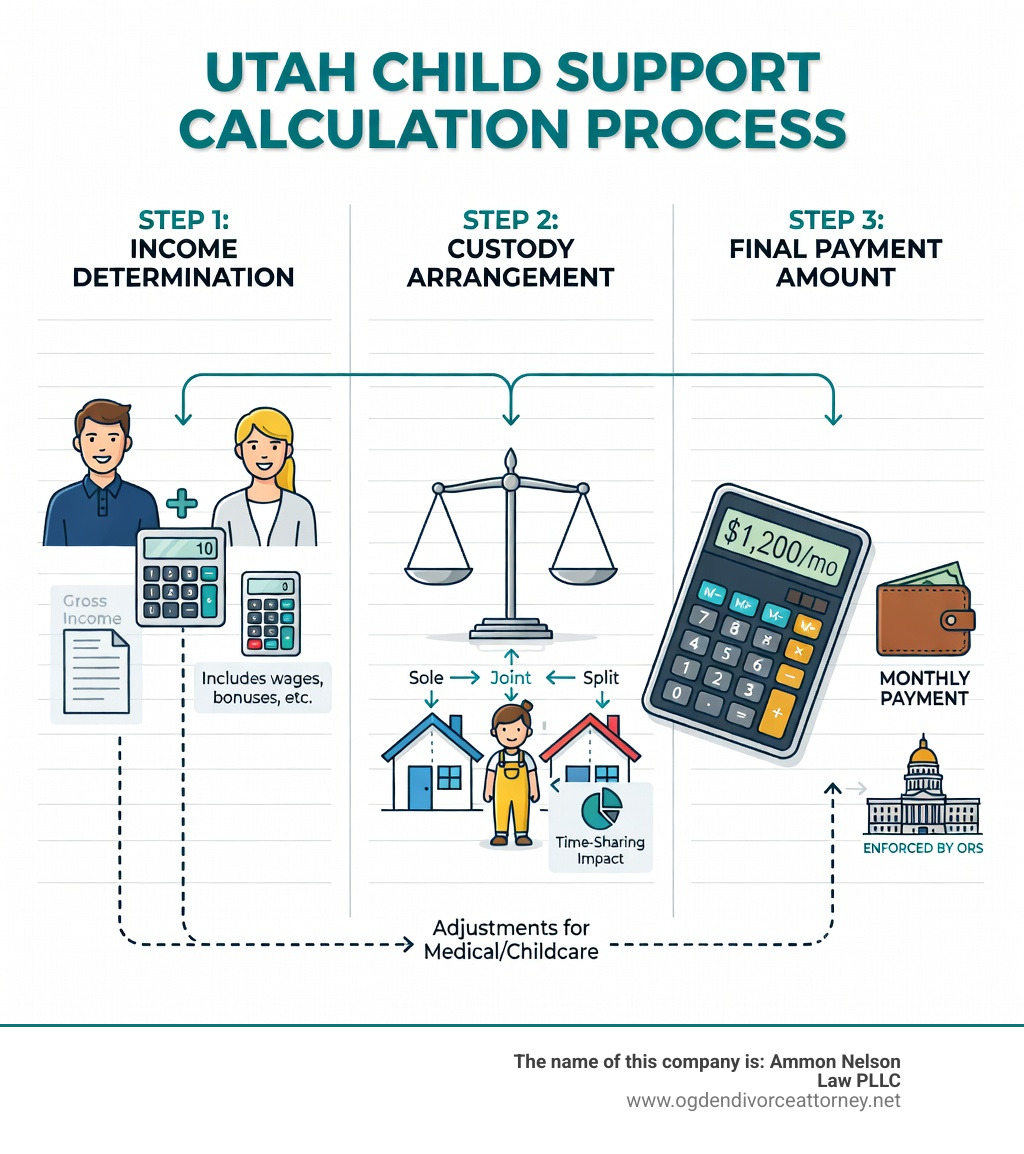
infographic showing the Utah child support calculation process from income determination through custody arrangement to final payment amount - child support utah infographic

How Child Support Utah is Calculated

When we sit down with clients in our Ogden or Salt Lake City offices, the first question is almost always: “How much is this going to cost?” or “How much will I receive?” In Utah, child support isn’t just a number pulled out of thin air by a judge who happens to be having a good day. It is governed by a very specific set of rules known as the Utah Code 81-6-203.

calculator and legal documents - child support utah

The process begins with the “Income Shares Model.” This model is based on the idea that a child should receive the same proportion of parental income that they would have received if the parents were still living together. To get to the final number, we use child support worksheets to determine the base combined child support obligation.

Here is the simplified three-step dance the court performs:

  1. Combine Adjusted Gross Incomes (AGI): We take the monthly income of Parent A and Parent B.
  2. Consult the Table: We look at the Utah Child Support Guidelines table to find the “base obligation” for that combined income level and the number of children involved.
  3. Split the Bill: Each parent is responsible for a proportional share of that base obligation. If Parent A earns 60% of the combined income, they are responsible for 60% of the support amount.

Understanding Gross Income for Child Support Utah

To get the math right, we have to start with the right numbers. “Gross income” in Utah is a broad net. According to the Utah Child Support Guidelines, it includes prospective income from almost any source.

Common inclusions are:

  • Salaries and wages
  • Bonuses, commissions, and severance pay
  • Pensions and Social Security benefits
  • Rental income and dividends
  • Gifts and prizes (yes, even that lottery win counts!)
  • Alimony from a previous marriage

However, not everything is fair game. The law excludes “means-tested” welfare benefits like SNAP (food stamps), housing subsidies, or Supplemental Security Income (SSI).

Once we have the gross income, we calculate the Adjusted Gross Income (AGI). We do this by subtracting alimony or child support that is already being paid for children from a previous relationship. This ensures that a parent’s total support obligations don’t exceed their actual ability to pay.

Imputed Income and Underemployment

“But what if my ex-spouse suddenly decides to quit their high-paying corporate job to become a full-time professional kite flier just to avoid paying support?”

We hear versions of this concern often. Utah courts are ahead of you on this one. If a parent is “voluntarily unemployed or underemployed,” the court can impute income. This means the court treats the parent as if they are earning what they should be earning based on their work history, education, and the current job market.

Typically, if a parent’s work history is unknown, the court will impute income at the federal minimum wage for a 40-hour work week. However, there are imputed income exceptions where the court will not assign phantom income, such as:

  • The parent is physically or mentally unable to work.
  • The parent is engaged in career training to establish basic job skills.
  • The cost of childcare would be nearly equal to what the parent would earn.
  • A child has unusual emotional or physical needs that require the parent to stay home.

Custody Arrangements and Their Financial Impact

The number of nights your children spend at your house doesn’t just affect your grocery bill; it’s a massive factor in child support Utah calculations. Utah recognizes three primary types of physical custody, each with its own worksheet and math.

  1. Sole Physical Custody: This applies when the child spends more than 255 nights a year with one parent. In this scenario, the non-custodial parent pays the full proportional share of the base obligation to the custodial parent.
  2. Joint Physical Custody: To qualify for a joint custody calculation, the child must spend at least 111 nights a year in each parent’s home. Because both parents are providing housing and food for a significant portion of the year, the support amount is typically lower than in sole custody cases.
  3. Split Custody: This is less common but happens when there are multiple children and at least one child lives with each parent.

The Equal parent-time schedule (often called 50/50 custody) has become increasingly common in Northern Utah since 2021. While it looks “fair” on paper, it requires a high level of cooperation between parents to work effectively.

Medical and Child Care Expenses in Child Support Utah

The “base support” amount you find on the table only covers the basics like food and shelter. Utah law requires that every child support order also addresses two other major categories:

  • Medical Expenses: Both parents are usually ordered to share the cost of health insurance premiums for the child. Furthermore, any “uninsured” costs (co-pays, dental work, glasses) are typically split 50/50.
  • Child Care Expenses: If childcare is necessary for a parent to work or attend career training, the cost is shared equally between the parents.

You can use the ORS Calculator to get an estimate of how these extras will impact the final monthly payment. You must provide verification of these costs (like a receipt or insurance premium breakdown) to the other parent within 30 days of payment to be reimbursed.

Modifying and Enforcing Your Support Order

Life changes. Jobs are lost, promotions are earned, and children grow up. Because of this, a child support order isn’t necessarily “forever.”

Modifying Your Order

In Utah, you can seek a modifying child support action under two main conditions:

  1. Substantial Change in Circumstances: If there has been a significant shift—like a 30% change in a parent’s income—you can petition for a change at any time.
  2. The Three-Year Rule: If it has been at least three years since the last order was entered, you can ask for a review if the new calculated amount would be at least 10% different from the current order.

It is vital to understand the difference between a Petition and a Motion. A Petition is essentially starting a new mini-lawsuit to change the permanent order, while a Motion is often used for temporary or procedural adjustments within an ongoing case.

Enforcement Tools and the Office of Recovery Services (ORS)

A court order is just a piece of paper unless it’s followed. If a parent falls behind, the ORS Services become the primary tool for enforcement. The ORS has a “toolbox” that would make most debt collectors jealous, including:

  • Income Withholding: Taking the support directly from a paycheck.
  • Tax Intercepts: Seizing federal or state tax refunds.
  • License Suspension: Taking away driver’s, professional, or even hunting/fishing licenses.
  • Liens: Placing a legal claim against the parent’s property or seizing bank accounts.
  • Contempt of Court: In extreme cases, a judge can order jail time for a parent who refuses to pay despite having the ability to do so.

Frequently Asked Questions about Utah Child Support

When does the child support obligation end?

In the Beehive State, your duty to pay generally ends when the child turns 18 or graduates with their high school class, whichever happens later. However, if a child is “emancipated” (gets married or joins the military), the obligation ends early. On the flip side, if a child has a disability that makes them a “disabled dependent,” support may be ordered to continue indefinitely.

Can child support be waived or changed by remarriage?

Let’s be clear: You cannot “waive” child support in Utah. Even if both parents agree to $0, a judge must approve it and ensure it’s in the child’s best interests. As for remarriage, the act of getting remarried doesn’t automatically change support. However, if the remarriage results in new children to support or a massive shift in the household’s financial resources, it might be grounds for a modification under Utah child support laws.

How does paternity affect support cases?

You cannot have a child support order without a legal father. For unmarried parents, paternity must be established first. This can be done through a Voluntary Declaration of Paternity at the hospital, through ORS, or via genetic testing ordered by the court. Once paternity is established, the legal father has both the duty to support and the right to seek custody or parent-time.

Conclusion

Navigating child support Utah can feel like trying to solve a Rubik’s Cube while blindfolded. Between gross income calculations, night-count thresholds, and ORS enforcement rules, there is a lot of room for error. But you don’t have to do this alone.

At Ammon Nelson Law PLLC, we provide customized, results-driven representation for clients throughout Northern Utah. Whether you are in Ogden, Salt Lake City, or South Ogden, our goal is to ensure your children are provided for while protecting your financial future. We believe in a straightforward approach that takes the “mind-losing” stress out of family law.

Ready to get your child support questions answered by a professional? Schedule a consultation for child support Utah today and let us help you find a path forward.

Filed Under: Child Support Tagged With: agreement

Understanding Your Rights: Why Legal Enforceability Matters

Are post nuptial agreements binding? Yes, postnuptial agreements are generally legally binding in most jurisdictions, including Utah, but only when they meet specific legal requirements. Courts will enforce these agreements if they are fair, entered into voluntarily, include full financial disclosure, and comply with state law.

Quick Answer: When Postnups Are Binding

  • Written and signed by both spouses (notarization recommended)
  • Full financial disclosure of all assets and debts
  • Voluntary agreement without pressure, threats, or coercion
  • Fair terms that are not unconscionable to either party
  • Independent legal counsel for both spouses (required in some states)
  • Proper consideration exchanged between parties (varies by state)
  • Cannot include child custody or child support provisions

Courts scrutinize postnuptial agreements more closely than prenuptial agreements because spouses owe each other a fiduciary duty after marriage. This means you must deal with each other in the highest good faith and transparency.

When a couple gets married, breaking up and postnuptial agreements are often the furthest thoughts from their minds. However, a postnuptial agreement is an effective legal tool that can offer both parties significant financial protection. These contracts become especially important when life circumstances change—like receiving an inheritance, starting a business, or reconciling after marital difficulties.

The key difference from prenuptial agreements lies in timing. Prenups are signed before marriage when the relationship is still independent. Postnups are signed after marriage, when a fiduciary relationship already exists between spouses. This higher standard means courts will examine these agreements carefully to ensure neither spouse took advantage of the other.

Why Enforceability Matters for Utah Families

If you’re facing divorce or separation in Northern Utah, understanding whether your postnuptial agreement will hold up in court directly affects your financial future and your children’s well-being. An unenforceable agreement provides no protection. The research shows that Utah courts are particularly hesitant to enforce postnuptials regarding wealth accumulated during marriage, making proper drafting essential.

I’m Ammon Nelson, and I’ve helped numerous Utah families steer complex family law issues, including ensuring that postnuptial agreements are binding and enforceable. My experience shows that when couples understand the legal requirements around are post nuptial agreements binding, they make better decisions to protect their assets and their families.

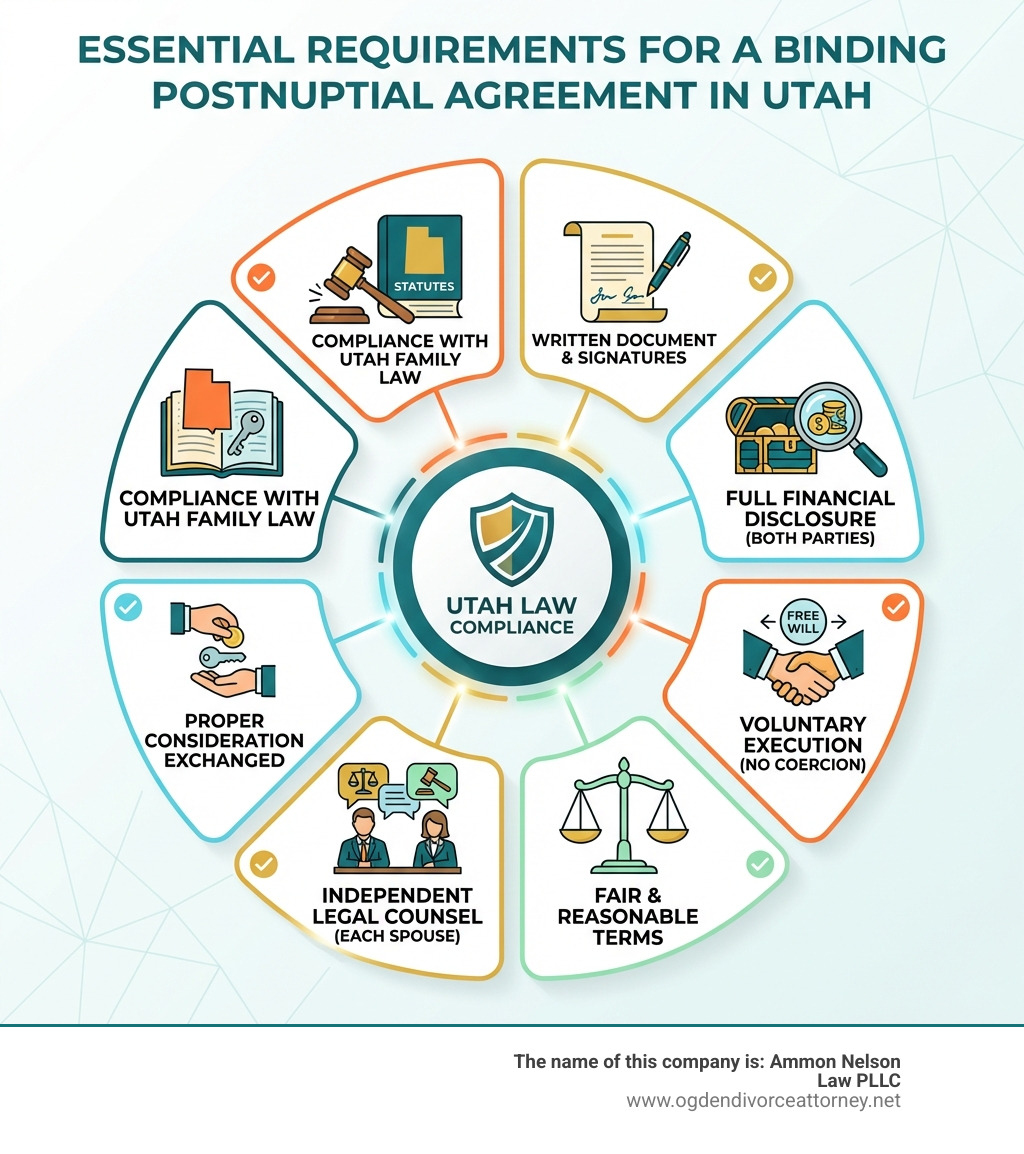
infographic showing the essential requirements for a binding postnuptial agreement in Utah: written document with signatures, full financial disclosure from both parties, voluntary execution without coercion, fair and reasonable terms, independent legal counsel for each spouse, proper consideration exchanged, and compliance with Utah family law statutes - are post nuptial agreements binding infographic

What is a Postnuptial Agreement and How Does it Differ from a Prenup?

calendar highlighting "After Marriage" - are post nuptial agreements binding

At its core, a postnuptial agreement is a contract entered into by spouses after they have already said “I do.” While it shares many similarities with a prenuptial agreement, the primary distinction is the timing of the execution. Married Couples: What is a Post-Nuptial Agreement? explains that these documents are intended to show exactly what a couple intends to happen to their money and property if the marriage ends.

In our practice serving Ogden and Salt Lake City, we often see couples turn to postnups when their financial landscape shifts. Perhaps one spouse receives a significant inheritance, or a family business suddenly takes off. Unlike a prenup, which deals with “what ifs” before the marriage begins, a postnup deals with the reality of a marriage already in progress.

Feature Prenuptial Agreement Postnuptial Agreement
Timing Signed before the wedding Signed after the wedding
Assets Covered Mostly pre-marital assets Both pre-marital and marital assets
Legal Standard Contract law Higher fiduciary standard
Common Use Protecting existing wealth Managing new wealth or reconciliation

For more details on how these differ, you can explore More info about Pre and Post Nuptial Agreements. A postnup is a powerful tool for asset protection, debt management, and clarifying inheritance rights, especially for blended families where children from previous relationships need to be protected.

Are Post Nuptial Agreements Binding in Utah and Other Jurisdictions?

When clients ask, “are post nuptial agreements binding?” the answer in Utah is a cautious “yes.” Utah law recognizes these agreements, but our courts approach them with a healthy dose of skepticism. Unlike prenups, which are governed by the Uniform Premarital Agreement Act, postnups are viewed through the lens of general contract law and equity.

Historically, the legal world was divided on this. However, landmark cases like Radmacher v Granatino have shifted the global perspective, suggesting that courts should give effect to a nuptial agreement that is freely entered into by each party with a full appreciation of its implications, unless it would be unfair to do so.

In Utah, courts are particularly hesitant to enforce agreements that attempt to divide wealth accumulated during the marriage in a way that seems fundamentally unfair. If you are navigating a Divorce, the court will look at the agreement to see if it simplifies the process or creates an “unconscionable” result. Can Postnuptial Agreements Simplify Separation Decisions? highlights that while they can streamline decisions, they must be drafted with precision to survive judicial scrutiny.

Understanding why some post nuptial agreements are binding while others fail

The reason postnups face tougher scrutiny is the fiduciary relationship that exists between spouses. In a marriage, you aren’t just two strangers making a deal; you are partners who owe each other a duty of “highest good faith and fair dealing.”

This concept is codified in places like California Family Code § 721, and while Utah has its own statutes, the principle remains: you cannot take unfair advantage of your spouse. If the agreement was born out of transparency and mutual consent, it stands a much better chance. If it was born out of a power imbalance or hidden bank accounts, it will likely fail.

Essential Legal Requirements for Validity and Enforceability

To ensure your agreement is more than just a piece of paper, it must meet several strict legal criteria.

  1. In Writing and Signed: Oral agreements about property division are virtually never enforceable in Utah. The document must be written and signed by both parties.
  2. Full Financial Disclosure: This is the “make or break” step. You must provide a complete and truthful list of all assets and debts. An agreement isn’t enforceable unless both spouses understand the value and extent of the property involved.
  3. Voluntary Execution: If one spouse was forced or pressured into signing, the agreement is void.
  4. Consideration: In contract law, “consideration” means something of value must be exchanged. This could be a mutual waiver of rights or even an agreement to work on the marriage. Utah courts generally look for a fair exchange.

Hiring an Attorney to oversee this process is the best way to ensure these boxes are checked.

How independent legal advice ensures post nuptial agreements are binding

We cannot stress this enough: both spouses should have their own lawyer. A postnup is only enforceable if each spouse had a meaningful opportunity to consult with independent counsel.

Even in Utah, where it might not be a strict statutory requirement for every single clause, a judge is much more likely to uphold an Agreement if both parties had professional review. It proves that the consent was “informed” and that neither party was bullied into a bad deal.

Factors That Lead to a Postnup Being Challenged or Invalidated

Even a well-drafted postnup can be challenged. Common grounds for invalidation include:

  • Duress or Coercion: Signing “with a pen to your head” (metaphorically) makes the contract invalid.
  • Unconscionability: If the agreement is so one-sided that it leaves one spouse destitute while the other remains wealthy, a judge may toss it out.
  • Fraud or Misrepresentation: Hiding a secret offshore account or undervalued business interest is a fast track to having your agreement invalidated.
  • Failure to Disclose: This is the most common pitfall. Transparency is non-negotiable.

Why timing matters for whether post nuptial agreements are binding

Timing isn’t just about the two-year rule. It’s about the context of the relationship. If a postnup is signed during a reconciliation period, it can be seen as a tool for stability. However, if it’s signed while one spouse is already moving into an apartment, it looks more like a separation agreement, which has different legal standards.

What Assets and Provisions Can a Postnup Cover?

A postnuptial agreement can be incredibly bespoke. Most couples use them to define:

  • Marital vs. Separate Property: Clarifying that the inheritance you received stays yours.
  • Business Interests: Ensuring that a business you started remains under your control and isn’t dismantled in a divorce.
  • Debts: Protecting one spouse from the other’s gambling debts, student loans, or business liabilities.
  • Spousal Support: You can pre-determine Spousal Support amounts or waive them entirely (though Utah courts will review this for fairness at the time of divorce).
  • Retirement Accounts: Deciding how 401(k)s or pensions will be divided.

According to What is a post-nuptial agreement, and is it binding?, these documents can even cover the family home and personal belongings, providing much-needed clarity.

Provisions that are typically NOT enforceable

While you can cover a lot, you cannot cover everything. Courts will ignore provisions regarding:

  1. Child Custody: Decisions about children are always based on the children’s best interests at the time of the split. You cannot “contract away” your child’s right to see a parent or a parent’s duty to care for them.
  2. Child Support: Similar to custody, you cannot waive or set child support in a postnup. The court retains the power to ensure children are financially supported.
  3. Marital Duties: Provisions requiring a spouse to perform certain chores or maintain a certain weight are generally considered against public policy and are unenforceable.
  4. Illegal Acts: Any clause requiring or encouraging illegal activity is void.

Frequently Asked Questions about Postnuptial Enforceability

Can I create a postnup without a lawyer?

Technically, yes, but it is extremely risky. Without professional guidance, you are likely to miss a disclosure requirement or include an unenforceable clause that could cause the whole agreement to be thrown out. Given that are post nuptial agreements binding depends heavily on following strict legal procedures, having an attorney is your best insurance policy.

Does a postnup protect my inheritance?

Yes, this is one of the most common reasons for a postnup. If you receive an inheritance during the marriage and want to ensure it remains separate property (and perhaps eventually goes to your children from a previous marriage), a postnup can clearly define it as non-marital.

How often should we update our postnuptial agreement?

We recommend reviewing it every 3 to 5 years or after any major life event, such as the birth of a child, a significant change in income, or the purchase of a new home. An outdated agreement may no longer reflect the “fairness” the court looks for.

Conclusion

Navigating the complexities of marital contracts requires a steady hand and local expertise. At Ammon Nelson Law PLLC, we provide customized, results-driven representation for clients throughout Northern Utah. Whether you are in Ogden or Salt Lake City, we understand the nuances of Utah family law and can help you determine if a postnup is right for your situation.

Don’t leave your financial future to chance or a cookie-cutter template. Protect your future with a Pre and Post Nuptial Agreement that is drafted to be binding, fair, and enforceable. Contact us today to schedule a consultation at our Ogden or Salt Lake City offices.

Filed Under: Divorce Tagged With: agreement

Introduction

Why Estate Planning Matters for Ogden Families

Finding the right estate planning lawyer Ogden services can protect your family’s future and prevent costly legal battles after you’re gone. Estate planning isn’t just for the wealthy—it’s essential for any parent who wants to ensure their children are cared for, their assets are distributed according to their wishes, and their loved ones avoid the stress of probate court.

What an Ogden estate planning lawyer does for you:

  • Creates wills and trusts custom to Utah law
  • Helps you avoid probate and minimize estate taxes
  • Establishes guardianship for minor children
  • Sets up powers of attorney for healthcare and financial decisions
  • Protects assets from creditors and unnecessary taxation
  • Ensures compliance with Weber County court requirements

Most people are surprised to learn they already have an estate plan—it’s just not the one they would have chosen. In the absence of legal planning, your estate will be distributed after death according to Utah’s laws of intestacy. That means the state decides who gets what, and your children could end up with guardians you never would have selected.

Without proper planning, your family faces lengthy probate court proceedings, potential disputes among loved ones, and unnecessary legal fees that eat into the inheritance you worked hard to build. Death and money can bring out the worst in people, even loved ones, as one local law firm notes. A comprehensive estate plan prevents these conflicts before they happen.

Ammon Nelson is**** an estate planning lawyer in Ogden with a seven-figure law firm serving all of Utah, he has helped countless families protect their assets and secure their children’s futures through customized estate plans that reflect their unique values and goals. The team at Ammon Nelson Law PLLC combines traditional legal expertise with modern technology to deliver efficient, client-focused estate planning services throughout Northern Utah.

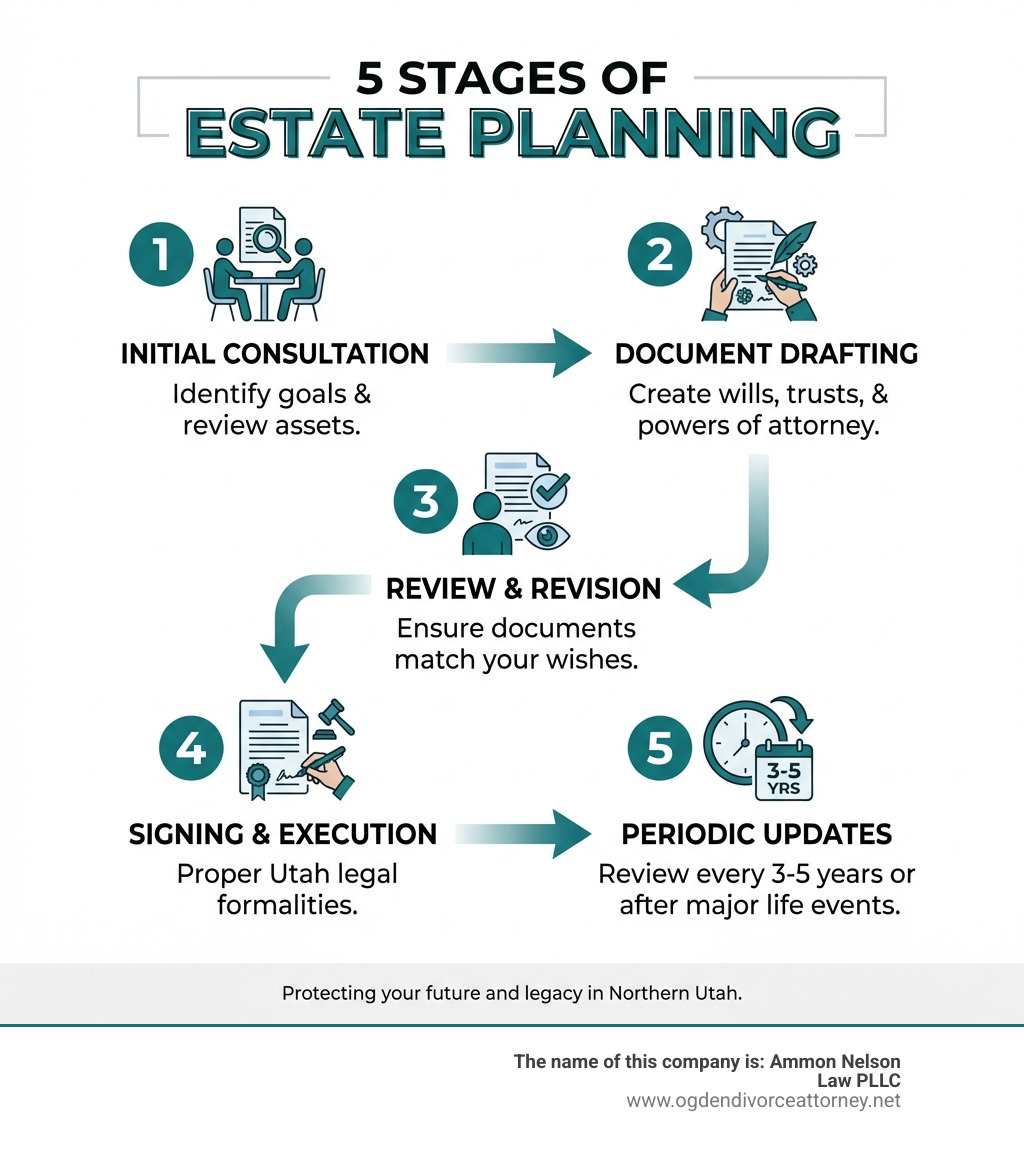
Infographic showing the 5 stages of estate planning: 1) Initial consultation to identify goals and review assets, 2) Document drafting including wills, trusts, and powers of attorney, 3) Review and revision to ensure documents match your wishes, 4) Signing and execution with proper Utah legal formalities, 5) Periodic updates every 3-5 years or after major life events - estate planning lawyer ogden infographic

Why You Need an Estate Planning Lawyer in Ogden

professional legal consultation in Ogden - estate planning lawyer ogden

When you decide to organize your affairs, you might be tempted by the “do-it-yourself” kits found online. However, estate planning is not a one-size-fits-all endeavor. In Northern Utah, we operate under specific statutes within the Utah Code, and local nuances in the Weber County courts can significantly impact how your documents are processed.

Hiring an Attorney ensures that your plan isn’t just a stack of papers, but a legally binding shield. An expert estate planning lawyer Ogden understands the regional regulations that a generic online template will miss. For instance, if you own real estate in Ogden or surrounding areas like South Ogden and North Ogden, the way those titles are held matters immensely for probate avoidance.

One of the most critical roles we fill is helping you select a personal representative (also known as an executor). This person is responsible for managing your estate, paying debts, and distributing assets. Without professional guidance, many people choose someone based on emotion rather than capability, which can lead to administrative nightmares.

DIY Wills vs. Professional Estate Plans

Feature DIY Online Will Professional Estate Plan
Utah Law Compliance General/Generic Specifically custom to Utah Code
Probate Avoidance Rarely addresses it Uses Trusts to bypass probate
Tax Strategy None Minimizes estate and capital gains taxes
Incapacity Planning Often missing Includes Durable POA and Directives
Guardianship Basic mention Detailed protections for minor children
Review & Updates Manual/Forgotten Scheduled 3-5 year professional reviews

Benefits of Local Legal Guidance

Working with a local team means we understand the community dynamics of Northern Utah. We know the local property types—from historic homes in the Ogden 25th Street area to sprawling agricultural land in Weber County. Our Ogden Testimonials reflect our commitment to families who want someone they can sit down with face-to-face, not a chatbot. Local expertise ensures your solutions fit Utah’s specific legal landscape, including the nuances of the Utah Uniform Probate Code.

Essential Documents for Your Utah Estate Plan

A comprehensive Estate Planning strategy is like a puzzle; it requires several interlocking pieces to be effective. While many think only of the “Will,” that is actually just the beginning. To get started, you can even Download Your Estate Planning Packet Below to see the types of information we’ll need to gather.

Key Documents Your Estate Planning Lawyer Ogden Recommends

  1. Last Will and Testament: This document outlines who receives your property and, perhaps most importantly, who will care for your minor children. In Utah, a Will has no legal authority until after death and must be submitted to the probate court.
  2. Durable Power of Attorney: This gives someone you trust the legal right to manage your finances if you become incapacitated. We recommend updating these frequently, as financial institutions sometimes hesitate to honor documents that are several years old.
  3. Advance Healthcare Directive: This is a legally binding document in Utah that specifies the type of medical care you want if you cannot communicate. It combines what used to be called a “living will” and a “healthcare proxy.”
  4. Guardianship and Conservatorship: For parents, documenting Guardianship and Conservatorship is non-negotiable. If you don’t name a guardian, the court will decide who raises your children, which can lead to a “family battle royal.”
  5. HIPAA Authorization: This allows your medical providers to share information with your designated decision-makers.

The Role of Revocable Living Trusts

We often tell our clients that there are Trusts for Everyone, Not Just the Wealthy. A Revocable Living Trust is a powerful tool because assets held in the trust pass to beneficiaries immediately upon your death without the need for probate.

Advantages of a Living Trust in Ogden:

  • Privacy: Unlike a Will, which becomes a public record in probate court, a trust remains private.
  • Continuity: It allows for a seamless transition of asset management if you become ill or pass away.
  • Protection: It can protect an inheritance from a beneficiary’s creditors or even a future divorce.

Navigating Utah Probate and Tax Laws

Probate is the court-supervised process of validating a Will and distributing assets. In Utah, this process is governed by the Uniform Probate Code. While the system is designed to be fair, it is often lengthy, public, and expensive.

For those dealing with smaller estates, Utah offers “small estate affidavits” which can sometimes bypass the full probate process if the estate value is under a certain threshold. However, for most homeowners in Ogden, the value of the Assets—specifically real estate—usually necessitates a more formal process unless a trust is in place.

It is also important to note residency requirements. We primarily work within the Weber County and Salt Lake County court systems to ensure your filings are handled correctly.

Minimizing Taxes and Avoiding Probate

One of our primary goals as your estate planning lawyer Ogden is to Protect Your Most Important Asset. This involves strategic tax planning. While Utah does not have a state inheritance tax, federal estate taxes can still apply to very large estates.

More commonly, we look at capital gains taxes. By using specific trust structures, we can ensure your heirs receive a “stepped-up basis” on property, potentially saving them thousands in taxes when they eventually sell the family home or Retirement accounts. We also use gift exemptions and charitable lead trusts for clients looking to leave a philanthropic legacy while reducing their taxable estate.

Advanced Strategies: Trusts, Business Succession, and Asset Protection

For many in Northern Utah, an estate isn’t just a house and a bank account—it’s a business. If you own a family company, Estate Planning UT must include a business succession plan. Who takes over the day-to-day operations? How is the value of the business distributed among children who may or may not work in the company?

Asset Protection with an Estate Planning Lawyer Ogden

Asset protection is about building a “legal fortress” around what you’ve earned. This can include:

  • LLC Formation: Using business entities to shield personal assets from business liabilities.
  • Irrevocable Trusts: These offer high levels of creditor protection and can assist with Medicaid planning, ensuring you qualify for long-term care without exhausting your life savings.
  • Special Needs Trusts: Ensuring a loved one with a disability can receive an inheritance without losing their government benefits.
  • Digital Assets: Your Blog, social media accounts, and cryptocurrency are part of your estate and need clear instructions for access.

We also specialize in planning for blended families. Without specific language in your Will or Trust, children from a previous marriage could be accidentally disinherited. We use contingent beneficiaries and specific trust provisions to ensure every family member is cared for according to your actual intentions.

Frequently Asked Questions about Estate Planning

How much does estate planning cost in Ogden?

The cost of estate planning varies based on the complexity of your situation. A simple Will package is less expensive than a comprehensive Revocable Living Trust with tax-planning provisions. However, the “cost” of not having a plan—probate fees, legal disputes, and unnecessary taxes—is almost always significantly higher. At Ammon Nelson Law PLLC, we provide transparent fee structures so you know exactly what to expect.

When should I review and update my estate plan?

We recommend our clients meet with our Team every 3 to 5 years. However, you should reach out immediately after major life events, such as:

  • Marriage or divorce
  • The birth or adoption of a child
  • A significant change in financial status
  • Moving to or from Utah
  • Death of a named guardian or representative

What happens if I die without a will in Utah?

If you die “intestate” (without a Will), Utah law dictates how your property is split. Usually, this goes to your spouse and children in specific percentages. If you have no immediate family, the state searches for more distant relatives. This process often results in outcomes the deceased never would have wanted and frequently leads to family disputes that require court intervention.

Conclusion

At Ammon Nelson Law PLLC, we believe that estate planning is the greatest gift you can leave your family. It provides clarity during a time of grief and ensures that your hard-earned legacy is preserved for the next generation. Whether you are a young family just starting out or a business owner looking toward retirement, our results-driven representation is custom to the unique needs of Northern Utah residents.

Ready to take the first step? Learn more About our philosophy or Contact Us today to schedule your consultation. Don’t leave your family’s future to chance—Secure your legacy with an Ogden estate planning expert and gain the peace of mind you deserve.

Filed Under: Estate Planning Tagged With: assets

  • « Previous Page
  • 1
  • 2
  • 3
  • 4
  • …
  • 21
  • Next Page »

Ogden Location

1492 East Ridgeline Dr., Suite 3
South Ogden, UT 84405
Phone: 801.337.4355
Fax: 801.337.0737
Email: ammon@ammonnelsonlaw.com

Monday9:00 AM - 6:00 PM
Tuesday9:00 AM - 6:00 PM
Wednesday9:00 AM - 6:00 PM
Thursday9:00 AM - 6:00 PM
Friday9:00 AM - 6:00 PM
SaturdayAvailable for Emergencies
SundayClosed

Directions

Navigation

  • Family Law
  • Divorce
  • Child Custody
  • Child Support
  • Spousal Support

Follow Us

Ammon Nelson Law - Facebook Ammon Nelson Law - Twitter Ammon Nelson Law - YouTube Ammon Nelson Law - Instagram

2022 Ammon Nelson Law | All Rights Reserved | Privacy Policy | Terms | XML Sitemap | Site by PDM