Understanding Your Rights: Why Legal Enforceability Matters
Are post nuptial agreements binding? Yes, postnuptial agreements are generally legally binding in most jurisdictions, including Utah, but only when they meet specific legal requirements. Courts will enforce these agreements if they are fair, entered into voluntarily, include full financial disclosure, and comply with state law.
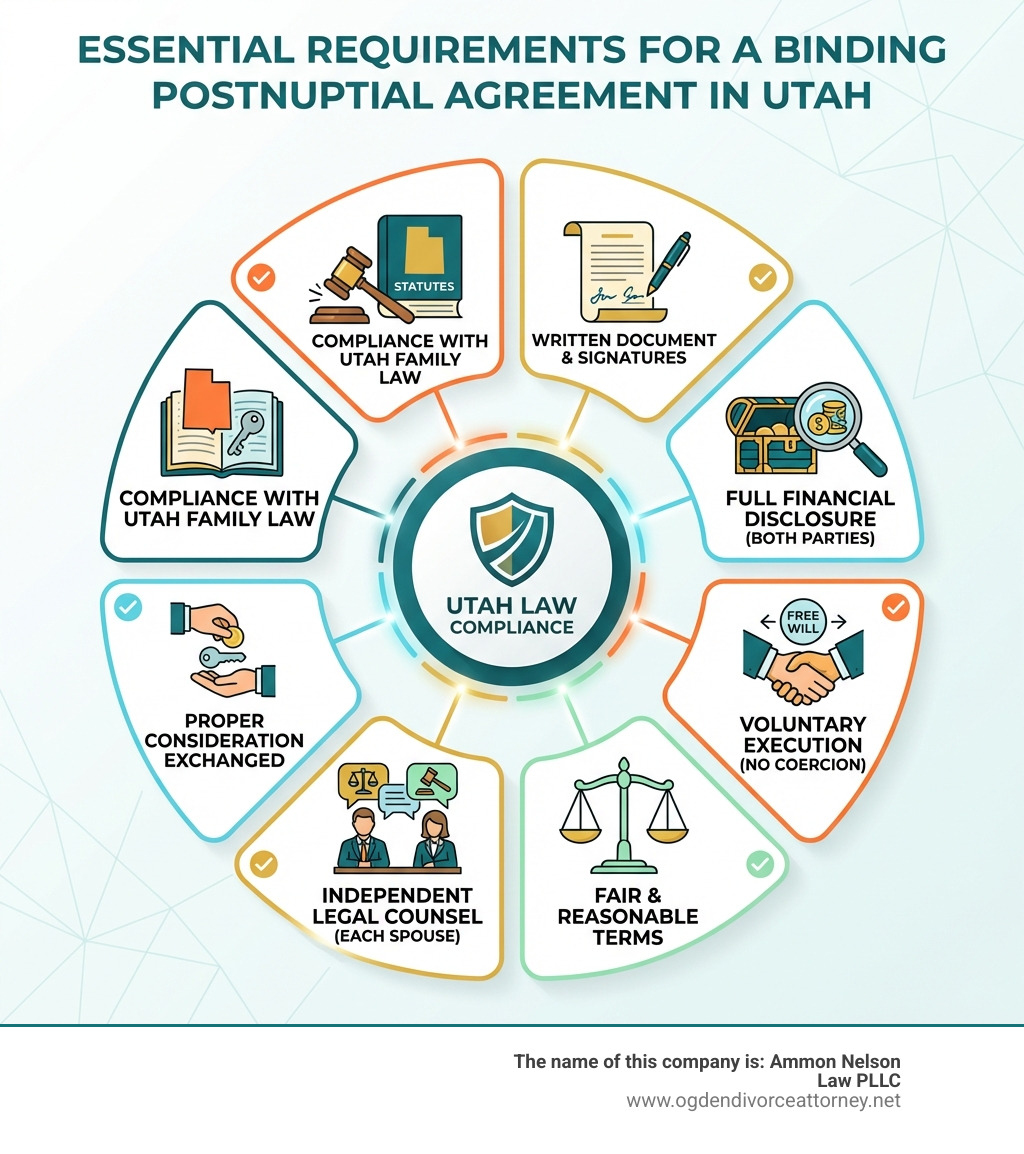
Quick Answer: When Postnups Are Binding
- Written and signed by both spouses (notarization recommended)
- Full financial disclosure of all assets and debts
- Voluntary agreement without pressure, threats, or coercion
- Fair terms that are not unconscionable to either party
- Independent legal counsel for both spouses (required in some states)
- Proper consideration exchanged between parties (varies by state)
- Cannot include child custody or child support provisions
Courts scrutinize postnuptial agreements more closely than prenuptial agreements because spouses owe each other a fiduciary duty after marriage. This means you must deal with each other in the highest good faith and transparency.
When a couple gets married, breaking up and postnuptial agreements are often the furthest thoughts from their minds. However, a postnuptial agreement is an effective legal tool that can offer both parties significant financial protection. These contracts become especially important when life circumstances change—like receiving an inheritance, starting a business, or reconciling after marital difficulties.
The key difference from prenuptial agreements lies in timing. Prenups are signed before marriage when the relationship is still independent. Postnups are signed after marriage, when a fiduciary relationship already exists between spouses. This higher standard means courts will examine these agreements carefully to ensure neither spouse took advantage of the other.
Why Enforceability Matters for Utah Families
If you’re facing divorce or separation in Northern Utah, understanding whether your postnuptial agreement will hold up in court directly affects your financial future and your children’s well-being. An unenforceable agreement provides no protection. The research shows that Utah courts are particularly hesitant to enforce postnuptials regarding wealth accumulated during marriage, making proper drafting essential.
I’m Ammon Nelson, and I’ve helped numerous Utah families steer complex family law issues, including ensuring that postnuptial agreements are binding and enforceable. My experience shows that when couples understand the legal requirements around are post nuptial agreements binding, they make better decisions to protect their assets and their families.
What is a Postnuptial Agreement and How Does it Differ from a Prenup?

At its core, a postnuptial agreement is a contract entered into by spouses after they have already said “I do.” While it shares many similarities with a prenuptial agreement, the primary distinction is the timing of the execution. Married Couples: What is a Post-Nuptial Agreement? explains that these documents are intended to show exactly what a couple intends to happen to their money and property if the marriage ends.
In our practice serving Ogden and Salt Lake City, we often see couples turn to postnups when their financial landscape shifts. Perhaps one spouse receives a significant inheritance, or a family business suddenly takes off. Unlike a prenup, which deals with “what ifs” before the marriage begins, a postnup deals with the reality of a marriage already in progress.
| Feature | Prenuptial Agreement | Postnuptial Agreement |
|---|---|---|
| Timing | Signed before the wedding | Signed after the wedding |
| Assets Covered | Mostly pre-marital assets | Both pre-marital and marital assets |
| Legal Standard | Contract law | Higher fiduciary standard |
| Common Use | Protecting existing wealth | Managing new wealth or reconciliation |
For more details on how these differ, you can explore More info about Pre and Post Nuptial Agreements. A postnup is a powerful tool for asset protection, debt management, and clarifying inheritance rights, especially for blended families where children from previous relationships need to be protected.
Are Post Nuptial Agreements Binding in Utah and Other Jurisdictions?
When clients ask, “are post nuptial agreements binding?” the answer in Utah is a cautious “yes.” Utah law recognizes these agreements, but our courts approach them with a healthy dose of skepticism. Unlike prenups, which are governed by the Uniform Premarital Agreement Act, postnups are viewed through the lens of general contract law and equity.
Historically, the legal world was divided on this. However, landmark cases like Radmacher v Granatino have shifted the global perspective, suggesting that courts should give effect to a nuptial agreement that is freely entered into by each party with a full appreciation of its implications, unless it would be unfair to do so.
In Utah, courts are particularly hesitant to enforce agreements that attempt to divide wealth accumulated during the marriage in a way that seems fundamentally unfair. If you are navigating a Divorce, the court will look at the agreement to see if it simplifies the process or creates an “unconscionable” result. Can Postnuptial Agreements Simplify Separation Decisions? highlights that while they can streamline decisions, they must be drafted with precision to survive judicial scrutiny.
Understanding why some post nuptial agreements are binding while others fail
The reason postnups face tougher scrutiny is the fiduciary relationship that exists between spouses. In a marriage, you aren’t just two strangers making a deal; you are partners who owe each other a duty of “highest good faith and fair dealing.”
This concept is codified in places like California Family Code § 721, and while Utah has its own statutes, the principle remains: you cannot take unfair advantage of your spouse. If the agreement was born out of transparency and mutual consent, it stands a much better chance. If it was born out of a power imbalance or hidden bank accounts, it will likely fail.
Essential Legal Requirements for Validity and Enforceability
To ensure your agreement is more than just a piece of paper, it must meet several strict legal criteria.
- In Writing and Signed: Oral agreements about property division are virtually never enforceable in Utah. The document must be written and signed by both parties.
- Full Financial Disclosure: This is the “make or break” step. You must provide a complete and truthful list of all assets and debts. An agreement isn’t enforceable unless both spouses understand the value and extent of the property involved.
- Voluntary Execution: If one spouse was forced or pressured into signing, the agreement is void.
- Consideration: In contract law, “consideration” means something of value must be exchanged. This could be a mutual waiver of rights or even an agreement to work on the marriage. Utah courts generally look for a fair exchange.
Hiring an Attorney to oversee this process is the best way to ensure these boxes are checked.
How independent legal advice ensures post nuptial agreements are binding
We cannot stress this enough: both spouses should have their own lawyer. A postnup is only enforceable if each spouse had a meaningful opportunity to consult with independent counsel.
Even in Utah, where it might not be a strict statutory requirement for every single clause, a judge is much more likely to uphold an Agreement if both parties had professional review. It proves that the consent was “informed” and that neither party was bullied into a bad deal.
Factors That Lead to a Postnup Being Challenged or Invalidated
Even a well-drafted postnup can be challenged. Common grounds for invalidation include:
- Duress or Coercion: Signing “with a pen to your head” (metaphorically) makes the contract invalid.
- Unconscionability: If the agreement is so one-sided that it leaves one spouse destitute while the other remains wealthy, a judge may toss it out.
- Fraud or Misrepresentation: Hiding a secret offshore account or undervalued business interest is a fast track to having your agreement invalidated.
- Failure to Disclose: This is the most common pitfall. Transparency is non-negotiable.
Why timing matters for whether post nuptial agreements are binding
Timing isn’t just about the two-year rule. It’s about the context of the relationship. If a postnup is signed during a reconciliation period, it can be seen as a tool for stability. However, if it’s signed while one spouse is already moving into an apartment, it looks more like a separation agreement, which has different legal standards.
What Assets and Provisions Can a Postnup Cover?
A postnuptial agreement can be incredibly bespoke. Most couples use them to define:
- Marital vs. Separate Property: Clarifying that the inheritance you received stays yours.
- Business Interests: Ensuring that a business you started remains under your control and isn’t dismantled in a divorce.
- Debts: Protecting one spouse from the other’s gambling debts, student loans, or business liabilities.
- Spousal Support: You can pre-determine Spousal Support amounts or waive them entirely (though Utah courts will review this for fairness at the time of divorce).
- Retirement Accounts: Deciding how 401(k)s or pensions will be divided.
According to What is a post-nuptial agreement, and is it binding?, these documents can even cover the family home and personal belongings, providing much-needed clarity.
Provisions that are typically NOT enforceable
While you can cover a lot, you cannot cover everything. Courts will ignore provisions regarding:
- Child Custody: Decisions about children are always based on the children’s best interests at the time of the split. You cannot “contract away” your child’s right to see a parent or a parent’s duty to care for them.
- Child Support: Similar to custody, you cannot waive or set child support in a postnup. The court retains the power to ensure children are financially supported.
- Marital Duties: Provisions requiring a spouse to perform certain chores or maintain a certain weight are generally considered against public policy and are unenforceable.
- Illegal Acts: Any clause requiring or encouraging illegal activity is void.
Frequently Asked Questions about Postnuptial Enforceability
Can I create a postnup without a lawyer?
Technically, yes, but it is extremely risky. Without professional guidance, you are likely to miss a disclosure requirement or include an unenforceable clause that could cause the whole agreement to be thrown out. Given that are post nuptial agreements binding depends heavily on following strict legal procedures, having an attorney is your best insurance policy.
Does a postnup protect my inheritance?
Yes, this is one of the most common reasons for a postnup. If you receive an inheritance during the marriage and want to ensure it remains separate property (and perhaps eventually goes to your children from a previous marriage), a postnup can clearly define it as non-marital.
How often should we update our postnuptial agreement?
We recommend reviewing it every 3 to 5 years or after any major life event, such as the birth of a child, a significant change in income, or the purchase of a new home. An outdated agreement may no longer reflect the “fairness” the court looks for.
Conclusion
Navigating the complexities of marital contracts requires a steady hand and local expertise. At Ammon Nelson Law PLLC, we provide customized, results-driven representation for clients throughout Northern Utah. Whether you are in Ogden or Salt Lake City, we understand the nuances of Utah family law and can help you determine if a postnup is right for your situation.
Don’t leave your financial future to chance or a cookie-cutter template. Protect your future with a Pre and Post Nuptial Agreement that is drafted to be binding, fair, and enforceable. Contact us today to schedule a consultation at our Ogden or Salt Lake City offices.