
Child Support When a Utah Guardian Cares for Your Child
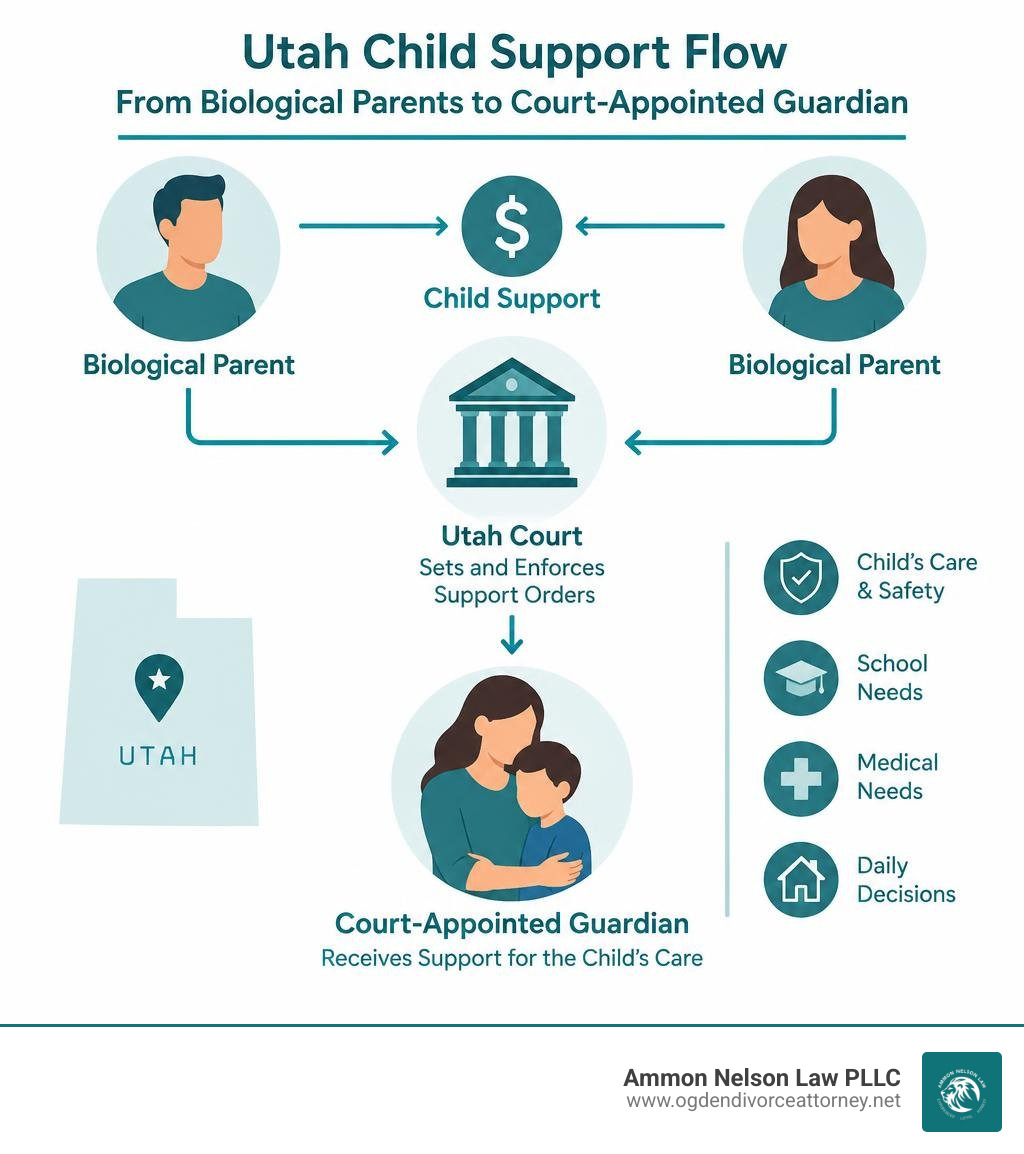
A guardianship does not end a parent’s duty to pay for their child. When a Utah judge appoints a guardian, parents must still pay child support. The guardian can ask the court to order monthly support payments.
Follow these four steps to start a child support guardianship Utah case:
- Get a signed court order that names the guardian.
- Collect pay stubs, health insurance costs, daycare bills, and visit schedules from both parents.
- Ask the judge to set, adjust, or enforce child support under state rules.
- Ask the Utah Office of Recovery Services to collect the monthly payments.
Guardians make daily choices about school, doctors, and safety. A guardianship does not take away parental duties. The court sets the payment amount based on each parent’s income, where the child lives, and health costs.
I am Ammon Nelson. I help Utah families resolve child support and guardianship disputes. My team protects children and helps caregivers obtain clear court orders.
Helpful topics to explore:
Understanding Utah Child Support Guardianship Rules and Custody Differences

Raising a child costs money. When a guardian cares for a child, state rules decide who pays for daily needs. Many people confuse guardianship with custody. Both allow an adult to raise a child, but they follow different legal paths.
When you review child custody laws in Utah, you learn that district courts grant custody during a divorce. Guardianship cases usually run through probate court under Title 75 of the Utah Code. A guardian makes choices about doctors, school, and daily shelter.
Parents must still support their children during a guardianship. Setting up guardianship and conservatorship orders allows caregivers to step in while parents pay their fair share.
Parental Duty to Pay When a Minor Has a Court-Appointed Guardian
Some parents think a guardianship cancels their financial duties. That is false. Parents always retain the legal duty to support their children.
Under Utah legal guidelines for child support, parents must pay support until the child turns 18 or graduates high school. Guardianship only pauses parental custody rights. It does not erase support duties.
Because parents keep their legal ties, their duties continue:
- Both parents pay monthly child support directly to the guardian.
- Parents help pay for medical bills, dental care, prescriptions, and daycare.
- A parent cannot stop payments just because they agree to the guardianship.
- Parents must pay support until a judge terminates their parental rights or signs an adoption order.
How Legal Guardianship Differs from Traditional Child Custody
Guardianship and custody serve different needs in Utah courts:
- Court Filings: Parents resolve Utah child custody cases in district court during a divorce. Relatives like grandparents, aunts, or uncles file for guardianship in probate or juvenile court.
- Parental Rights: Custody divides parenting time between two parents. Guardianship transfers daily care to a non-parent caregiver when parents cannot safely raise the child.
- Duration: Guardianship is temporary. When parents fix their housing, health, or financial challenges, they can ask the judge to return the child.

How to Calculate and Establish Support in a Guardianship
Utah courts calculate child support in a guardianship case much like a standard custody case. The court treats both biological parents as paying parties.
Step 1: Determining Parental Incomes and Imputed Wages
First, the court reviews the gross monthly income of each parent. Gross income includes wages, salaries, bonuses, and side work.
Parents prove their income by submitting:
- Recent pay stubs.
- Tax returns from the last two years.
- W-2 forms or 1099 statements.
When a parent refuses to work, the judge can assign them an “imputed income.” This means the court counts the money the parent could earn. The judge examines past jobs, job skills, and local open roles. If the parent lacks work history, the court counts 40 hours per week at minimum wage.
Step 2: Applying the Utah Child Support Guidelines and Schedules
Next, the court uses state support tables to find the base payment. Our Utah child support schedule and calculation guide explains how Utah matches parental income to support amounts.
In a guardianship case, the child lives full-time with the guardian. The court determines what each parent owes the guardian separately. A parent can ask for a different amount only if they prove a special legal reason.
Step 3: Dividing Childcare, Medical, and Out-of-Pocket Expenses
Base child support pays for food, clothes, and housing. Parents must split other direct costs equally:
- Health Insurance: Parents split the premium cost for health and dental insurance 50/50.
- Medical Bills: Parents split co-pays, dental work, and prescription costs 50/50.
- Daycare: Parents split work-related daycare costs 50/50 so the guardian can work.
When a guardian pays a medical or daycare bill, they must send the receipt to the parents within 30 days. The parents then have 30 days to pay their share.
How to Calculate Child Support Guardianship Utah Payments Step-by-Step
Review the official Utah minor guardianship requirements before filing your papers.
| Expense Category | Standard Custody Case | Guardianship Case |
|---|---|---|
| Physical Custody | Split between Parent A and Parent B | Granted to Non-Parent Guardian |
| Base Support Payer | Non-Custodial Parent pays Custodial Parent | Both Parent A and Parent B pay Guardian |
| Overnight Calculations | Counted between two parents | Child resides full-time with Guardian |
| Medical Insurance | Split 50/50 between parents | Split 50/50 between biological parents |
| Daycare Costs | Shared based on parental work schedules | Shared 50/50 to support guardian’s work |
| Payment Recipient | Primary Caretaker Parent | Appointed Legal Guardian |
Follow these five simple steps:
- Gather Income Records: Collect pay stubs and tax forms for both parents.
- Fill Out Worksheets: Complete the state child support forms for each parent.
- Add Medical and Daycare: Divide health insurance and daycare costs in half.
- File the Motion: Submit your child support calculations to the court clerk.
- Get Signed Orders: Ask the judge to sign the final Child Support Order.
How Guardians Can Collect, Enforce, and Modify Child Support Orders
Getting a support order gives you legal protection. The guardian must also collect those payments on time. Learning how to obtain child support through automatic bank transfers saves time and prevents conflict.
Support can also cover older children. If an adult child has a disability, Utah law allows support payments to continue past age 18. Guardians can review the state guidelines for adult children with disabilities to protect adult dependents.
Enforcing Child Support Guardianship Utah Orders Through the State
If a parent stops paying, you do not need to chase the money alone. You can use the Utah Office of Recovery Services collection options (ORS).
ORS collects support directly from a parent’s paycheck. The state uses several proven child support enforcement tools to collect unpaid money:
- Paycheck Deductions: The state takes money directly from wages.
- Tax Intercepts: The state takes tax refunds to pay overdue support balances.
- Property Liens: The state places liens on houses, cars, or bank accounts.
- License Suspensions: The state suspends driver’s and professional licenses.
- Court Sanctions: A judge can fine non-paying parents or send them to jail.
Modifying or Terminating Support When Life Circumstances Change
Support orders can change over time. Either parent or the guardian can ask the judge to adjust the support order when major life events occur:
- A parent’s monthly income changes by 30% or more.
- The child develops new medical or special school needs.
- Daycare expenses stop because the child starts school full-time.
Support orders end when the child turns 18 or graduates high school. Orders also end if the child marries, joins the military, or joins an adoptive family. When closing a case, check the rules for ending guardian authority and responsibilities so you file your final documents correctly.
Less Restrictive Alternatives to Minor Guardianship in Utah
Full court guardianship is not the only option. Utah law encourages families to try simpler steps first.
Before filing court papers, try getting your Utah guardianship documents organized to choose the right path:
- Power of Attorney for a Minor Child: Under Utah Code Section 75-5-103, parents can give a caregiver authority over school and medical care for up to six months using a notarized form.
- School-Based Guardianship: Under Utah Code Section 53G-6-303, local schools allow a child to enroll with a caregiver without a court order during family hardships.
- Kinship Subsidies: When DCFS places a child with relatives, caregivers can receive monthly cash aid for child expenses.
- Voluntary Written Agreements: Parents and caregivers can sign a written contract that outlines daily care rules and monthly financial help.
Frequently Asked Questions About Child Support and Guardianship
Can a biological parent stop paying child support if a relative becomes the legal guardian?
No. A parent must still support their child after a relative becomes the guardian. Both parents must continue paying for food, housing, medical care, and school costs until a court terminates their parental rights or another person adopts the child.
Does a legal guardian have to spend their own personal money to raise the child?
No. Guardians do not have to pay for the child out of their own savings. A guardian manages the child’s funds, collects child support from both parents, and can apply for state benefits or kinship funds to cover basic costs.
What happens to child support payments if the legal guardianship is terminated?
When a judge ends a guardianship, the guardian’s duties stop immediately. If the child moves back home with a parent, future support payments to the guardian end. However, parents must still pay any past-due balance they accumulated during the guardianship.
Conclusion
Stepping up as a guardian is a generous choice. You do not have to bear the financial cost alone. Utah law requires biological parents to support their children and fund their daily needs.
Court paperwork, support math, and state collection systems can feel overwhelming. Our team at Ammon Nelson Law PLLC is ready to help. We guide families in Ogden, Salt Lake City, and across Northern Utah.
If you need help calculating support, collecting payments, or seeking legal guidance for guardianship and conservatorship matters, call our office today to schedule your consultation.