Ammon Nelson Law - Facebook Ammon Nelson Law - Twitter Ammon Nelson Law - YouTube Ammon Nelson Law - Instagram
  • About Us
  • Team
  • Contact Us
  • FAQs
  • En Español
Ammon Nelson Law

Ammon Nelson Law

Visit North Carolina Website

Call For A Consultation

801.337.4355
  • Family Law
    • Divorce
    • Child Custody
    • Child Support
    • Spousal Support
    • Special Needs Children
    • Father’s Rights
    • Visitation Rights
    • Grandparents Rights
  • Divorce
    • Annulment
    • How To File
    • No Fault Divorce
    • Uncontested Divorce
    • Contested Divorce
    • Irretrievable Breakdown & Divorce
    • Division of Intellectual Property
    • Divorce By Publication
    • Equitable Distribution
    • High-Asset Marital Estates
  • Child Custody
    • How to Get Full Custody
    • Joint Custody
    • Relocation & Custody
    • Interstate & International Custody and Recovery
  • Child Support
    • How to Obtain Child Support
  • Spousal Support
    • Pre and Post Nuptial Agreements
    • Post Judgement Enforcement Modification
    • Orders of Protection
  • Estate Planning and Probate
    • Social Security Disability
    • Estate Planning
    • Personal Injury
    • Probate
    • Guardianship and Conservatorship
  • Mediation

Why Every Resident Needs a Salt Lake City Estate Planning Lawyer

Home » attorney » Page 2

Why Having a Salt Lake City Estate Planning Lawyer Matters for Your Family’s Future

A Salt Lake City estate planning lawyer helps residents protect their assets, name guardians for minor children, avoid lengthy probate, and ensure their wishes are honored after death or incapacity.

Quick Answer: What Can a Salt Lake City Estate Planning Lawyer Do for You?

  • Protect your children: Name guardians and set up trusts to manage their inheritance
  • Avoid probate delays: Structure assets to pass directly to loved ones
  • Plan for incapacity: Create powers of attorney and healthcare directives
  • Minimize family conflict: Establish clear instructions that reduce disputes
  • Preserve your legacy: Ensure assets go where you want, not where Utah law decides

Most people think estate planning is only for the wealthy. The truth is simpler and more urgent: if you have children, own property, or care about who inherits your belongings, you need an estate plan.

More than 60% of Americans don’t have a will. In Utah, dying without one means the state decides who gets your assets under intestate succession laws (Utah Code §75-2-101). Your minor children could end up with court-appointed guardians you’ve never met. Your spouse might have to share your estate with other relatives. Your family could face months of probate proceedings and thousands of dollars in unnecessary legal fees.

Estate planning isn’t about death—it’s about protecting what you value most while you’re still here. It’s about making sure your children are cared for by people you trust. It’s about giving your spouse clear authority to manage finances if you’re hospitalized. It’s about leaving instructions that spare your family from guessing what you would have wanted.

I’m Ammon Nelson, and I’ve helped countless Northern Utah families create estate plans that protect their children and preserve their legacies. As a Salt Lake City estate planning lawyer serving families throughout the region, I understand the unique concerns of parents navigating divorce, custody issues, and family transitions who need to ensure their children’s future is secure no matter what happens.
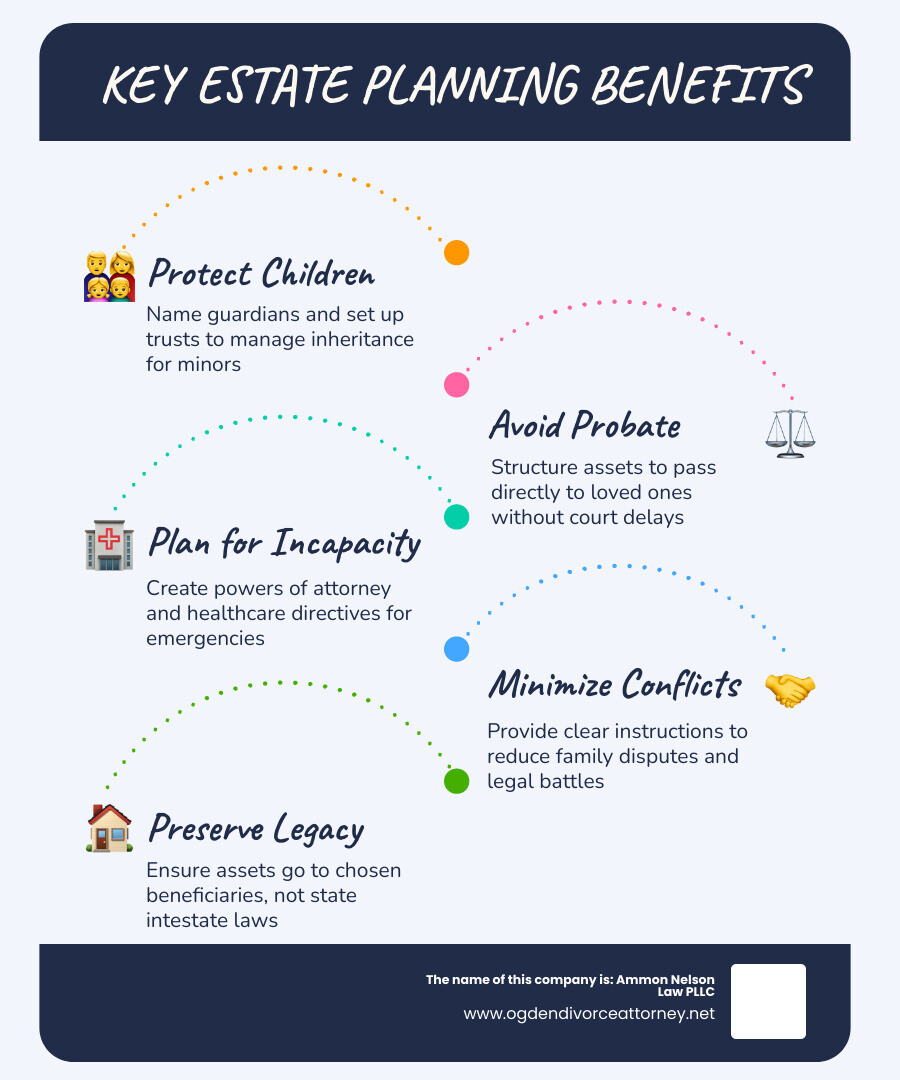
Infographic showing key estate planning benefits: guardianship appointments prevent court-appointed strangers from raising your children, powers of attorney allow trusted family to manage finances during incapacity, healthcare directives ensure medical wishes are honored, trusts protect assets for minor children and avoid probate delays, proper planning reduces family conflict and legal costs - salt lake city estate planning lawyer infographic infographic-line-5-steps-blues-accent_colors

The Role of a Salt Lake City Estate Planning Lawyer in Protecting Your Legacy

When we talk about a “legacy,” we aren’t just talking about millions of dollars in a bank account. We are talking about your home, your family heirlooms, your business, and most importantly, your values. A Salt Lake City estate planning lawyer acts as the architect of your future, helping you build a framework that protects these assets from unnecessary taxes, creditors, and legal battles.

Family meeting with a legal professional - salt lake city estate planning lawyer

In Utah, the law provides a “default” plan for those who don’t create their own. This is known as intestate succession under Utah Code §75-2-101. If you pass away without a will, the state uses a rigid formula to distribute your property. While this might seem fine on the surface, it rarely accounts for the nuances of modern families—especially blended families or those with specific needs.

For example, if you are in the middle of a divorce or have recently remarried, the state’s default distribution might leave assets to an ex-spouse or fail to provide for children from a previous relationship. By working with us, you can engage in personalized planning that ensures your assets go exactly where you want them to.

Beyond just distribution, we focus on:

  • Asset Protection: Keeping your hard-earned property safe from potential lawsuits or creditors.
  • Incapacity Planning: Ensuring that if you are ever unable to make decisions for yourself due to illness or injury, someone you trust has the legal authority to step in.
  • Tax Efficiency: Minimizing the “bite” that taxes might take out of your estate, preserving more for your heirs.

More info about estate planning services

Essential Components of a Utah Estate Plan: Wills, Trusts, and Powers of Attorney

A comprehensive estate plan is more than just a single piece of paper; it is a toolkit of legal instruments designed to handle different scenarios.

1. The Last Will and Testament

Think of a will as the foundation of your plan. It allows you to:

  • Appoint a personal representative (executor) to manage your affairs.
  • Name legal guardians for your minor children—this is perhaps the most critical step for parents in Salt Lake City.
  • Specify who receives specific items of personal property.

2. Revocable Living Trusts

While a will is essential, it usually must go through probate court. A Revocable Living Trust is a powerful alternative that allows your assets to pass to your beneficiaries without court intervention. You remain in control of the assets during your lifetime and can change the trust at any time. It is a misconception that these are only for the “one percent.” In reality, trusts are for everyone, not just the wealthy, as they save your family the time and expense of the probate process.

3. Powers of Attorney (Financial and Medical)

What happens if you are alive but cannot speak for yourself?

  • Financial Power of Attorney: This document names an agent to manage your bank accounts, pay your mortgage, and handle business affairs if you become incapacitated.
  • Advance Health Care Directive: This combines a living will and a medical power of attorney. It tells doctors what kind of life-sustaining treatment you want and names someone to make medical decisions on your behalf.

How a Salt Lake City Estate Planning Lawyer Simplifies Probate

If a loved one has already passed away, you might find yourself facing the Utah Uniform Probate Code. Probate is the court-supervised process of validating a will, paying off debts, and distributing what remains. It can be a “legal weed” patch that is difficult to navigate alone.

A Salt Lake City estate planning lawyer simplifies this by:

  • Executor Guidance: We help the person in charge understand their fiduciary duties so they don’t accidentally break the law or incur personal liability.
  • Debt Settlement: Ensuring creditors are paid in the correct order of priority.
  • Dispute Resolution: If siblings are fighting over a family home or a specific inheritance, we provide the legal mediation or litigation support needed to reach a resolution.

More info about probate services

Specialized Planning: Elder Law, Medicaid, and Special Needs Trusts

As we age, our legal needs shift from “what happens when I’m gone” to “how do I afford the care I need now?” This is where elder law and specialized planning become vital for Salt Lake City residents.

Medicaid Planning

Long-term care in Utah can be incredibly expensive. Many families fear that a few years in a nursing home will wipe out an entire lifetime of savings. We assist with Medicaid planning strategies that help you qualify for assistance while legally preserving assets for your spouse or children.

Special Needs Trusts

If you have a child or family member with a disability, leaving them a direct inheritance could be a disaster. It might disqualify them from essential government benefits like SSI or Medicaid. A Special Needs Trust (or Supplemental Needs Trust) allows you to provide for their quality of life—buying them clothes, electronics, or specialized therapy—without jeopardizing their basic benefits.

Guardianship and Conservatorship

Sometimes, an adult loved one loses the capacity to care for themselves, and they haven’t signed powers of attorney. In these cases, we help families petition the court for Guardianship (to make personal/medical decisions) or Conservatorship (to manage money). This is a complex legal process that requires expert guidance to ensure the protected person’s rights are respected while they receive the care they need.

More info about guardianship and conservatorship

Choosing the Right Salt Lake City Estate Planning Lawyer for Your Family

Choosing a lawyer isn’t just about finding someone who can draft a document; it’s about finding a partner who understands your family dynamics. At Ammon Nelson Law PLLC, we pride ourselves on a customized, results-driven approach.

Feature Last Will & Testament Revocable Living Trust
Probate Required? Yes No
Privacy Public Record Private
Cost Lower Upfront Higher Upfront
Ease of Use Simple to Create Requires Asset Retitling
Protection Basic Advanced

When looking for a Salt Lake City estate planning lawyer, consider these factors:

  1. Experience: Look for a firm with decades of combined experience in Utah law.
  2. Billing Practices: Many of our clients appreciate flat-fee billing for standard estate plans, so there are no surprises when the bill arrives.
  3. Communication: You want a lawyer who listens more than they talk. Your plan should reflect your values, not a template.

If you want to compare top rated Utah attorneys, you will see that the best ones are those who prioritize the client relationship over the transaction.

What to Expect When Meeting Your Salt Lake City Estate Planning Lawyer

If you’ve never met with an attorney before, the process can feel intimidating. We try to keep it as warm and simple as possible.

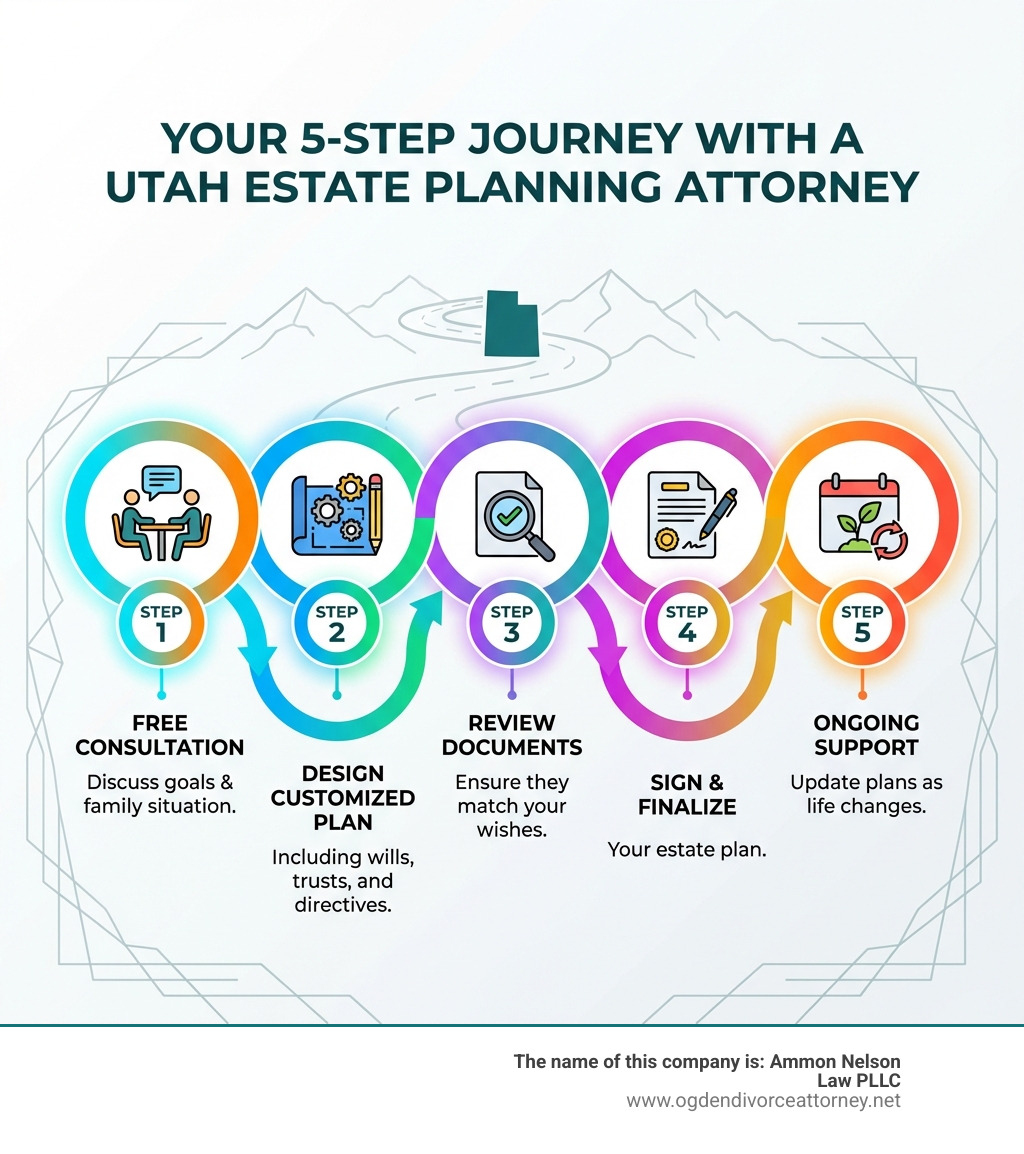
  • Initial Consultation: We sit down (or meet virtually) to discuss your family, your assets, and your goals. We’ll ask “what if” questions you might not have considered.
  • Document Review: Once we draft your plan, we’ll go through it together to ensure every name is spelled correctly and every wish is accurately captured.
  • The Signing Meeting: This is the formal part. We ensure all documents are signed, witnessed, and notarized according to Utah law.
  • Asset Retitling: A trust is like a safe; it only works if you put your valuables inside. We help you understand how to move your home or accounts into the trust’s name.
  • Periodic Updates: Life changes. We recommend a review every 3 to 5 years.

Frequently Asked Questions about Estate Planning in Utah

Do I need a will if I don’t have a large estate?

Absolutely. Even if you only own a car and a modest bank account, a will ensures those items go to the person of your choosing. More importantly, if you have minor children, a will is the only place you can legally nominate a guardian. Without it, a judge—who doesn’t know your family—will decide who raises your kids.

How often should I update my estate plan?

We generally suggest a “check-up” every few years. However, major life events should trigger an immediate update, including:

  • Marriage or divorce (especially important in Utah!)
  • The birth or adoption of a child
  • Purchasing a new home or starting a business
  • A significant change in tax laws

What happens if I die without a will in Salt Lake City?

As mentioned, you fall under Utah’s “intestate” laws. This often leads to family disputes. For example, if you are remarried, your current spouse and your children from a previous marriage might end up in a legal tug-of-war over your house. A Salt Lake City estate planning lawyer prevents this “state-mandated distribution” from causing unnecessary pain for your survivors.

Conclusion

Estate planning is one of the greatest gifts you can give your family. It provides a roadmap during their most difficult moments, ensuring that your love and protection continue even when you aren’t there to provide them personally.

At Ammon Nelson Law PLLC, we are committed to providing customized, results-driven representation for families in Salt Lake City, Ogden, and throughout Northern Utah. Whether you need a simple will, a complex trust, or help navigating the probate of a loved one’s estate, we are here to help.

Don’t leave your family’s future to chance or the “default” settings of the state. Start your estate plan today and gain the peace of mind that comes with knowing your legacy is secure.

Filed Under: Estate Planning Tagged With: attorney

Why Understanding Utah Sole Custody Cases is Critical for Your Family’s Future

Utah sole custody cases are among the most challenging family law matters to win. Here’s what you need to know right away:

Quick Facts About Utah Sole Custody:

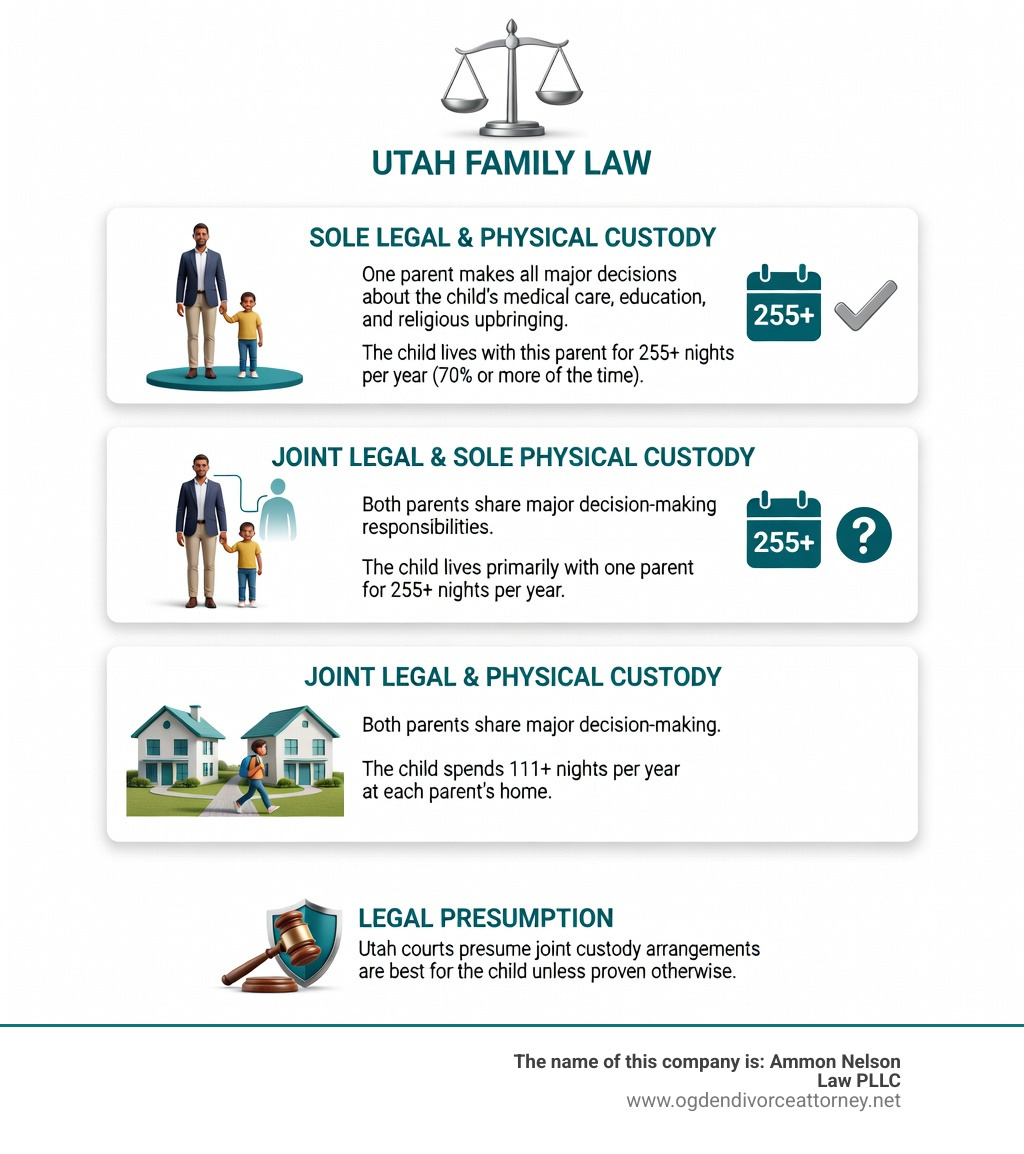
  • Sole physical custody means your child lives with you at least 255 nights per year (70% or more of the time)
  • Sole legal custody means you alone make major decisions about your child’s medical care, education, and religious upbringing
  • Joint custody is presumed – Utah courts start with the assumption that joint legal custody serves children best
  • You must prove otherwise – To win sole custody, you need clear evidence that joint custody would harm your child
  • Key evidence includes domestic violence, substance abuse, neglect, parental unfitness, or geographic distance between parents

The end of a relationship is difficult, especially when children are involved. In Utah, you’re fighting against a legal system designed to keep both parents actively involved in a child’s life. The court won’t award sole custody just because you prefer it or because you and your ex don’t get along. You need compelling evidence that sole custody protects your child’s welfare.

This creates real challenges for parents who genuinely need sole custody to protect their children. The burden of proof falls on you to demonstrate why the standard joint custody arrangement won’t work. You’ll need to gather evidence, steer court procedures, attend mediation, and potentially go to trial – all while managing the emotional stress of protecting your child.

At Ammon Nelson Law, PLLC, we’ve guided countless families through Utah sole custody cases across Northern Utah, helping parents build strong cases that prioritize their children’s safety and wellbeing. My firm combines traditional legal expertise with modern technology to provide clear, effective representation when your family’s future is on the line.

Infographic showing Utah custody types: Sole Legal and Physical Custody (one parent makes all major decisions and child lives with them 255+ nights/year), Joint Legal and Sole Physical Custody (both parents make decisions but child lives primarily with one parent 255+ nights/year), Joint Legal and Physical Custody (both parents make decisions and child lives at each home 111+ nights/year), and the legal presumption favoring joint custody arrangements - utah sole custody cases infographic

Understanding Sole Legal and Physical Custody in Utah

When we talk about Utah sole custody cases, we have to break the concept of “custody” into two distinct buckets: legal and physical. In Utah, these are treated separately, though they often overlap in sole custody awards.

parent and child in a safe home environment - utah sole custody cases

Legal Custody: The Power to Decide

Legal custody refers to the right and responsibility to make major life decisions for your child. This isn’t about what they eat for lunch; it’s about the big stuff. If you are awarded sole legal custody, you have the final say on:

  • Education: Which school they attend or if they are homeschooled.
  • Healthcare: Decisions regarding elective surgeries, vaccinations, and mental health therapy.
  • Religion: Which religious practices the child will be raised with.

Physical Custody: Where the Child Lives

Physical custody refers to the actual residence of the child. When a court awards sole physical custody, the child lives primarily with one parent. However, this doesn’t mean the other parent disappears (more on that later).

According to Utah Code Section 81-1-101, a “custodial parent” is defined based on where the child spends their nights. Understanding the difference between these types is vital, as explored in our guide on Divorce: Two Types of Custody.

Feature Sole Custody Joint Custody
Primary Residence One parent’s home (255+ nights) Both parents’ homes (at least 111 nights each)
Major Decisions One parent decides Parents must agree/consult
Parent-Time Usually scheduled for non-custodial parent Shared more equally
Legal Presumption Must be proven as “best interest” Default starting point for courts

Defining Sole Physical Custody in Utah Sole Custody Cases

In the eyes of Utah law, physical custody is a numbers game. To be considered the sole physical custodian, the child must reside with you for more than 70% of the year. Specifically, this means the child spends 255 nights or more at your home.

If the other parent has the child for 111 nights or more (roughly 30%), the state considers it “joint physical custody.” This distinction is critical because it impacts everything from child support calculations to the daily routine of the child. You can read more about these definitions on our Custody page.

Decision-Making Authority in Utah Sole Custody Cases

One of the most common reasons parents tell us, “I Want Sole Custody,” is because they cannot agree with the other parent on fundamental issues. If you have sole legal custody, you are the “tie-breaker” by default—actually, there is no tie to break because you hold the authority.

In many Utah sole custody cases, a judge might award “Joint Legal Custody” but give one parent “final decision-making authority” over specific areas, like education, if the parents are prone to deadlocking. However, true sole legal custody is usually reserved for cases where one parent is completely unavailable, incapacitated, or deemed unfit to participate in the child’s upbringing.

Why Winning Utah Sole Custody Cases is Challenging

If you walk into a courtroom in Ogden or Salt Lake City and simply say, “I’m the better parent,” you aren’t going to win sole custody. Utah law has a very strong “rebuttable presumption” that joint legal custody is in the best interest of the child.

The Rebuttable Presumption

A “rebuttable presumption” means the judge starts the case assuming that both parents should be involved in decision-making. It is your job to “rebut” or disprove that assumption with cold, hard evidence. The court’s primary concern is never the parent’s feelings; it is always the “best interest of the child.”

Utah Code Section 81-9-204 outlines the factors a judge must look at. These include the past conduct of the parents, their emotional stability, and their ability to put the child’s needs first. For a deeper dive, see our article on Understanding Child Custody Laws in Utah.

Overcoming the Preference for Joint Custody

To overcome this preference, we must show the court that joint custody is actually harmful or impossible. Common reasons a judge might move away from Joint Custody include:

  • Parental Unfitness: Issues like chronic substance abuse or untreated severe mental illness.
  • Geographic Distance: If one parent lives in Northern Utah and the other lives in Florida, joint physical custody (111 nights each) is logistically impossible once the child is school-aged.
  • Domestic Violence: This is a major factor that can immediately shift the court’s perspective on what is “safe” for the child.
  • Special Needs: If a child has profound medical or educational needs that require a level of stability and consistency that a two-home shuffle cannot provide.

Key Factors and Evidence for Awarding Sole Custody

Winning Utah sole custody cases requires a mountain of evidence. You cannot rely on hearsay or “he said, she said” arguments. The court needs documentation.

The “Big Three”: Abuse, Neglect, and Substance Abuse

The most straightforward (though tragic) way to secure sole custody is by proving the other parent is a danger to the child. Under Utah Code 81-9-104, the court must consider evidence of:

  1. Domestic Violence: Whether directed at the child, the other parent, or even another household member.
  2. Neglect: Failure to provide food, clothing, shelter, or medical care.
  3. Abuse: Physical, sexual, or emotional harm.

If these factors are present, the court may not only award sole custody but also order “supervised parent-time” to ensure the child is never left alone with the dangerous parent. We discuss these heavy topics further in our Custody Considerations guide.

Proving the Best Interest of the Child in Utah Sole Custody Cases

Beyond the “Big Three,” the court looks at the “Best Interest Factors.” This is a holistic view of the child’s life.

  • Stability: Who has been the primary caregiver? Who takes the child to doctor appointments and parent-teacher conferences?
  • Moral Conduct: While Utah courts don’t judge parents for having a new partner, they do care if that partner is a convicted felon or if the parent’s lifestyle exposes the child to harmful situations.
  • Child’s Desires: If the child is at least 14 years old, the judge will give their preference “added weight,” though it is not the deciding factor.
  • Financial Stability: While a parent’s wealth isn’t a reason to award custody, the ability to provide a stable, clean home is.

To learn more about building this part of your case, check out How to Get Full Custody. You may also want to review the official factors for custody evaluators used by the state.

The Legal Process of Seeking Sole Custody

Seeking sole custody isn’t just about showing up to court. It’s a structured, often lengthy legal journey.

Step 1: Filing the Petition

The process begins when we file a “Petition for Custody” (or a Petition for Divorce if you are married). This document tells the court exactly what you want and why. Along with the petition, a Domestic Relations Injunction is automatically issued. This order prevents either parent from doing anything drastic, like moving the kids out of state or canceling insurance, while the case is pending.

Step 2: Service of Process

The other parent must be “served”—formally given the papers. They then have 21 days (if they live in Utah) or 30 days (if they live elsewhere) to file an “Answer.” If they don’t respond, you might win by “default,” but that is rare in contested Utah sole custody cases.

Step 3: Mediation

Utah law requires parents to attempt mediation before going to trial. A neutral third party helps you try to reach an agreement. If you can agree on sole custody here, the process is much faster and cheaper. If not, the case moves toward trial.

Step 4: Temporary Orders

Because court cases take time, we often ask for a “Temporary Order.” This sets the rules for custody and child support right now while we wait for the final trial.

You can find many of the necessary Utah Court Forms online, but we highly recommend having an attorney review them to ensure you aren’t accidentally signing away your rights.

The Role of Custody Evaluations and Trials

If mediation fails, the judge needs more information. This is where a Custody Evaluation comes in.

Under Rule 4-903, the court can appoint a professional (usually a psychologist) to investigate your family. They will:

  • Interview both parents.
  • Observe the parents with the child.
  • Talk to “collateral contacts” like teachers and doctors.
  • Review medical and school records.

The evaluator then writes a report recommending who should have custody. While the judge doesn’t have to follow this report, they usually do. For more detail, read the official Information on Utah custody evaluations.

Rights of the Non-Custodial Parent and Order Modifications

Even if you win sole physical custody, the other parent usually retains “parent-time” (the legal term for visitation).

Parent-Time Schedules

In Utah sole custody cases, the non-custodial parent is typically entitled to a minimum schedule outlined in Utah Code Section 81-9-302. For children ages 5-18, this usually includes:

  • One weekday evening.
  • Alternating weekends.
  • Holidays and several weeks in the summer.

If the non-custodial parent is dangerous, we can fight for “supervised parent-time,” where a third party must be present during all visits.

Modifying an Existing Custody Decree

Life changes. A parent who was stable two years ago might struggle with addiction today. Or, a parent who was “unfit” may have completed rehab and turned their life around.

To change a custody order, you must prove:

  1. There has been a substantial and material change in circumstances.
  2. The modification is in the best interest of the child.

Moving to a new house in the same neighborhood isn’t a “substantial change.” Moving 200 miles away or a parent getting arrested is. You can find more on this in the Utah Courts Custody Guide.

Frequently Asked Questions about Utah Sole Custody Cases

Can a history of domestic violence guarantee sole custody?

While it is a massive factor, it is not an automatic “guarantee.” The court will look at how recent the violence was, whether it was directed at the child, and if the parent has sought treatment. However, Utah law takes this very seriously. If you are in immediate danger, please contact the National Domestic Violence Hotline or local Northern Utah law enforcement immediately.

How does a parent’s relocation affect sole custody?

Utah has a “150-mile rule.” If a parent plans to move more than 150 miles away, they must provide 60 days’ notice to the other parent and the court. This often triggers a review of the custody arrangement because the existing schedule will no longer work. The court will use the factors in Utah Code Section 81-9-207 to decide if the child should move with the relocating parent or stay with the other parent.

At what age can a child choose which parent to live with?

In Utah, a child never gets to make the final choice until they are 18. However, once a child turns 14, the judge is legally required to give their desires “added weight.” The judge will still look at why the child wants to live with a certain parent. If the child wants to live with Dad because Dad has no rules and lets them skip school, the judge will likely ignore that preference.

Conclusion: Partnering with Ammon Nelson Law PLLC

Navigating Utah sole custody cases is an emotional marathon. Whether you are in Ogden, Salt Lake City, or anywhere in Northern Utah, you don’t have to run it alone.

At Ammon Nelson Law PLLC, we provide customized, results-driven representation. We understand that every family is different, and we are dedicated to protecting the bonds that matter most. We don’t just fill out paperwork; we build a strategy designed to show the court exactly why your proposed arrangement is what’s best for your child.

If you are ready to take the next step in securing your child’s future, we are here to help. Contact an Ogden Divorce Attorney at our office today to schedule a consultation and begin building your case.

Filed Under: Custody Tagged With: attorney

Why Choosing the Right Utah Estate Planning Attorney Matters for Your Family’s Future

A Utah estate planning attorney helps Utah families protect assets, avoid probate, minimize taxes, and ensure their wishes are honored through legal documents like wills, trusts, powers of attorney, and healthcare directives. The right attorney will guide you through Utah-specific laws, create customized plans for your unique family situation, and provide ongoing support as your life changes.

Key factors when choosing a Utah estate planning attorney:

  1. Experience and credentials – Look for attorneys with 20+ years of practice and specialized certifications like CELA (Certified Elder Law Attorney)
  2. Specialized focus – Choose attorneys who focus 100% on estate planning rather than general practice
  3. Client reviews – Seek firms with 5-star ratings and testimonials about personalized service
  4. Clear pricing – Expect free consultations and transparent flat-fee structures
  5. Utah law expertise – Ensure familiarity with Utah’s probate process, homestead exemptions, and trust laws

Estate planning is about more than legal documents. It’s about protecting the people you love and ensuring your family avoids painful probate processes, costly legal disputes, and unnecessary taxes. One CPA firm described a well-crafted living trust as “the best they had ever seen” – that’s the level of quality you deserve.

Without proper estate planning, Utah’s intestacy laws decide who gets your assets. Your family could face months of probate court, public disclosure of your private affairs, and frozen assets when they need financial support most. If you become incapacitated without healthcare directives, courts may appoint strangers to make medical decisions for you.

Many Utah families put off estate planning because the process feels overwhelming or they assume it’s only for the wealthy. The truth is that everyone with loved ones needs a plan – whether you own a home, have minor children, run a business, or simply want to ensure your wishes are followed.

As Ammon Nelson, I’ve helped countless Northern Utah families steer estate planning with personalized legal solutions that protect what matters most. My firm focuses on making complex legal processes simple and accessible, ensuring you understand every decision in your Utah estate planning attorney journey.

Infographic showing the 5 steps of working with a Utah estate planning attorney: 1) Free consultation to discuss goals and family situation, 2) Design customized plan including wills, trusts, and directives, 3) Review documents to ensure they match your wishes, 4) Sign and finalize your estate plan, 5) Ongoing support to update plans as life changes - utah estate planning attorney infographic

Why Estate Planning Is Essential for Utah Residents

Beautiful Utah landscape representing the legacy we leave behind - utah estate planning attorney

Living in Northern Utah, from the busy streets of Salt Lake City to the scenic foothills of Ogden, we understand the value of hard work and the importance of community. But hard work isn’t just about what you earn today; it’s about what you preserve for tomorrow. For residents in our corner of the Beehive State, estate planning isn’t just a “rich person’s problem”—it’s a vital tool for every family.

At its core, estate planning is the process of arranging the management and disposal of your estate during your life and after you pass away. We often tell our clients that it is a “gift” to their families. Why? Because without a plan, your grieving loved ones are left to steer the complex Utah legal system alone while trying to guess what you would have wanted.

A comprehensive plan addresses several critical areas:

  • Asset Distribution: Ensuring your home, savings, and personal belongings go to the specific people you choose.
  • Family Legacy: Preserving your values and providing for future generations.
  • Guardianship: If you have minor children, this is perhaps the most important part. You—not a judge—decide who will raise them if you are gone.
  • Incapacity Planning: Deciding who handles your finances and medical decisions if you become temporarily or permanently unable to do so yourself.

By working with a Utah estate planning attorney, you move from uncertainty to total control. You can find more info about estate planning services to see how these tools fit your specific Northern Utah lifestyle.

Benefits for Asset Protection and Tax Minimization

One of the biggest misconceptions we hear in our Ogden and Salt Lake City offices is that “the government will take everything.” While that’s an exaggeration, without a plan, taxes and creditors certainly can take a significant bite out of your legacy.

Asset Protection:
We live in a litigious world. Prudent decisions made today can protect your personal and professional properties from loss due to lawsuits, creditors, or bankruptcies. A multidisciplinary approach—combining estate law with asset protection strategies—shields your hard-earned wealth from “unscrupulous creditors” and even potential divorcing spouses of your heirs.

Tax Minimization:
While Utah does not have a state inheritance tax, federal estate tax laws still apply. History shows how quickly these things change. For example, in 2011, the federal estate tax exemption was $5,000,000 with a 35% tax rate on amounts exceeding it. Today’s exemptions are higher, but they are scheduled to “sunset” or decrease in the coming years.

Effective tax planning might involve:

  • Setting up specific irrevocable trusts.
  • Making charitable donations that provide tax breaks.
  • Re-titling assets to maximize the “basis step-up” (a tax concept that can save your heirs thousands in capital gains taxes).

To get started on organizing your thoughts, you can Download Your Free Workbook Below.

Key Components of a Comprehensive Utah Estate Plan

A “plan” isn’t just a single piece of paper. It’s a toolkit. Think of it like a Swiss Army knife for your future; each tool has a specific purpose.

Feature Last Will and Testament Revocable Living Trust
Probate Required? Yes No
Privacy Public Record Private
Asset Control Only after death During life and after death
Cost Lower upfront Higher upfront, lower later
Out-of-State Property Requires multiple probates Avoids out-of-state probate

1. Last Will and Testament: This is your basic roadmap. It outlines who gets what and names guardians for your kids. However, in Utah, a will must go through probate to be validated.

2. Financial Power of Attorney: This allows you to designate a “trusted agent” to handle your bills, banking, and business affairs if you can’t. Without this, your family might have to go to court to get a “conservatorship,” which is expensive and stressful.

3. Advance Healthcare Directive: In Utah, this combines what used to be called a “Living Will” and “Medical Power of Attorney.” It tells doctors your wishes for end-of-life care and names someone to speak for you.

4. Beneficiary Designations: Don’t forget your 401(k) or life insurance! These often pass outside of your will or trust, so they must be kept up to date.

For those dealing with aging parents or children with disabilities, you can find more info about guardianship and conservatorship to ensure they are protected.

Understanding Utah-Specific Laws

Utah has its own set of rules that a general online form won’t account for. For instance, the Utah Uniform Probate Code governs how estates are settled.

  • Homestead Exemptions: Utah law provides certain protections for your primary residence from creditors, which can be integrated into your estate plan.
  • Dynasty Trusts: Utah is a “trust-friendly” state. We can create trusts that last for generations, protecting wealth from taxes and creditors for your grandkids and beyond.
  • Family LLCs: For our clients in Salt Lake City and Ogden who own rental properties or businesses, a Family Limited Liability Company (LLC) can be a powerful tool to consolidate assets and provide another layer of protection.

Differences Between Wills and Trusts Under Utah Law

We often get asked, “Do I really need a trust?” While a will is a great start, a Revocable Living Trust is often the gold standard for Utah families.

A trust allows you to maintain complete control while you are alive. You can add property, take it out, or even cancel the trust entirely. But the magic happens when you pass away. Because the trust “owns” the assets, there is no need for a judge to get involved. This keeps your affairs out of the public record. In contrast, a will becomes a public document once it enters probate—meaning anyone can see what you owned and who you left it to.

If you choose a trust, we often include a “Pour-over Will.” This acts as a safety net, catching any assets you forgot to put in the trust and “pouring” them in after you pass. You can read more about living trust quality and legal documents to understand why quality drafting matters.

Navigating the Utah Probate Process and Why to Avoid It

Probate is the court-supervised process of authenticating a last will and testament if the deceased made one, or distributing assets according to state law if they didn’t. In Utah, while we have “informal probate” which is simpler than in some other states, it can still be a headache.

Why do most people want to avoid it?

  1. It’s Slow: Even a simple probate in Northern Utah can take 6 months to a year.
  2. It’s Public: Your nosy neighbor (or a predator looking for “new money” targets) can look up exactly what your heirs received.
  3. It’s Costly: Attorney fees, court costs, and personal representative fees add up quickly.
  4. Asset Freezes: Sometimes, accounts are frozen during the initial stages of probate, leaving families without cash for immediate needs.

Our goal as a utah estate planning attorney is often to help you bypass this system entirely. You can find more info about probate services if you are currently facing this process with a loved one’s estate.

How a Utah Estate Planning Attorney Uses Trusts to Avoid Probate

By “funding” a revocable living trust—which means re-titling your house, bank accounts, and investments into the name of the trust—you ensure that these assets pass directly to your beneficiaries.

This is especially critical if you own real estate outside of Utah (like a cabin in Idaho or a condo in Arizona). Without a trust, your family might have to go through probate in every single state where you owned land. A trust consolidates everything under one “umbrella,” saving your family thousands in multi-state legal fees.

The Role of a Utah Estate Planning Attorney in Trust Administration

Setting up the trust is only half the battle. When the time comes, someone has to “administer” it. This involves:

  • Fiduciary Duties: Ensuring the trustee follows the law and the trust’s instructions.
  • Record Keeping: Tracking all income and distributions.
  • Tax Compliance: Filing the necessary tax returns for the estate.
  • Avoiding Conflict: Acting as a neutral third party to explain the “why” behind your decisions to beneficiaries.

We provide legal guidance to trustees to ensure they fulfill these duties without making mistakes that could lead to personal liability or family feuds.

Specialized Planning: Business Succession, Special Needs, and Elder Law

Estate planning isn’t just about the “end.” It’s about the “now” and the “what if.”

Business Succession:
Did you know that family businesses generate an estimated one-half of the U.S. Gross National Product and pay half of all wages? If you own a business in Ogden or Salt Lake City, your business is your legacy. We help you create clear succession plans so your life’s work doesn’t crumble the moment you step away. This includes inter-generational transfers and tax-efficient strategies for selling or gifting the business.

You can read more about estate planning and contracts law to see how business and estate law overlap.

Special Needs and Elder Law Issues in Utah

For families with loved ones who have disabilities, traditional estate planning can actually be dangerous. If you leave money directly to a person receiving government benefits (like SSI or Medicaid), they could be disqualified from those benefits.

Supplemental Needs Trusts (SNTs): These allow you to provide for a loved one’s quality of life without jeopardizing their essential government support. We also look at ABLE accounts, which are tax-advantaged savings accounts for individuals with disabilities.

Elder Law: As we age, the cost of long-term care becomes a major concern. We assist with:

  • Medicaid Planning: Helping you qualify for help with nursing home costs while legally protecting assets for your spouse.
  • Long-Term Care Options: Navigating the complex world of assisted living and home care.

There’s more info about trusts for everyone because these tools are designed to protect people at every stage of life.

How to Choose a Utah Estate Planning Attorney

Choosing an attorney is a big decision. You aren’t just buying a document; you are choosing a partner for your family’s future.

What to Look for in a Utah Estate Planning Attorney

  1. Experience Levels: Look for a firm with deep roots. For example, some top Utah attorneys have over 30 or 40 years of experience. You want someone who has seen how these documents actually play out in court ten or twenty years later.
  2. Specialized Focus: Some lawyers do “a little bit of everything.” For estate planning, you want someone who lives and breathes this area of law.
  3. Client Reviews: 5-star ratings on Google tell a story. Look for words like “patient,” “knowledgeable,” and “made it simple.”
  4. Credentials: While not always necessary, look for specialized certifications like a CELA (Certified Elder Law Attorney). There are very few in Utah, and they represent the gold standard in elder law.

To help you prepare for a meeting, Download Your Estate Planning Packet Below.

Cost of Hiring a Utah Estate Planning Attorney

“How much is this going to cost?” It’s the elephant in the room. In Utah, pricing typically depends on complexity.

  • Flat Fees: Many firms offer flat-fee packages for standard estate plans (Will, Trust, Power of Attorney, etc.). This gives you peace of mind knowing the price upfront.
  • Hourly Rates: Usually reserved for complex business litigation or ongoing probate administration.
  • Free Consultations: Most reputable Utah estate planning attorney firms offer a free initial consultation. This is your chance to “interview” the lawyer and see if they are a good fit for your family.

The Risk of DIY: While “online kits” are cheap, they often fail to comply with Utah-specific laws or aren’t “funded” correctly. Saving $1,000 now could cost your family $10,000 in probate fees later. As one attorney put it, professional planning offers the “convenience of DIY but with the counsel only a human expert can provide.”

Common Mistakes and When to Update Your Plan

The biggest mistake? Doing nothing. But even if you have a plan, it can become a “zombie” document—dead, but still walking around.

Common Pitfalls:

  • Failing to Fund the Trust: A trust is like a suitcase; it only works if you put your stuff inside it. If your house isn’t deeded to the trust, it’s going to probate.
  • Choosing the Wrong Executor: Just because someone is your oldest child doesn’t mean they are good with paperwork or neutral in family disputes.
  • Ignoring Beneficiary Designations: If your ex-spouse is still the beneficiary on your life insurance, they get the money—regardless of what your new will says!

When to Review Your Utah Estate Plan

We recommend a check-up every 3 to 5 years. However, certain “Life Events” should trigger an immediate review:

  1. Marriage or Divorce: Your legal status changes everything.
  2. Birth or Adoption: You need to ensure the new addition is provided for and has a guardian named.
  3. Moving: If you moved to Utah from another state, your old documents might not take advantage of Utah’s specific laws (like our homestead exemptions).
  4. Financial Changes: If you start a business or receive a large inheritance.

You can explore more info about Utah estate planning categories to stay updated on what’s relevant to you.

Frequently Asked Questions about Utah Estate Planning Attorneys

How do revocable living trusts help avoid probate in Utah?

A trust avoids probate because the trust itself is the legal owner of the assets. When you pass away, the trust doesn’t “die”—it just gets a new manager (your Successor Trustee). Since the owner (the trust) is still “alive,” the court doesn’t need to get involved to transfer the property.

What qualifications should I look for in a Utah estate planning attorney?

Look for an attorney who focuses heavily on estate law and probate. Check for years in practice (20+ is ideal), local experience in Northern Utah courts, and high peer and client ratings. Professional affiliations like the Utah State Bar’s Estate Planning Section are also a good sign.

How much does estate planning cost in Utah?

A basic “young family” plan (will, guardian naming, power of attorney) might be relatively inexpensive. A full “Living Trust” package for a homeowner with a family usually costs more but saves significantly on future probate fees. Most firms provide a quote after a free consultation.

Conclusion

At Ammon Nelson Law PLLC, we believe that estate planning is about more than just numbers and legal jargon—it’s about people. Whether you are in Ogden, Salt Lake City, or anywhere in Northern Utah, your family deserves a plan that reflects your values and protects your hard-earned legacy.

We pride ourselves on providing customized, results-driven representation. We don’t do “cookie-cutter” law. We listen to your goals, explain your options in plain English, and build a fortress around your family’s future.

Don’t leave your family’s peace of mind to chance. Schedule a consultation for Utah estate planning with us today, and let’s start building your legacy together. We are here to make the complex simple and the future secure.

Filed Under: Estate Planning Tagged With: attorney

  • « Previous Page
  • 1
  • 2
  • 3
  • 4
  • …
  • 6
  • Next Page »

Ogden Location

1492 East Ridgeline Dr., Suite 3
South Ogden, UT 84405
Phone: 801.337.4355
Fax: 801.337.0737
Email: ammon@ammonnelsonlaw.com

Monday9:00 AM - 6:00 PM
Tuesday9:00 AM - 6:00 PM
Wednesday9:00 AM - 6:00 PM
Thursday9:00 AM - 6:00 PM
Friday9:00 AM - 6:00 PM
SaturdayAvailable for Emergencies
SundayClosed

Directions

Navigation

  • Family Law
  • Divorce
  • Child Custody
  • Child Support
  • Spousal Support

Follow Us

Ammon Nelson Law - Facebook Ammon Nelson Law - Twitter Ammon Nelson Law - YouTube Ammon Nelson Law - Instagram

2022 Ammon Nelson Law | All Rights Reserved | Privacy Policy | Terms | XML Sitemap | Site by PDM