Ammon Nelson Law - Facebook Ammon Nelson Law - Twitter Ammon Nelson Law - YouTube Ammon Nelson Law - Instagram
  • About Us
  • Team
  • Contact Us
  • FAQs
  • En Español
Ammon Nelson Law

Ammon Nelson Law

Visit North Carolina Website

Call For A Consultation

801.337.4355
  • Family Law
    • Divorce
    • Child Custody
    • Child Support
    • Spousal Support
    • Special Needs Children
    • Father’s Rights
    • Visitation Rights
    • Grandparents Rights
  • Divorce
    • Annulment
    • How To File
    • No Fault Divorce
    • Uncontested Divorce
    • Contested Divorce
    • Irretrievable Breakdown & Divorce
    • Division of Intellectual Property
    • Divorce By Publication
    • Equitable Distribution
    • High-Asset Marital Estates
  • Child Custody
    • How to Get Full Custody
    • Joint Custody
    • Relocation & Custody
    • Interstate & International Custody and Recovery
  • Child Support
    • How to Obtain Child Support
  • Spousal Support
    • Pre and Post Nuptial Agreements
    • Post Judgement Enforcement Modification
    • Orders of Protection
  • Estate Planning and Probate
    • Social Security Disability
    • Estate Planning
    • Personal Injury
    • Probate
    • Guardianship and Conservatorship
  • Mediation

The Essential Guide to Alimony Law in Utah

Home » alimony

Why Understanding Alimony Law in Utah Matters for Your Financial Future

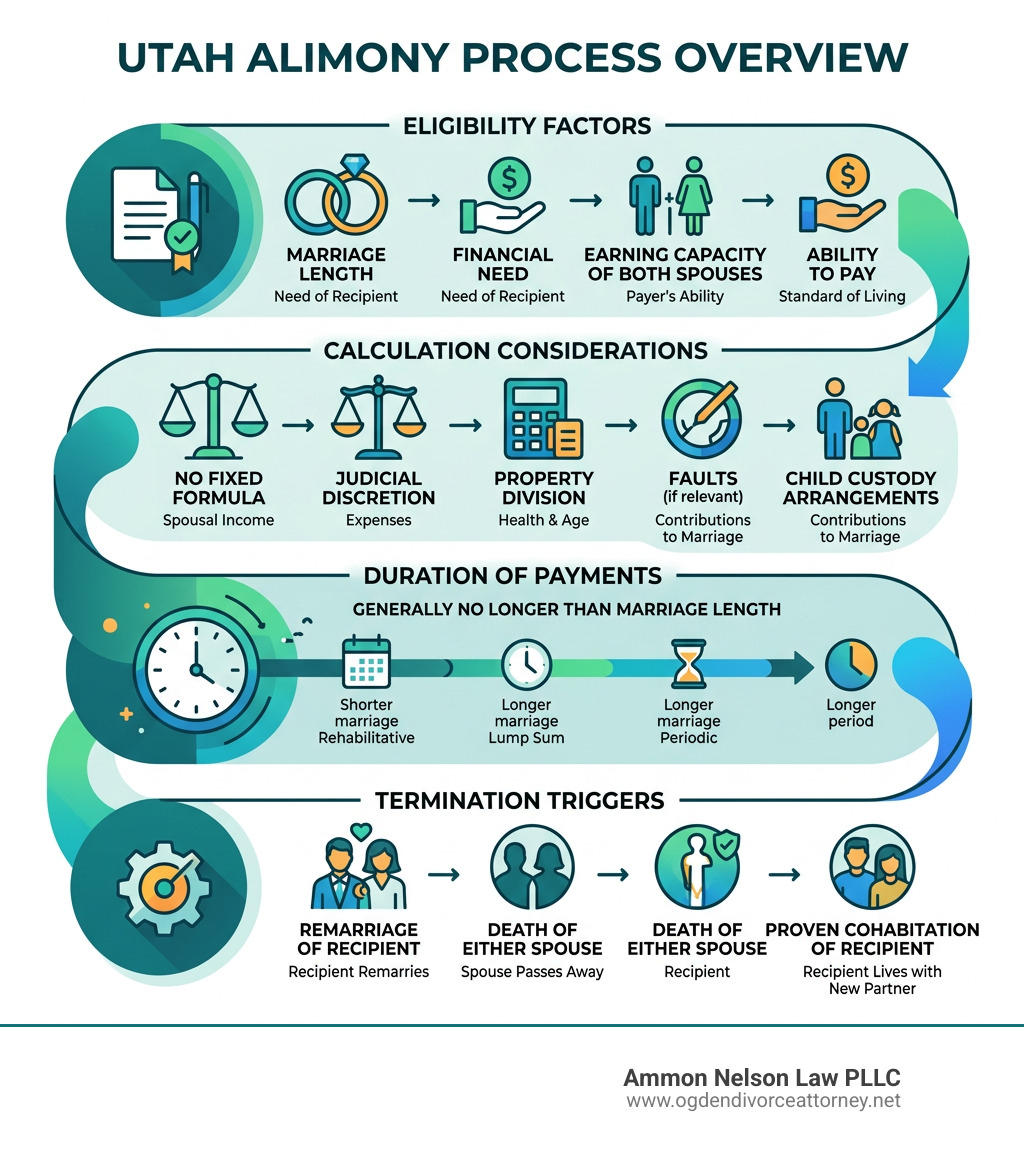
Alimony law in Utah provides financial support to spouses who need assistance maintaining their standard of living after divorce. Here’s what you need to know:

Key Points About Utah Alimony:

  • Eligibility – Either spouse can request alimony based on financial need, earning capacity, and ability to pay
  • Duration – Generally cannot exceed the length of the marriage (except in special circumstances)
  • Termination – Automatically ends upon remarriage or death of the recipient; cohabitation also terminates support
  • 2024 Reforms – New laws emphasize fairness, income equalization for long marriages, and consideration of stay-at-home parent contributions
  • Modification – Can be changed due to substantial changes like retirement, job loss, or health issues
  • Types – Includes temporary, rehabilitative, reimbursement, and durational support

Money questions in divorce can be tricky. And hard to change once the court signs a decree. Whether you’re the spouse seeking support or the one who may be ordered to pay, understanding how Utah courts determine alimony is essential for protecting your financial future.

Alimony—also called spousal support—is not automatically granted in every case. Utah courts have broad discretion to decide whether support is necessary and fair based on multiple factors including your standard of living during marriage, each spouse’s financial condition and earning capacity, the length of your marriage, and even marital fault in some situations.

The landscape of alimony in Utah changed significantly in 2024. New reforms introduced more structured criteria and clearer guidelines, particularly for marriages lasting 10 years or more where one spouse reduced their career to care for children. These changes affect both how alimony is initially determined and how it can be modified later.

At Ammon Nelson Law, PLLC, we’ve guided countless families in Northern Utah through complex divorce proceedings involving spousal support, ensuring fair outcomes under alimony law in Utah while protecting my clients’ rights and financial stability. We understand both the legal complexities and the emotional challenges families face during divorce.

Infographic showing the Utah alimony determination process: eligibility factors, duration limits, types of support, 2024 reform highlights, modification triggers, and automatic termination conditions - alimony law in utah infographic pillar-4-steps

Understanding Alimony Law in Utah: Eligibility and Factors

In our practice at Ammon Nelson Law PLLC, we often see clients who are surprised to learn that alimony isn’t a “one-size-fits-all” calculation. Unlike child support, which follows a fairly rigid formula, alimony is highly discretionary. To understand if you or your spouse qualifies, we must look at the primary statutory factors.

Under Utah Code Title 81, Chapter 4, Part 5, the court evaluates several core elements:

  1. The financial condition and needs of the recipient spouse: Does the spouse asking for money actually need it to meet their reasonable monthly expenses?
  2. The recipient’s earning capacity: This includes their education, work history, and ability to produce income.
  3. The payor spouse’s ability to provide support: You can’t squeeze blood from a turnip; the court won’t order support that the other spouse simply cannot afford after meeting their own needs.
  4. The length of the marriage: This is a heavy hitter in determining both the amount and how long the checks will keep coming.
  5. Custody of minor children: Whether the recipient spouse has physical custody of children who require care that limits employment.

We also look at whether the recipient spouse worked in a business owned by the other spouse or contributed to the other spouse’s education (like working to put a partner through medical school). For a deeper dive into these basics, you can explore our overview of Spousal Support.

Legal documents and a gavel on a wooden desk - alimony law in utah

The Role of Marital Standard of Living

One of the most important concepts in alimony law in Utah is the “marital standard of living.” The court’s goal is generally to keep both parties as close as possible to the lifestyle they enjoyed while married.

Judges look at the lifestyle at the time of separation. If you were living in a luxury home in Salt Lake City and vacationing twice a year, the court will try to ensure the dependent spouse isn’t suddenly forced into a lifestyle that is vastly inferior. However, since two households are more expensive to run than one, “income equalization” often becomes the practical solution when there isn’t enough money to keep both people in the lap of luxury.

Factor Pre-2024 Reform Approach Post-2024 Reform (HB 220)
Standard of Living Broad judicial discretion. Specific factors added to define “standard.”
Look-back Period Vague or inconsistent. Required look-back for financial needs.
Income Equalization Common in long marriages. Mandatory rebuttable presumption for 10+ year marriages with childcare impact.
Income Imputation Often assumed full-time work. Limitations if there is a disability or no recent work history.

For more details on how these factors play out in real cases, check out Alimony in Utah: A Guide to Spousal Support.

How Fault Impacts Alimony Law in Utah

Utah is a “no-fault” divorce state, meaning you don’t have to prove your spouse did something wrong to get a divorce. However—and this is a big “however”—Utah is unique because the court can consider “fault” when deciding alimony.

Under Utah Code 81-4-503, “wrongful conduct” that substantially contributed to the breakup of the marriage can be used to increase, decrease, or even deny alimony. This includes:

  • Adultery: Engaging in sexual relations with someone other than your spouse.
  • Physical Harm: Intentionally causing or attempting to cause physical harm.
  • Fear of Harm: Causing a spouse or child to fear life-threatening harm.
  • Financial Undermining: Substantially undermining the financial stability of the other party.

It’s important to note that this isn’t meant to be a “punishment” in the criminal sense, but rather an equitable consideration. If a spouse’s bad behavior caused the financial rift, the judge has the discretion to let that influence the final number.

Determining the Amount and Duration of Support

When we sit down with clients in our Ogden or Salt Lake City offices, the first question is usually, “How much and for how long?” Because there is no set formula, we have to build a case based on your specific financial records.

The court typically looks at your monthly budget. If your reasonable needs are $4,000 a month and you can only earn $2,500, your “need” is $1,500. If your spouse has a surplus of $1,500 after their own expenses, that’s often where the alimony amount lands. This is part of the broader process of Equitable Distribution that we manage for our clients.

Types of Alimony Available Under Alimony Law in Utah

Not all alimony looks the same. Depending on your situation, the court might order:

  • Temporary Support (Alimony Pendente Lite): This is paid while the divorce is still moving through the courts to keep the bills paid.
  • Rehabilitative Alimony: This is short-term support intended to get a spouse back on their feet—perhaps while they finish a degree or a job training program.
  • Durational Alimony: This is the most common type, providing support for a set number of years.
  • Reimbursement Alimony: This might be awarded if one spouse supported the other through professional school, expecting to share in the future high earnings that are now being lost to divorce.

Understanding which type applies to you is a key part of The Divorce Process in Utah.

Statutory Limits on Duration

One of the firmest rules in alimony law in Utah involves the clock. Per Utah Code § 81-4-502(7), alimony cannot be ordered for a period longer than the length of the marriage.

If you were married for 12 years, the maximum alimony duration is 12 years. There are very rare “extenuating circumstances” that might allow a judge to go beyond this, but they are the exception, not the rule. It is also important to remember that the time you spend paying temporary alimony during the divorce process usually counts toward that total time limit. You can find more official guidance on this at the Alimony – Utah Courts page.

Recent 2024 Reforms and HB 220 Changes

The year 2024 brought significant updates to how we handle these cases. The 2024 HB 220 Divorce Amendments were designed to make alimony more predictable and fairer for modern families.

One of the biggest shifts involves income imputation. In the past, courts often assumed a stay-at-home parent could immediately go out and earn a full-time wage. The new law is more compassionate. It places restrictions on imputing income if a spouse has been out of the workforce for a long time due to childcare or has a diagnosed disability. The court now has to look at “reasonable barriers” to employment rather than just assuming everyone can work a 40-hour week at a certain rate.

Equalization in Long-Term Marriages

For those in long-term marriages (defined as 10 years or more), the 2024 reforms added a powerful tool. If a recipient spouse has “diminished workplace experience” because they stayed home to raise the couple’s children, there is now a rebuttable presumption that the court should equalize the parties’ standards of living.

This means the starting point for the judge is to try and make sure both spouses end up with a similar lifestyle, acknowledging that the stay-at-home parent’s contribution to the family allowed the other spouse to build their career. This is particularly relevant in High Asset Marital Estates where the income gap can be substantial.

Modification and Termination of Spousal Support

Life doesn’t stand still after a divorce decree is signed. Jobs are lost, people retire, and ex-spouses move in with new partners. Alimony law in Utah allows for modifications, but only if there is a “substantial material change in circumstances” that wasn’t anticipated in the original decree.

Common reasons for modification include:

  • Retirement: Utah law now explicitly states that a payor’s retirement is a substantial change that can lead to a reduction or termination of alimony.
  • Job Loss or Disability: If the person paying can no longer earn what they used to, the payment may need to drop.
  • Income Increase: If the person receiving alimony suddenly lands a high-paying executive job, the “need” for support might vanish.

The process involves filing a petition with the court. You can learn more about this in our guide on Post-Judgement Enforcement and Modification.

Terminating Alimony for Cohabitation or Remarriage

Alimony doesn’t always last until the end of the court-ordered duration. It terminates automatically if:

  1. The recipient spouse remarries.
  2. Either spouse dies.

However, the most contentious termination issue is cohabitation. If the person receiving alimony moves in with a new romantic partner, the payor can petition to stop the payments.

Under Utah Code Section 81-4-502, cohabitation means living together on a regular basis in a relationship of a romantic or sexual nature. It’s not just about having a roommate; it’s about a shared life that resembles a marriage. Pro-tip: You must file your motion to terminate within one year of when you knew (or should have known) about the cohabitation. If you wait too long, you might lose your right to stop the payments.

Frequently Asked Questions about Alimony in Utah

Are alimony payments taxable in Utah?

This is a point of major confusion. For any divorce finalized after December 31, 2018, federal tax laws changed significantly.

  • For the Payor: Alimony payments are not tax-deductible.
  • For the Recipient: Alimony received is not considered taxable income.

This was a massive shift from the old rules where the payor got a tax break and the recipient paid the bill. If your divorce was finalized before 2019, you might still be under the old “tax-deductible” rules, so always consult with a tax professional or our team to be sure.

Can spouses agree to waive alimony?

Absolutely. Many couples choose to resolve alimony through Pre and Post Nuptial Agreements or by negotiating a settlement during the divorce. You can agree to a “non-modifiable” waiver, meaning that no matter what happens in the future, neither party can ask for alimony. This provides a level of certainty that many of our Northern Utah clients appreciate.

What happens if alimony is not paid?

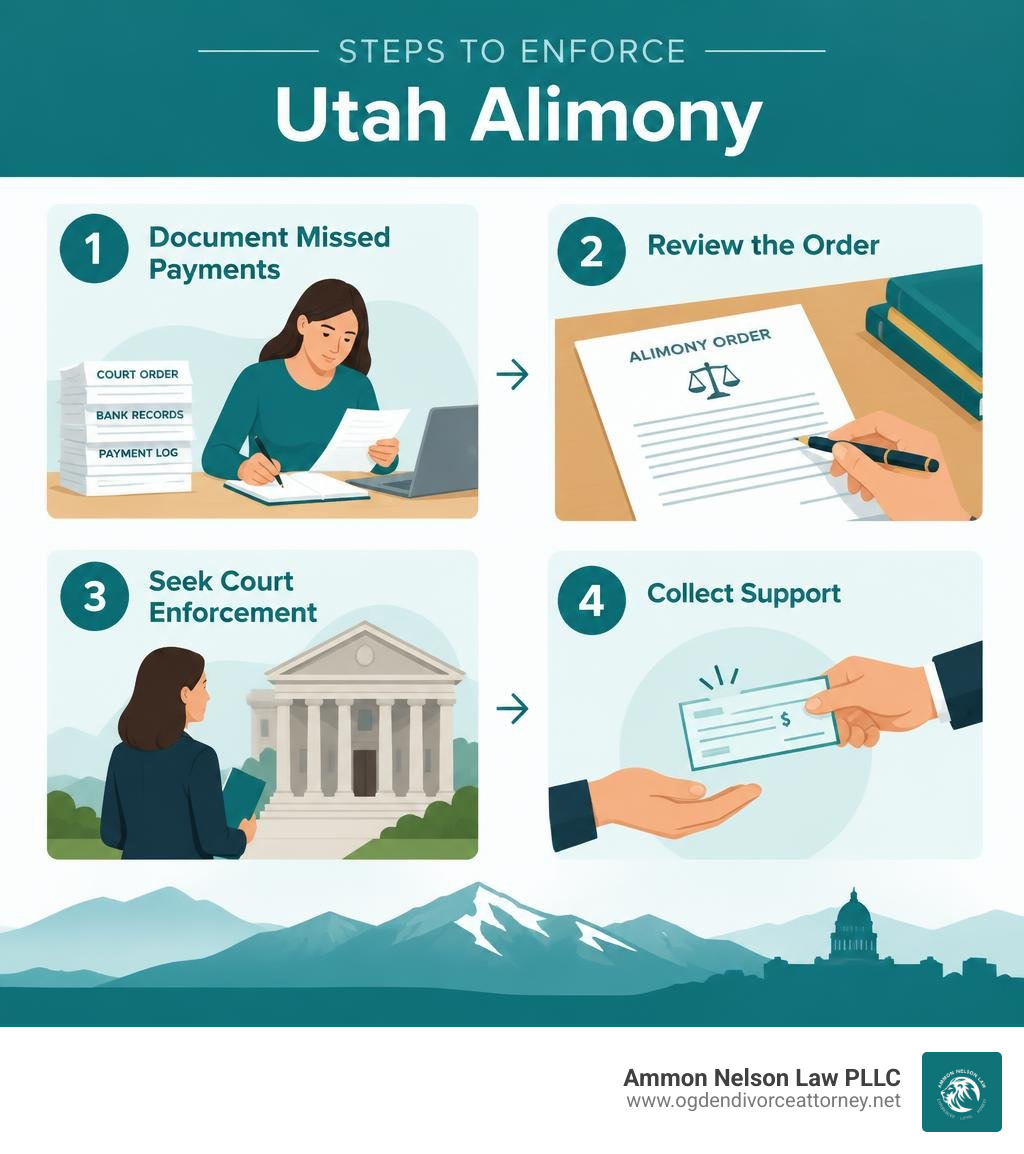
Alimony is a court order, not a suggestion. If a spouse stops paying, they can be found in contempt of court. This can lead to:

  • Income Withholding: The money is taken directly from their paycheck.
  • Judgments: A judge can issue a judgment for the total amount of past-due alimony (arrears), plus interest.
  • Legal Fees: The non-paying spouse may be ordered to pay the other spouse’s attorney fees.
  • Jail Time: In extreme cases of willful non-payment, a judge can order jail time.

Conclusion

Navigating alimony law in Utah is one of the most stressful parts of a divorce. Whether you are worried about how you will support yourself or concerned that your hard-earned income will be unfairly distributed, you don’t have to face these questions alone.

At Ammon Nelson Law PLLC, we pride ourselves on providing customized, results-driven representation. We understand the nuances of the 2024 reforms and how to build a compelling case for our clients in Ogden, Salt Lake City, and throughout Northern Utah. Our goal is to ensure that your final divorce decree is fair, sustainable, and protects your future.

If you have questions about your specific situation, we invite you to reach out. For more resources, visit our spousal support services page or contact us today to schedule a consultation. Let us help you find the clarity and stability you deserve.

Filed Under: Divorce Tagged With: alimony

Understanding Arrears and Collecting Back Child Support in Utah

When we talk about collecting back child support in Utah, we are dealing with “arrears.” In simple terms, arrears are the accumulated unpaid child support installments that a parent was ordered to pay but didn’t. In Utah, child support isn’t just a suggestion; it is a legal debt.

One of the most important things to understand about Child Support in Utah is that each monthly installment becomes a “judgment by operation of law” the moment it is due and unpaid. This means you don’t necessarily have to go back to court every single month to prove they owe you money; the law already recognizes the debt.

Feature Administrative Enforcement (ORS) Judicial Enforcement (Court)
Cost Low (Nominal annual fee) Higher (Attorney fees/filing fees)
Speed Can be slow due to high caseloads Often faster for specific assets
Tools Tax intercepts, license suspension Contempt of court, jail time, bank levies
Legal Advice None provided Provided by your private attorney
Complexity Standardized forms Customized motions and hearings

How Back Child Support in Utah Accrues

Back child support accrues automatically. If the court orders $500 a month and the parent pays $0, they owe $500. If they pay $300, they owe $200 in arrears. This balance continues to grow until it is paid in full.

In Utah, interest may also be added to these arrears. While it doesn’t always happen automatically in every administrative case, a judge can certainly include interest when we go to court to finalize a “sum certain” judgment. This makes child support debt function much like a high-stakes loan that the non-custodial parent never asked for but is obligated to repay.

Legal Consequences of Non-Payment

The consequences of failing to pay are intentionally designed to be “uncomfortable.” Beyond just owing money, the delinquent parent faces serious credit reporting issues. ORS regularly reports significant arrears to credit bureaus, which can tank a person’s credit score, making it impossible to buy a car or get a mortgage.

There are also Three Things You Must Know About Child Support: it is non-dischargeable in bankruptcy, it survives the child turning 18 (if arrears exist), and the federal government will intervene if missed payments extend beyond two years or exceed $5,000, potentially turning a civil matter into a federal crime.

The Role of the Utah Office of Recovery Services (ORS)

Utah State Capitol - collecting back child support in utah

The Office of Recovery Services (ORS) is the state agency responsible for the Title IV-D program in Utah. Their primary mission is to promote parental responsibility. For many parents, ORS is the first stop for How to Obtain Child Support.

ORS acts as a middleman. They process, record, and distribute payments. If you have an ORS case, the non-custodial parent pays ORS, and ORS pays you. This creates a clear “paper trail” that prevents the “he-said, she-said” arguments about whether a payment was actually made.

Administrative Tools for Collecting Back Child Support in Utah

ORS has a “toolbox” of administrative powers that don’t require a judge’s signature for every action. These Enforcement Tools are highly effective if the non-custodial parent has a steady job or receives government checks.

  • Wage Garnishment: This is the “gold standard” of collection. ORS sends an income withholding order to the parent’s employer, and the support is taken out before the parent even sees their paycheck.
  • Tax Refund Interception: If the parent is due a federal or state tax refund, ORS can snatch it to pay off arrears.
  • Workers’ Comp and Unemployment: Even if the parent is out of work, ORS can often garnish a portion of these benefits.
  • Lottery Winnings: If they hit the jackpot, the state gets its cut for the kids first.

License Suspension and Passport Denial

If the “money tools” don’t work, ORS moves to “lifestyle tools.” Under the ENFORCEMENT OF SUPPORT OBLIGATION guidelines, ORS can initiate the suspension of various licenses. This includes:

  • Driver’s Licenses: Making it difficult to commute.
  • Professional Licenses: Affecting contractors, nurses, or barbers.
  • Recreational Licenses: Suspending hunting and fishing permits is a surprisingly effective motivator in Utah!
  • Passport Denial: If the parent owes more than $2,500, the U.S. State Department can refuse to issue or renew a passport, effectively grounding them from international travel.

Judicial Enforcement: Contempt of Court and Sum Certain Judgments

courtroom interior - collecting back child support in utah

While ORS is great for routine collection, sometimes you need the “heavy lifting” that only a judge can provide. This is where Post-Judgment Enforcement & Modification comes into play.

If a parent is willfully refusing to pay despite having the ability to do so, we can file a Motion to Enforce and an Order to Show Cause. This forces the parent to come to court and explain to a judge why they shouldn’t be held in civil contempt. Contempt can lead to fines and, in extreme cases, jail time. As we often tell our clients, jail is the last resort because a parent in jail isn’t earning money to pay support, but the threat of jail is a powerful tool.

Statute of Limitations and Duration of Judgments

A common myth is that child support debt vanishes when the child turns 18. In Utah, that couldn’t be further from the truth. According to 710P – State of Utah Office of Recovery Services, there is a specific timeframe for enforcement:

  1. The Four-Year Rule: You can enforce child support arrears for up to four years after the youngest child reaches the age of majority (usually 18 or high school graduation).
  2. The Eight-Year Rule: If you obtain a “Sum Certain Judgment” (a specific court order stating exactly how many dollars are owed), that judgment is valid for eight years and can be renewed indefinitely.

This means if you are proactive, you can continue collecting back child support in Utah well into the child’s adulthood.

Strategies for Collecting Back Child Support in Utah

Sometimes ORS hits a wall. They might not be able to find a parent who is “working under the table” or hiding assets. This is when private attorneys like us step in. We can pursue more aggressive avenues:

  • Bank Levies: Freezing and seizing funds directly from a bank account.
  • Writ of Execution: Having a sheriff seize and sell non-exempt property (like a second car or a boat).
  • Property Liens: Placing a legal claim against their real estate so they can’t sell or refinance without paying you first.

Common Challenges: Incarceration, Emancipation, and Modifications

Life happens, and sometimes the “system” gets complicated. For instance, child support does not automatically stop the day a child turns 18. In Utah, you often need to file an Affidavit for Termination to stop the current support, though any arrears stay on the books. Understanding The Divorce Process in Utah helps you anticipate these transitions.

Addressing Incarceration and Unemployment

If a parent goes to jail, their obligation doesn’t necessarily stop, but their ability to pay certainly does. Prison wages are notoriously low, but they can be garnished. We often work with the Domestic Relations Office (DRO) to ensure that even small amounts are collected.

However, if a parent loses their job through no fault of their own, they should immediately file a petition for modification.

Avoiding Common Enforcement Mistakes

We see the same mistakes over and over. To protect your rights, avoid these:

  • Verbal Agreements: “He said he’d pay me double next month if I let him skip this month.” Unless it’s in a court order, it didn’t happen in the eyes of the law.
  • Withholding Parent-Time: You cannot stop the other parent from seeing the child just because they are behind on support. These are two separate legal issues, and withholding visitation could put you in contempt of your Divorce Decree.
  • Waiting Too Long: The longer you wait, the harder it is to find the money. Start enforcement the moment the pattern of non-payment begins.

Frequently Asked Questions about Utah Child Support Arrears

Can back child support be forgiven or reduced in Utah?

It is extremely rare. Courts generally believe that the money belongs to the child, not the parent, so the custodial parent doesn’t always have the right to “waive” it. Forgiveness usually only happens in very specific cases of “equitable indemnity” or if there was a massive factual error in the original calculation.

What happens if the non-custodial parent moves out of state?

We use the Uniform Interstate Family Support Act (UIFSA). Utah ORS coordinates with the other state’s agency to enforce the order. The “long-arm jurisdiction” of the Utah courts allows us to reach across state lines to garnish wages or seize assets, regardless of where the parent hides.

How long does it take to start receiving payments through ORS?

If an order is already in place and we know where the parent works, it usually takes about 30 to 60 days for employer processing to kick in. If we have to “establish” a new order first, it can take 6 months or longer depending on how much the other parent resists. Consistent Child Support tracking is key.

Conclusion

At Ammon Nelson Law PLLC, we know that collecting back child support in Utah isn’t just about the money—it’s about the dance lessons, the braces, the school clothes, and the peace of mind that comes from knowing your child’s needs are met. Whether you need help navigating the ORS system or you need an aggressive Ogden Divorce Attorney to take the matter to court, we provide customized, results-driven representation.

Don’t let arrears continue to pile up while your child goes without. Hiring an Attorney who understands the Northern Utah legal landscape can move your case from “pending” to “paid.”

Secure your child’s future by contacting our child support experts at Ammon Nelson Law PLLC today.

Filed Under: Child Support Tagged With: alimony

Understanding the Intersection of Domestic Violence and Alimony in Utah

Utah alimony domestic violence cases present unique legal challenges where survivors of abuse must navigate complex financial obligations during divorce. Here’s what you need to know:

Key Facts About Utah Alimony and Domestic Violence:

  • Utah considers fault: Courts may consider domestic violence when determining alimony awards under Utah Code § 81-4-502
  • Fault includes physical harm: Knowingly causing or attempting to cause physical harm, creating fear of life-threatening harm, or substantially undermining financial stability qualifies as “fault”
  • Not automatic disqualification: Unlike California, Utah does not automatically bar abusers from receiving alimony—judges have discretion
  • Survivors can be ordered to pay: Without explicit statutory protection, domestic violence survivors may still be required to pay alimony to their abusers
  • Duration typically limited: Alimony generally cannot exceed the length of the marriage unless extenuating circumstances exist
  • Protective orders help: Obtaining a protective order creates legal documentation of abuse that can influence alimony decisions

What This Means for You:

If you’re a domestic violence survivor facing alimony obligations, Utah law provides some protection through the “fault” consideration, but it’s not automatic. You’ll need to prove the abuse substantially contributed to the marriage’s breakdown. Courts can close proceedings and seal records when fault is at issue, protecting your privacy while presenting evidence.

Conversely, if you suffered abuse during your marriage, proving fault can increase the amount and duration of alimony you receive, or potentially deny your abuser any spousal support.

Ammon Nelson Law, family law attorneys serving Northern Utah with experience in complex divorce and domestic violence cases, We’ve helped numerous clients steer the challenging intersection of Utah alimony domestic violence law to protect their financial futures while escaping abusive situations. Understanding how Utah courts weigh domestic violence in alimony determinations is critical for achieving fair outcomes in these emotionally charged cases.

Infographic showing how domestic violence impacts alimony in Utah: fault consideration factors, protective order benefits, evidence requirements, and potential outcomes for both survivors and abusers - Utah alimony domestic violence infographic 3_facts_emoji_grey

Utah’s Legal Framework: How Domestic Violence Impacts Alimony

Navigating the waters of divorce in Utah often means dealing with the concept of alimony—money one party pays the other for support. While many think of divorce as a strictly “no-fault” process, Utah law maintains a significant exception when it comes to spousal support.

Under the Utah Code Title 81, Chapter 4, Part 5 Introduction, alimony is designed to help the lower-earning spouse maintain a standard of living similar to what they enjoyed during the marriage. However, when domestic violence enters the picture, the court’s focus shifts from simple math to equity. Utah is unique because, while you don’t need to prove a “reason” to get divorced, the court has the judicial discretion to consider “fault” when deciding how much alimony should be paid and for how long.

Economic abuse is a frequently overlooked factor in these cases. If one spouse controlled all the finances or intentionally sabotaged the other’s ability to work, Utah courts can view this as a form of marital fault that justifies a higher alimony award for the survivor.

Legal documents and a gavel representing Utah family law statutes - Utah alimony domestic violence

Defining Fault Under Utah Alimony Domestic Violence Statutes

Recent legislative updates, specifically HB 220, have brought much-needed clarity to what “fault” actually means in our state. According to Utah Code 81-4-502, “fault” isn’t just a vague term for being a “bad spouse.” It specifically includes:

  1. Physical Harm: Knowingly and intentionally causing or attempting to cause physical harm to the other party or a minor child.
  2. Life-Threatening Fear: Knowingly and intentionally causing the other party or a minor child to reasonably fear life-threatening harm.
  3. Financial Undermining: Conduct that substantially undermines the financial stability of the other party.

The law requires that this conduct be “knowing and intentional.” This means accidental harm (like a car accident) generally won’t count as fault. For the court to reduce or deny alimony based on these factors, the abuse must have “substantially contributed” to the breakup of the marriage.

The Role of Protective Orders in Financial Awards

If you are in immediate danger, Orders of Protection are your first line of defense. In Utah, a court can issue an ex parte protective order (an order granted without the other side present) that includes temporary spousal support.

According to Utah Code 78B-7-603, these orders can provide:

  • No-contact provisions: Keeping the abuser away from your home and work.
  • Temporary Maintenance: Financial support to ensure the survivor can pay bills while the divorce is pending.
  • Safety Retrieval: Law enforcement accompaniment to safely retrieve personal belongings.

To secure financial relief through a protective order, you must provide income verification, such as pay stubs or tax returns, at the subsequent hearing. These orders serve as powerful evidence when we later argue for a permanent alimony determination.

Can a Survivor Be Forced to Pay Alimony to an Abuser?

This is perhaps the most painful question a survivor can ask. Unfortunately, because Utah does not have a “bright-line” rule that automatically bars abusers from receiving support, it is statistically possible for a higher-earning survivor to be ordered to pay their abuser. This often happens when the survivor has been the primary breadwinner, and the abuser claims a “need” based on their standard of living during the marriage.

Abusers often use the tag/abusive-spouse dynamic to maintain control even after the separation. They may argue that because they didn’t work during the marriage, the survivor “owes” them support. This creates a situation of gross inequality, where the survivor’s hard-earned income is used to fund the lifestyle of the person who harmed them.

Factor Utah Approach
Fault Consideration Discretionary; judge may consider it.
Statutory Bar No automatic bar for convicted abusers.
Definition of Abuse Includes physical, fear, and financial.
Privacy Proceedings can be closed/records sealed.

Utah Alimony Domestic Violence: The Unconscionability Defense

When the law seems to fail, we turn to deeper legal doctrines like unconscionability. Originally a concept from contract law, we can apply this to tag/abuse cases by arguing that a divorce settlement requiring a survivor to pay an abuser is fundamentally unfair.

  • Procedural Unfairness: This occurs when there was a lack of meaningful choice. If a survivor signed a lopsided agreement because they were under duress or suffering from the psychological effects of abuse, the agreement may be procedurally unconscionable.
  • Substantive Unfairness: This refers to the terms themselves. We argue that forcing a victim to subsidize their tormentor violates public policy and is “shocking to the conscience.”

Comparing Utah Law to Other State Approaches

Utah’s approach is often described as a “middle ground.” While we aren’t a “pure” no-fault state like some, we also don’t have the strict disqualification laws found in California (Family Code § 4325), which presumes that any spouse convicted of domestic violence within five years of the divorce filing should receive zero alimony.

The Utah Courts generally prioritize the “financial need vs. ability to pay” analysis. However, the 2024 legislative updates show a clear move toward giving survivors more leverage to challenge these awards based on the “fault” of the abuser.

Legal Strategies: Challenging Alimony Awards to Abusers

Winning a Utah alimony domestic violence dispute requires more than just telling your story; it requires a mountain of evidence. We work with our clients to gather:

  • Police Reports and 911 transcripts: These provide a timeline of incidents.
  • Medical Records: Documentation of injuries or psychological treatment for PTSD.
  • Financial Records: Proof of “financial undermining,” such as secret accounts or destroyed credit.
  • Testimony: Statements from witnesses who observed the abuse or its aftermath.

If you are getting a restraining order, that document becomes a cornerstone of our financial strategy. It serves as a court-recognized “finding of fact” that abuse occurred.

Proving Fault to Terminate or Deny Support

To successfully deny an abuser alimony, we must show the court that the violence was a primary cause of the divorce. If we can prove “chronic violence,” Utah judges are much more likely to exercise their discretion to deny support entirely. We often use tag/protective-order violations to show the court that the abuser remains a threat, further justifying a total cutoff of financial ties.

Utah Alimony Domestic Violence and Imputed Income

One common tactic abusers use is “voluntary unemployment.” They may refuse to work to maximize the alimony they receive from the survivor. Under Utah Code 81-4-503, we can ask the court to “impute” income to them. This means the court treats them as if they are earning what they could earn based on their work history and education.

Conversely, for survivors whose earning capacity was diminished due to abuse or disability, the law now provides protections. Courts must consider the “impact of diminished workplace experience” and cannot simply force a survivor back into the workforce if they have been out for years caring for children or recovering from trauma.

The Psychological and Financial Toll on Survivors

The trauma of domestic violence doesn’t end when the physical danger stops. Research shows that 63.8% of female survivors of intimate partner violence suffer from PTSD. This often manifests as a “fight-flight-freeze” response during legal proceedings.

At Ammon Nelson Law PLLC, we help our clients stay safe by recognizing these triggers. Financial abuse—where an abuser controls access to money—is present in nearly 99% of domestic violence cases. This leaves survivors with no “war chest” to fight a legal battle. We often point clients toward Local Resources | Utah Domestic Violence to find support groups and emergency financial aid.

Impact of Trauma on Divorce Negotiations

Trauma can literally impair a survivor’s ability to negotiate. The pressure to “just get it over with” leads many survivors to agree to unfair alimony terms just to escape the abuser’s presence. Abusers use this “settlement pressure” as a final act of coercive control.

If you are facing a divorce involving an abuser, it is vital to have an advocate who understands these power dynamics. We ensure that negotiations happen in a safe environment, often through counsel, so the survivor isn’t re-traumatized by face-to-face contact with their ex-spouse.

Legislative Reform and the Future of Utah Alimony Laws

The landscape of Utah alimony domestic violence law is shifting. The 2024 General Session saw the passage of HB 220, which represents a major step forward for survivor rights.

Key updates include:

  • Look-back Periods: Courts now require a more thorough review of financial records to prevent spouses from hiding assets right before a divorce.
  • Income Equalization: For marriages over 10 years where one spouse stayed home (often a dynamic in abusive relationships), there is now a rebuttable presumption that the court should equalize standards of living.
  • Fault Definition: As mentioned earlier, the explicit inclusion of “fear of life-threatening harm” as fault allows us to argue cases where physical bruises may not be present, but psychological terror was constant.

These reforms are heavily influenced by the #MeToo movement and advocacy from organizations like the Office of Recovery Services (ORS), which helps manage the financial fallout of dissolved marriages.

Frequently Asked Questions about Utah Alimony Domestic Violence

Does domestic violence automatically disqualify a spouse from receiving alimony in Utah?

No. Utah is not an “automatic disqualification” state. However, the court “may” consider fault. If the domestic violence was the primary cause of the divorce and substantially contributed to the breakup, a judge has the authority to deny alimony to the abuser or significantly reduce it.

How does a protective order affect my alimony case?

A protective order is vital evidence. It provides a legal record of the abuse that can be used to prove “fault” under Utah Code § 81-4-502. Furthermore, it can provide immediate, temporary financial support (temporary maintenance) before the divorce is even finalized.

Can I modify my alimony if my ex-spouse becomes abusive after the divorce?

Generally, alimony is based on conduct during the marriage. However, if the abuse constitutes a “material change in circumstances”—for example, if the abuse results in your inability to work or requires significant medical expenses—you may be able to petition the court for a modification. Additionally, if the abuser is the recipient of alimony and begins cohabiting with a new partner, alimony can often be terminated.

Conclusion

At Ammon Nelson Law PLLC, we understand that a divorce involving Utah alimony domestic violence is about more than just numbers on a spreadsheet—it’s about your safety, your dignity, and your future. Whether you are in Ogden, Salt Lake City, or anywhere in Northern Utah, we provide customized, results-driven representation designed to break the cycle of abuse and secure your financial independence.

We specialize in Spousal Support cases where the stakes are high and the emotions are higher. Our team is committed to ensuring that the legal system works for survivors, not against them. If you are ready to take the next step toward a life free from abuse and financial burden, we are here to fight for the results you deserve.

Contact our Ogden or Salt Lake City offices today to schedule a consultation and begin building a safer, more secure future.

Filed Under: Divorce Tagged With: alimony

  • 1
  • 2
  • 3
  • Next Page »

Ogden Location

1492 East Ridgeline Dr., Suite 3
South Ogden, UT 84405
Phone: 801.337.4355
Fax: 801.337.0737
Email: ammon@ammonnelsonlaw.com

Monday9:00 AM - 6:00 PM
Tuesday9:00 AM - 6:00 PM
Wednesday9:00 AM - 6:00 PM
Thursday9:00 AM - 6:00 PM
Friday9:00 AM - 6:00 PM
SaturdayAvailable for Emergencies
SundayClosed

Directions

Navigation

  • Family Law
  • Divorce
  • Child Custody
  • Child Support
  • Spousal Support

Follow Us

Ammon Nelson Law - Facebook Ammon Nelson Law - Twitter Ammon Nelson Law - YouTube Ammon Nelson Law - Instagram

2022 Ammon Nelson Law | All Rights Reserved | Privacy Policy | Terms | XML Sitemap | Site by PDM