Why Understanding Alimony Law in Utah Matters for Your Financial Future
Alimony law in Utah provides financial support to spouses who need assistance maintaining their standard of living after divorce. Here’s what you need to know:
Key Points About Utah Alimony:
- Eligibility – Either spouse can request alimony based on financial need, earning capacity, and ability to pay
- Duration – Generally cannot exceed the length of the marriage (except in special circumstances)
- Termination – Automatically ends upon remarriage or death of the recipient; cohabitation also terminates support
- 2024 Reforms – New laws emphasize fairness, income equalization for long marriages, and consideration of stay-at-home parent contributions
- Modification – Can be changed due to substantial changes like retirement, job loss, or health issues
- Types – Includes temporary, rehabilitative, reimbursement, and durational support
Money questions in divorce can be tricky. And hard to change once the court signs a decree. Whether you’re the spouse seeking support or the one who may be ordered to pay, understanding how Utah courts determine alimony is essential for protecting your financial future.
Alimony—also called spousal support—is not automatically granted in every case. Utah courts have broad discretion to decide whether support is necessary and fair based on multiple factors including your standard of living during marriage, each spouse’s financial condition and earning capacity, the length of your marriage, and even marital fault in some situations.
The landscape of alimony in Utah changed significantly in 2024. New reforms introduced more structured criteria and clearer guidelines, particularly for marriages lasting 10 years or more where one spouse reduced their career to care for children. These changes affect both how alimony is initially determined and how it can be modified later.
At Ammon Nelson Law, PLLC, we’ve guided countless families in Northern Utah through complex divorce proceedings involving spousal support, ensuring fair outcomes under alimony law in Utah while protecting my clients’ rights and financial stability. We understand both the legal complexities and the emotional challenges families face during divorce.
Understanding Alimony Law in Utah: Eligibility and Factors
In our practice at Ammon Nelson Law PLLC, we often see clients who are surprised to learn that alimony isn’t a “one-size-fits-all” calculation. Unlike child support, which follows a fairly rigid formula, alimony is highly discretionary. To understand if you or your spouse qualifies, we must look at the primary statutory factors.
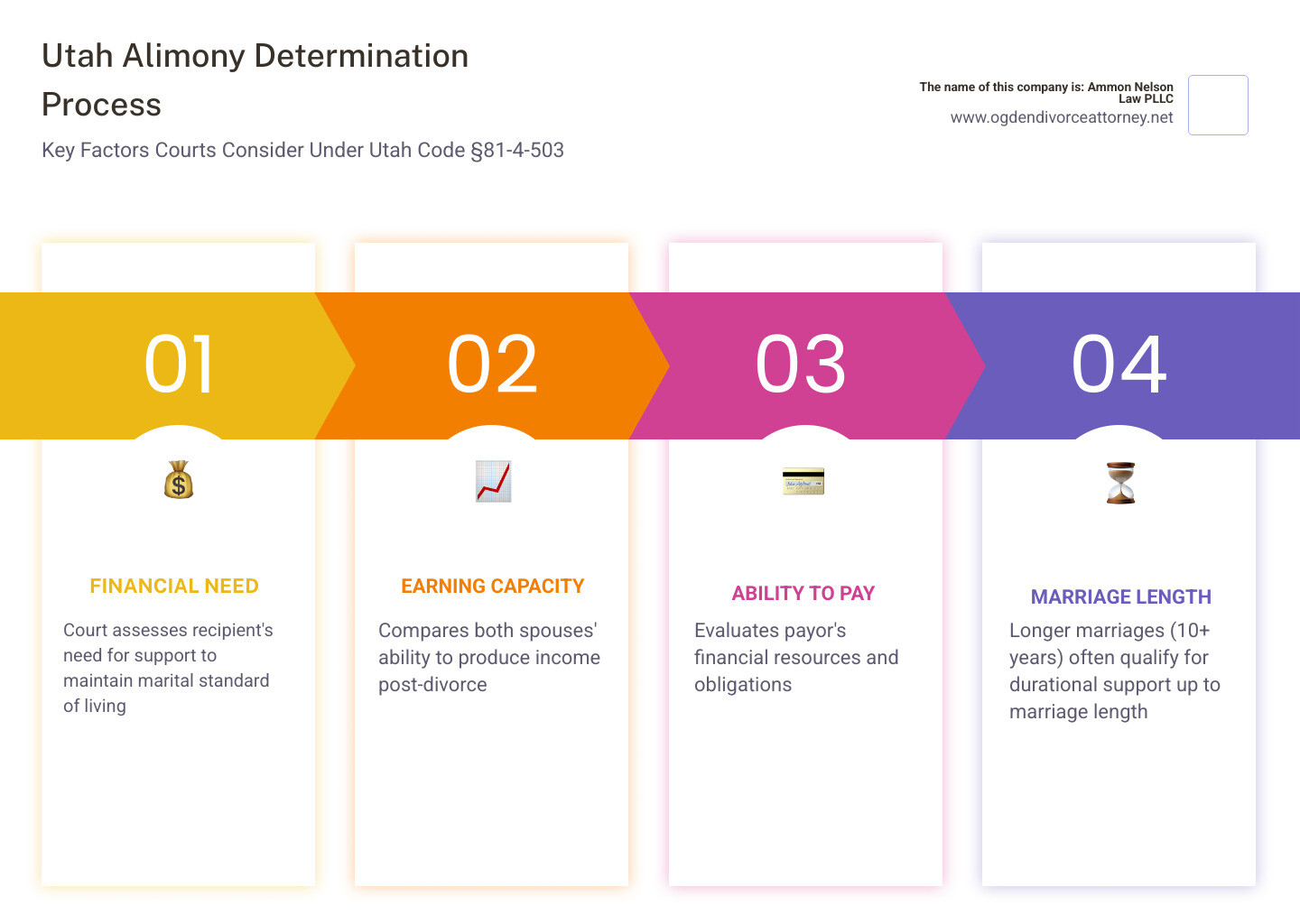
Under Utah Code Title 81, Chapter 4, Part 5, the court evaluates several core elements:
- The financial condition and needs of the recipient spouse: Does the spouse asking for money actually need it to meet their reasonable monthly expenses?
- The recipient’s earning capacity: This includes their education, work history, and ability to produce income.
- The payor spouse’s ability to provide support: You can’t squeeze blood from a turnip; the court won’t order support that the other spouse simply cannot afford after meeting their own needs.
- The length of the marriage: This is a heavy hitter in determining both the amount and how long the checks will keep coming.
- Custody of minor children: Whether the recipient spouse has physical custody of children who require care that limits employment.
We also look at whether the recipient spouse worked in a business owned by the other spouse or contributed to the other spouse’s education (like working to put a partner through medical school). For a deeper dive into these basics, you can explore our overview of Spousal Support.

The Role of Marital Standard of Living
One of the most important concepts in alimony law in Utah is the “marital standard of living.” The court’s goal is generally to keep both parties as close as possible to the lifestyle they enjoyed while married.
Judges look at the lifestyle at the time of separation. If you were living in a luxury home in Salt Lake City and vacationing twice a year, the court will try to ensure the dependent spouse isn’t suddenly forced into a lifestyle that is vastly inferior. However, since two households are more expensive to run than one, “income equalization” often becomes the practical solution when there isn’t enough money to keep both people in the lap of luxury.
| Factor | Pre-2024 Reform Approach | Post-2024 Reform (HB 220) |
|---|---|---|
| Standard of Living | Broad judicial discretion. | Specific factors added to define “standard.” |
| Look-back Period | Vague or inconsistent. | Required look-back for financial needs. |
| Income Equalization | Common in long marriages. | Mandatory rebuttable presumption for 10+ year marriages with childcare impact. |
| Income Imputation | Often assumed full-time work. | Limitations if there is a disability or no recent work history. |
For more details on how these factors play out in real cases, check out Alimony in Utah: A Guide to Spousal Support.
How Fault Impacts Alimony Law in Utah
Utah is a “no-fault” divorce state, meaning you don’t have to prove your spouse did something wrong to get a divorce. However—and this is a big “however”—Utah is unique because the court can consider “fault” when deciding alimony.
Under Utah Code 81-4-503, “wrongful conduct” that substantially contributed to the breakup of the marriage can be used to increase, decrease, or even deny alimony. This includes:
- Adultery: Engaging in sexual relations with someone other than your spouse.
- Physical Harm: Intentionally causing or attempting to cause physical harm.
- Fear of Harm: Causing a spouse or child to fear life-threatening harm.
- Financial Undermining: Substantially undermining the financial stability of the other party.
It’s important to note that this isn’t meant to be a “punishment” in the criminal sense, but rather an equitable consideration. If a spouse’s bad behavior caused the financial rift, the judge has the discretion to let that influence the final number.
Determining the Amount and Duration of Support
When we sit down with clients in our Ogden or Salt Lake City offices, the first question is usually, “How much and for how long?” Because there is no set formula, we have to build a case based on your specific financial records.
The court typically looks at your monthly budget. If your reasonable needs are $4,000 a month and you can only earn $2,500, your “need” is $1,500. If your spouse has a surplus of $1,500 after their own expenses, that’s often where the alimony amount lands. This is part of the broader process of Equitable Distribution that we manage for our clients.
Types of Alimony Available Under Alimony Law in Utah
Not all alimony looks the same. Depending on your situation, the court might order:
- Temporary Support (Alimony Pendente Lite): This is paid while the divorce is still moving through the courts to keep the bills paid.
- Rehabilitative Alimony: This is short-term support intended to get a spouse back on their feet—perhaps while they finish a degree or a job training program.
- Durational Alimony: This is the most common type, providing support for a set number of years.
- Reimbursement Alimony: This might be awarded if one spouse supported the other through professional school, expecting to share in the future high earnings that are now being lost to divorce.
Understanding which type applies to you is a key part of The Divorce Process in Utah.
Statutory Limits on Duration
One of the firmest rules in alimony law in Utah involves the clock. Per Utah Code § 81-4-502(7), alimony cannot be ordered for a period longer than the length of the marriage.
If you were married for 12 years, the maximum alimony duration is 12 years. There are very rare “extenuating circumstances” that might allow a judge to go beyond this, but they are the exception, not the rule. It is also important to remember that the time you spend paying temporary alimony during the divorce process usually counts toward that total time limit. You can find more official guidance on this at the Alimony – Utah Courts page.
Recent 2024 Reforms and HB 220 Changes
The year 2024 brought significant updates to how we handle these cases. The 2024 HB 220 Divorce Amendments were designed to make alimony more predictable and fairer for modern families.
One of the biggest shifts involves income imputation. In the past, courts often assumed a stay-at-home parent could immediately go out and earn a full-time wage. The new law is more compassionate. It places restrictions on imputing income if a spouse has been out of the workforce for a long time due to childcare or has a diagnosed disability. The court now has to look at “reasonable barriers” to employment rather than just assuming everyone can work a 40-hour week at a certain rate.
Equalization in Long-Term Marriages
For those in long-term marriages (defined as 10 years or more), the 2024 reforms added a powerful tool. If a recipient spouse has “diminished workplace experience” because they stayed home to raise the couple’s children, there is now a rebuttable presumption that the court should equalize the parties’ standards of living.
This means the starting point for the judge is to try and make sure both spouses end up with a similar lifestyle, acknowledging that the stay-at-home parent’s contribution to the family allowed the other spouse to build their career. This is particularly relevant in High Asset Marital Estates where the income gap can be substantial.
Modification and Termination of Spousal Support
Life doesn’t stand still after a divorce decree is signed. Jobs are lost, people retire, and ex-spouses move in with new partners. Alimony law in Utah allows for modifications, but only if there is a “substantial material change in circumstances” that wasn’t anticipated in the original decree.
Common reasons for modification include:
- Retirement: Utah law now explicitly states that a payor’s retirement is a substantial change that can lead to a reduction or termination of alimony.
- Job Loss or Disability: If the person paying can no longer earn what they used to, the payment may need to drop.
- Income Increase: If the person receiving alimony suddenly lands a high-paying executive job, the “need” for support might vanish.
The process involves filing a petition with the court. You can learn more about this in our guide on Post-Judgement Enforcement and Modification.
Terminating Alimony for Cohabitation or Remarriage
Alimony doesn’t always last until the end of the court-ordered duration. It terminates automatically if:
- The recipient spouse remarries.
- Either spouse dies.
However, the most contentious termination issue is cohabitation. If the person receiving alimony moves in with a new romantic partner, the payor can petition to stop the payments.
Under Utah Code Section 81-4-502, cohabitation means living together on a regular basis in a relationship of a romantic or sexual nature. It’s not just about having a roommate; it’s about a shared life that resembles a marriage. Pro-tip: You must file your motion to terminate within one year of when you knew (or should have known) about the cohabitation. If you wait too long, you might lose your right to stop the payments.
Frequently Asked Questions about Alimony in Utah
Are alimony payments taxable in Utah?
This is a point of major confusion. For any divorce finalized after December 31, 2018, federal tax laws changed significantly.
- For the Payor: Alimony payments are not tax-deductible.
- For the Recipient: Alimony received is not considered taxable income.
This was a massive shift from the old rules where the payor got a tax break and the recipient paid the bill. If your divorce was finalized before 2019, you might still be under the old “tax-deductible” rules, so always consult with a tax professional or our team to be sure.
Can spouses agree to waive alimony?
Absolutely. Many couples choose to resolve alimony through Pre and Post Nuptial Agreements or by negotiating a settlement during the divorce. You can agree to a “non-modifiable” waiver, meaning that no matter what happens in the future, neither party can ask for alimony. This provides a level of certainty that many of our Northern Utah clients appreciate.
What happens if alimony is not paid?
Alimony is a court order, not a suggestion. If a spouse stops paying, they can be found in contempt of court. This can lead to:
- Income Withholding: The money is taken directly from their paycheck.
- Judgments: A judge can issue a judgment for the total amount of past-due alimony (arrears), plus interest.
- Legal Fees: The non-paying spouse may be ordered to pay the other spouse’s attorney fees.
- Jail Time: In extreme cases of willful non-payment, a judge can order jail time.
Conclusion
Navigating alimony law in Utah is one of the most stressful parts of a divorce. Whether you are worried about how you will support yourself or concerned that your hard-earned income will be unfairly distributed, you don’t have to face these questions alone.
At Ammon Nelson Law PLLC, we pride ourselves on providing customized, results-driven representation. We understand the nuances of the 2024 reforms and how to build a compelling case for our clients in Ogden, Salt Lake City, and throughout Northern Utah. Our goal is to ensure that your final divorce decree is fair, sustainable, and protects your future.
If you have questions about your specific situation, we invite you to reach out. For more resources, visit our spousal support services page or contact us today to schedule a consultation. Let us help you find the clarity and stability you deserve.