What the Utah Child Support Worksheet Actually Tells You (And How to Use It)
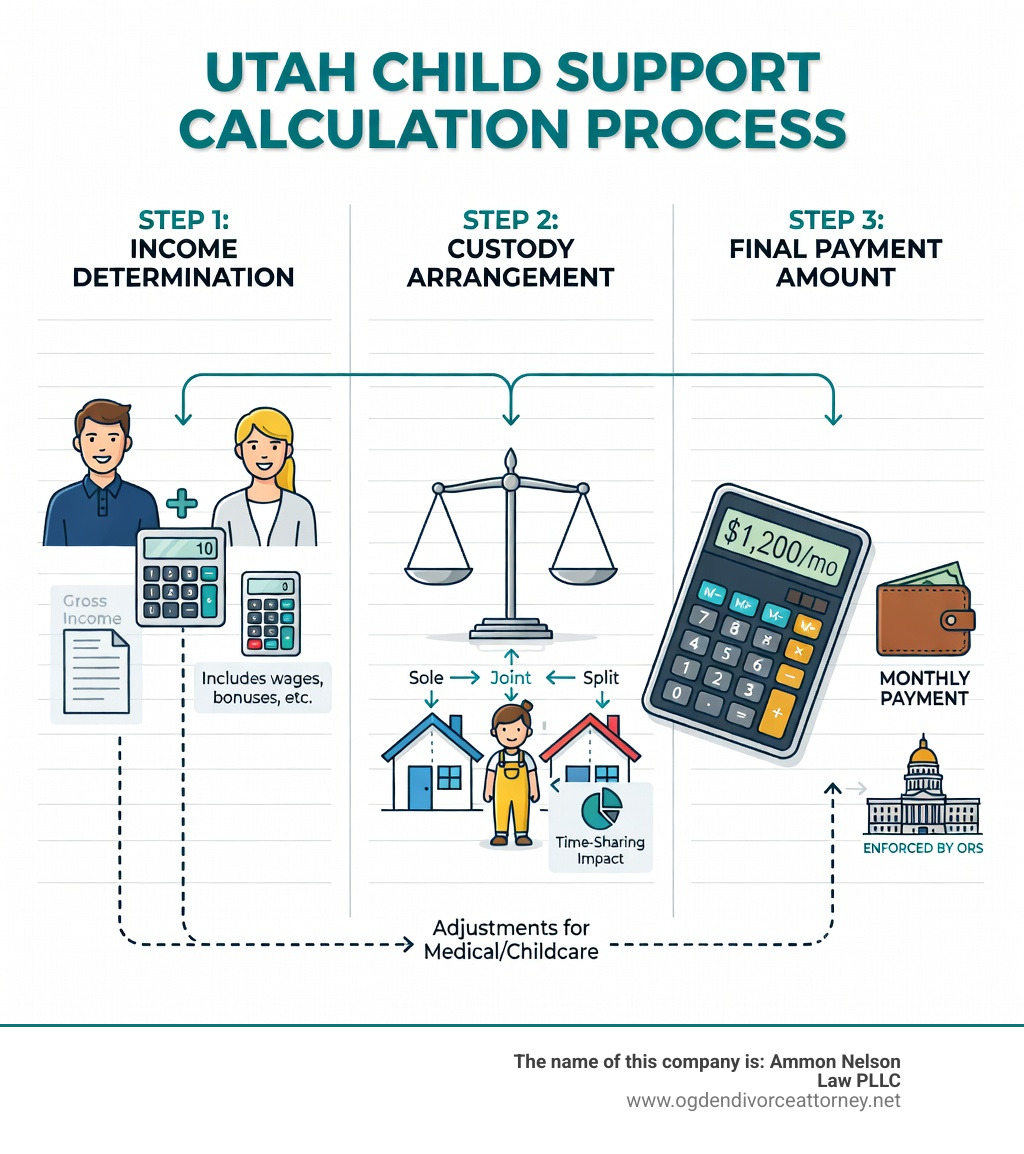
The Utah child support worksheet is the official form Utah courts use to calculate how much one parent pays the other for child support. Here is a quick overview of how it works:
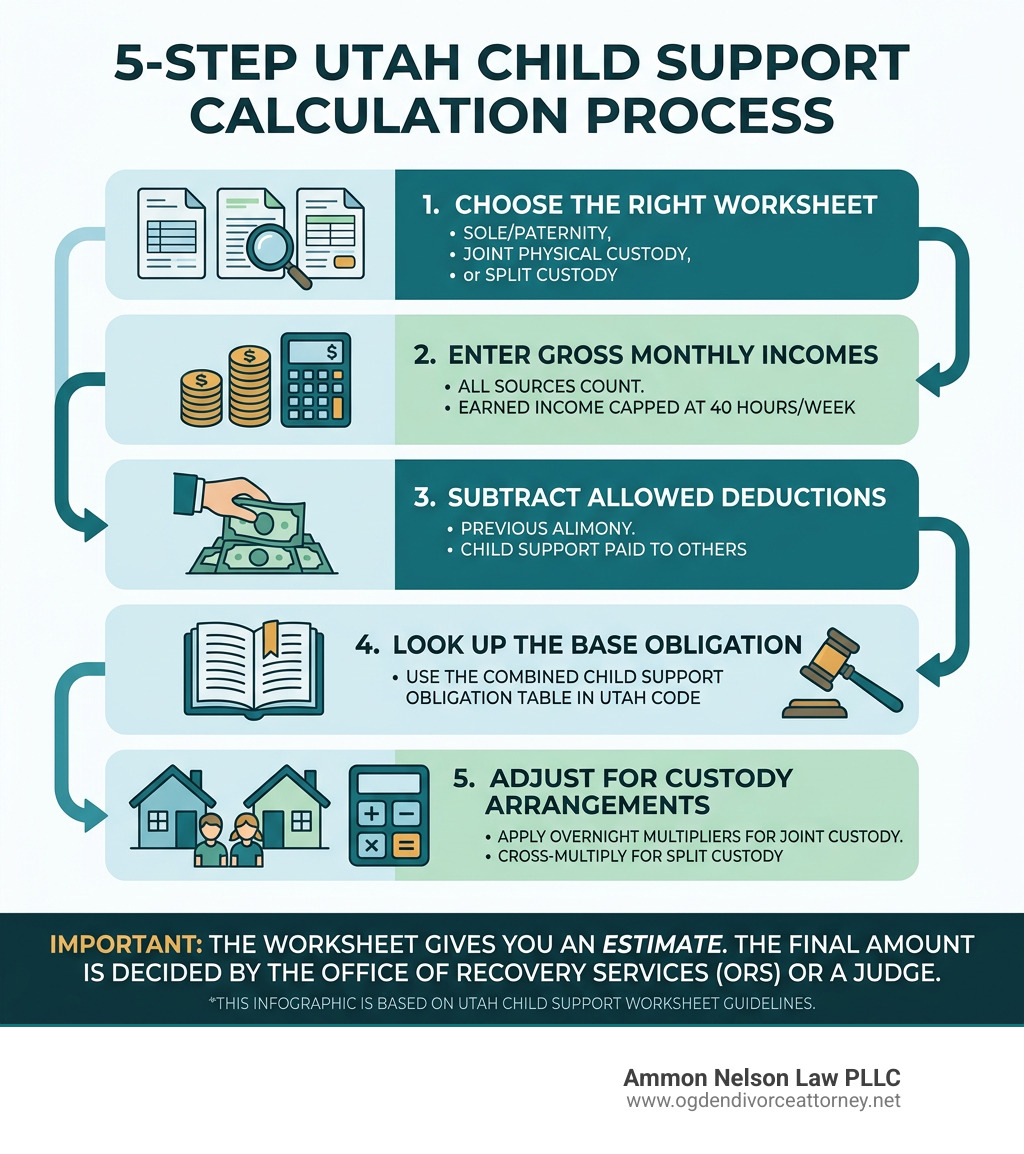
The 5 steps to calculate Utah child support:
- Choose the right worksheet – Sole/Paternity, Joint Physical Custody, or Split Custody
- Enter each parent’s gross monthly income – all sources count, earned income capped at 40 hours/week
- Subtract allowed deductions – previously ordered alimony and child support paid to others
- Look up the base obligation – use the Combined Child Support Obligation Table in Utah Code
- Adjust for custody – apply overnight multipliers for joint custody or cross-multiply for split custody
Important: The worksheet gives you an estimate. The final amount is decided by the Office of Recovery Services (ORS) or a judge.
Figuring out child support during a divorce or custody dispute is stressful – especially when you are not sure which form to use, how to report your income, or what adjustments apply to your situation. Getting the numbers wrong can cost you thousands of dollars over the life of an order.
I’m Ammon Nelson, a Utah family law attorney with years of experience helping parents across Northern Utah navigate the Utah child support worksheet process and fight for fair outcomes. Let me walk you through exactly how this works.
Understanding the Different Types of Utah Child Support Worksheets
When we sit down with clients in our Ogden or Salt Lake City offices, the first thing we have to do is identify which Utah child support worksheet fits their family structure. Using the wrong form is like trying to fit a square peg in a round hole—the math simply won’t work for your legal case.
Utah provides three primary worksheets based on physical custody arrangements. If you aren’t sure where to start, you can Calculate Child Support using the state’s online estimator, but you will still need to file the specific paper version with the court. For a deeper dive into the legal nuances, check out our More info about child support page.
Choosing the Correct Utah Child Support Worksheet
- Sole Physical Custody / Paternity: This is the most common worksheet. We use this when the children live with one parent most of the time, and the other parent has “parent-time” (visitation) for fewer than 111 overnights per year.
- Joint Physical Custody: To qualify for this worksheet, each parent must have at least 111 overnights with the children annually. The math here is more favorable to the “obligor” (the payer) because it accounts for the costs the second parent incurs while the children are in their home.
- Split Custody: This is a rarer scenario where, for example, one child lives primarily with the Mother and another child lives primarily with the Father. This requires a complex cross-multiplication of support obligations.
Statutory Tables and Utah Code References
The numbers you plug into a Utah child support worksheet don’t come out of thin air. They are governed by the Utah Child Support Act. One of the biggest points of confusion we see involves which table to use.
As of early 2023, Utah updated its support tables. If you are modifying a final order that was entered for the first time prior to January 1, 2023, you may still be looking at Utah Code 81-6-302. However, for most new cases or recent modifications, we use the updated tables found in Utah Code 81-6-304. These tables set the “Base Combined Child Support Obligation” based on the parents’ combined income and the number of children. You can read the specific language regarding income in Utah Code 81-6-203.

How to Calculate Income for the Utah Child Support Worksheet
The “engine” of any child support calculation is income. In Utah, we use “Gross Monthly Income,” which is your income before taxes are taken out. This can be tricky if you are self-employed or have multiple income streams. If you’re feeling overwhelmed, we have a guide on How to obtain child support that breaks down the initial steps.
Defining Gross Monthly Income
Utah law defines gross income very broadly. It includes prospective income from almost any source:
- Salaries and wages
- Commissions, royalties, and bonuses
- Social Security benefits (non-means-tested)
- Pensions and annuities
- Alimony received from a previous marriage
- Dividends and interest
However, there is a very important “40-hour limit.” Per 45 C.F.R. 302.56 Guidelines, income from earned sources is generally limited to the equivalent of one full-time, 40-hour work week. If you work 60 hours a week to make ends meet, the court usually won’t punish you by including those extra 20 hours in the calculation for an initial order.
Imputing Income for Unemployed or Underemployed Parents
What happens if a parent refuses to work or takes a lower-paying job to avoid support? The court can “impute” income. This means the judge treats that parent as if they are earning what they could be earning based on their work history and qualifications.
If a parent has no recent work history, the default is often the federal minimum wage. In Utah, $7.25 per hour equates to a gross monthly income of $1,260 for a 40-hour week. We also look at incarceration; under Utah law, if a parent is incarcerated for at least six months, it is generally not considered “voluntary unemployment.”
Adjusting the Utah Child Support Worksheet for Custody and Deductions
Once we have the gross income, we don’t just jump to the table. We have to calculate the “Adjusted Gross Income.” This is where we subtract “credits” for other obligations. For a quick refresher, see our post on Three things you must know about child support.
Joint Physical Custody and Overnight Adjustments
In a joint custody Utah child support worksheet, the number of overnights is everything.
- 111 to 130 overnights: The parent with fewer overnights gets a small reduction. We multiply the number of nights over 110 by .0027, then multiply that by the combined support obligation.
- 131+ overnights: The reduction gets steeper. We multiply the nights over 130 by .0084.
These multipliers ensure that as a parent spends more time (and money) physically caring for the child, their cash support obligation decreases.
Deductions and Credits for Other Children
You are allowed to subtract certain costs from your gross income:
- Previously Ordered Alimony: If you are actually paying alimony from a prior marriage.
- Previously Ordered Child Support: If you are paying support for children from a different relationship.
- Children in Present Home: This is an optional credit under Utah Code. If you have natural or adopted children living with you who are not part of this specific case, you can sometimes get a credit to ensure you can support them, too.
| Custody Type | Overnight Requirement | Calculation Method |
|---|---|---|
| Sole Custody | < 111 nights for one parent | Standard Table Lookup |
| Joint Custody | 111+ nights for both | Multiplier Adjustments (.0027/.0084) |
| Split Custody | Each parent has 1+ child | Cross-Multiplication of Obligations |
Navigating Deviations and Required Documentation
Sometimes, the standard math on the Utah child support worksheet just doesn’t produce a fair result. In these cases, we ask the court for a “deviation.” If you’re worried about how these orders are actually enforced, read our Ultimate guide to enforcement tools.
Valid Reasons for Guideline Deviations
The court has the discretion to change the amount if the guideline version is “unjust or inappropriate.” Common reasons include:
- Property Settlements: If one parent took on more marital debt in exchange for lower support.
- Extraordinary Travel Expenses: If one parent has to fly across the country for parent-time.
- Special Needs: If a child has medical or educational needs not covered by the standard table.
- Low Income: If a payer earns between $650 and $1,050, we use a special “Low Income Table” to ensure they can still afford to live.
Documentation Required for Verification
You cannot just “guess” your income. The court requires proof. We always tell our clients to gather:
- The last 12 months of pay stubs.
- The most recent year’s tax returns.
- Employer statements if you just started a job.
- Copies of previous court orders for alimony or other child support.
- Verification of health insurance premiums and child care costs (these are shared 50/50 in addition to the base support).
Frequently Asked Questions about the Utah Child Support Worksheet
Are overtime pay and second jobs included in the calculation?
Generally, no. Utah policy (and ORS guidelines) typically focuses on a standard 40-hour work week for first-time orders. If you have always worked two jobs and that income is consistent, it might be included, but we often fight to keep that second job out of the calculation so you aren’t penalized for working extra hard. However, in a modification, if the original order included overtime, the new one likely will too.
What happens if my income is inconsistent or seasonal?
If you are a contractor, a salesperson on commission, or work seasonally (like in construction), we use “income averaging.” We typically look at a multi-year average or a year-to-date average to find a “fair” monthly number. This prevents a parent from paying too much during a slow month or too little during a boom month.
Where can I get help completing the worksheet?
The Office of Recovery Services (ORS) provides an online calculator, but their staff cannot give you legal advice or help you fill out the forms. You can work with a Licensed Paralegal Practitioner for basic forms, but if there are disputes about income or custody, a private attorney is your best bet to ensure the Utah child support worksheet is accurate.
Conclusion
Calculating child support isn’t just about plugging numbers into a box; it’s about ensuring your children are provided for while maintaining your own financial stability. Whether you are in Ogden, Salt Lake City, or anywhere in Northern Utah, the team at Ammon Nelson Law PLLC is here to help. We provide customized, results-driven representation to ensure your Utah child support worksheet reflects the reality of your life.
Don’t leave your financial future to chance or a glitchy online calculator. If you need to Calculate your Utah child support and want to make sure it’s done right the first time, reach out to us today. We’ll help you navigate the math so you can focus on what matters most—your family.