
What Post Nuptial Agreements Actually Do (And Why They Matter)
Post nuptial agreements are legal contracts signed by married couples after their wedding that define how assets, debts, and financial responsibilities will be divided if the marriage ends.
Here is a quick overview of what you need to know:
| Question | Quick Answer |
|---|---|
| What is it? | A written contract signed by spouses after marriage |
| When can you get one? | At any point during your marriage |
| What does it cover? | Property, debts, spousal support, inheritance |
| What can’t it cover? | Child custody or child support |
| Is it legally binding? | Yes, if properly drafted and executed |
| Do you need a lawyer? | Strongly recommended for both spouses |
Maybe you skipped a prenup because the wedding was coming fast. Maybe your finances have changed significantly since you said “I do.” Or maybe you and your spouse just want clarity and peace of mind going forward. Whatever brought you here, a postnup can be a practical tool for protecting your family’s future.
Research consistently shows that couples with clear financial agreements report higher marriage satisfaction. That is not a coincidence. When money expectations are spelled out, there is less room for conflict and resentment to grow.
I’m Ammon Nelson, a Utah family law attorney with extensive experience helping couples navigate post nuptial agreements and other complex marital legal matters. My firm, Ammon Nelson Law PLLC, serves families across Northern Utah from our South Ogden location, and I have seen how the right legal agreement can protect a family before a crisis hits.
Understanding Post Nuptial Agreements

At its simplest, a post nuptial agreement is a written contract entered into by spouses after they have already tied the knot. While most people are familiar with prenuptial agreements—those contracts signed in the frantic weeks leading up to a wedding—postnups serve a similar purpose but are executed during the marriage itself.
Historically, these agreements were not always easy to come by. Under the old legal concept known as the “marital unity doctrine,” a husband and wife were seen as a single legal entity. Because you cannot technically contract with yourself, agreements between spouses were often considered invalid. You can read more about the evolution of this concept in The Legal Unity of Husband and Wife. However, as laws evolved in the 1970s alongside the rise of no-fault divorce, courts began to recognize that married couples should have the right to manage their financial destinies.
In Utah and across the U.S., the prevalence of these agreements is growing. While only about 3% of couples signed prenups in 2010, that number jumped to 15% by 2022. Many couples who missed the window for a prenup are now turning to post nuptial agreements to find that same level of security.
The Fiduciary Difference
One of the most critical things we explain to our clients in Ogden and Salt Lake City is that a postnup is held to a higher legal standard than a prenup. Why? Because once you are married, you have a fiduciary relationship with your spouse. This is a relationship of “highest good faith and fair dealing.” You cannot take unfair advantage of one another, and you must provide complete transparency. Because of this bond, judges scrutinize postnups very closely to ensure no one was pressured into signing away their rights. For those concerned about how this affects alimony or future payments, you can find More info about spousal support services to see how these legal obligations intersect.
| Feature | Prenuptial Agreement | Postnuptial Agreement |
|---|---|---|
| Timing | Signed before the wedding | Signed after the wedding |
| Legal Standard | Contractual arms-length | Fiduciary (higher standard) |
| Primary Goal | Protect pre-marital assets | Address changes during marriage |
| Ease of Enforcement | Generally high | Subject to stricter court review |
Why Couples Choose a Postnup
Life changes fast. The financial reality you had on your wedding day might look nothing like your life five or ten years later. We often see couples seek out post nuptial agreements when a significant “life event” occurs.
One common reason is inheritance protection. If you receive a large inheritance from a parent, Utah law generally views that as separate property. However, if you deposit that money into a joint bank account or use it to pay off the family mortgage, it can become “commingled,” meaning it might be split 50/50 in a divorce. A postnup keeps those family assets protected.
Another frequent driver is infidelity recovery. It might sound counterintuitive, but a postnup can actually help save a marriage. Prevalence rates for infidelity in American marriages range from 20% to 40%. For some couples, a postnup serves as a “reconciliation agreement.” It provides the aggrieved spouse with financial security and clear terms for the future, allowing the couple to focus on rebuilding trust rather than worrying about “what if.”
We also work with many stay-at-home parents. If one spouse leaves a high-paying career to raise children in Northern Utah, they are often at a financial disadvantage if the marriage ends years later. A postnup can guarantee them a specific share of assets or alimony to recognize their contribution to the home. If you’re wondering if it’s too late for you, check out our guide on is-it-ever-too-late-for-a-postnuptial-agreement-after-marriage.
Protecting Assets with Post Nuptial Agreements
For the entrepreneurs in Salt Lake City and Ogden, protecting a business is often the top priority. If you started a business during the marriage, it is likely considered marital property. A post nuptial agreement allows you to:
- Designate the business as separate property.
- Avoid the massive expense of a professional business valuation during a divorce.
- Protect family heirlooms or physical gifts from being sold to settle debts.
- Outline how future earnings or “side hustles” will be handled.
- Override standard community property-style overrides to ensure a fair, customized split.
Legal Requirements for Enforceability
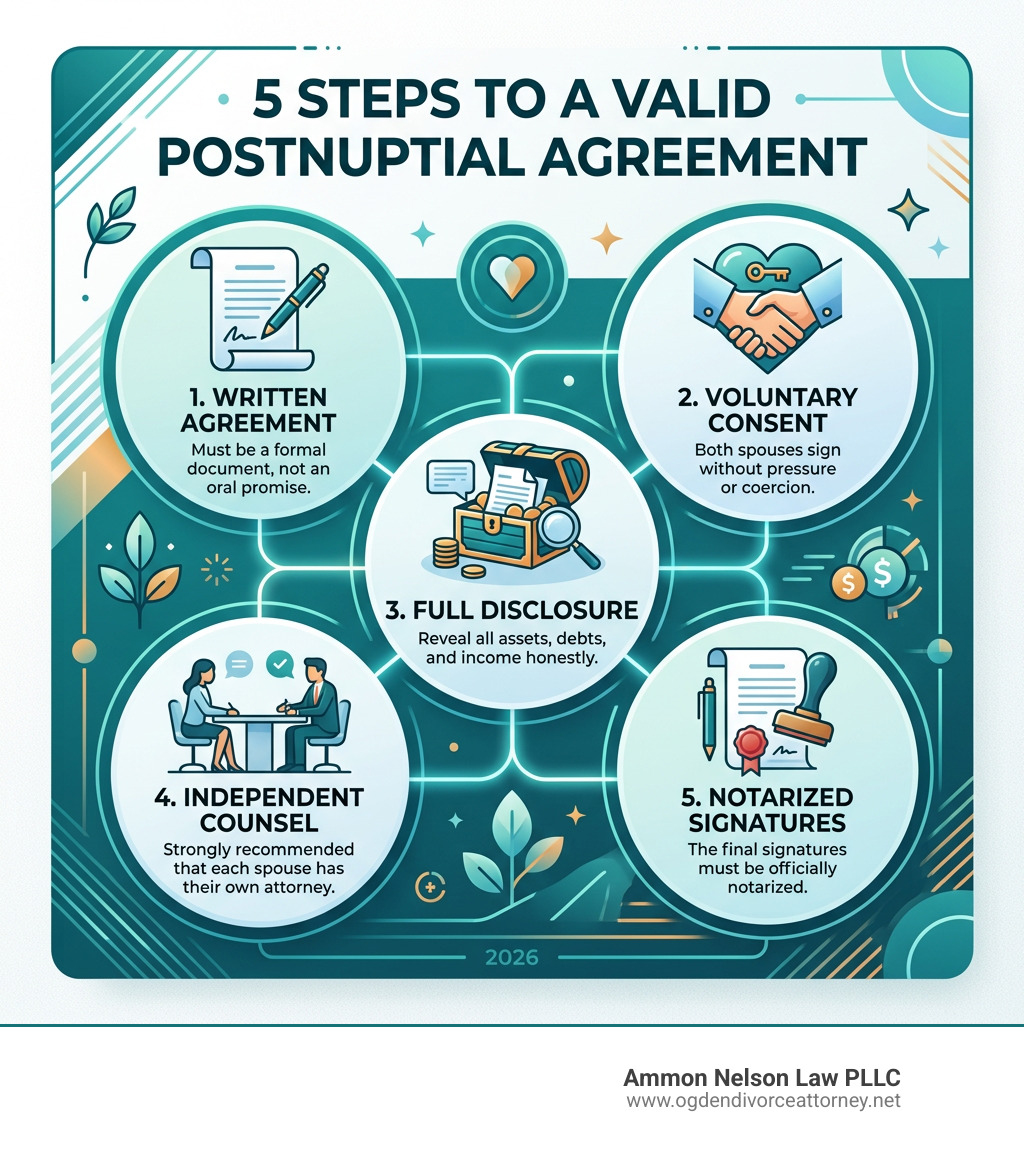
A postnup isn’t worth the paper it’s written on if it isn’t enforceable. Because Utah courts want to ensure fairness, there are strict rules you must follow. You can’t just scribble an agreement on a napkin and expect it to hold up.
First and foremost, there must be full financial disclosure. This means both spouses must lay all their cards on the table—bank accounts, debts, retirement funds, and property values. If you hide an offshore account or a secret debt, the entire agreement could be tossed out by a judge later.
Secondly, the execution must be voluntary. If there is any evidence of “duress” or “coercion”—basically, if one spouse felt forced into signing—the contract is void. This is why timing is everything. Signing a postnup during a heated argument is a recipe for a legal challenge.
According to Prenuptial and Postnuptial Contract Law in the USA, the agreement must also not be “unconscionable.” This is a fancy legal word for “grossly unfair.” If the agreement leaves one spouse wealthy and the other on public assistance, a judge is unlikely to enforce it.
The “Must-Haves” for a Utah Postnup:
- Written Format: Oral promises are never enforceable in this area of law.
- Signatures and Notarization: Both parties must sign, and having a notary public witness the signatures is a standard requirement for validity.
- Independent Legal Counsel: While not always strictly required by every statute, having separate lawyers is the best way to prove the agreement was fair.
- Meeting the Statute of Frauds: This ensures the contract is formal and documented.
What Can and Cannot Be Included
Couples are often surprised by how much—and how little—they can control with a postnup. Most financial matters are fair game. You can decide who gets the house, how the 401(k) is split, and who is responsible for that pesky credit card debt. You can even include provisions for what happens if a spouse passes away during the marriage.
However, there are “no-go” zones. You cannot use a postnup to regulate “routine marital duties.” You can’t, for example, include a clause that fines a spouse for not doing the dishes or failing to walk the dog. Courts view these as “lifestyle clauses” that violate public policy.
Limitations of Post Nuptial Agreements
The most important limitation involves children. Post nuptial agreements cannot legally determine child custody or child support.
- Child Custody: Judges always retain the final say based on the children’s best interests. You cannot “contract away” a child’s right to see a parent or decide where they will live five years before a separation happens.
- Child Support: Similarly, child support belongs to the child, not the parents. You cannot agree to waive child support in a postnup, as this would deprive the child of necessary resources.
- Illegal Acts: Any clause requiring a spouse to do something illegal is automatically void.
Frequently Asked Questions about Postnups
How much does a postnuptial agreement cost?
The cost of a postnup varies based on complexity. If you have a simple financial life—one house and a few bank accounts—the process is relatively straightforward. However, if you own multiple businesses, have international assets, or are dealing with complex tax structures, the attorney fees will reflect that.
In terms of timing, a simple postnup can often be drafted and signed within 2-3 weeks. More complex cases involving extensive negotiations between separate lawyers can take 3-4 months. Think of it as an investment; the cost of a postnup is a fraction of the cost of a litigated divorce.
Can a postnuptial agreement be challenged in court?
Yes, they can be challenged, which is why professional drafting is so important. Common reasons for a challenge include:
- Duress: “I only signed it because they threatened to leave me.”
- Hidden Assets: “I didn’t know about the $200,000 retirement account.”
- Lack of Counsel: “I didn’t have a lawyer to explain what I was giving up.”
- Unfairness: The terms are so one-sided they “shock the conscience” of the court.
Do both spouses need separate lawyers?
While some couples try to save money by using one lawyer, this is a major risk. In fact, a judge is much more likely to throw out an agreement if both spouses didn’t have independent representation.
Because of the fiduciary duty and the requirement for highest good faith, each spouse needs an advocate who is looking out only for their interests. Using the same lawyer creates a conflict of interest that can jeopardize the entire agreement.
Conclusion
At Ammon Nelson Law PLLC, we believe that post nuptial agreements aren’t about planning for a divorce—they are about planning for a successful marriage. By removing financial ambiguity and protecting your individual interests, you create a foundation of transparency and trust.
Whether you are a business owner in Salt Lake City or a family in South Ogden looking to protect an inheritance, we provide customized, results-driven representation. We understand the unique landscape of Northern Utah law and are here to ensure your agreement is fair, legal, and built to last.
Don’t wait for a crisis to define your financial future. Schedule a consultation for post nuptial agreements with our team today and get the peace of mind you deserve.