
What to Do When Alimony Payments Stop in Utah
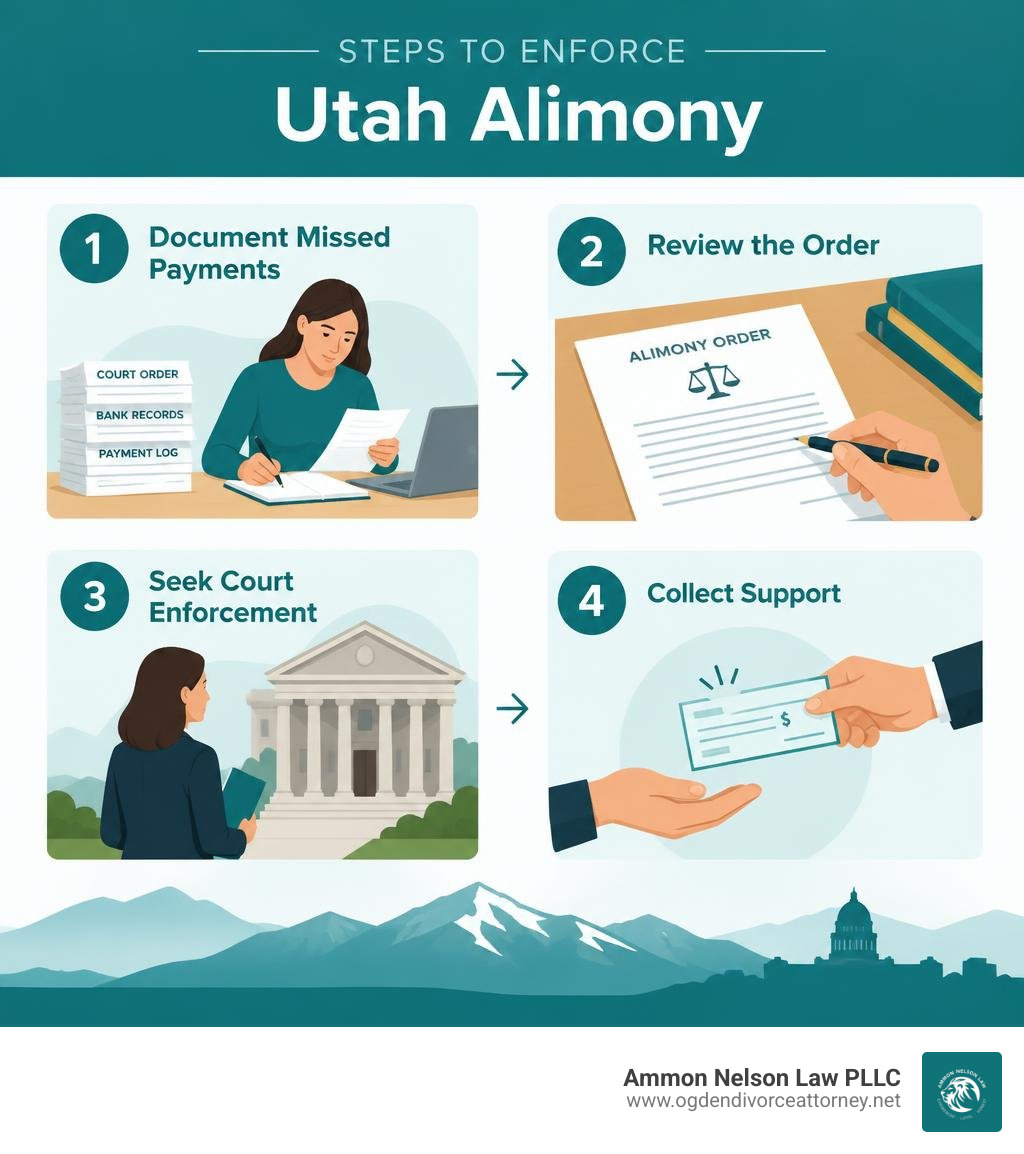
If your ex-spouse misses an alimony payment, save your court order, bank records, and a list of what was due and what was paid. A Utah alimony enforcement attorney can use those records to ask the court to enforce the order. Depending on the facts, the court may order payment of overdue support, allow collection from wages or assets, or consider contempt if your ex-spouse can pay but refuses.
You do not have to guess which step fits your case. Start by documenting each missed payment and keeping any messages about it. Then get legal advice before delays make the records harder to sort out.
I’m Ammon Nelson, a Utah alimony enforcement attorney with Ammon Nelson Law PLLC, a firm serving clients across Utah. I help people understand their support orders and their options when payments stop.
Learn more about Utah alimony enforcement attorney:
For a broader view of how Utah courts handle support enforcement, the Utah Courts guide on motions to enforce domestic orders explains the basic court process.
Immediate Steps When Your Ex Stops Paying Alimony in Utah

When an alimony payment does not arrive, act right away. In Utah, about 30% to 40% of alimony orders face payment issues. You rely on these funds for groceries, housing, and daily bills. Staying calm and taking clear steps will protect your rights.
Do not send angry text messages or make threats. Keep your talks polite and in writing. Review your A-Z Guide to Alimony in Utah to confirm the exact payment dates and amounts required by law.
Documenting Non-Payment and Calculating Arrears
Good records win court cases. Start an organized file as soon as a payment is late:
- Check Your Bank Statements: Print your statements to prove the deposit never arrived.
- Track the Balance: Keep a simple spreadsheet showing each due date, the amount owed, the amount paid, and the missing balance.
- Save All Messages: Keep text messages, emails, and letters about missed payments.
- Send a Written Reminder: Send a calm message asking about the late payment.
Total unpaid alimony is called arrears. Clear math makes it easy for a judge to see what you are owed.
Navigating the Utah Court System and Enforcement Timelines
Utah family courts handle over 2,000 alimony modification and enforcement cases each year. You must file your paperwork in the Utah District Court that entered your original divorce decree.
Your lawyer files a formal Motion to Enforce Order. The court then schedules a hearing. An enforcement case in Utah takes about 6 to 9 months on average to resolve. Because court schedules take time, starting early protects your budget. Reviewing the overall divorce process in Utah will help you know what to expect inside the courtroom.
Legal Remedies to Collect Unpaid Spousal Support in Utah

A divorce decree is a binding court order. Your ex-spouse cannot choose to ignore it. Utah judges have powerful tools to collect alimony and spousal support when someone refuses to pay.
Wage Garnishment, Liens, and Property Seizure
The court can take money directly from your former spouse through several collection tools:
- Income Withholding: Utah courts issue over 500 wage garnishment orders each year. The state orders an employer to send support straight from your ex’s paycheck to you.
- Bank Account Levies: A judge can freeze bank accounts and take funds to pay down back support.
- Property Liens: You can place a legal lien against real estate owned by your ex-spouse. They cannot sell or refinance the property without paying you first.
- Tax Refund Intercepts: State and federal tax refunds can be redirected to cover past-due support.
These remedies fall under post-judgment enforcement and modification, which turns a court order into real payments.
How a Utah Alimony Enforcement Attorney Builds Your Contempt Case
About 15% of Utah enforcement cases involve contempt of court. Contempt applies when your ex-spouse has the money to pay but willfully refuses to follow the order.
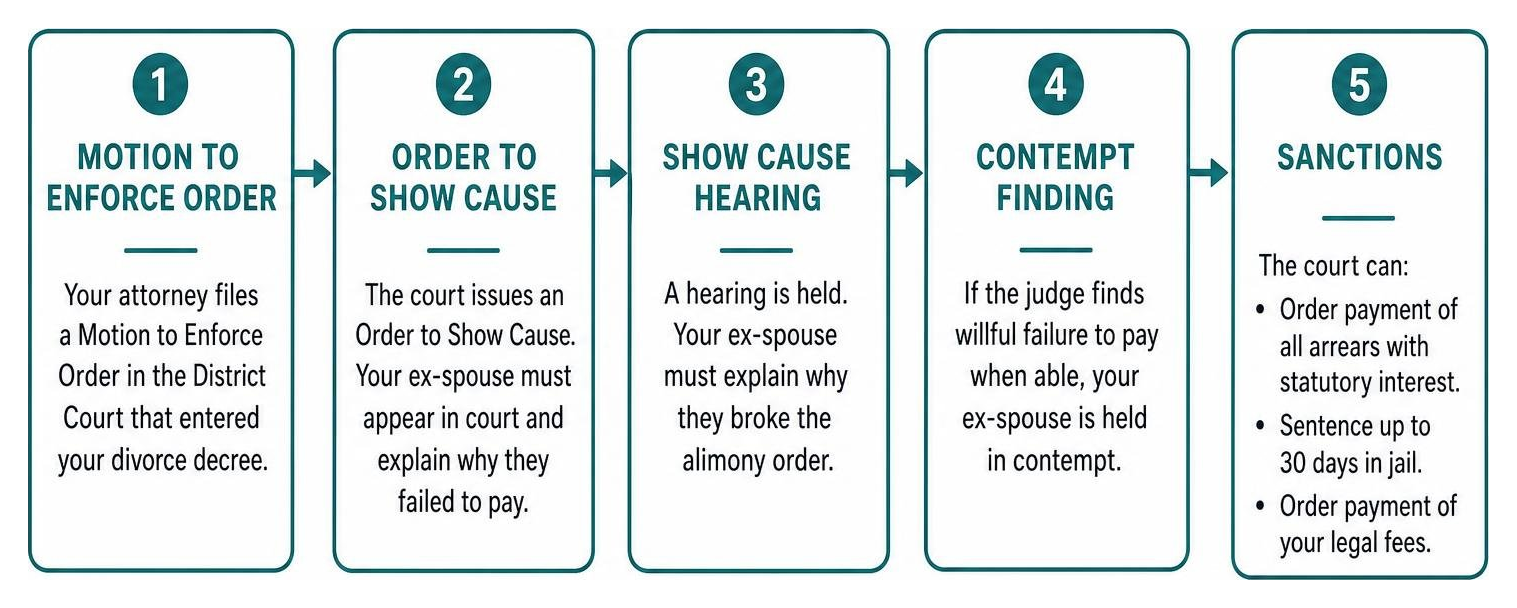
We ask the court to issue an Order to Show Cause. Your ex-spouse must appear in court and explain why they broke the order. If the judge finds them in contempt, the court can:
- Order them to pay all missing support with statutory interest.
- Sentence them to up to 30 days in jail.
- Order them to pay your legal fees.
Judges often offer “purge conditions.” This means the paying spouse can avoid jail time by paying a set amount of back support immediately.
When to Hire a Utah Alimony Enforcement Attorney for Unpaid Support
You can try to collect money on your own, use a state agency, or hire private legal counsel. Having an experienced team helps you secure faster results. Understanding the top benefits of a divorce attorney helps you choose the right path for your situation.
| Feature | Utah Office of Recovery Services (ORS) | Private Alimony Enforcement Attorney |
|---|---|---|
| Primary Focus | Child support (alimony only if paired with child support) | Dedicated spousal support and alimony enforcement |
| Speed of Action | Slower due to high state agency caseloads | Fast, direct filings in District Court |
| Contempt Filings | Does not file contempt motions for you | Files Orders to Show Cause and seeks jail sanctions |
| Asset Seizure | Standard tax intercepts and basic wage withholding | Custom bank levies, real estate liens, and discovery |
| Legal Advice | Cannot give you personalized legal advice | Direct strategy tailored to your financial goals |
Office of Recovery Services (ORS) vs. Private Legal Counsel
The Utah Office of Recovery Services handles state child support collections. They can collect alimony, but usually only when child support is collected in the same order. ORS manages thousands of cases across the state, which often creates delays.
When you choose hiring an attorney, your lawyer acts right away. We file court motions directly, locate hidden assets, and ask the judge for sanctions without waiting on agency queues.
Working with a Utah Alimony Enforcement Attorney for Out-of-State Obligors
If your former spouse moves out of Utah, they still must pay their court-ordered alimony. Interstate support is governed by the Uniform Interstate Family Support Act (UIFSA).
You register your Utah divorce decree as a foreign judgment in your ex-spouse’s new home state. This lets local courts in that state garnish their out-of-state wages, freeze local bank accounts, and enforce payment orders without delay.
Enforcement vs. Modification: Addressing Changes in Financial Circumstances
Sometimes, non-payment happens because of real life changes. A payer might lose a job or suffer a major injury. In other cases, an ex-spouse simply stops paying because they do not want to share their income. Our essential guide to alimony law in Utah breaks down how courts view these financial shifts.
When the Paying Spouse Requests a Reduction
A paying spouse cannot just reduce payments on their own. They must file a formal petition to modify support with the court.
- Substantial Material Change: They must prove a major, unplanned change in circumstances that was not foreseen during the divorce.
- No Retroactive Reductions: Utah law does not allow judges to erase support that became due before the modification was filed. Past-due balances remain fully owed.
- Voluntary Income Drops: If an ex-spouse quits a high-paying job to dodge support, the court will base support on their historical earning capacity instead.
Costs, Timelines, and Recovering Legal Fees in Enforcement Actions
Enforcing an alimony order in Utah usually costs between $3,000 and $5,000 in attorney fees and takes 3 to 6 months.
You should not have to empty your savings to collect money that is already yours. Under Utah Code § 30-3-3, judges can order the non-paying spouse to pay your attorney fees and court costs. When we prove that your ex willfully ignored a clear court order, we ask the judge to make them cover your legal bills.
Frequently Asked Questions About Utah Alimony Enforcement
Yes. If the court finds your ex-spouse in civil contempt for willfully refusing to pay, the judge can order up to 30 days in jail. In most cases, the judge allows the payer to avoid jail if they pay a set portion of the back balance right away.
How far back can I collect unpaid alimony in Utah?
Utah judgments are enforceable for eight years. You can renew an unpaid support judgment before that eight-year period ends to keep collecting. Past-due support also accrues statutory interest over time.
Can alimony be taken directly from a former spouse’s paycheck in Utah?
Yes. An income withholding order directs an employer to withhold alimony from the payer’s paycheck and send it to you. This can help prevent late payments and missed-payment excuses.
Conclusion
You should not have to chase down the spousal support promised in your divorce decree. At Ammon Nelson Law PLLC, we provide customized, results-driven representation for clients across Northern Utah from our offices in Ogden and Salt Lake City. We act quickly to protect your financial security, calculate your full arrears, and hold non-paying ex-spouses accountable.
Contact our team today for dedicated spousal support representation and take the first step toward recovering the money you are owed.