Why Understanding Child Support Utah Matters for Your Family
Child support Utah is a legal obligation that ensures both parents financially contribute to their children’s needs after separation or divorce. Here’s what you need to know right away:
Quick Facts About Child Support in Utah:
- Who Pays: The non-custodial parent typically pays support to the custodial parent
- How Much: Based on both parents’ incomes, custody arrangement, and number of children
- Duration: Until the child turns 18 or graduates high school, whichever is later
- Cannot Be Waived: Utah law requires child support in every case involving minor children
- Enforcement Agency: The Office of Recovery Services (ORS) handles collection and enforcement
- Modification: Possible with a 30% income change or after 3 years with a 10% difference
Understanding child support in Utah doesn’t have to be overwhelming. The state uses specific guidelines and formulas to calculate support amounts, considering factors like your gross income, custody arrangement (sole, joint, or split), and additional expenses like medical care and childcare. Whether you’re establishing a new order, seeking modification, or dealing with enforcement issues, knowing how the system works protects both your rights and your children’s well-being.
I’m Ammon Nelson, and I’ve helped countless Northern Utah families navigate the complexities of child support Utah cases with clarity and confidence. With offices in South Ogden and a client-focused approach, my firm combines legal expertise with technology to make the child support process as straightforward as possible.
How Child Support Utah is Calculated
When we sit down with clients in our Ogden or Salt Lake City offices, the first question is almost always: “How much is this going to cost?” or “How much will I receive?” In Utah, child support isn’t just a number pulled out of thin air by a judge who happens to be having a good day. It is governed by a very specific set of rules known as the Utah Code 81-6-203.

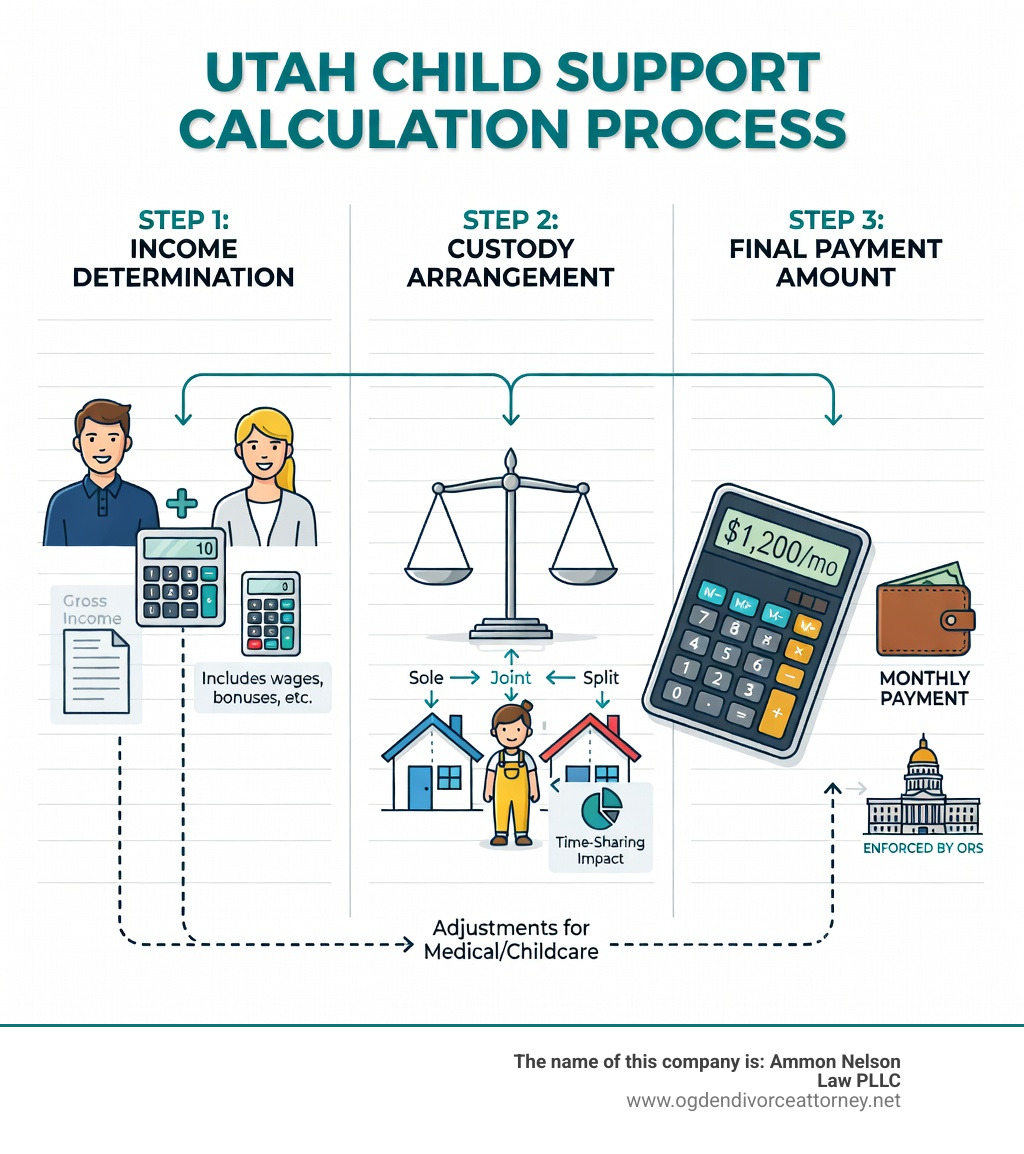
The process begins with the “Income Shares Model.” This model is based on the idea that a child should receive the same proportion of parental income that they would have received if the parents were still living together. To get to the final number, we use child support worksheets to determine the base combined child support obligation.
Here is the simplified three-step dance the court performs:
- Combine Adjusted Gross Incomes (AGI): We take the monthly income of Parent A and Parent B.
- Consult the Table: We look at the Utah Child Support Guidelines table to find the “base obligation” for that combined income level and the number of children involved.
- Split the Bill: Each parent is responsible for a proportional share of that base obligation. If Parent A earns 60% of the combined income, they are responsible for 60% of the support amount.
Understanding Gross Income for Child Support Utah
To get the math right, we have to start with the right numbers. “Gross income” in Utah is a broad net. According to the Utah Child Support Guidelines, it includes prospective income from almost any source.
Common inclusions are:
- Salaries and wages
- Bonuses, commissions, and severance pay
- Pensions and Social Security benefits
- Rental income and dividends
- Gifts and prizes (yes, even that lottery win counts!)
- Alimony from a previous marriage
However, not everything is fair game. The law excludes “means-tested” welfare benefits like SNAP (food stamps), housing subsidies, or Supplemental Security Income (SSI).
Once we have the gross income, we calculate the Adjusted Gross Income (AGI). We do this by subtracting alimony or child support that is already being paid for children from a previous relationship. This ensures that a parent’s total support obligations don’t exceed their actual ability to pay.
Imputed Income and Underemployment
“But what if my ex-spouse suddenly decides to quit their high-paying corporate job to become a full-time professional kite flier just to avoid paying support?”
We hear versions of this concern often. Utah courts are ahead of you on this one. If a parent is “voluntarily unemployed or underemployed,” the court can impute income. This means the court treats the parent as if they are earning what they should be earning based on their work history, education, and the current job market.
Typically, if a parent’s work history is unknown, the court will impute income at the federal minimum wage for a 40-hour work week. However, there are imputed income exceptions where the court will not assign phantom income, such as:
- The parent is physically or mentally unable to work.
- The parent is engaged in career training to establish basic job skills.
- The cost of childcare would be nearly equal to what the parent would earn.
- A child has unusual emotional or physical needs that require the parent to stay home.
Custody Arrangements and Their Financial Impact
The number of nights your children spend at your house doesn’t just affect your grocery bill; it’s a massive factor in child support Utah calculations. Utah recognizes three primary types of physical custody, each with its own worksheet and math.
- Sole Physical Custody: This applies when the child spends more than 255 nights a year with one parent. In this scenario, the non-custodial parent pays the full proportional share of the base obligation to the custodial parent.
- Joint Physical Custody: To qualify for a joint custody calculation, the child must spend at least 111 nights a year in each parent’s home. Because both parents are providing housing and food for a significant portion of the year, the support amount is typically lower than in sole custody cases.
- Split Custody: This is less common but happens when there are multiple children and at least one child lives with each parent.
The Equal parent-time schedule (often called 50/50 custody) has become increasingly common in Northern Utah since 2021. While it looks “fair” on paper, it requires a high level of cooperation between parents to work effectively.
Medical and Child Care Expenses in Child Support Utah
The “base support” amount you find on the table only covers the basics like food and shelter. Utah law requires that every child support order also addresses two other major categories:
- Medical Expenses: Both parents are usually ordered to share the cost of health insurance premiums for the child. Furthermore, any “uninsured” costs (co-pays, dental work, glasses) are typically split 50/50.
- Child Care Expenses: If childcare is necessary for a parent to work or attend career training, the cost is shared equally between the parents.
You can use the ORS Calculator to get an estimate of how these extras will impact the final monthly payment. You must provide verification of these costs (like a receipt or insurance premium breakdown) to the other parent within 30 days of payment to be reimbursed.
Modifying and Enforcing Your Support Order
Life changes. Jobs are lost, promotions are earned, and children grow up. Because of this, a child support order isn’t necessarily “forever.”
Modifying Your Order
In Utah, you can seek a modifying child support action under two main conditions:
- Substantial Change in Circumstances: If there has been a significant shift—like a 30% change in a parent’s income—you can petition for a change at any time.
- The Three-Year Rule: If it has been at least three years since the last order was entered, you can ask for a review if the new calculated amount would be at least 10% different from the current order.
It is vital to understand the difference between a Petition and a Motion. A Petition is essentially starting a new mini-lawsuit to change the permanent order, while a Motion is often used for temporary or procedural adjustments within an ongoing case.
Enforcement Tools and the Office of Recovery Services (ORS)
A court order is just a piece of paper unless it’s followed. If a parent falls behind, the ORS Services become the primary tool for enforcement. The ORS has a “toolbox” that would make most debt collectors jealous, including:
- Income Withholding: Taking the support directly from a paycheck.
- Tax Intercepts: Seizing federal or state tax refunds.
- License Suspension: Taking away driver’s, professional, or even hunting/fishing licenses.
- Liens: Placing a legal claim against the parent’s property or seizing bank accounts.
- Contempt of Court: In extreme cases, a judge can order jail time for a parent who refuses to pay despite having the ability to do so.
Frequently Asked Questions about Utah Child Support
When does the child support obligation end?
In the Beehive State, your duty to pay generally ends when the child turns 18 or graduates with their high school class, whichever happens later. However, if a child is “emancipated” (gets married or joins the military), the obligation ends early. On the flip side, if a child has a disability that makes them a “disabled dependent,” support may be ordered to continue indefinitely.
Can child support be waived or changed by remarriage?
Let’s be clear: You cannot “waive” child support in Utah. Even if both parents agree to $0, a judge must approve it and ensure it’s in the child’s best interests. As for remarriage, the act of getting remarried doesn’t automatically change support. However, if the remarriage results in new children to support or a massive shift in the household’s financial resources, it might be grounds for a modification under Utah child support laws.
How does paternity affect support cases?
You cannot have a child support order without a legal father. For unmarried parents, paternity must be established first. This can be done through a Voluntary Declaration of Paternity at the hospital, through ORS, or via genetic testing ordered by the court. Once paternity is established, the legal father has both the duty to support and the right to seek custody or parent-time.
Conclusion
Navigating child support Utah can feel like trying to solve a Rubik’s Cube while blindfolded. Between gross income calculations, night-count thresholds, and ORS enforcement rules, there is a lot of room for error. But you don’t have to do this alone.
At Ammon Nelson Law PLLC, we provide customized, results-driven representation for clients throughout Northern Utah. Whether you are in Ogden, Salt Lake City, or South Ogden, our goal is to ensure your children are provided for while protecting your financial future. We believe in a straightforward approach that takes the “mind-losing” stress out of family law.
Ready to get your child support questions answered by a professional? Schedule a consultation for child support Utah today and let us help you find a path forward.