
How Long Does Alimony Last in Utah?
In Utah, alimony usually cannot last longer than the marriage itself. A judge may order a shorter term, and temporary alimony paid during the divorce counts toward the total. A longer term is possible if the court finds a legal reason for an exception.
That limit is a starting point, not a promise of payments for every year of the marriage. The court looks at each spouse’s finances and the family’s needs. Payments may also end early or change if circumstances change.
I’m Ammon Nelson, a family law attorney serving clients across Utah. When parents ask how long does alimony last in utah, I help them understand how the law and their own court order apply to the years ahead.
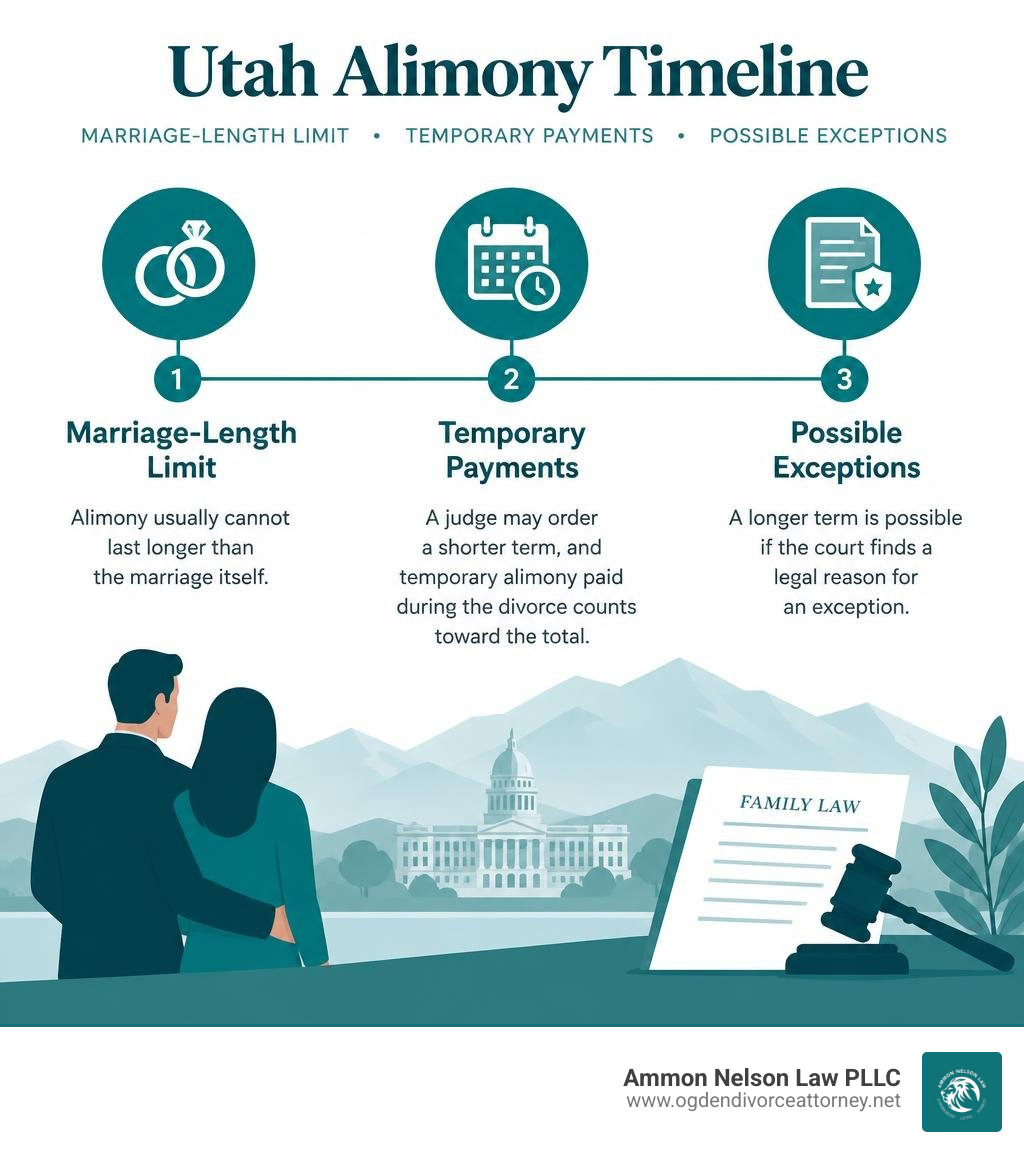
Simple guide to how long does alimony last in utah terms:
Statutory Limits: How Long Does Alimony Last in Utah?
Utah state law sets clear rules for support payments after divorce. Under Utah Code Section 81-4-502, the state limits how long a person must pay spousal support. The main goal of support is to help both spouses maintain a fair standard of living. Judges use their legal discretion to review every case. You can explore the essential guide to alimony law in Utah to learn how these statutes apply in family court.
Utah has a young population, a high birth rate, and a high median household income of $93,400. Many spouses stay home to care for children. Because of this, judges look closely at how a divorce affects household stability.
The General Rule: Capped at the Length of the Marriage
The biggest rule in Utah is simple: alimony cannot last longer than the marriage itself. We call this the statutory cap. The court measures the marriage from the wedding day to the day the judge signs the final divorce decree.
- If you were married for 6 years, your support cannot exceed 6 years.
- If you were married for 14 years, the maximum possible duration is 14 years.
- If you had a short marriage of 2 years, alimony cannot last more than 2 years.
A judge can always order a shorter period. The marriage length serves as the absolute ceiling, not an automatic guarantee. Our comprehensive A-Z guide to alimony in Utah breaks down how judges decide whether to award the full duration or a shorter term.
Calculating Marriage Duration and How Long Does Alimony Last in Utah
Calculating the exact length of a marriage requires precise dates. Utah judges count from the legal marriage date until the date of the final decree.
What happens if you marry the same person twice? Under current Utah law, if spouses remarry each other after a prior divorce, the court can combine the durations of both marriages when setting alimony limits.
Also, the Utah Courts alimony self-help guidelines state that temporary support paid while the divorce is active counts toward the total time cap. If your divorce takes two years and you pay temporary alimony the entire time, those two years reduce your remaining alimony term after the final decree.
Exceptions and Extenuating Circumstances for Longer Durations
Judges can go past the marriage-length cap only when rare, extenuating circumstances exist. A spouse who asks for an extension must show good cause before the original alimony order expires.
Common reasons for an exception include:
- A severe, permanent physical or mental disability that prevents work.
- Advanced age with no realistic way to earn a living wage.
- Extraordinary medical or caregiving needs that make self-sufficiency impossible.
The requesting spouse must present clear financial and medical evidence to prove why ending support would cause extreme hardship.
Key Factors Utah Courts Consider When Determining Spousal Support Duration
Utah judges must balance many legal and economic factors before choosing an alimony end date. They do not guess. They review sworn financial declarations, pay stubs, bank statements, and tax returns. The court also evaluates how the couple divided their marital property through equitable distribution during divorce.
To set an alimony amount and timeframe, judges look at three primary questions:
- What are the financial needs of the spouse asking for support?
- What is the earning capacity of that spouse?
- Does the paying spouse have the ability to provide support?
The court looks at the standard of living the couple shared during the marriage. If one spouse gave up a career to care for the home, support helps bridge the income gap. The court also considers whether one spouse helped pay for the other spouse’s college degree or business venture. When spouses want to resolve these issues peacefully outside of court, collaborative law for alimony offers a cooperative path forward.
How Long Does Alimony Last in Utah for Marriages Over 10 Years?
Utah law contains a special rebuttable presumption for long-term marriages. If a marriage lasts 10 years or longer, and one spouse reduced their work experience to raise children, the court presumes that it should equalize the standard of living between both households.
In these long marriages, judges often award alimony for the maximum allowed duration—matching the full length of the marriage. This protection helps stay-at-home parents rebuild their financial independence after years out of the workforce.
Temporary Alimony vs. Long-Term Decrees
Temporary alimony, also called pendente lite support, covers living costs while the divorce is ongoing. Long-term alimony is set in the final decree. The table below outlines how these two forms of support differ:
| Feature | Temporary Alimony (Pendente Lite) | Long-Term Final Alimony |
|---|---|---|
| Purpose | Keeps both households stable during litigation | Provides post-divorce financial transition |
| Duration | Lasts only until the judge signs the final decree | Lasts for a set period, capped at marriage length |
| Time Cap Credit | Every month paid counts toward the total time limit | Deducts time already served during temporary orders |
| Modification | Can change quickly based on immediate monthly needs | Requires a substantial material change in circumstances |
Early Termination and Grounds for Modifying Support Orders
An alimony order is not set in stone forever. Under Utah law, certain life events can end or reduce payments ahead of schedule. Spouses can also outline customized end dates using pre- and post-nuptial agreements before or during their marriage.
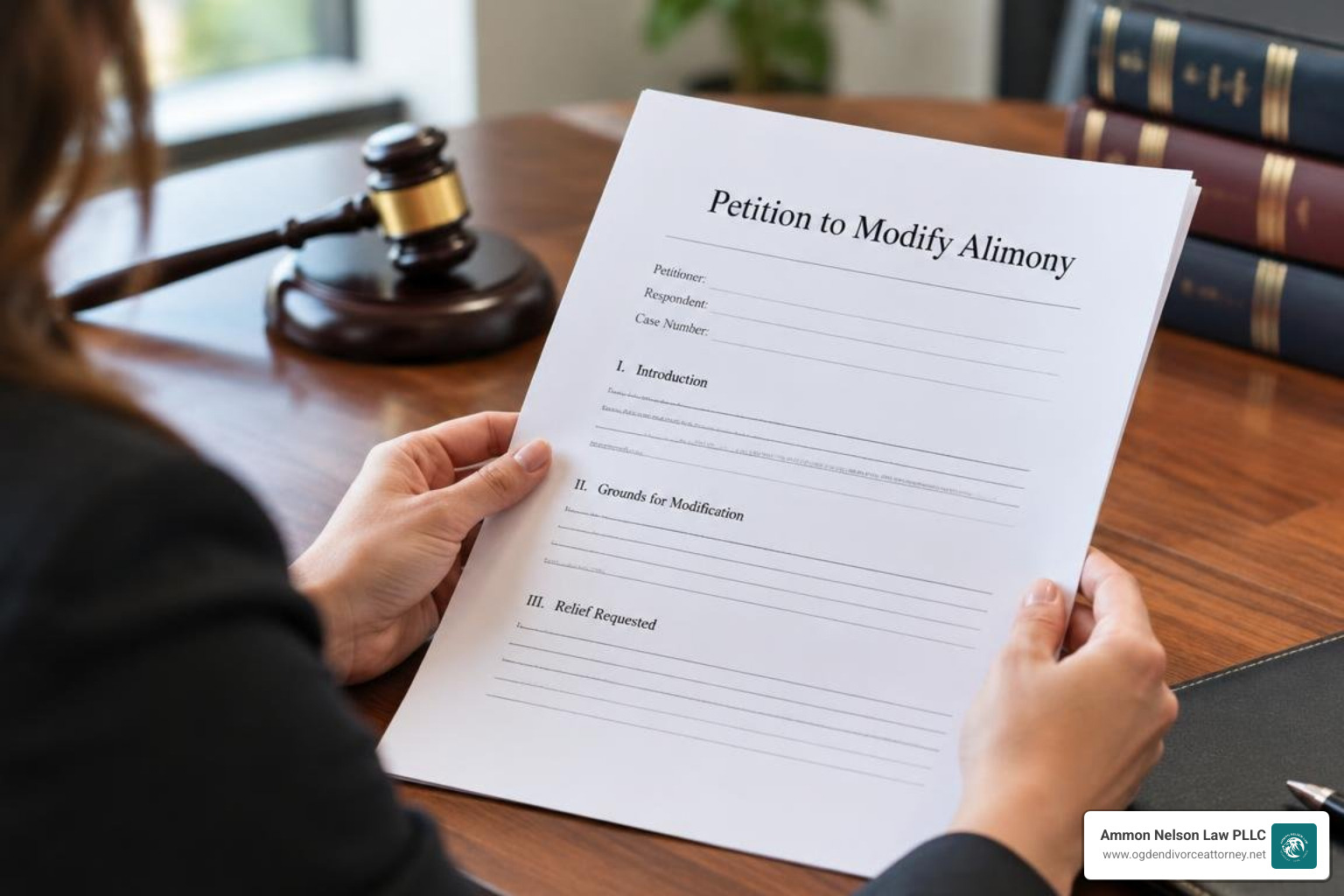
How Do Remarriage, Cohabitation, and Death Provisions Affect Alimony in Utah
Utah law provides specific rules that trigger an immediate end to alimony:
- Remarriage: Alimony ends automatically on the date the receiving spouse remarries. The paying spouse does not need a court order to stop paying, though filing a notice with the court is best practice.
- Cohabitation: If the receiving spouse lives with a new romantic partner and shares living expenses, alimony can terminate. The paying spouse must file a motion to terminate within one year of discovering the cohabitation.
- Death: Alimony ends immediately upon the death of either spouse.
Substantial Material Changes, Income Reductions, and Retirement Age
Either spouse can ask the court to adjust support if a substantial material change occurs. Under Utah statutes, reaching normal retirement age qualifies as a material change for divorces finalized after May 11, 2020.
Other valid reasons to seek post-judgment enforcement and modification include:
- Involuntary job loss or a major pay cut despite good-faith job searches.
- Long-term health issues or sudden medical disability.
- A major increase in the recipient spouse’s personal income.
Frequently Asked Questions About Utah Alimony Duration
Is there a set mathematical formula for alimony duration in Utah?
No. Utah law does not use a fixed mathematical formula like it does for child support. Judges evaluate financial need, earning ability, and the length of the marriage on a case-by-case basis.
Can alimony be awarded for an indefinite or lifetime period in Utah?
Permanent or lifetime alimony is rare in Utah. A judge will only award open-ended support if a spouse shows extreme, permanent disability or advanced age where they can never earn income.
Does temporary alimony count against the total alimony duration cap?
Yes. Utah law requires the court to deduct every month of temporary alimony paid during the divorce process from the maximum duration allowed in the final divorce decree.
Conclusion
Understanding how long alimony lasts protects your financial future. Whether you need support to rebuild your career or want to ensure fair payment terms, having skilled legal counsel makes all the difference.
At Ammon Nelson Law PLLC, we provide customized, results-driven legal help from our offices in Ogden and Salt Lake City. We proudly guide clients across Northern Utah through every step of divorce and spousal maintenance. Contact our team today for dedicated spousal support representation and clear answers for your family’s needs.