
A Clear Starting Point for the Divorce Process in Utah
The process of divorce in Utah usually follows a clear path: confirm that you meet the county residency rule, file a Petition for Divorce, formally serve your spouse, work through custody and financial issues, and submit final papers for a judge to sign. Utah generally requires one spouse to have lived in the filing county for at least 90 days, and a divorce cannot usually be finalized until at least 30 days after filing.
For a less stressful start, focus on these priorities:
- Gather income, debt, property, retirement, and parenting records before filing.
- Seek temporary orders early if you need a plan for children, support, bills, or living arrangements while the case is pending.
- Do not ignore deadlines. A spouse served in Utah generally has 21 days to respond.
- Aim for a workable agreement where possible, but protect your rights when custody, support, or property issues are disputed.
Divorce is not just paperwork. It can affect where your children live, how expenses are paid, and what financial stability looks like after the case ends. Understanding the roadmap now can help you make calmer decisions later.
I am Ammon Nelson, a Utah family law attorney who leads a seven-figure practice serving clients across Utah, including Northern Utah parents facing difficult custody, support, and property disputes. In the sections ahead, I will break down the process of divorce in Utah into practical steps so you can understand what comes next and prepare with confidence.
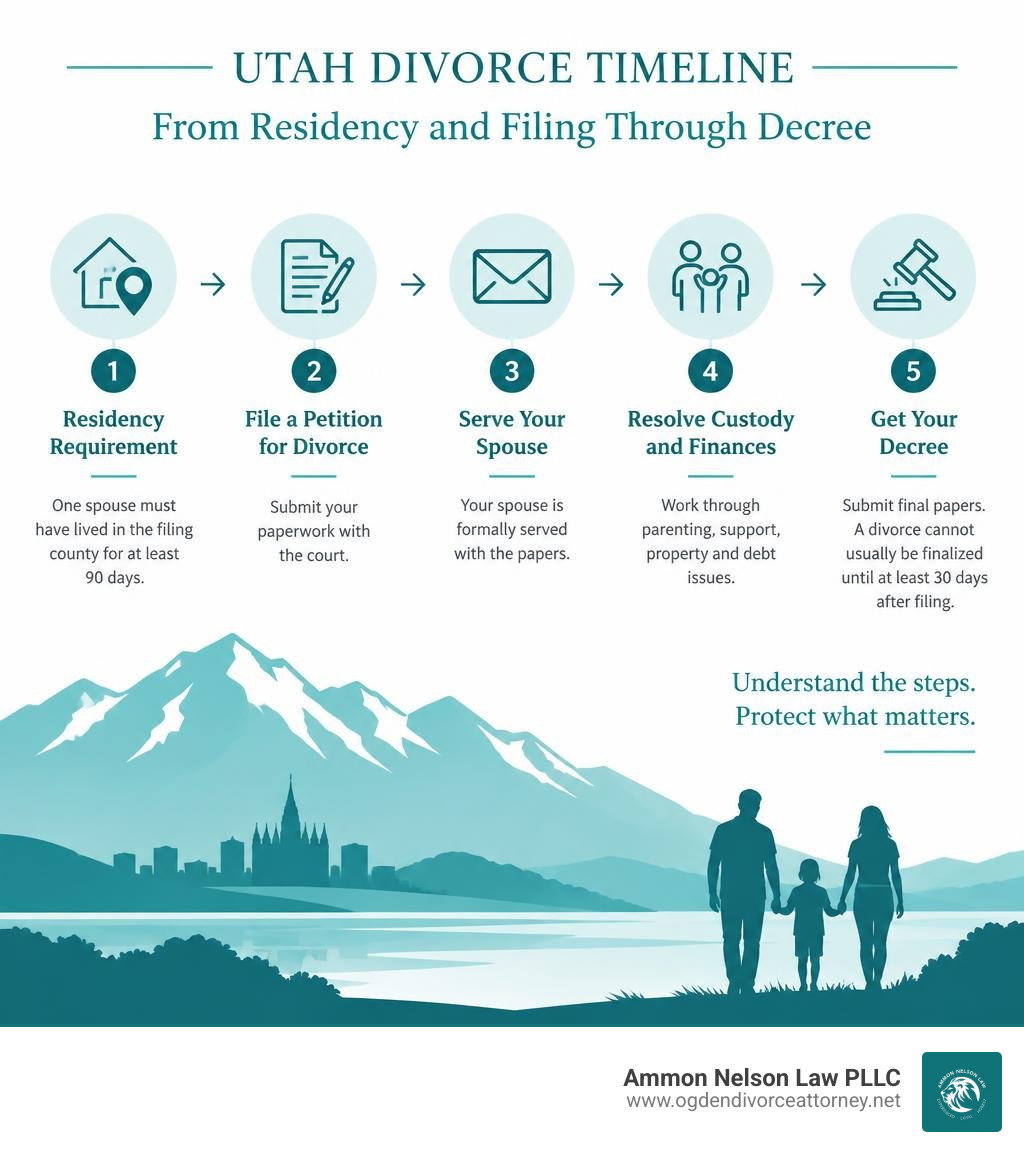
Understanding the Legal Process of Divorce in Utah: Residency, Grounds, and Waiting Periods
Navigating a divorce requires an understanding of the legal requirements established by the state. In Utah, domestic relations laws were updated and recodified under Title 81 of the Utah Code. These statutes establish rules for jurisdiction, statutory waiting periods, and the grounds required to dissolve a marriage.
Before jumping into court paperwork, it helps to understand what divorce legally accomplishes versus other legal statuses. In Utah, separated is not divorced; informal physical separation leaves marital property rights, debt obligations, and parental presumptions active. Similarly, exploring the differences between an annulment and divorce reveals that annulments render a marriage void from its inception, which requires narrow legal grounds such as fraud or bigamy, whereas divorce formally dissolves a legally valid marriage.
State law also establishes a mandatory 30-day waiting period under Utah Code § 81-4-402. The court cannot sign your final decree until at least 30 calendar days have elapsed from the date the petition is filed. While filers facing extraordinary circumstances—such as urgent military deployments or severe safety risks—can petition the court with a Motion to Waive the 30-Day Waiting Period, the vast majority of cases observe this timeline. Official rules and procedures can be reviewed directly via the Divorce – Utah State Courts portal.
Step 1: Confirming Jurisdiction and County Residency
Under Utah Code § 81-4-402, a district court does not possess subject-matter jurisdiction to dissolve your marriage unless specific residency standards are met. Either you or your spouse must have been a continuous, bona fide resident of the state of Utah—and of the specific county where the petition is filed—for at least 90 days immediately prior to filing.
For families with minor children, jurisdiction over child custody matters generally requires the children to have resided in Utah for at least six continuous months under the Uniform Child Custody Jurisdiction and Enforcement Act (UCCJEA). For members of the United States Armed Forces, being stationed on active duty in Utah for at least 90 days satisfies the statutory residency mandate. Establishing verified residency records—such as lease agreements, utility statements, or a driver’s license—is a critical part of preparing for divorce before initiating court action in Weber, Davis, or Salt Lake counties.
Step 2: Selecting No-Fault vs. Fault Grounds
When filing, you must declare the legal basis for the dissolution. Utah recognizes both no-fault and fault-based grounds:
- No-Fault Grounds: The vast majority of filers choose an Ogden divorce attorney for a no-fault divorce grounded in irreconcilable differences. This means the marriage has suffered an irreparable breakdown without requiring either party to prove wrongdoing in court. Utah also recognizes an irretrievable breakdown divorce based on living separate and apart under a decree of separate maintenance for three consecutive years.
- Fault-Based Grounds: Governed by Utah Code § 81-4-405, fault grounds include adultery, willful desertion for more than one year, habitual drunkenness, conviction of a felony, extreme cruelty, permanent impotency existing at the time of marriage, willful neglect, and incurable insanity. While alleging fault can sometimes impact decisions surrounding alimony or asset dissipation, it often increases litigation time and legal fees due to the evidentiary burdens required at trial.
Step-by-Step Workflow: Filing, Service, and Court Procedures

Initiating a domestic case involves specific administrative and procedural rules that dictate how documents must be formatted, submitted, and delivered to the other party.

To initiate proceedings in Northern Utah, you can review local filing instructions via File for Divorce | Ogden, UT and work alongside an Ogden divorce attorney on how to file your pleadings in the appropriate district court. As of 2026, the statutory filing fee for a divorce petition in Utah district courts is $325. Filers experiencing financial hardship can file Form 1301FA (Motion to Waive Fees) alongside a verified financial statement to request a fee waiver from the assigned judge.
Immediately upon filing the petition, Utah Rule of Civil Procedure 109 automatically issues a Domestic Relations Injunction. This binding court order prohibits both spouses from liquidating retirement accounts, modifying insurance policies, transferring marital assets, harassing one another, or taking the minor children out of the state of Utah without written permission or an order of the court.
Initiating the Case and Serving the Initial Papers
Once the Petition for Divorce and Summons are filed through the state’s MyPaperwork court portal or the district court clerk, the petitioner must arrange formal service of process under Utah Rule of Civil Procedure 4. You cannot hand the documents to your spouse yourself. Service must be executed within 120 days of filing by:
- A county sheriff or constable.
- A licensed private process server.
- Any individual over 18 who is not a party to the case.
- Certified mail with a signed return receipt.
If your spouse is cooperative, they can sign an Acceptance of Service, which waives the formal delivery requirement, saves service fees, and starts the statutory response clock immediately.
Once served within the state of Utah, the respondent has 21 calendar days to file a formal Answer with the district court (or 30 calendar days if served outside of Utah). If the respondent fails to file an Answer within this window, the petitioner may file a Motion for Default Judgment, enabling the court to enter a final decree granting the relief requested in the original petition.
Step-by-Step Breakdown: The Procedural Process of Divorce in Utah
If the case involves contested requests for immediate financial relief or child custody, either party can file a Motion for Temporary Orders. These orders establish legally enforceable rules for parent-time schedules, child support payments, exclusive use of the marital residence, and bill payment while the case moves through litigation.
When minor children are involved, both parents must complete two mandatory court-approved courses before the judge will grant a decree:
- Divorce Orientation Class ($30 fee): Focuses on the legal process, alternative dispute resolution, and community resources.
- Divorce Education for Parents Class ($35 fee): Educates parents on mitigating the psychological impact of marital dissolution on children.
Both courses must be completed, and the resulting Certificates of Completion filed with the court. Additionally, under Utah Rule of Civil Procedure 26.1, both parties must exchange formal Financial Declarations within specified deadlines. This sworn document requires full disclosure of monthly income, itemized living expenses, all outstanding debts, and complete documentation including three years of tax returns, recent pay stubs, bank statements, and retirement account portfolios.
If you are just beginning to evaluate your options, considering a divorce requires looking closely at how these disclosures and injunctions will affect your household budget from day one.
Resolving Disputed Issues: Contested vs. Uncontested Tracks

Every divorce proceeds down one of two tracks: uncontested or contested. Understanding the mechanics of contested vs uncontested divorces helps you determine the most efficient strategy for your family.
In an uncontested divorce, both spouses reach a complete settlement on every legal issue, including property distribution, debt allocation, alimony, child custody, and child support. The parties sign a Stipulation that is submitted directly to the judge, bypassing the need for depositions or trial.
Conversely, if disputes arise over parental rights or financial assets, the case becomes contested. Reviewing what you need to know about contested divorces can prepare you for formal discovery, motions practice, and evidentiary hearings. When high-value assets or contentious custody matters are at stake, working with an experienced Ogden divorce attorney for a contested divorce helps safeguard your parental rights and financial future.
Managing Children and Finances During the Process of Divorce in Utah
The financial and parental aspects of divorce require strict adherence to statutory models:
- Equitable Distribution: Utah is an equitable distribution state, not a 50/50 community property state. The district court divides marital property—assets acquired during the marriage—fairly, taking into account factors like the length of the marriage, each spouse’s financial contributions, and their earning capabilities. Separate property, such as assets acquired prior to the marriage or through personal inheritance, generally remains with the original owner unless commingled.
- Child Custody and Support: Custody decisions center on the child’s best interests under statutory factors such as parental bonding, past caregiving history, and the child’s emotional needs. Utah law carries a statutory presumption favoring joint legal custody. Child support is calculated using state-mandated guidelines based on an income-shares model, accounting for gross monthly incomes, the number of overnights awarded under the parent-time schedule, childcare costs, and health insurance obligations.
- Alimony and the 2024 HB 220 Reform: Alimony in Utah is evaluated based on the recipient’s financial need, the payor’s ability to pay, the duration of the marriage, and the standard of living established during the marriage. Under the 2024 legislative updates (HB 220), standard of living definitions were clarified to reflect the actual economic realities of the household prior to separation. The duration of alimony cannot exceed the total duration of the marriage, except in extraordinary circumstances. For couples seeking a structured, less adversarial approach to financial settlements, collaborative law for alimony and the kinder Utah divorce provides a cooperative method to resolve support without contentious court battles.
Alternative Dispute Resolution and Finalizing the Decree
Under Utah Code § 81-4-406, all contested divorce actions must participate in at least one session of mandatory alternative dispute resolution before the court will schedule a trial. Engaging in professional mediation allows couples to negotiate settlement terms with a neutral third party in a confidential setting. Experience consistently shows that mediation can save you money by resolving disputes outside the courtroom and drastically reducing discovery and litigation expenses.
If mediation yields a full settlement, the mediator or counsel drafts a formal Settlement Agreement and Findings of Fact and Conclusions of Law. Once the 30-day statutory waiting period has elapsed, the decree documents are submitted to the judge for review.
In uncontested cases, Utah judges typically enter the final Decree of Divorce on the basis of written affidavits without requiring an in-person appearance. In limited situations, such as default cases with complex property requests, the court may schedule a brief 10-to-15-minute prove-up hearing to take sworn testimony before the decree is signed. Utilizing the top benefits of a divorce attorney ensures that your settlement documents and Qualified Domestic Relations Orders (QDROs) are properly drafted and accepted by the court without rejection.
Frequently Asked Questions About the Utah Divorce Process
For additional answers to specific legal concerns, review our comprehensive frequently asked questions library.
How long does an uncontested divorce take in Utah?
An uncontested divorce in Utah typically finalizes within 45 to 60 days from the initial filing date. While the court is bound by the mandatory 30-day statutory waiting period under Utah Code § 81-4-402, administrative processing times and document execution usually add two to four weeks. If extraordinary circumstances exist, such as military deployment or urgent medical necessity, filers can submit a Motion to Waive the 30-Day Waiting Period to expedite finalization.
What is the total cost to file for divorce in Utah?
The base statutory filing fee for a divorce petition in Utah district courts is $325. For parents of minor children, mandatory education courses add an additional $65 ($30 for Divorce Orientation and $35 for Divorce Education). Service of process via a sheriff or process server typically costs between $50 and $100. Filers meeting state low-income thresholds can apply for a waiver of court fees by submitting Form 1301FA.
Do I have to appear in court for my divorce to become final?
In approximately 90% of Utah divorce cases, parties never have to appear in a courtroom. When spouses reach a full stipulation or when a default judgment is entered, the court finalizes the case through written declarations and affidavits submitted through the electronic filing portal. In-person hearings are generally reserved for contested motions, temporary order disputes, rare prove-up hearings, or full trials.
Conclusion: Protecting Your Rights and Future
Navigating a divorce requires balancing emotional adjustments with complex legal, financial, and parental decisions. By understanding county residency rules, completing mandatory disclosures, and exploring settlement options through mediation, you can navigate the legal system with clarity and control.
At Ammon Nelson Law PLLC, we provide customized, results-driven family law representation for clients across Ogden, South Ogden, Salt Lake City, and throughout Northern Utah. Whether you are facing a high-conflict child custody dispute or seeking an efficient, uncontested dissolution, we work to protect your rights, your assets, and your relationship with your children.
To learn more about your options, read our detailed guide on the divorce process in Utah, download our free Utah guide to divorce, or explore our insight on hiring an attorney to schedule a consultation and take the next step forward with confidence.