
How to Start a Utah Divorce
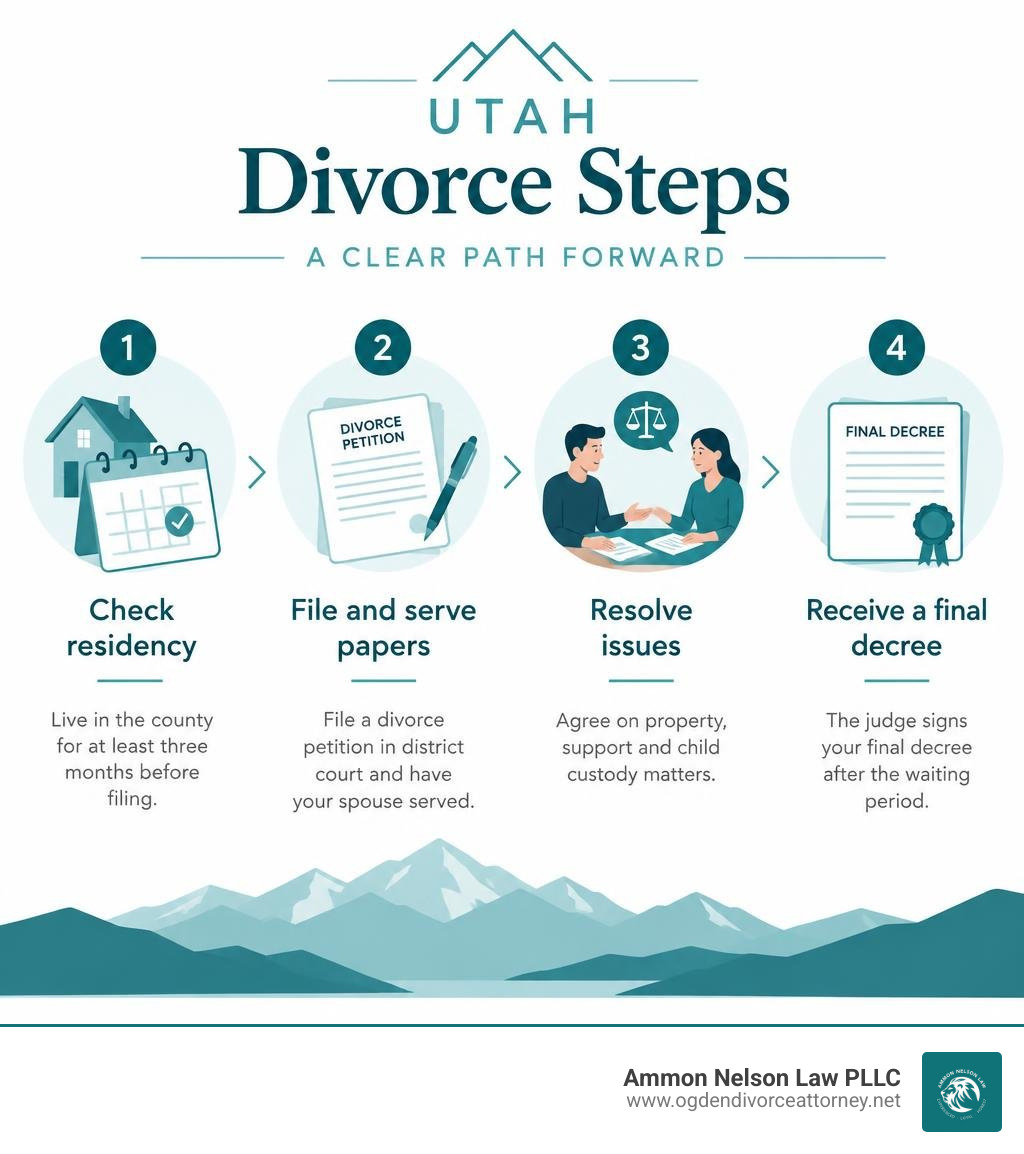
To get a Utah divorce, you or your spouse must first meet the county residency rule. You must live in the county where you file for at least three months. Next, you file a divorce petition in the local district court and serve the papers on your spouse.
You and your spouse must resolve all key family issues before a judge signs your final decree. These issues include dividing marital property, deciding alimony, setting child support, and creating a custody plan. The court usually must wait at least 30 days after filing to finalize any divorce case.
I am Ammon Nelson. I have helped many Northern Utah families work through divorce, custody, and child support matters. This step-by-step guide will walk you through the entire legal journey from start to finish. You can also review our free utah guide to divorce for a quick overview of what to expect.
Frequently Asked Questions About Utah Divorce
How long does a Utah divorce take?
State law sets a mandatory 30-day waiting period after your filing date. An uncontested divorce usually finishes within one to three months if both spouses agree on every detail quickly. A contested divorce with major disputes over money or children can take six months to two full years. Complex trials take more time.
How much does it cost to file?
The district court charges a $350 filing fee under Utah Code 78A-2-301. You can submit a fee waiver request to the court if you have a low household income. Legal industry data shows that average family lawyer rates run around $317 per hour. Simple uncontested cases often cost $1,500 to $3,500 in total legal fees. Contested trials with litigation can easily exceed $10,000 for each spouse.
Can I get a divorce if my spouse refuses?
Yes. Utah is a no-fault divorce state. One spouse can end the legal marriage even if the other partner strongly objects. If your spouse refuses to sign or simply ignores the served paperwork, you can ask the district court for a default judgment to grant your requests.
Do I need a lawyer for a Utah divorce?
You can file without a lawyer, but family law issues can be complex. An attorney helps you protect your assets, your parental rights, and your future. If you are unsure where to begin, contact an experienced Ogden divorce attorney to review your options.
Legal Requirements Before Filing Your Case
Residency Rules and Grounds for Utah Divorce
You must meet strict residency rules before filing. You or your spouse must live in your chosen county for at least 90 continuous days. Active military members stationed in Utah for at least three months also qualify. You can also file if both spouses agree in writing to Utah court jurisdiction. Minor children must live in Utah for at least six straight months before the court can make custody rulings.
Utah law gives couples two paths: no-fault and fault-based grounds. Most people choose a no-fault divorce based on irreconcilable differences under Utah Code Title 30, Chapter 3 (2023) – Divorce :: 2023 Utah Code :: U.S. Codes and Statutes :: U.S. Law :: Justia. Irreconcilable differences mean you and your spouse cannot resolve your marital problems. You can also claim fault-based grounds. These include adultery, cruelty, felony conviction, or desertion for over one year. Gathering records is an essential part of preparing for divorce.
Cooling-Off Period and Domestic Injunctions
Utah enforces a mandatory cooling-off window before the court issues a final decree. This time allows spouses to negotiate terms or seek counseling. You can ask the court to waive this wait for emergencies.
When you file, the court clerk automatically issues a Domestic Relations Injunction under Utah Rule of Civil Procedure 109. This binding order protects both spouses and children immediately:
- Spouses cannot sell, transfer, hide, or destroy marital assets.
- Neither spouse can cancel or change existing insurance policies.
- Parents cannot travel outside Utah with children without written consent or a court order.
- Spouses cannot shut off utilities, modify bank accounts, or harass one another.
Divorce filings made after April 1, 2012, remain private under state rules. Only the parties, their attorneys, and court staff can review personal filings. However, final signed decrees remain public records.
Key Steps in the Utah Divorce Process
Preparing and Filing Court Forms with MyPaperwork
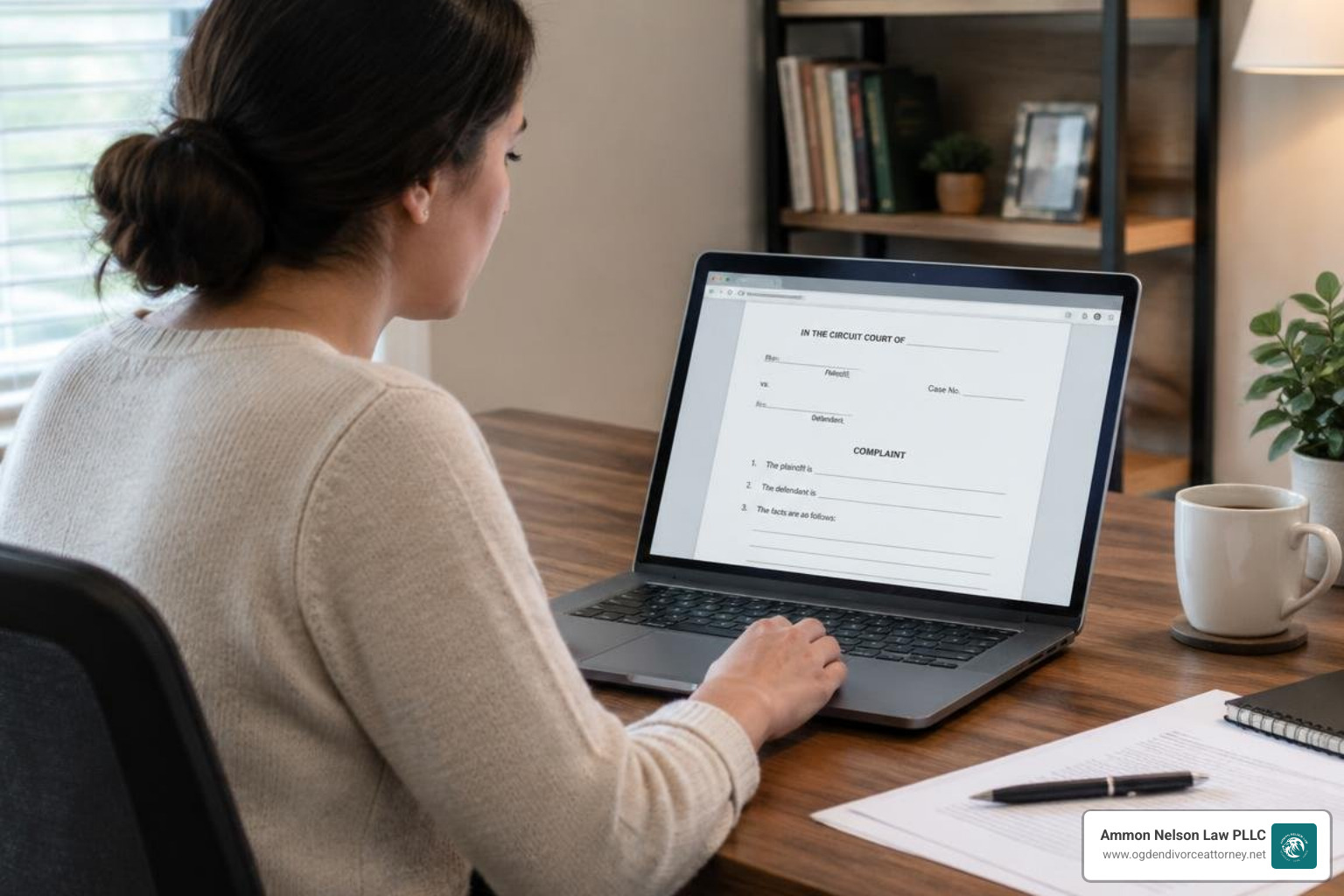
Utah replaced its older OCAP system with MyPaperwork. This online tool helps you draft court documents on a computer, tablet, or phone. You answer questions about your marriage, property, and children. Next, you sign the forms digitally and download them. The system stores your forms for seven days.
MyPaperwork does not file forms electronically with the court. You must file printed forms with the district court clerk by mail, in person, or by email as clean PDF files. To learn more, review our guide on the divorce process in utah.
Serving Papers and Default Judgments
You must formally serve your spouse with the petition and summons within 120 days of filing. You cannot hand the papers to your spouse yourself. Instead, use a county sheriff, constable, private process server, or any neutral adult aged 18 or older.
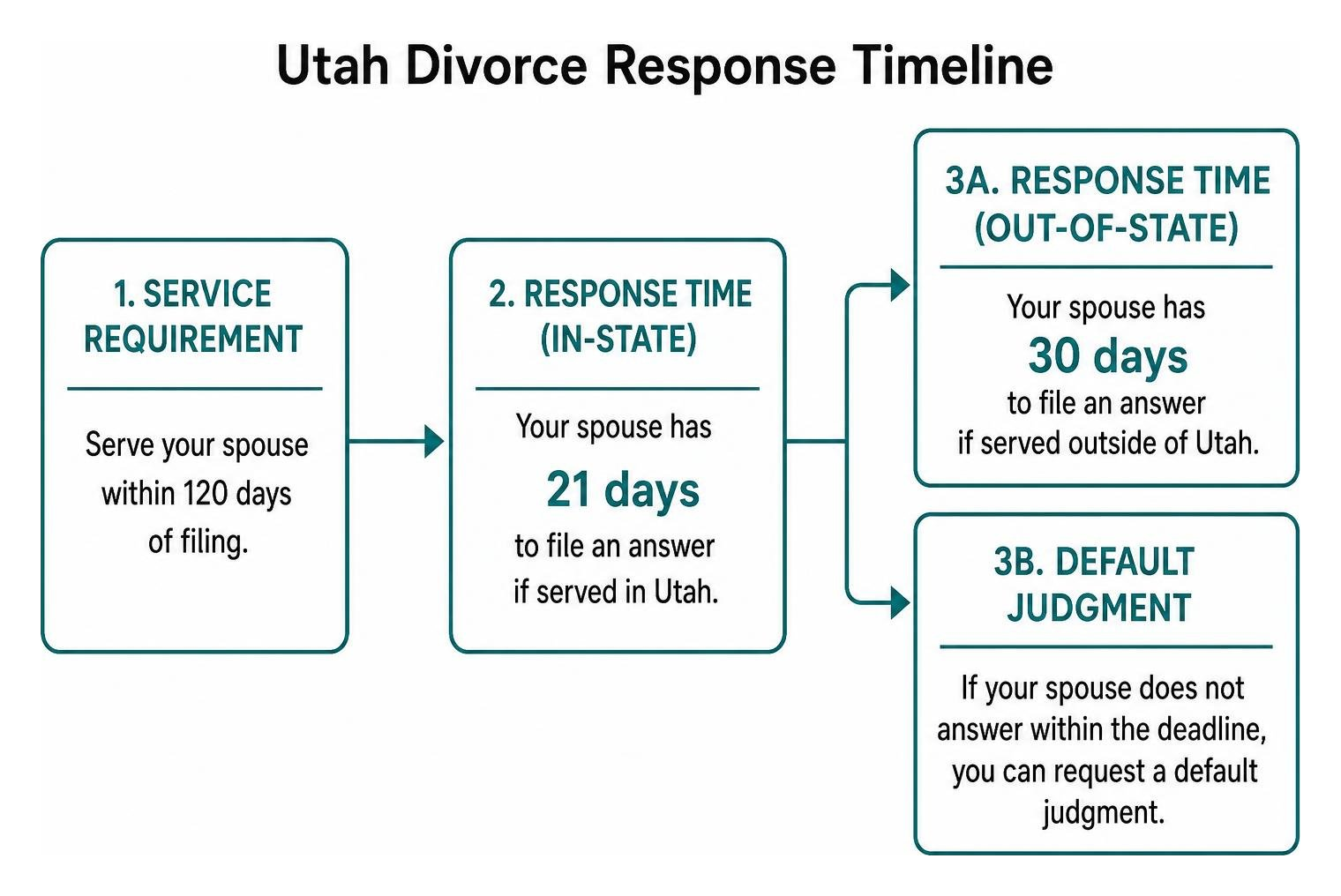
Your spouse has a strict deadline to file a written answer with the court:
- 21 days if served inside Utah.
- 30 days if served outside Utah.
Your process server must file a Proof of Service document with the court clerk. If your spouse fails to answer in time, you can request a default judgment. A default judgment asks the judge to grant your requests without your spouse’s input. For a visual guide, see the state Roadmap for divorce cases (flowchart – Revised February 2019) .
Settling Disputes vs. Going to Trial
When spouses agree on all terms, they sign a joint stipulation for an uncontested divorce. When spouses disagree, the case becomes contested.
| Step / Factor | Uncontested Divorce | Contested Divorce |
|---|---|---|
| Mediation | Not required | Mandatory under Utah rules |
| Financial Declarations | Basic settlement summary | Full mandatory disclosures |
| Discovery Phase | Informal information exchange | Formal document requests and depositions |
| Final Resolution | Signed stipulation decree | District court trial and ruling |
In contested cases, Utah court rules require at least one formal mediation session before trial. Spouses can also request temporary orders for custody, child support, and home use while the case proceeds. Learn more by comparing contested vs uncontested divorces.
Dividing Marital Assets, Alimony, and Child Support
Equitable Property Division and Alimony Rules

Utah divides property using an equitable distribution model. Judges divide marital assets, real estate, bank accounts, and debts fairly. Fair does not always mean an exact 50/50 split.
Marital property includes assets, income, vehicles, and debts acquired during the marriage. Separate property includes items you owned before the wedding, gifts, and inheritances. If you mix separate funds in joint accounts, the court may treat them as marital property.
To divide retirement funds without tax penalties, your lawyer must prepare a Qualified Domestic Relations Order (QDRO).
Judges set alimony using state factors. They review the recipient’s financial need, the marital standard of living, and the paying spouse’s ability to pay. Alimony cannot last longer than the length of the marriage. Spousal support ends if the recipient remarries, passes away, or lives with a new romantic partner. The paying spouse must file to end alimony within one year of discovering cohabitation.
Child Custody, Parent-Time, and Mandatory Classes
Utah courts base custody and parent-time on the best interests of the child. Legal custody gives parents the right to make major decisions about schooling, medical care, and religion. Physical custody determines where the child lives. Utah law sets standard parent-time schedules for children of all ages.
Judges calculate child support using state guidelines. These guidelines factor in both parents’ gross income and overnight visits.
When cases involve minor children, both parents must complete two mandatory classes within 60 days of filing:
- Divorce Orientation Class: Explains the legal process, timelines, and resolution options.
- Divorce Education for Parents Class: Helps parents guide children through emotional stress and household changes.
Parents get a fee discount if they finish these classes within 30 days of service. Utah also offers a free online coping class for children aged 6 to 17. For extra guidance, download our free utah guide to divorce.
Conclusion
A Utah divorce officially ends your marriage and sets clear legal guidelines for your future. Once you resolve all disputed matters through negotiation or trial, the district court judge signs your final divorce decree. This order dissolves the marriage and enforces all child custody, parent-time, property division, and spousal support terms.
You do not have to handle this legal process alone. Our team at Ammon Nelson Law PLLC provides skilled representation to families across Northern Utah. Contact an experienced Ogden divorce attorney today to protect your assets, parental rights, and future.