
Understanding Guardianship and Conservatorship: Core Legal Distinctions
Guardianship grants authority over an adult’s personal and medical decisions, while conservatorship manages their financial assets and property. Both are court-appointed protective roles created when an adult cannot manage essential needs due to cognitive decline, catastrophic injury, or intellectual disability. Because these legal arrangements remove fundamental civil liberties, the law treats them as measures of last resort.
Fiduciary roles carry strict legal and ethical obligations. Under standard legal frameworks like the Uniform Guardianship, Conservatorship, and Other Protective Arrangements Act (UGCOPAA), courts separate the management of a person’s physical well-being from the management of their property. While specific terms vary across state jurisdictions, the central distinction between personal care and financial administration remains the benchmark for protective proceedings.
Defining Guardianship and Conservatorship Roles and Authority
In standard legal practice, a guardian focuses on personal welfare and daily care, whereas a conservator functions as a financial fiduciary. A single individual can serve in both capacities if the court finds it appropriate, but the responsibilities remain distinct.
| Feature / Power | Guardianship (Person) | Conservatorship (Estate) |
|---|---|---|
| Primary Scope | Personal care, health, and daily welfare | Financial assets, income, property, and debts |
| Living Arrangements | Chooses residential placement and living conditions | Manages leases, mortgages, and property upkeep |
| Medical Authority | Consents to or withholds medical treatments | Pays medical bills and manages insurance claims |
| Asset Management | No authority over large bank accounts or real estate | Sells assets, manages investments, pays expenses |
| Court Reporting | Annual reports on physical and mental well-being | Detailed annual financial accountings and ledgers |
These roles are designed to safeguard individuals while keeping their dignity intact. For those seeking clarity on legal decision-making boundaries, understanding adult legal authority helps clarify who holds the final say when navigating complex adult care situations.
Scope of Authority: Full, Limited, and Emergency Appointments
Courts tailor protective orders to the specific functional limitations of the individual (referred to legally as the respondent or protected person).
- Full (Plenary) Appointments: The court grants the fiduciary complete authority over all personal or financial decisions. This level is reserved for cases of severe, total cognitive incapacity where the individual cannot participate in any decision-making.
- Limited Appointments: The preferred statutory model under modern protective statutes. The court order specifies exact, restricted powers—such as consenting to specialized medical care or managing a specific bank account—while leaving all other civil rights intact.
- Emergency (Temporary) Appointments: When an individual faces immediate, substantial harm or severe financial exploitation, courts can issue emergency orders on an expedited timeline. In many jurisdictions, emergency authority lasts for a short duration (often up to 30 days, or up to 60 days in certain states) unless extended after a full evidentiary hearing.
Understanding the Utah protective proceedings framework ensures that families do not request more authority than is strictly necessary to keep their loved ones safe.
Establishing Protective Roles: Eligibility, Need, and Court Procedures
Taking the legal step to request authority over another adult requires thorough preparation. Courts do not simply accept a petitioner’s word that an adult needs help; they require clear, objective evidence before altering anyone’s legal autonomy. Navigating Utah guardianship preparations early helps families organize required medical records and background paperwork before filing.
Evaluating Incapacity and Due Process Protections
To appoint a guardian or conservator, the court must find that the respondent has mental incapacity demonstrated by clear and convincing evidence. This standard requires proving that the individual cannot evaluate information, make decisions, or communicate choices regarding their physical health, safety, or financial assets.
Key elements of this evaluation process include:
- Medical and Psychological Certifications: A formal written assessment from a licensed physician, psychologist, or psychiatrist detailing cognitive deficits, prognosis, and functional capacity.
- Court Visitors and Investigators: An independent person appointed by the court to interview the respondent, visit their residence, meet the proposed fiduciary, and provide an unbiased report to the judge.
- Due Process Rights: The respondent retains essential legal protections, including formal notice of all proceedings, the right to attend hearings, the right to present evidence, the ability to cross-examine witnesses, and the mandatory right to legal counsel. If the respondent cannot afford an attorney, the court appoints one.
These procedural safeguards align with federal guidance on protected rights, ensuring that protective actions do not bypass individual civil liberties.
Step-by-Step Petitioning and Appointment Process
Navigating a formal petition requires following strict procedural steps to ensure proper jurisdiction and notice.
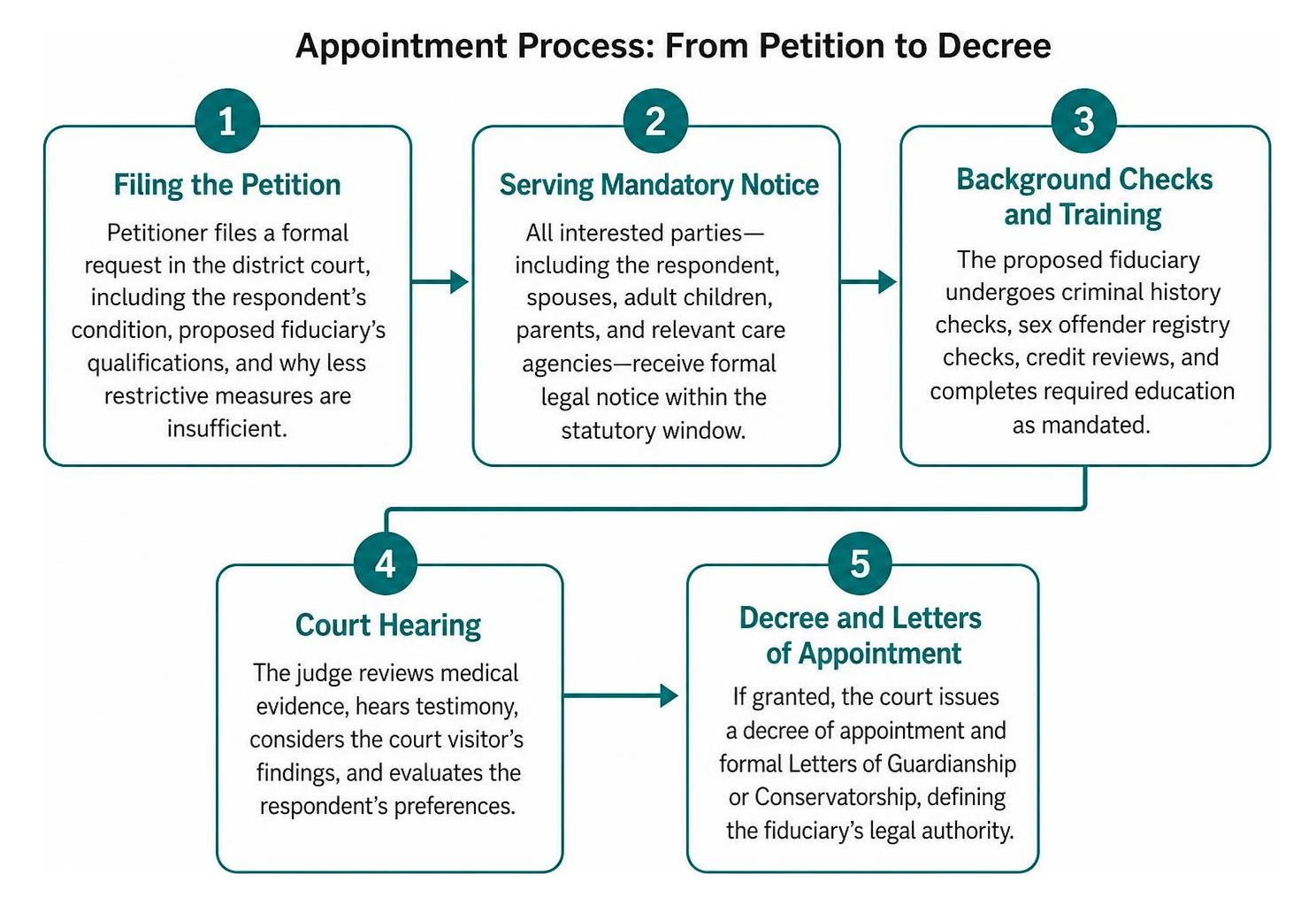
- Filing the Petition: The petitioner files a formal request in the appropriate district court, specifying the respondent’s condition, the proposed fiduciary’s qualifications, and why less restrictive measures are insufficient.
- Serving Mandatory Notice: All interested parties—including the respondent, spouses, adult children, parents, and relevant care agencies—must receive formal legal notice within the statutory window before the hearing.
- Background Checks and Training: The proposed fiduciary must undergo criminal history checks, sex offender registry checks, credit reviews, and, in many states, complete mandatory guardian/conservator education modules.
- Court Hearing: The judge reviews medical evidence, hears testimony, listens to the court visitor’s findings, and evaluates the respondent’s preferences.
- Decree and Letters of Appointment: If granted, the court issues a decree of appointment and formal Letters of Guardianship or Conservatorship, defining the fiduciary’s legal authority.
- Posting Bond: Conservators are typically required to secure a surety bond to protect the estate’s assets from mismanagement or theft.
Reviewing statutory appointment guidelines helps clarify procedural expectations. When preparing these complex filings, consulting a Salt Lake guardianship lawyer helps ensure that all statutory notices, medical exhibits, and background verifications satisfy court requirements.
Fiduciary Duties, Reporting, and Ongoing Court Monitoring

Being appointed as a guardian or conservator is not a blank check of authority; it establishes a formal fiduciary duty to act strictly for the benefit of the protected person. Fiduciaries must make decisions using two core legal standards:
- Substituted Judgment: The fiduciary must make the decision the protected individual would have made if they were capable, honoring their expressed values, past statements, religious beliefs, and personal preferences.
- Best Interests Standard: If the individual’s wishes are unknown, impossible to determine, or would cause direct and substantial harm, the fiduciary must make a decision that promotes the individual’s safety, health, and general welfare.
When managing property, conservators must also adhere to the Prudent Investor Rule, which requires diversifying investments, avoiding speculative risks, preserving capital, and keeping personal funds entirely separate from the estate.
Mandatory Court Oversight and Annual Accountings
Courts maintain active oversight throughout the lifespan of a protective appointment to prevent neglect, abuse, and financial exploitation.
- Initial Inventory (Within 60 Days): The conservator must locate, appraise, and file a comprehensive inventory of all real estate, bank accounts, personal property, and income sources belonging to the protected person.
- Detailed Annual Accountings: Every year, the conservator must submit a complete accounting listing all income received, every dollar spent (with supporting receipts), investment performance, and the remaining asset balances.
- Annual Well-Being Reports: Guardians must file regular status updates describing the protected person’s current living conditions, medical status, social activities, and ongoing care plans.
- Prior Court Authorization: Fiduciaries cannot make major life decisions—such as selling real estate, moving the individual out of state, placing them in a secure memory-care facility, or altering estate plans—without filing a specific motion and securing prior court approval.
Exploring Alternatives, Associated Costs, and Financial Obligations
Because protective court proceedings require substantial time, financial investment, and oversight, exploring less restrictive alternatives should always be the first step in long-term planning.
Less Restrictive Alternatives to Guardianship and Conservatorship
Whenever possible, families should utilize proactive legal and community tools that allow an individual to receive assistance without losing their civil rights. Integrating comprehensive estate planning strategies allows adults to name trusted decision-makers long before cognitive challenges emerge.
- Durable Financial Power of Attorney (POA): Authorizes a chosen agent to manage bank accounts, pay bills, and handle real estate if the principal becomes incapacitated, avoiding the need for a court conservator.
- Advance Health Care Directives: Designates a medical surrogate to make healthcare choices and outlines end-of-life treatment preferences.
- Revocable Living Trusts: Places assets into a trust managed by a trustee for the benefit of the individual, bypassing court-supervised conservatorships and simplifying eventual probate administration.
- Social Security Representative Payee & VA Fiduciaries: Administrative designations through federal agencies that allow a trusted person to manage government benefit payments without broad court orders.
- ABLE Accounts & Special Needs Trusts: Specialized financial vehicles that hold assets for individuals with disabilities without jeopardizing eligibility for needs-based government programs like Medicaid or SSI.
- Supported Decision-Making (SDM): A collaborative framework where trusted family members, friends, or professionals assist the adult in understanding choices, reviewing documents, and communicating decisions without removing their legal rights.
Breakdown of Filing Fees, Legal Costs, and Bonding Requirements
Establishing a court-supervised protective arrangement involves several mandatory costs. Depending on the complexity of the case and whether it is contested, total initial expenses can range from relatively low amounts to substantial outlays:
- Court Filing Fees: Typically range between $200 and $400 depending on the county jurisdiction.
- Attorney Fees: Legal representation for drafting petitions, managing service, and attending hearings generally ranges from $1,500 to $10,000 or more in contested litigation.
- Court Visitor and Evaluation Fees: Appointed visitors and independent medical examiners often bill between $500 and $2,000 for evaluations.
- Surety Bond Premiums: Conservators must pay annual premiums to a bonding company based on the total value of the liquid assets under management.
- Fee Waivers: Most courts provide fee waivers (in forma pauperis) for filing and court visitor costs if the respondent has minimal income or assets (often under $3,000).
Modifying and Terminating Court Appointments
Court-ordered protective roles are not necessarily permanent. Because the primary goal of the law is to foster self-reliance, the court must modify or end an appointment whenever the underlying need changes.
- Restoration of Capacity: If a protected individual recovers from a medical crisis, brain injury, or temporary impairment, they or an interested party can petition the court for full restoration of rights. Medical documentation demonstrating regained capacity is presented at a formal hearing.
- Modifying Scope: A plenary arrangement can be converted to a limited appointment if the individual develops new capabilities or if specific assets are moved into a trust.
- Removal and Replacement of Fiduciaries: If an appointed guardian or conservator fails to submit annual accountings, mismanages funds, neglects the individual’s medical needs, or exhibits a clear conflict of interest, the court can remove them and appoint a successor.
- Final Accounting and Discharge: When a protected individual passes away or regains full legal capacity, the conservator must file a final accounting detailing all property transfers and expenditures before the court officially releases the fiduciary and discharges their surety bond.
Frequently Asked Questions About Protective Proceedings
How long does an emergency guardianship order remain valid?
Emergency protective orders are short-term measures designed to address immediate threats of physical danger or severe financial loss. In most court systems, these temporary orders remain valid for 30 to 60 days. The court uses this window to coordinate formal evaluations, conduct investigations, and schedule a full evidentiary hearing where all parties can present long-term evidence.
What rights does an individual retain while under conservatorship?
Even under a full conservatorship, an individual does not lose all civil liberties. Unless the court specifically restricts them in the written decree, the person retains the right to vote, marry, receive personal mail, express opinions on medical care, retain private legal counsel to challenge the conservatorship, and petition the court for annual reviews or removal of the fiduciary.
How can family members challenge or replace an appointed fiduciary?
Any interested party—such as a relative, close friend, or agency—can file a formal motion for removal in the court that issued the original appointment. The moving party must provide concrete evidence of misconduct, such as missing annual accounting deadlines, self-dealing, commingling personal funds with the estate, or failing to visit the protected person. The judge will hold a hearing to evaluate the evidence and determine whether appointing a successor fiduciary is necessary.
Conclusion: Securing Protection While Preserving Dignity
Navigating protective legal proceedings requires balancing the need to keep a loved one safe with the duty to respect their personal independence. Whether you are addressing an unexpected health emergency or planning support for an aging parent, choosing the least restrictive path ensures that vulnerable adults receive support while retaining their dignity.
At Ammon Nelson Law PLLC, we provide clear, results-driven legal guidance to clients across Ogden, South Ogden, Salt Lake City, and throughout Northern Utah. If you need help evaluating your family’s options, explore guardianship and conservatorship services with our team to secure practical, compassionate solutions tailored to your loved one’s needs.