
Frequently Asked Questions About Child Support Attorneys
What do child support attorneys do?
Child support attorneys help parents set up, review, change, and enforce support orders. They explain Utah’s rules in plain terms. They check income figures and support calculations. They negotiate agreements and speak for you in court. They also help when a parent stops paying.
When should I hire a child support attorney?
Hire one when income or parenting time is disputed. Hire one when paternity is unclear, when payments are missed, or when your finances change. You should also call one when custody issues are complex or when safety is a concern. Early advice often prevents costly mistakes.
How can I find affordable legal help for child support?
Start with a free or low-cost consultation. Ask about payment plans and limited-scope help, where an attorney handles only part of your case. You can also look into legal aid groups, law school clinics, and court self-help centers. Many programs check your income first, so ask about eligibility early.
Find Child Support Attorneys in Northern Utah
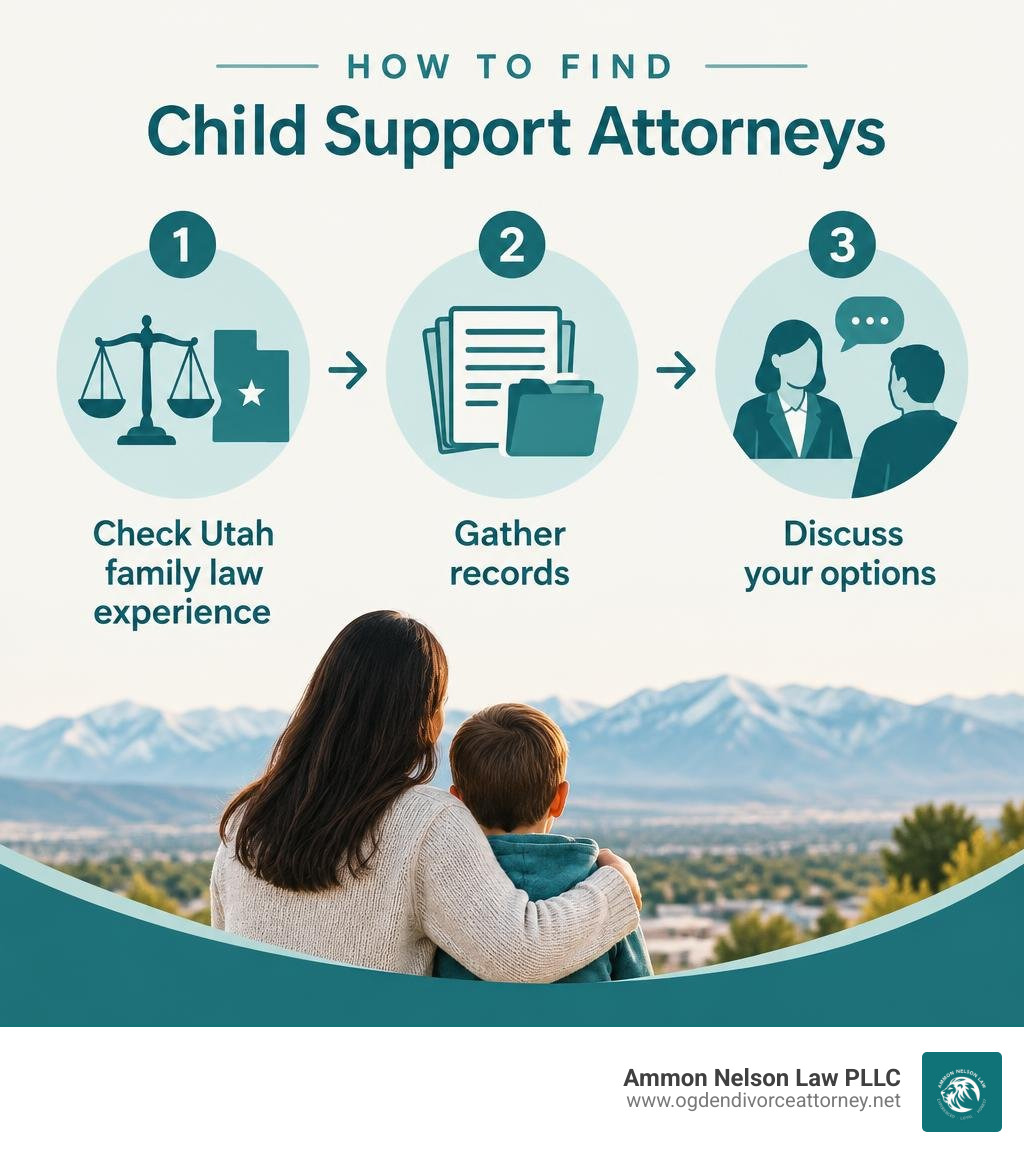
Child support attorneys help parents set up, change, or enforce child support orders. If you need legal help in Northern Utah, look for an attorney who handles Utah family law. Bring your current order, income records, child care costs, and payment history to your first meeting. This helps the attorney spot issues and explain your next steps.
Utah uses state guidelines to calculate support, but disputes over income, parenting time, or a child’s needs can make a case harder. You may also need help if payments have stopped or your finances have changed.
I’m Ammon Nelson, and my firm helps Northern Utah parents with child support and other family law matters. I know that finding child support attorneys can feel overwhelming, so this guide starts with the questions parents ask most. I have been practicing family law for 15 years. I have helped hundreds of people with their child support matters in Utah. Since child support is one of those things that can’t be negotiated away, its important to understand it as much as possible.
What Child Support Attorneys Do and When to Hire One
Both parents have a legal duty to support their children. That duty applies whether the parents were married or not. Child support helps cover food, housing, health care, child care, and school costs.
Many parents handle simple cases on their own. Others need a lawyer to protect their rights and their child’s needs. We explain both paths below so you can decide what fits your case.
When to hire child support attorneys
You do not need a lawyer for every support question. But some situations call for one. Consider calling an attorney in these cases:
- Disputed income or parenting time. Self-employment, bonuses, and overtime can make income hard to measure. Overnight counts can change the support amount.
- Paternity questions. If a child’s legal father is not established, support may not be possible yet.
- Missed payments. Unpaid support grows over time. Delay can make collection harder.
- Major life or financial changes. A job loss, a raise, a new baby, or a move may call for a new order.
- Complicated custody issues. Support and custody often connect. A change in one can affect the other.
- Safety concerns. If you fear contact with the other parent, you need a careful plan.
We see many parents wait too long. A short consultation can show you where you stand. It can also save you from a weak agreement that is hard to change later.
How child support attorneys help with support cases
A good attorney guides you through each stage of a case. Here is what that looks like:
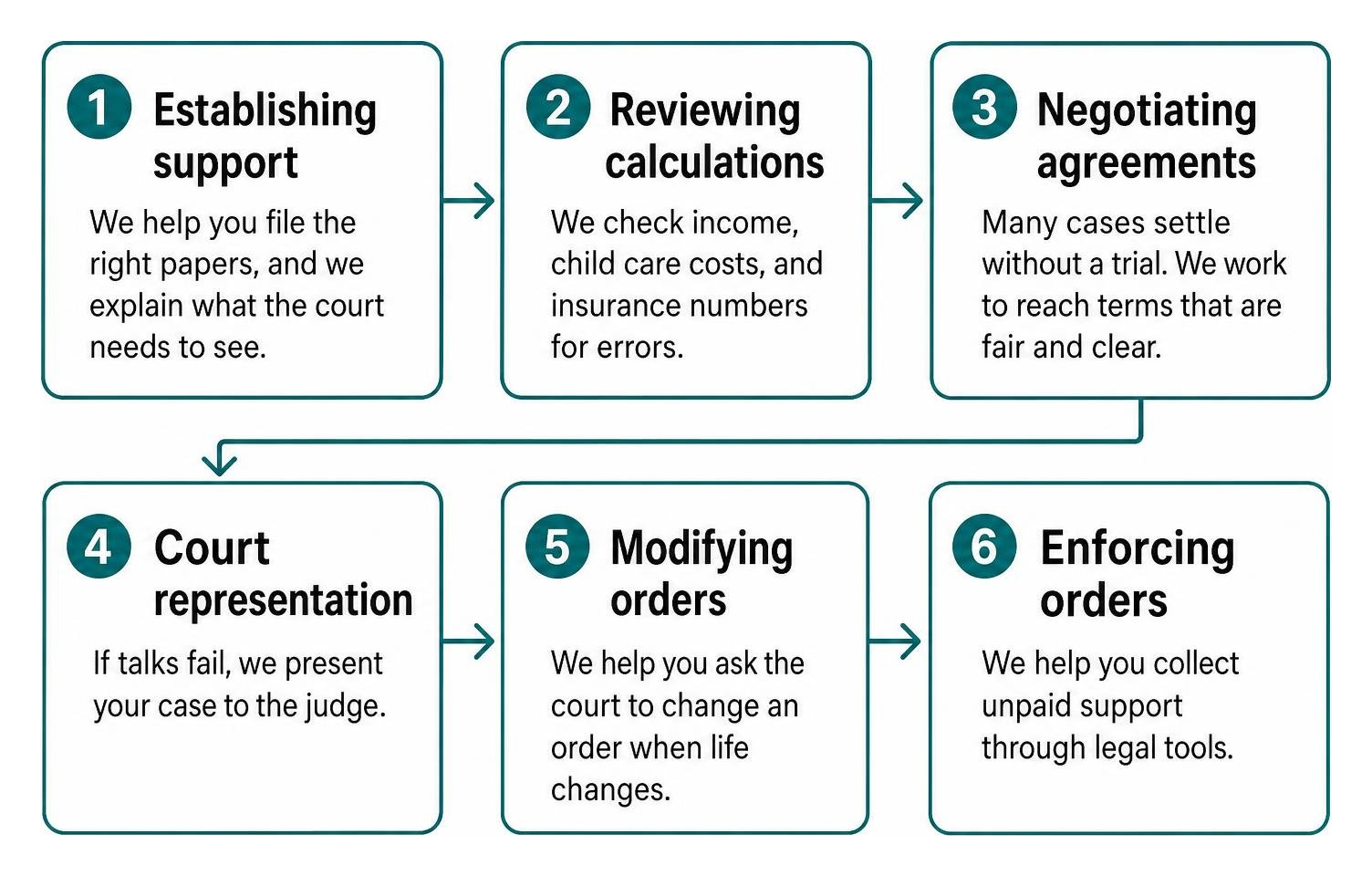
- Establishing support. We help you file the right papers, and we explain what the court needs to see.
- Reviewing calculations. We check income, child care costs, and insurance numbers for errors.
- Negotiating agreements. Many cases settle without a trial. We work to reach terms that are fair and clear.
- Court representation. If talks fail, we present your case to the judge.
- Modifying orders. We help you ask the court to change an order when life changes.
- Enforcing orders. We help you collect unpaid support through legal tools.
You can read more about relevant child support services on our website. Our guide on how to obtain child support walks through the first steps.
How Child Support Is Calculated, Modified, and Enforced
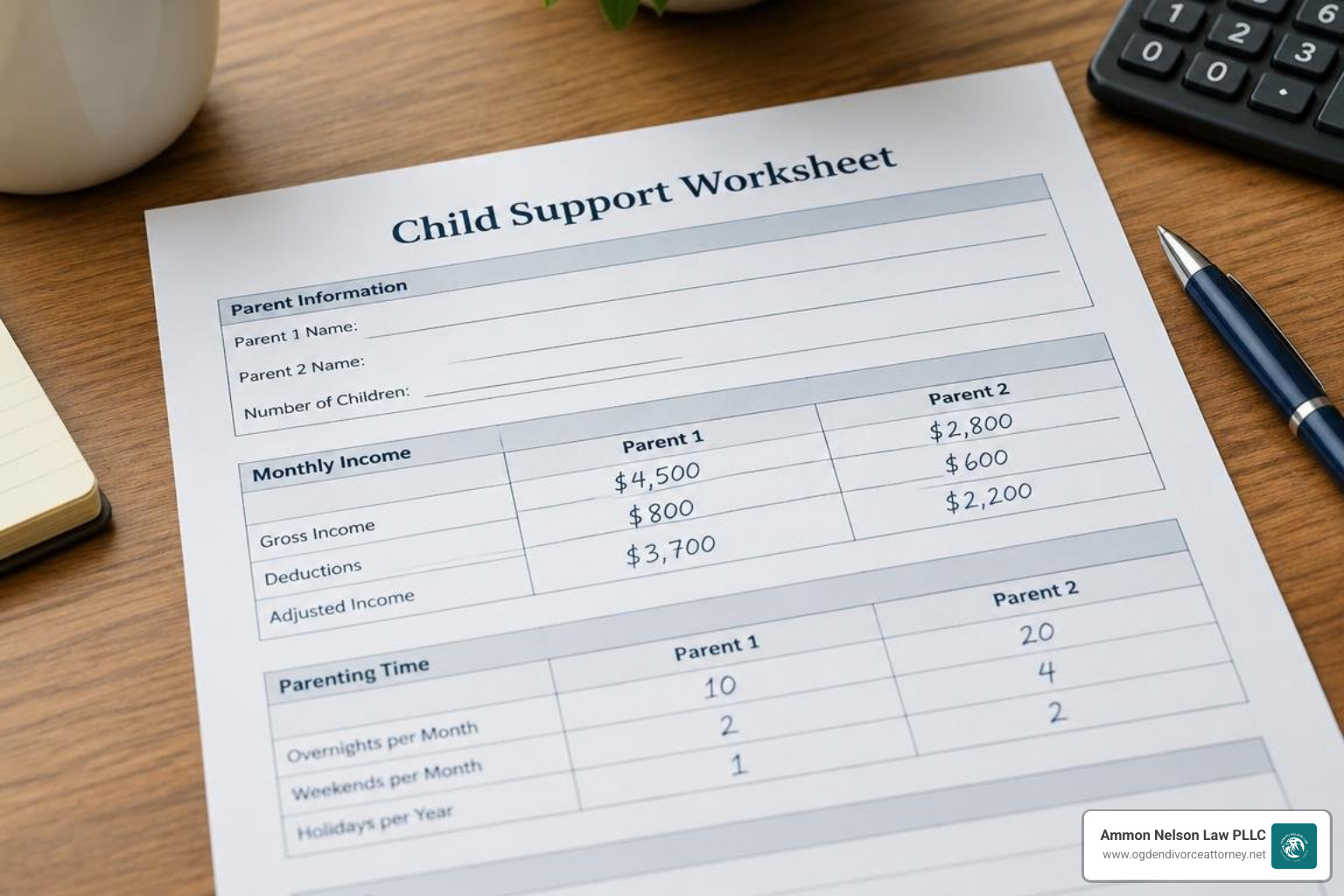
Every state sets its own rules. Most states use written guidelines. Judges start with the guideline amount and then look at the facts of your case.
Many states use an income shares model. This model estimates what parents would spend on a child if the family lived together. Then it splits that cost between the parents based on their incomes. Some states, such as Kansas and Texas, use their own formulas and factors. Those details differ from Utah’s, so always check the rules where your case is filed.
Courts across the country look at similar factors:
- Each parent’s gross income
- Parenting time and overnight stays
- Child care costs
- Health insurance premiums
- Special needs of the child
- Tax deductions
- Long-distance travel costs for visits, in some states
The Utah Office of Recovery Services offers a child support calculator and guidance from Utah DHHS. It gives you a rough estimate. An attorney can tell you whether the numbers fit your facts.
How state guidelines affect the amount
Each state has its own formula and its own worksheet. Utah’s rules use both parents’ incomes and the number of children. They also account for parenting time. A parent with the children for more overnights may owe less. Shared parenting can change the math in a big way.
Guideline tables also have income limits. For very high or very low incomes, the court may use extra discretion. Judges can also deviate from the guideline amount. They must have a good reason and must explain it. Examples include unusual medical costs or special needs.
Small input errors can change the final number. A wrong income figure or a missed child care bill can cost you for years. Our Utah child support schedule and calculation guide explains the process in more depth. You can also review child support basics before you meet with a lawyer.
How paternity affects a support order
Child support starts with legal parentage. If parents are married when a child is born, the law usually treats the husband as the father. If they are unmarried, the father may need to be legally established first.
A birth certificate alone may not settle this. Parents have two main paths:
- Voluntary acknowledgment. Both parents sign a legal form that names the father.
- Genetic testing and a court order. A court can order a DNA test and then enter a parentage order.
Once paternity is set, a court can order support. It can also address custody and parenting time. Paternity protects the child’s rights too. These include inheritance, insurance, and benefits.
Paternity also protects fathers. An unmarried father who does not act may lose chances to take part in his child’s life. A father with a legal order can seek parenting time. He also takes on the duty to pay support. Our page on fathers’ rights covers this topic further.
How to modify an existing order
A support order is not always permanent. You can ask the court to change it when circumstances shift in a real way. Courts call this a material change. Common reasons include:
- A big rise or drop in either parent’s income
- A change in health insurance costs
- New needs for the child, such as medical care
- A change in where the child lives most of the time
- A change in parenting time
You cannot simply stop paying or change the amount on your own. A written deal between parents is not enough either. Until a judge signs a new order, the old one stays in force.
Here is how to prepare:
- Collect pay stubs, tax returns, and benefit letters.
- Gather records of insurance and child care costs.
- Write down what changed and when it changed.
- File a formal request with the court.
Keep records of everything. Your evidence matters. Our Utah child support guide for parents offers more tips.
How unpaid support can be enforced
When a parent does not pay, the law gives you tools. Utah and federal rules allow several:
- Income withholding. The employer takes support straight from the paycheck.
- Tax refund intercepts. Government agencies can take refunds to pay overdue support.
- License suspension. Some licenses may be limited when a parent falls far behind.
- Court enforcement. A judge can hold a parent in contempt, which may bring penalties.
- Interstate enforcement. If the other parent lives in another state, laws allow the order to be enforced there.
Payment records matter. Keep bank statements, receipts, and any state payment history. They show how much is owed. An attorney can use those records to build a strong request.
State agencies also help collect support. Private counsel adds another option. An attorney can speak for you in court and handle disputes tied to custody or modification. Read our Utah child support enforcement tools guide to learn more.
How to Find and Afford Child Support Attorneys

Choosing a lawyer is a big step. Take your time. Look for these points:
- A valid Utah State Bar license
- Family law experience
- A record of handling child support cases
- Clear fees
- Good communication
- Knowledge of local courts
How to choose child support attorneys in your state
Start with the state bar. You can check whether a lawyer is licensed and in good standing. Then look at the lawyer’s focus. A family law practice that handles support cases every week will know the local judges and procedures.
You can also use online tools. You can search family-law attorneys by location to see profiles in your area. You can also browse child support attorney listings to compare options. Always confirm credentials with the state bar.
Use your first meeting to ask good questions:
- How many child support cases have you handled in Utah?
- Who will work on my case day to day?
- How do you charge, and what costs are extra?
- What is your plan for my case?
- How will we communicate, and how fast do you reply?
Ask for a written fee agreement. It should explain the hourly rate, the retainer, and any filing fees. Do not sign until you understand it. A good lawyer will also tell you honestly when your case is simple enough to handle on your own.
Local court knowledge matters. Our offices in Ogden serve clients in Salt Lake City and across Northern Utah, and that local experience helps us plan each case.
What low-income parents can do to get legal help
Cost should not keep a child from getting support. You have several options:
- Legal aid. Nonprofit groups help parents who meet income limits.
- Law school clinics. Law students work under a supervising attorney, often for free.
- Court self-help centers. Court staff can explain forms and steps, though they cannot give legal advice.
- Limited-scope representation. A lawyer handles one task, such as reviewing papers or attending one hearing.
- Payment plans. Some firms spread fees over time.
- Reduced-fee programs. Some groups offer lower rates to people who earn too much for free aid.
Some nonprofit programs set income caps. Many use a percentage of the federal poverty level, often between 200 and 250 percent. Some charge a flat starting fee and a low hourly rate. They usually screen your income first. Expect to answer questions about your household and pay.
Prepare before you call. Gather proof of income, your current order, and your case papers. Ask each office about fees and eligibility on the first call.
If you can afford some help, even a short consult can shape your path. Our page on hiring an attorney explains what to expect.
Special Circumstances and Next Steps
Some families face added challenges. Military service, jail time, and family violence can change how a case works. Government agencies offer programs for these cases. Private counsel can add personal guidance and court representation. Divorce and separation also affect kids, so our page on children and divorce may help.
How special circumstances can affect a case
Military families. Military pay can include base pay and allowances. Courts must decide which parts count as income. Deployments also affect parenting schedules. Orders should plan for long absences and for how a child keeps contact with a deployed parent. Federal rules also protect service members in some court matters. Military families should ask a lawyer about these details.
Incarcerated parents. A parent in jail or prison often cannot earn the same income. But support does not always stop on its own. The parent may need to ask the court for a review. Waiting can lead to a large unpaid balance. A prompt request helps the court set a fair amount based on ability to pay.
Family violence. Safety comes first. If you fear the other parent, tell your attorney at the start. Courts can allow steps to protect you. These may include keeping your address private. They may also include safe ways to serve papers and communicate. Use a safe phone number and email. Do not share details through any shared device or account. Our page on getting a restraining order covers protective options.
In all these cases, an experienced lawyer can fit the plan to your family.
Get help with a Utah child support matter
Ammon Nelson Law PLLC serves families throughout Utah from our Ogden offices. We build each plan around your goals and facts. We help with new orders, changes, and enforcement. We also handle related custody and divorce issues.
You can start with our Utah child support legal guidance. When you are ready to talk, contact the firm. Bring your order, pay records, and payment history. We will review them and explain your options in plain language.