Why Alimony Utah Collaborative Law Is the Smarter Way to Handle Spousal Support
Alimony Utah collaborative law gives divorcing spouses a structured, out-of-court path to negotiate spousal support — without the stress, cost, and bitterness of a courtroom battle.
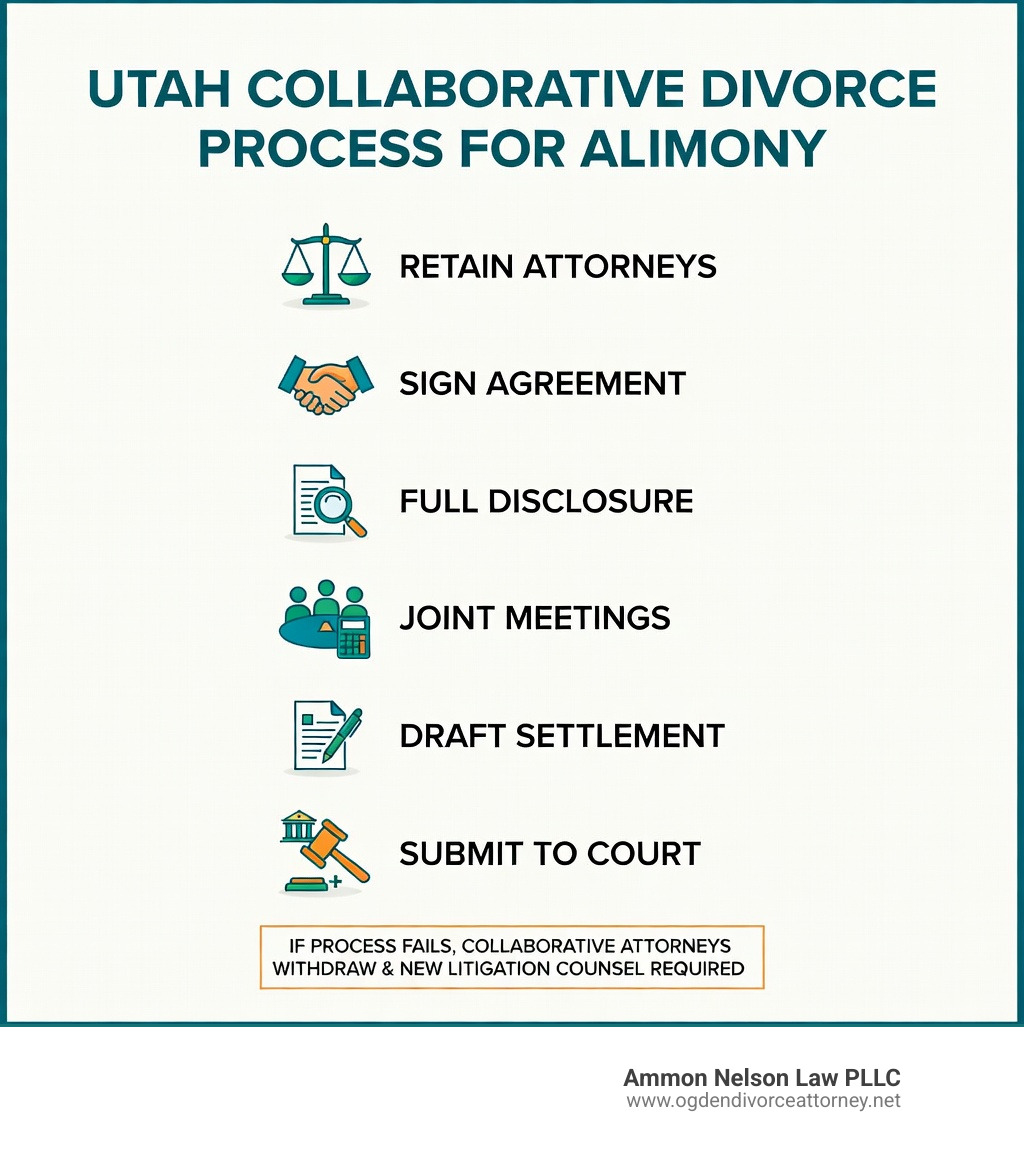
Here is a quick overview of how it works:
- Both spouses hire collaboratively trained attorneys who commit to staying out of court.
- Everyone signs a participation agreement — the official start of the process under Utah’s Uniform Collaborative Law Act.
- Both parties fully disclose finances — income, assets, debts, and needs.
- Joint meetings are held to negotiate alimony terms, often with neutral financial experts.
- A written settlement is drafted and submitted to the court for approval.
- If the process breaks down, collaborative attorneys must withdraw and new counsel is needed for litigation.
This approach is especially valuable when children are involved, when the financial picture is complex, or when you simply want to move forward with dignity.
I’m Ammon Nelson, a Utah family law attorney with years of experience helping families in Northern Utah navigate alimony Utah collaborative law disputes and divorce proceedings. I’ve guided clients through both collaborative and litigated spousal support cases, and I’ve seen how the right process can protect your financial future and your family relationships.
Understanding Alimony Utah Collaborative Law and Spousal Support Basics
Before we dive into the “how-to” of the collaborative process, we need to understand what alimony actually is under Utah law. Alimony, or spousal support, is court-ordered money paid from one former spouse to another. Its primary goal isn’t to punish anyone (though it might feel like it sometimes!); it’s to maintain the standard of living established during the marriage and ensure neither party falls into financial ruin.
In Northern Utah, whether you are in Ogden or Salt Lake City, the courts look at several key factors. Under Utah Code Section 30-3-5(10) and the more recent recodification in Utah Code 81-4-502, the court evaluates:
- Financial Need: What are the recipient’s actual monthly expenses?
- Earning Capacity: What is the recipient’s ability to earn income, considering their education and work history?
- Ability to Pay: Can the other spouse actually afford the support while still meeting their own needs?
- Marriage Length: Generally, alimony won’t last longer than the marriage itself.
- Standard of Living: The lifestyle you shared at the time of separation.
One of the unique aspects of Utah law is that “fault” can still play a role. If one spouse committed adultery, caused physical harm, or undermined the family’s financial stability, a judge can take that into account when setting the award. However, in a collaborative setting, we often focus more on future stability than past mistakes. For a deeper dive into these basics, you can check out our Alimony in Utah: A Guide to Spousal Support.
The Collaborative Process: Negotiating Spousal Support
If you’ve ever seen a divorce on TV, it usually involves a lot of shouting in a mahogany-paneled courtroom. Alimony Utah collaborative law is the exact opposite. It’s a voluntary process where both parties agree to resolve their issues outside of court.
The process officially begins when both spouses and their respective attorneys sign a Participation Agreement. This is a binding contract where everyone agrees to play fair, be honest, and—most importantly—stay out of the courtroom. If either party decides to ditch the process and go to trial, both collaborative attorneys must withdraw, and the spouses have to hire entirely new legal teams. This “disqualification requirement” gives everyone a huge incentive to make the collaboration work.
Collaborative Law vs. Litigation: A Quick Comparison
| Feature | Collaborative Law | Litigation |
|---|---|---|
| Control | You and your spouse decide the outcome | A judge decides the outcome |
| Privacy | Negotiations are confidential | Court records are mostly public |
| Cost | Often lower (shared experts) | Usually higher (battle of experts) |
| Speed | Moves at your own pace | Tied to the court’s busy calendar |
| Relationship | Focuses on mutual respect | Often adversarial and bitter |
In the collaborative model, we use “Interest-Based Negotiation.” Instead of saying, “I want $2,000 a month,” we ask, “What are the financial needs for both households to remain stable?” This often involves Mediation techniques and joint meetings where we look at the big picture. You can learn more about how this fits into the broader timeline in The Divorce Process in Utah.
Negotiating Alimony Utah Collaborative Law Agreements
One of the best parts of the collaborative process is the “Team.” We don’t just have lawyers in the room. We often bring in:
- Neutral Financial Professionals: To help create realistic budgets.
- Divorce Coaches: To help manage the emotional “noise” that can derail money talks.
- Child Specialists: If custody issues are intertwined with financial needs.
Recent legislative changes, specifically 2024 H.B. 220 Legislation, have made these negotiations more structured. For instance, there is now a rebuttable presumption that for marriages of 10 years or more, the court should attempt to equalize the standard of living if the recipient spouse has diminished workplace experience due to caring for children.
In a collaborative setting, we use these laws as a framework, but we have the flexibility to be creative. We might look at a “look-back period” to see what expenses really were, or we might discuss “income imputation”—deciding what a spouse could earn if they returned to the workforce—without the hostility of a cross-examination.
Navigating Cohabitation and Alimony Modification
A common “gotcha” in Utah alimony cases is cohabitation. Under Utah law, alimony typically terminates if the recipient spouse starts living with a new romantic partner. But it’s not as simple as having a boyfriend or girlfriend stay over for the weekend.
Utah courts use a strict definition of cohabitation based on cases like Myers v. Myers and Haddow v. Haddow. To terminate alimony, the payer usually has to prove:
- A shared residence.
- A romantic or sexual relationship.
- A “marriage-like” relationship (sharing chores, keys, and finances).
A recent case, Kinsey v. Kinsey, showed just how high this bar is. Even though the ex-wife spent many nights at her boyfriend’s house, the court didn’t terminate alimony because she didn’t have a key, didn’t leave her car there, and didn’t share expenses.
In Alimony Utah collaborative law, we can address these “what-ifs” ahead of time. We can draft specific language in your settlement about what happens if one spouse moves in with a partner. This prevents future legal battles and the need for private investigators. If things change down the road, you may need to look into Spousal Support / Post-Judgement Enforcement & Modification.
Protecting Your Rights with Alimony Utah Collaborative Law
Whether you are the one paying or the one receiving, the goal is protection.
- For the Recipient: We ensure your earning capacity is accurately assessed. If you have a disability or have been out of the workforce for 20 years raising kids, we make sure the agreement reflects that “diminished workplace experience.”
- For the Payer: We look at future milestones like retirement. In Utah, retirement is generally considered a “substantial material change in circumstances” that allows for alimony modification.
By using the collaborative process, you can build these protections directly into your agreement. Instead of a rigid court order, you get a customized roadmap. This is the essence of Spousal Support in a kinder divorce.
Frequently Asked Questions about Utah Alimony
How does cohabitation affect my alimony payments in Utah?
In Utah, alimony is required to terminate if the recipient is proven to be cohabiting with another person in a relationship that resembles marriage. This requires more than just dating; it usually involves sharing a residence and financial responsibilities. Under the law, you have one year from the time you knew (or should have known) about the cohabitation to file a motion to terminate support.
What happens if the collaborative law process fails?
If the parties cannot reach an agreement and the collaborative process “breaks down,” the process terminates. Because of the “withdrawal clause,” both attorneys must resign, and you will have to hire new litigation attorneys to take the case to court. This is designed to ensure everyone negotiates in good faith.
Can alimony be modified after a collaborative agreement is signed?
Yes, but only if there is a “substantial material change in circumstances” that wasn’t contemplated at the time of the original agreement. Examples include a significant involuntary loss of income, a permanent disability, or the payer reaching a reasonable retirement age. Collaborative law can also be used for these modifications to avoid returning to court.
Conclusion
Divorce is never easy, but it doesn’t have to be a war. At Ammon Nelson Law PLLC, we believe that alimony Utah collaborative law offers a path to a more stable and respectful future. By focusing on customization and results-driven representation, we help our clients in Ogden, Salt Lake City, and throughout Northern Utah reach agreements that actually work for their real lives.
If you are looking for a way to handle your spousal support issues with dignity and financial clarity, we are here to help. Whether you need to establish a new order or modify an existing one, our team is dedicated to protecting your rights. For More info about spousal support services, contact us today to schedule a consultation and see if the collaborative path is right for you.